
The pursuit of miniaturization in flapping-wing micro air vehicles (FWMAVs) often encounters a critical trade-off: achieving sufficient structural integrity while minimizing mass to ensure adequate flight power and endurance. Conventional designs incorporating complex mechanical transmission systems can lead to excessive weight, directly impinging on lift generation and overall flight performance. To address this fundamental challenge, this paper presents the design and analysis of a novel, lightweight bionic butterfly drone employing a direct dual-servo actuation mechanism. This approach simplifies the kinematic chain, significantly reduces mass, and offers precise, independent control over each wing. The development encompasses two primary domains: the holistic structural design focused on ultra-lightweight materials and the implementation of an advanced electronic control system for stable, controllable flight.
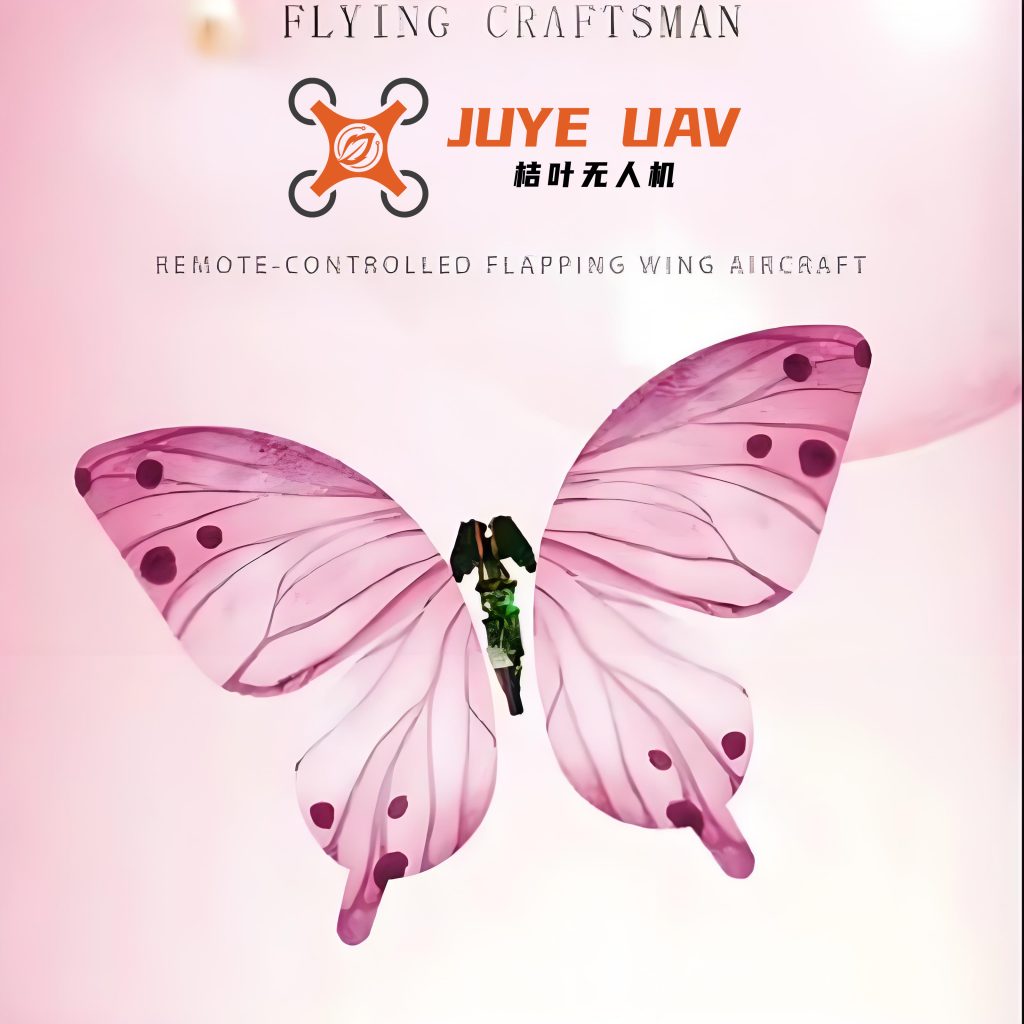
The core philosophy of the structural design is mass minimization without compromising necessary rigidity. The airframe, specifically the servo mounting bracket, and the intricate wing spars are fabricated using carbon fiber reinforced polymer via 3D printing. Carbon fiber offers an exceptional strength-to-weight ratio, making it ideal for this application. The fuselage is completed using carbon rods of varying diameters, contributing to a lightweight yet stiff backbone. The wings mimic the morphology of a Pieris butterfly, comprising leading and trailing edges constructed from 1mm diameter carbon fiber rods. These rods are interconnected at junctions using specifically designed, lightweight 3D-printed connectors (Connectors 2, 3, and 4) to facilitate assembly and enhance robustness. The wing membrane is crafted from P31n rip-stop nylon, a material favored in high-performance kites for its excellent tear resistance, minimal stretch, and vibrant color options, allowing for both functional durability and biomimetic aesthetics. The forewings and hindwings on each side are rigidly joined using Connectors 1 and 4, creating a continuous wing surface. This ensures that during both the downstroke and upstroke, the entire wing area acts as the effective lifting surface, thereby maximizing the lift potential per stroke—a principle derived from insect flight studies where leading-edge vortices play a crucial role in generating high lift coefficients. The wing root is attached to the servo arm via a custom connector, allowing for fine-tuning of the wing’s angle of attack (dihedral and incidence) to optimize flight dynamics. A unique feature is the inclusion of a short silicone tube segment within the fuselage. This flexible linkage allows for a passive, slight pitching motion of the aft section (housing the electronics) relative to the main body during flapping. Research suggests that such body oscillations in biological butterflies can interact beneficially with the wake vortices, potentially augmenting lift. The overall structural assembly prioritizes modularity and ease of repair.
The bionic butterfly drone’s electromechanical core is governed by a sophisticated control system centered on an STM32F103C8T6 microcontroller unit (MCU). This 32-bit ARM Cortex-M3 processor serves as the central command unit, executing flight control algorithms, processing sensor data, and generating actuator signals. The control system’s hardware architecture is designed for integration and weight savings. The primary flight maneuvers—forward flight, ascent, descent, and yaw turns—are achieved by precisely controlling the two wing servos. We employ KST X80plus micro digital metal-gear servos for their compelling combination of low weight (9g each), high torque output, and fast response. The servo operation is governed by a standard Pulse Width Modulation (PWM) signal. The control signal is a 50 Hz PWM wave with a pulse width varying between 0.5 ms and 2.5 ms, linearly corresponding to servo angular positions from 0° to 180°. The relationship between the desired servo angle $\theta_{servo}$ (in degrees) and the required pulse width $PW$ (in milliseconds) can be expressed as:
$$ PW = 0.5 + \frac{\theta_{servo}}{90} $$
The MCU’s Timer 3 and Timer 4 are independently configured to generate two separate PWM output channels, allowing for independent control of the left and right wing’s flapping frequency, amplitude, and phase. For forward flight, both servos are driven synchronously with identical frequency, amplitude, and phase. To execute a yaw turn (e.g., right turn), the left and right wings are driven at the same frequency but with a deliberately introduced phase shift or amplitude difference. This creates an asymmetry in the horizontal component of the aerodynamic forces, generating a net yawing moment $M_z$:
$$ M_z = (F_{x,right} – F_{x,left}) \cdot d_{yaw} $$
where $F_{x,right}$ and $F_{x,left}$ are the thrust components from the right and left wings, respectively, and $d_{yaw}$ is the moment arm. The lift force, primarily vertical, counters gravity. The key servo specifications under different operating voltages are summarized below:
| Voltage (V) | Torque (N·m) | Speed (s/60°) |
|---|---|---|
| 3.8 | 0.240 | 0.18 |
| 6.0 | 0.385 | 0.15 |
| 7.4 | 0.485 | 0.12 |
| 8.4 | 0.530 | 0.09 |
Flight stability is paramount and is achieved through a feedback loop involving an MPU6050 inertial measurement unit (IMU). This chip integrates a 3-axis gyroscope and a 3-axis accelerometer. Its embedded Digital Motion Processor (DMP) fuses sensor data to provide stable quaternion or Euler angle outputs (roll $\phi$, pitch $\theta$, yaw $\psi$) with minimal drift. The MCU communicates with the MPU6050 via the I²C protocol to read these attitude angles in real-time. A Proportional-Integral-Derivative (PID) controller is implemented on the MCU to maintain desired flight attitudes. The PID algorithm calculates a corrective output $u(t)$ based on the error $e(t)$ between the desired setpoint $r(t)$ and the measured process variable $y(t)$:
$$ u(t) = K_p e(t) + K_i \int_{0}^{t} e(\tau) d\tau + K_d \frac{de(t)}{dt} $$
Where $K_p$, $K_i$, and $K_d$ are the proportional, integral, and derivative gains, respectively. For attitude control, $e(t)$ could represent the error in roll, pitch, or yaw angle. The output $u(t)$ is then mapped to adjustments in the servo PWM signals (e.g., differential wing amplitude for roll control), forming a closed-loop system that actively stabilizes the bionic butterfly drone against disturbances.
For command and monitoring, the bionic butterfly drone incorporates an HC-05 Bluetooth module, soldered directly onto the main control board to save space and weight. This module establishes a wireless serial link between the drone’s MCU and a ground station, typically a smartphone running a serial terminal application (e.g., SPP Bluetooth App). This bi-directional full-duplex communication link, operating at 9600 baud, allows a human operator to send flight mode commands (e.g., “forward,” “turn right”) and receive real-time telemetry data (e.g., attitude angles, battery voltage). The control software, developed in C using the Keil µVision5 IDE, orchestrates all these functions. The main program flow initializes hardware peripherals (Timers, I²C, UART), then enters a continuous loop where it reads IMU data, executes PID control algorithms, processes incoming Bluetooth commands, and updates the servo PWM outputs accordingly.
The final bionic butterfly drone prototype was meticulously assembled, resulting in a compact and lightweight platform. The complete drone has a wingspan of 29.5 cm, a body length of 12.6 cm, and a critical total mass of only 37.5 grams. The mass distribution is detailed in the following table, highlighting the success of the lightweight design strategy.
| Component | Mass (g) |
|---|---|
| Complete Drone | 37.5 |
| Wing Pair (with membrane & spars) | 5.5 |
| Fuselage (including two servos) | 19.0 |
| Battery & Control Board | 13.0 |
Extensive flight tests and system debugging were conducted to validate performance. The Bluetooth link proved robust, maintaining stable communication at distances up to 9 meters, ensuring reliable control. The MPU6050-based stabilization system was rigorously tested. For instance, when commanded to hold a specific attitude during a right-turn maneuver (e.g., Pitch: 17°, Roll: -45°, Yaw: -65°), the actual measured angles deviated by less than 1°, demonstrating the effectiveness of the PID controller. The drone successfully executed basic flight maneuvers including steady forward flight, climbing, descending, and controlled left/right turns by modulating the servo drive signals as described. The flapping frequency was varied between 1-5 Hz, directly influencing lift and thrust, allowing for speed and altitude control.
In conclusion, this work presents a functional and innovative approach to designing a bionic butterfly drone. By synergizing a minimalist, carbon-fiber-based structural design with a direct dual-servo actuation scheme, we have successfully addressed the weight burden typical of micro flapping-wing robots. The integration of an STM32-based flight controller, an MPU6050 IMU for active stabilization, and a Bluetooth wireless interface results in a drone that is not only lightweight (37.5g) but also capable of stable, controllable flight mimicking several key behaviors of its biological counterpart. The bionic butterfly drone prototype validates the design philosophy and offers a compelling platform for further research into agile, efficient, and ultra-lightweight bio-inspired aerial robotics.