
Under the night sky of Harbin’s Ice and Snow World, hundreds of drones soar into the air, dancing and transforming into patterns of snowflakes and snowmen, illuminating the night with a dazzling display of light. During this year’s operational period of the Harbin Ice and Snow World, drone shows have become a regular feature, frequently captivating audiences with their mesmerizing performances.
It’s not just Harbin; during the recent New Year’s holiday, from Beijing’s Gubei Water Town to Haikou’s countdown concerts, and from Hong Kong’s Victoria Harbour to Abu Dhabi in the UAE, drone light shows have emerged as a global “ritual” for celebrating the new year, showcasing a unique blend of technology and art. Behind these spectacular drone shows are Chinese companies, orchestrating the displays that have become synonymous with modern festivities.
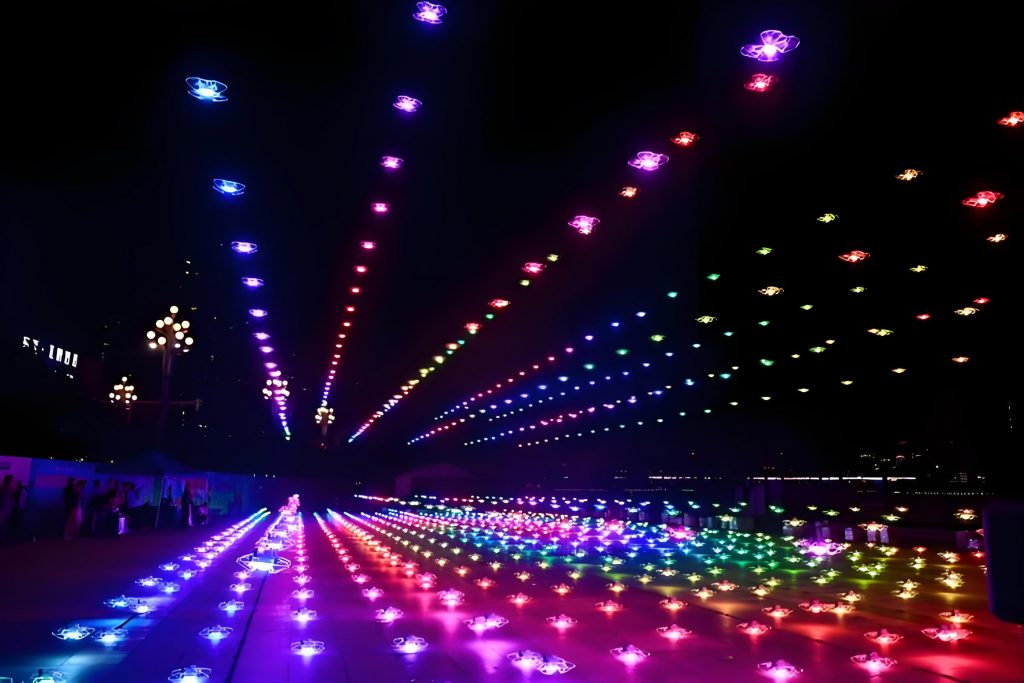
Interviews with multiple drone formation performance companies reveal that, driven by the low-altitude economy, the demand for drone shows has surged dramatically over the past two years, rapidly penetrating下沉 markets and expanding overseas. As a key application scenario in the “low-altitude+” ecosystem, drone shows represent one of the few segments capable of generating stable profits. Although market prices have declined due to technological advancements and intensified competition, this price reduction has unlocked new market opportunities, attracting numerous players striving to carve out their niche through differentiated strategies.
- Soaring Demand for Drone Shows
“In the past two years, the demand for formation drone shows has exploded. Whether it’s performance services or equipment system sales, operations are running at full capacity,” said Qin Haiqun, Deputy General Manager and Head of the Technical Support Department at Shenzhen Damoda Intelligent Control Technology Co., Ltd. (hereinafter referred to as Damoda), in an interview.
Every New Year and Spring Festival marks the peak season for the industry. Currently, companies have just wrapped up New Year’s Eve events and are gearing up for the upcoming “Spring Festival season.” “The number of performances is similar to last year, but the scale of each drone show has increased. Previously, a show might feature 1,000 drones; with technological progress, it now often involves 2,000 or even 3,000 drones,” Qin added. As a leading drone formation performance company, Damoda has been深耕 this niche segment for over eight years since completing China’s first 80-drone show in 2016, witnessing and contributing to the industry’s evolution.
The most noticeable change lies in market demand. Since its emergence in 2016, drone formation performances, with their novel format and stunning effects, have been widely adopted in areas such as event exhibitions, entertainment shows, tourist attractions, commercial branding, and private定制, entering a phase of rapid growth. However, the outbreak of the pandemic brought a three-year slowdown, with domestic performance markets severely depressed and order numbers plummeting. “It was during this period that we began exporting equipment systems, relying mainly on overseas sales to sustain the company’s development,” Qin recalled.
In 2023, as pandemic control policies were adjusted, China’s cultural tourism market, large-scale events, and commercial performances复苏, leading to a sharp increase in orders for drone shows. In 2024, the inclusion of “low-altitude economy” as a new productive force in the government work report further fueled industry growth. “Amid the wave of low-altitude economy, regions are seeking applications for ‘low-altitude+.’ Drone shows, with their technological appeal,观赏性, and传播性, help create viral hotspots, boost nighttime economy development, and stimulate consumer enthusiasm. Moreover, the technology is relatively mature, naturally making them a standard feature for large events or cultural tourism sites to attract visitors,” an industry insider analyzed.
Another evident change is the diversification of performance formats and the increase in scale. In recent years, with technological iterations, drone formation performances have innovatively incorporated equipment such as cold fireworks, Kongming lanterns, and laser lights, enhancing the visual impact. Simultaneously, technological improvements have enabled larger-scale drone shows. As the number of participating drones grows, the patterns that can be drawn and the effects achieved become more丰富 and精细. It is understood that before 2019, drone formation performances typically involved hundreds of drones, whereas shows with over a thousand drones are now commonplace.
“Our first-generation drone products had a positioning accuracy error of about two meters, requiring a safety spacing of 5 to 7 meters between drones in the air. With the second-generation products, we adopted RTK (Real-Time Kinematic) positioning, significantly improving accuracy and reducing the aerial spacing to just two meters,” Qin explained. Drone formation performance is a complex engineering feat that integrates cutting-edge technologies, especially in large-scale formations of thousands of drones, where challenges such as navigation, anti-interference, and path coordination must be addressed. “Due to enhanced safety, stability, and increasing technological maturity, which meet the market’s diverse performance demands, drone formation performances have sustained their prosperity,” Qin stated.
- Influx of Players in the Drone Show Market
Behind the surging demand, a critical factor is the decline in prices. Interviews indicate that in recent years, with lower technological barriers and continuous improvement in supply chains, the cost per drone for performances has steadily decreased. “Previously, due to the high cost of a single drone light show, early clients were primarily government entities. Now, with more affordable prices, the consumer base has expanded to include businesses and individuals,” the aforementioned insider noted.
A relevant person in charge from a drone formation performance company shared that in late 2017, the company charged nearly 10,000 yuan per drone for an advertising performance—a one-time service, not a sale—which was extremely expensive. Today, the market rate for event-type performances is only 500 yuan per drone. Besides performance services, some drone formation performance companies also offer integrated hardware and software systems to clients or agents, with average prices ranging from 5,000 to 8,000 yuan per drone.
In the past, a 500-drone drone show cost 5 million yuan; now, a 1,000-drone performance requires only 500,000 yuan. This significantly lowers the threshold for corporate or individual consumers. However, despite the price drop, technological advancements have substantially reduced manufacturing and operational costs. With surging market demand, drone formation performance remains a profitable business. According to industry estimates, at a rate of 500 yuan per drone for event performances, a 15-minute drone show with 2,000 drones can generate 1 million yuan in revenue. From a capital回收 perspective, the drone show market still holds strong profit potential.
Currently, leading companies in the drone performance industry include Damoda, Gaoju Innovation, Yifei Zhikong, and Qianji Technology. Over the past two years, as demand for drone formation performances has surged,除了头部公司及其代理商, new players have entered the market to “分一杯羹.”
Kebote, founded in 2009, previously focused on the industrial-grade drone sector. In November 2024, Kebote launched a drone formation light performance product, venturing into the performance market. “Drone light performances belong to the cultural tourism industry. With the popularity of the low-altitude economy concept, regions nationwide are exploring application scenarios, especially those that can generate profits. Cultural tourism is an excellent integration point,” said Guo Yuxin, Technical Director of Kebote, in an interview. “In recent years, we’ve明显 felt that client inquiries about performances have increased, prompting our entry into this market.”
Facing日益激烈的市场竞争, various drone manufacturers are adopting different strategies to establish their foothold. Guo told reporters that as a new entrant, Kebote’s goal is not to replace leading companies but to “fill gaps” in the market by building differentiated competitiveness. “We recognized early on the importance of AI technology for drone performances and the entire industry, hence investing heavily in R&D and innovation,” Guo elaborated. From a workflow perspective, the biggest challenge for clients is timeliness—choreography design cycles are long, ranging from several days to a week, making it difficult to meet sudden performance demands. Kebote’s software platform uses AI algorithms, allowing clients to simply input text or images, and the system quickly generates the required number of drones and positioning,大幅缩短 design cycles.
- Prospects of the Drone Show Industry
Compared to the current bustling scene, the development of drone formation performance originated as a “beautiful accident.”
Around 2016, DJI dominated the consumer drone market, the industry landscape was set, and many drone manufacturers struggled to survive after the capital retreat, desperately seeking new出路. Restricted by the “Regulations on the Safety Management of Fireworks and Firecrackers,” hundreds of cities nationwide banned or limited fireworks. Many urban landscape lighting projects, including light shows, were halted amid criticism of “vanity projects.” In large festive events, drone formation performances filled the market gap. “Many companies replaced the cameras at the bottom of drones with light bulbs, performed a show, and saved their companies,” a drone formation performance company executive recalled. The cash flow generated by drone performances helped several companies weather the industry winter.
Among them, EHang Intelligent, which listed on NASDAQ in 2019, is the most典型 case. After engaging in formation performance business, EHang意外扭转 its unprofitable situation. Its IPO prospectus showed that in 2018, the aerial media business centered on drone performances contributed 31.3 million yuan in revenue, accounting for 47% of total income. However, post-listing, the drone performance business gradually became marginalized. EHang now focuses almost entirely on eVTOL (electric vertical take-off and landing aircraft), seen by capital as having greater potential, and rarely involves itself in formation performance business.
The aforementioned industry insider admitted that compared to other segments, due to relatively lower technological barriers and充分 competition, companies have weaker bargaining power, and drone formation performances were previously less favored by investors, making financing difficult. “This creates a paradox: while drone shows can generate real revenue, they are less看好 in the long term compared to other loss-making sectors,” the insider said.
Nevertheless, regarding development over the next three to five years, interviewees are generally optimistic. Guo Yuxin believes that with the current consensus on developing the low-altitude economy, regions are encouraging the expansion of low-altitude economic applications. From a profit perspective, drone performances are短时间内无法替代 by other application scenarios. This policy consensus has also shifted some investors’ attitudes, attracting more capital to increase布局 in drone performances. On January 5, Damoda announced the successful completion of its first round of financing, raising several hundred million yuan, with investors including Tongchuang Weiye, China Merchants Capital, CMB International, Shenzhen Hi-Tech Investment, and Changde Caixin.
Qin Haiqun stated that although competition has increased, the formation performance market has become more活跃, with client types and performance scenarios continuously expanding. In recent years, drone shows have accelerated their penetration into下沉 markets, with demand in small cities and counties also surging. “We have a client specializing in下沉 markets who purchased 1,000 drones from us at the end of 2022, added 600 in 2023, and repurchased 800 at the end of last year. It must be profitable, otherwise they wouldn’t repurchase,” Qin said.
The overseas business布局 that the industry undertook during the pandemic for survival has shown increasingly strong growth in recent years. According to another leading company, Yifei Zhikong, during the New Year period, it conducted 72 performance flights in 29 cities across 11 countries worldwide, safely handling over 30,000 take-offs and landings. For Damoda, which focuses on selling system equipment overseas, drones have been sold to “every continent except Antarctica,” with “particularly noticeable growth in the Middle East market,” Qin noted. Industry analysts attribute this to Middle Eastern countries’ economic development, strong purchasing power, and high acceptance of high-tech products, making it a格外活跃 overseas market.
Additionally, drone performances are transforming the advertising industry, partially replacing traditional building advertisements and LED ads, emerging as a new aerial media form. Qin mentioned that in recent years, besides cultural tourism sites and theme parks, demand for drone performances in advertising has significantly increased. “Not only because of the excellent live viewing experience but更重要的是, the footage can be repurposed on social media, sometimes going viral, bringing greater exposure and forming effective promotional results,” Qin explained.
| Year | Type | Price per Drone (approx.) | Notes |
|---|---|---|---|
| 2017 | Performance Service | ~10,000 yuan | One-time advertising performance |
| 2024 | Performance Service | 500 yuan | Event-type performances |
| 2024 | System Sale | 5,000 – 8,000 yuan | Integrated hardware and software |
The drone show market continues to evolve, driven by innovation and economic factors. As companies leverage AI and other technologies to enhance efficiency and reduce costs, the accessibility and appeal of drone shows are expected to grow further. The integration of drone performances into various sectors, from entertainment to advertising, underscores their versatility and potential for sustained expansion. With supportive policies and increasing global recognition, the future of the drone show industry appears bright, promising more spectacular displays and broader applications in the years to come.