
In the evolving landscape of unmanned aerial systems, the demand for versatile platforms capable of both vertical take-off and landing (VTOL) and efficient forward flight has surged. Among various VTOL concepts, the lift fan system presents a compelling solution, as it enables VTOL capability without drastically altering the conventional fixed-wing airframe. However, this integration introduces significant additional weight—often termed “dead weight”—that does not contribute during the primary cruise phase. This dead weight detrimentally impacts key performance metrics such as payload capacity, endurance, and range. In this analysis, I explore the mathematical modeling and parametric influences of dead weight in lift fan VTOL UAVs, aiming to provide insights for optimal overall design.
The core challenge with lift fan VTOL UAVs lies in the inherent trade-off between VTOL functionality and weight efficiency. During vertical flight, the lift fan system and associated drivetrain are active, but in cruise mode, these components become inactive, constituting explicit dead weight. Furthermore, to meet the high power demands of vertical lift, the engine often must be oversized compared to what is needed for level flight alone. This results in an implicit dead weight due to the heavier powerplant. Understanding and minimizing this dead weight is critical for enhancing the operational effectiveness of VTOL UAVs.
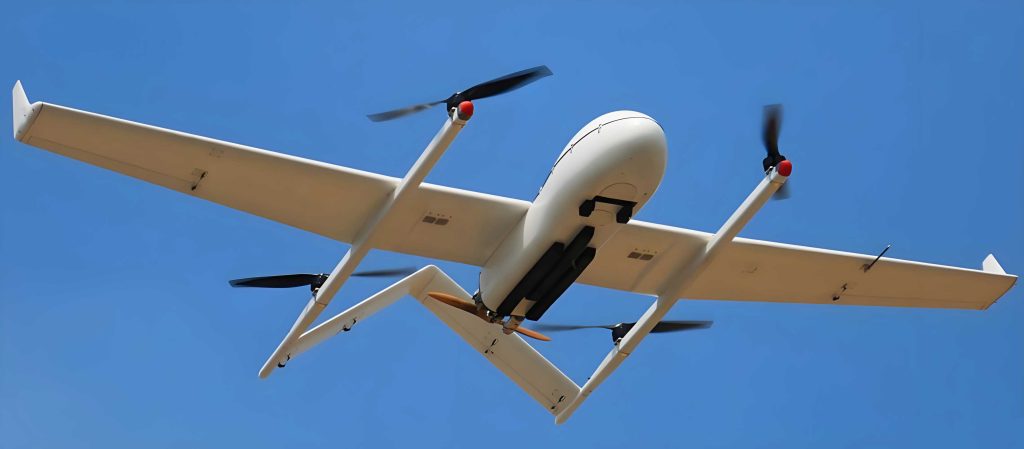
From a design perspective, the dead weight in a lift fan VTOL UAV can be attributed to three primary sources: the structural weight of the lift fan system itself, the weight of the transmission and gearbox systems, and the incremental weight of the engine due to power surplus. A comprehensive model that captures these elements is essential for systematic analysis. I derive this model by considering overall design parameters, such as disk loading, hover height, and power-to-weight ratios, which directly influence the dead weight coefficient—a dimensionless measure of dead weight relative to total take-off weight.
The mathematical formulation begins with the total dead weight, denoted as ΔW_e, expressed as:
$$ \Delta W_e = W_{fae} + W_{ce} + W_{\Delta de} $$
Here, W_{fae} represents the weight of the lift fan assembly, W_{ce} is the weight of the transmission and gearbox systems, and W_{\Delta de} is the engine weight increment. Each component is modeled as a function of key design variables.
First, the lift fan system weight is estimated using its thrust-to-weight ratio. Based on existing literature, the thrust-to-weight ratio for lift fan systems can vary with equivalent disk loading. For conservative analysis, a ratio of 27 is often assumed. Given that the total lift during hover typically requires a lift-to-weight ratio of about 1.2 for stability, the fan weight can be approximated as:
$$ W_{fae} = \frac{T_{S0}}{27} = 1.2 \times \frac{W_0}{27} = 0.044W_0 $$
where T_{S0} is the maximum static thrust of the lift fan system and W_0 is the gross take-off weight of the VTOL UAV.
Second, the transmission and gearbox weight, W_{ce}, is derived from helicopter design practices, as it correlates with shaft power. The formula is:
$$ W_{ce} = 250 K_D^{0.67} $$
with K_D defined as:
$$ K_D = K_t \left( \frac{N_X}{N_R} \right) Z^{1/4} $$
In this context, K_t is a layout coefficient (taken as 1.3 for tandem configurations), N_X is the transmission power (set at 1.2 times the hover power), N_R is the fan rotational speed, and Z is the number of gear stages (assumed as 2 for high-speed fans). This relationship highlights how power transmission efficiency and rotational dynamics affect structural weight.
Third, the engine weight increment arises from the difference between the installed engine power (P_S) and the power required for fixed-wing flight (P_H). Using the engine power-to-weight ratio σ_d, this increment is:
$$ W_{\Delta de} = \frac{P_S – P_H}{\sigma_d} = \frac{P_S}{\sigma_d} – \frac{W_0}{\sigma_q \sigma_d} $$
where σ_q is the overall power-to-weight ratio for fixed-wing flight mode. Combining these elements, the total dead weight model becomes:
$$ \Delta W_e = \frac{T_{S0}}{27} + 250 \left[ K_t \left( \frac{1.2 P_S}{N_R} \right) Z^{1/4} \right]^{0.67} + \frac{P_S}{\sigma_d} – \frac{W_0}{\sigma_q \sigma_d} $$
To generalize for design analysis, I normalize this by W_0 and incorporate aerodynamic and efficiency parameters. The hover power required for the lift fan system is given by momentum theory as:
$$ P_H = \frac{T_{S0} \sqrt{T_{S0} / (2 \rho A)}}{\eta_S \eta_Z} $$
where ρ is air density, A is the fan disk area, η_S is the fan efficiency (typically 0.9), and η_Z is the transmission efficiency (typically 0.9). The static thrust ratio q_0 accounts for thrust sharing among multiple fans. Substituting and rearranging yields the dead weight coefficient model:
$$ \frac{\Delta W_e}{W_0} = 0.044 + 8.707 \frac{W_0^{0.33}}{\eta_S N_R} \left[ \sqrt{\frac{2 \rho}{(1 – q_0) \left( \frac{T_{S0}}{A} \right)}} \right]^{-0.67} + \frac{1}{\sigma_d} \left( \frac{11.76}{\eta_Z \eta_S} \sqrt{\frac{2 \rho}{(1 – q_0) \left( \frac{T_{S0}}{A} \right)}} \right) – \frac{\sigma_q}{\sigma_d} $$
This equation explicitly ties the dead weight coefficient to critical design parameters: equivalent disk loading (T_{S0}/A), static thrust ratio q_0, hover height (through ρ), fan speed N_R, gross weight W_0, and power-to-weight ratios σ_d and σ_q. Analyzing these parameters reveals their individual and combined impacts on the viability of lift fan VTOL UAVs.
To systematically evaluate parametric influences, I conduct a sensitivity analysis using typical values for a medium-altitude VTOL UAV: W_0 = 3000 kg, ρ = 1.225 kg/m³ (sea level), q_0 = 0.4, T_{S0}/A = 800 kg/m², N_R = 3800 rpm, σ_d = 6663 W/kg (based on engines like the T700), and σ_q = 420 W/kg. The following tables summarize how variations in each parameter affect the dead weight coefficient.
| Parameter | Baseline Value | Range Studied | Effect on ΔW_e/W_0 | Physical Rationale |
|---|---|---|---|---|
| Engine Power-to-Weight Ratio (σ_d) | 6663 W/kg | 5000–8000 W/kg | Decreases with higher σ_d | Higher σ_d reduces engine weight for same power surplus. |
| Hover Height (H) | 0 m (sea level) | 0–2000 m | Increases with higher H | Lower air density at altitude raises hover power demand. |
| Equivalent Disk Loading (T_{S0}/A) | 800 kg/m² | 600–1000 kg/m² | Increases with higher loading | Higher disk loading requires more power for same thrust. |
| Static Thrust Ratio (q_0) | 0.4 | 0.3–0.6 | Decreases with higher q_0 | Higher q_0 reduces net thrust needed from each fan. |
| Gross Take-off Weight (W_0) | 3000 kg | 2000–4000 kg | Decreases with higher W_0 | Economies of scale in transmission weight. |
| Fan Rotational Speed (N_R) | 3800 rpm | 3000–4500 rpm | Decreases with higher N_R | Higher speed lowers torque, reducing transmission weight. |
| Fixed-wing Power-to-Weight Ratio (σ_q) | 420 W/kg | 300–500 W/kg | Decreases with higher σ_q | Reduces power surplus, minimizing engine weight increment. |
The interplay among these parameters underscores the complexity of optimizing a lift fan VTOL UAV. For instance, increasing disk loading may compact the lift fan system but at the cost of higher power requirements, thereby amplifying dead weight. Conversely, a higher static thrust ratio, which might be achieved through innovative ducting or fan arrangements, can mitigate dead weight by distributing thrust more efficiently.
To delve deeper, I examine the engine weight increment component separately. The condition P_S > P_H typically holds, but if the fixed-wing flight requires more power than hover—possible in high-speed designs—the engine increment could become negative, implying no penalty. This scenario is captured by:
$$ \text{If } P_S \leq P_H, \quad W_{\Delta de} = 0 $$
Thus, the dead weight model adapts based on the power balance. The power surplus ΔP = P_S – P_H is a key driver, expressed as:
$$ \Delta P = \frac{T_{S0} \sqrt{T_{S0} / (2 \rho A)}}{\eta_S \eta_Z} – \frac{W_0}{\sigma_q} $$
This leads to a critical design insight: minimizing dead weight hinges on aligning hover and cruise power needs. Since cruise power is often dictated by mission requirements (e.g., dash speed), the focus shifts to reducing hover power through careful selection of disk loading, fan efficiency, and hover height.
I further quantify sensitivity using partial derivatives of the dead weight coefficient with respect to each parameter. For example, the sensitivity to disk loading is:
$$ \frac{\partial (\Delta W_e / W_0)}{\partial (T_{S0}/A)} = -\frac{4.3535 W_0^{0.33}}{\eta_S N_R} \left[ \sqrt{\frac{2 \rho}{(1 – q_0) (T_{S0}/A)}} \right]^{-1.67} \cdot \frac{1}{(T_{S0}/A)^2} – \frac{5.88}{\sigma_d \eta_Z \eta_S} \sqrt{\frac{2 \rho}{(1 – q_0)}} \cdot \frac{1}{(T_{S0}/A)^{3/2}} $$
This derivative is generally positive, confirming that higher disk loading increases dead weight. Similarly, for fan speed:
$$ \frac{\partial (\Delta W_e / W_0)}{\partial N_R} = -\frac{8.707 W_0^{0.33}}{\eta_S N_R^2} \left[ \sqrt{\frac{2 \rho}{(1 – q_0) (T_{S0}/A)}} \right]^{-0.67} $$
which is negative, indicating benefits from higher rotational speeds. These mathematical insights guide trade-offs during preliminary design.
In practice, designing a lift fan VTOL UAV involves iterative parameter tuning. A useful approach is to define a merit function that combines dead weight with other performance metrics, such as endurance or payload fraction. For instance, the effective payload capacity W_{payload} can be estimated as:
$$ W_{payload} = W_0 – W_{empty} – \Delta W_e – W_{fuel} $$
where W_{empty} is the basic airframe weight. By integrating the dead weight model into a broader optimization framework, designers can explore Pareto frontiers to balance VTOL capability and cruise efficiency.
To illustrate parametric interactions, I present a computational study varying two parameters simultaneously while holding others at baseline. The results are summarized in the table below, showing dead weight coefficient percentages for different combinations of disk loading and engine σ_d.
| Disk Loading (kg/m²) | Engine σ_d = 6000 W/kg | Engine σ_d = 7000 W/kg | Engine σ_d = 8000 W/kg |
|---|---|---|---|
| 600 | 12.5% | 11.8% | 11.2% |
| 800 | 14.3% | 13.5% | 12.9% |
| 1000 | 16.7% | 15.8% | 15.0% |
This table underscores that even with advanced engines (high σ_d), higher disk loading elevates dead weight significantly. Thus, for VTOL UAVs intended for long-endurance missions, lower disk loading—often implying larger fan diameters—might be preferable despite increased drag or structural challenges.
Another critical aspect is the transmission system. The weight model for W_{ce} assumes conventional gear trains, but emerging technologies like magnetic gears or direct-drive systems could alter this relationship. For example, if transmission efficiency η_Z improves to 0.95, the dead weight coefficient reduces approximately by:
$$ \Delta \left( \frac{\Delta W_e}{W_0} \right) \approx -0.015 $$
highlighting the value of technological advancements in drivetrain design for VTOL UAVs.
Furthermore, environmental factors play a role. Operations at high altitudes or in hot conditions reduce air density, increasing hover power. The model incorporates density ρ, which varies with height H as per the International Standard Atmosphere. For a quick estimate, ρ can be modeled as:
$$ \rho = \rho_0 e^{-H / H_s} $$
with ρ_0 = 1.225 kg/m³ and H_s ≈ 8400 m. Substituting into the dead weight equation shows that designing for hover at 2000 m altitude can increase dead weight by up to 10% compared to sea level, assuming other parameters fixed. This has direct implications for VTOL UAVs deployed in mountainous regions.
The fixed-wing power-to-weight ratio σ_q is another lever. It depends on aerodynamic efficiency (L/D ratio) and propulsion system performance. For a typical VTOL UAV, improving σ_q from 400 to 500 W/kg—perhaps through better propeller design or airframe streamlining—can cut the engine weight increment by:
$$ \Delta W_{\Delta de} \approx \frac{W_0}{\sigma_d} \left( \frac{1}{400} – \frac{1}{500} \right) $$
which, for a 3000 kg UAV with σ_d = 6663 W/kg, amounts to about 7 kg reduction. While modest, this contributes to overall weight savings.
In summary, the dead weight analysis for lift fan VTOL UAVs reveals a multifaceted optimization problem. Key takeaways include:
- Dead weight is predominantly influenced by disk loading, hover height, and engine characteristics.
- Minimizing dead weight requires balancing hover and cruise power demands, often through careful selection of disk loading and fan speed.
- Advanced materials and efficient transmission systems can mitigate dead weight, enhancing the practicality of VTOL UAVs.
Future work could extend this model to include dynamic effects, such as transition phases between hover and cruise, and integrate with control system weights. Additionally, empirical data from prototype VTOL UAVs would help validate and refine the weight estimates. Ultimately, a holistic design approach that prioritizes weight efficiency from the outset is essential for realizing the full potential of lift fan VTOL UAVs in diverse operational scenarios.
Through this analysis, I aim to provide a foundational framework for designers to navigate the trade-offs inherent in VTOL UAV development. By repeatedly considering parameters like disk loading and power-to-weight ratios, and by incorporating technological innovations, the dead weight penalty can be minimized, paving the way for more capable and efficient VTOL UAVs that leverage the lift fan concept for enhanced versatility.