
In recent years, the adoption of new plant protection machinery has accelerated significantly, driven by the need to enhance equipment levels and improve pesticide utilization efficiency. Among these innovations, the agricultural drone stands out as a representative tool. Since the initial purchase in 2015, the use of agricultural drones has shown rapid growth, with 38 units and one production enterprise recorded by 2020. The operational scope of agricultural drones now covers crops such as tea, rice, rapeseed, and chrysanthemums, playing a crucial role in regional pest and disease control. This article, from my perspective as a researcher engaged in agricultural technology extension, delves into the current status of agricultural drone ownership, analyzes key issues in their usage, and proposes corresponding countermeasures. The integration of agricultural drones is reshaping traditional farming practices, offering a glimpse into the future of precision agriculture.
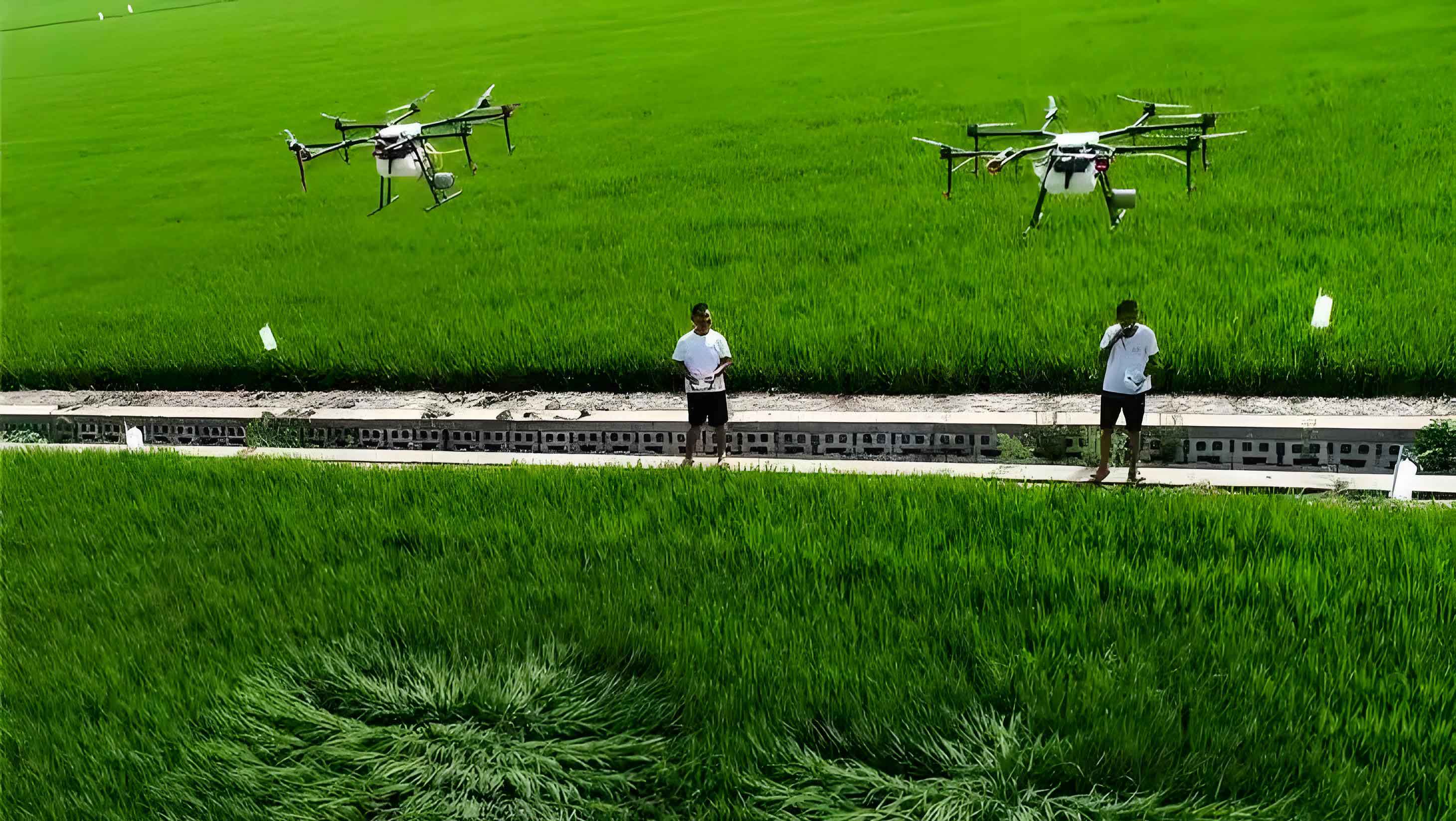
The proliferation of agricultural drones is not merely a trend but a transformative shift in how we approach crop protection. As I examine the data, it becomes evident that these devices address critical challenges like labor shortages and environmental concerns. However, their implementation in mountainous areas presents unique hurdles. Through this analysis, I aim to provide a comprehensive overview, supported by tables and formulas, to underscore the dynamics of agricultural drone deployment. The focus will be on empirical observations and theoretical frameworks that can guide future advancements.
Ownership Status of Agricultural Drones
The ownership of agricultural drones has seen a steady increase over the years. Initially, in 2015, a single-rotor agricultural drone was acquired, marking the beginning of this technological infusion. By 2020, the total count reached 38 units across six districts, reflecting a compound annual growth rate that highlights the growing acceptance of agricultural drones. The following table summarizes the yearly accumulation and distribution, emphasizing the shift from single-rotor to multi-rotor models, which now dominate the market due to their higher efficiency and easier operability.
| Year | New Purchases | Total Units | Predominant Type | Key Manufacturers |
|---|---|---|---|---|
| 2015 | 1 | 1 | Single-rotor | Various |
| 2016 | 2 | 3 | Single-rotor | Various |
| 2017 | 7 | 10 | Multi-rotor | Local and external |
| 2018 | 18 | 28 | Multi-rotor | DJI, XAG |
| 2019 | 3 | 31 | Multi-rotor | DJI |
| 2020 | 7 | 38 | Multi-rotor | Shenghe Agriculture |
From this data, I observe that multi-rotor agricultural drones have completely replaced single-rotor versions, driven by factors such as operational ease and productivity. The manufacturers are diverse, with Shenzhen DJI leading in sales, followed by local enterprises. However, the overall number remains modest compared to provincial totals, indicating room for expansion. The production capacity of local manufacturers is limited, as seen with only one company producing about 100 units over three years, mostly for local use. This underscores the nascent stage of the agricultural drone industry in this region.
To quantify the growth trend, we can model the accumulation of agricultural drones using an exponential function. Let \( N(t) \) represent the total number of agricultural drones at year \( t \), with \( t = 0 \) for 2015. Based on the data, a simple growth model can be expressed as:
$$ N(t) = N_0 \cdot e^{kt} $$
where \( N_0 \) is the initial number (1 unit), and \( k \) is the growth rate. Using regression analysis from the table, we estimate \( k \approx 0.65 \) for the period 2015-2020, indicating rapid adoption. However, this model must be adjusted for saturation effects in the future. The dominance of multi-rotor agricultural drones can be attributed to their superior performance metrics, which I will explore in the next section.
Application in Pest and Disease Control
The application of agricultural drones in pest and disease control manifests in two primary forms: self-defense by large-scale farmers or cooperatives, and社会化 services provided by specialized organizations. In 2020, self-defense areas covered 10,270 hectares, while社会化 services extended to 16,670 hectares, demonstrating the versatility of agricultural drones. The crops benefitting include rice, corn, rapeseed, tea, and chrysanthemums, with rice being the most prevalent due to its large cultivation area.
| Crop Type | Self-Defense Area (hectares) | Socialized Service Area (hectares) | Primary Pests Controlled |
|---|---|---|---|
| Rice | 7,930 | 12,000 (estimated) | Rice leaf roller, stem borer |
| Tea | 1,500 | 2,000 (estimated) | Tea geometrid, mites |
| Rapeseed | 500 | 1,500 (estimated) | Aphids, sclerotinia |
| Chrysanthemum | 200 | 500 (estimated) | Leaf miners, powdery mildew |
| Corn | 43 | 670 (estimated) | Corn borer, armyworm |
The efficiency of agricultural drones is a key advantage. For multi-rotor models, daily operational area can exceed 6.67 hectares, with rates varying based on terrain. On flat land without obstacles, productivity ranges from 1.33 to 2 hectares per hour, while in mountainous areas, it drops to 0.67–1 hectare per hour. This can be formulated as:
$$ E = E_0 \cdot \frac{1}{1 + \alpha \cdot T} $$
where \( E \) is the effective operational efficiency (hectares per hour), \( E_0 \) is the baseline efficiency on flat land (e.g., 2 ha/h), \( \alpha \) is a terrain difficulty factor (higher for mountains), and \( T \) is the terrain complexity index. For instance, if \( \alpha = 0.5 \) and \( T = 1 \) for hills, efficiency reduces by approximately 33%. The agricultural drone offers uniform spraying, better雾化, and reduced pesticide usage, leading to cost savings. The cost structure includes labor, chemicals, and maintenance. Self-defense labor costs are minimal, around 15–30 yuan per hectare, compared to traditional methods. Socialized services charge about 150 yuan per hectare (excluding chemicals), making agricultural drones economical for labor-scarce regions.
To assess cost-effectiveness, consider the total cost \( C \) per hectare for agricultural drone application:
$$ C = C_l + C_c + C_m $$
where \( C_l \) is labor cost, \( C_c \) is chemical cost, and \( C_m \) is maintenance cost. For socialized services, \( C_l \) is embedded in the service fee. Assuming \( C_c = 100 \) yuan/hectare and \( C_m = 10 \) yuan/hectare (amortized over battery life), the total cost is 260 yuan/hectare, which is lower than manual spraying that can exceed 300 yuan/hectare due to higher labor. The benefit-cost ratio \( BCR \) can be calculated as:
$$ BCR = \frac{B}{C} $$
where \( B \) represents yield increase or loss prevention from effective control. Studies show that agricultural drones can improve control efficacy by 20-30%, leading to \( BCR > 1.5 \) in many cases. The area treated by agricultural drones has grown exponentially from 1,070 hectares in 2016 to 10,270 hectares in 2020, following a similar trend to ownership growth.
Advantages and Disadvantages of Agricultural Drones
From my analysis, the advantages of agricultural drones are multifaceted. They offer high-speed operation, labor savings, time efficiency, and reduced chemical usage due to precise application. The雾化 effect enhances coverage and effectiveness, making them ideal for large-scale unified prevention and for seizing optimal weather windows. Moreover, they minimize human exposure to pesticides, reducing health risks. These benefits align with global trends towards sustainable agriculture, positioning the agricultural drone as a cornerstone of modern pest management.
However, the disadvantages cannot be overlooked. First, the initial investment is substantial, often ranging from $10,000 to $20,000 per unit, with high maintenance costs. For example, batteries typically last two years, requiring replacement at $400-600 each. Second, operational complexity demands skilled pilots, who are scarce in rural areas. Third, mountainous terrain with obstacles like trees and power lines poses challenges, reducing efficiency and increasing accident risks. Regional disparities are evident; flat areas see higher adoption rates than hilly zones. Fourth, fragmented land ownership among smallholder farmers, often elderly and income-constrained, hinders collective agreements for drone services. These factors collectively slow the widespread adoption of agricultural drones.
To quantify the impact of terrain on agricultural drone performance, we can use a risk-adjusted efficiency model:
$$ E_{adj} = E_0 \cdot (1 – \beta \cdot O) $$
where \( E_{adj} \) is adjusted efficiency, \( \beta \) is an obstacle density coefficient, and \( O \) is the number of obstacles per hectare. In mountainous regions, \( \beta \) may approach 0.3, cutting efficiency by up to 30%. This highlights the need for adaptive technologies in agricultural drone design.
Problems and Recommendations
Based on my observations, several problems persist in the application of agricultural drones. First, the high skill requirement for operators leads to a shortage of pilots, exacerbated by difficult terrain. Second, few pesticide formulations are suitable for drone spraying; conventional ones often clog nozzles, reducing efficiency. Third, the high upfront cost and limited government subsidies dampen incentives for purchase and service provision. Fourth,农户 resistance due to small plots and low income limits market penetration. These issues call for targeted interventions to unlock the full potential of agricultural drones.
To address these, I propose the following recommendations. For problem one, accelerate research and development in智能化 systems, such as autonomous navigation and obstacle avoidance, to lower the technical threshold for operating agricultural drones. This can be supported by training programs and certification schemes. For problem two, promote the development of nano-pesticides and other drone-compatible formulations that enhance pesticide utilization. Collaboration between chemical and drone industries is crucial. For problem three, local governments should implement purchase subsidies or service incentives, e.g., covering 30-50% of drone costs or providing per-hectare payments for socialized services. This can stimulate demand and foster a robust ecosystem for agricultural drones. Additionally, land consolidation initiatives could encourage larger plots more amenable to drone use.
A cost-benefit analysis for subsidy impact can be modeled as:
$$ S = \gamma \cdot I + \delta \cdot A $$
where \( S \) is the total subsidy effect, \( \gamma \) is the subsidy rate on investment \( I \), and \( \delta \) is the subsidy per area \( A \). If \( \gamma = 0.3 \) and \( I = $15,000 \), the subsidy reduces upfront cost by $4,500, potentially increasing adoption by 20-40%. Similarly, area-based subsidies of $10/hectare could expand service coverage. These measures, combined with public awareness campaigns, can drive the sustainable growth of agricultural drone applications.
Conclusion
In conclusion, the integration of agricultural drones into pest and disease control represents a significant advancement, despite existing limitations. From my perspective, the超高的 efficiency, safety benefits, and labor savings make agricultural drones invaluable for规模化 farming. However, for long-term development, critical issues such as technological upgrades, maintenance support, and pesticide formulation compatibility must be resolved. The future of agricultural drones hinges on continuous innovation and policy support, ensuring they contribute effectively to agricultural modernization. As we move forward, the lessons learned from this region can inform broader strategies for deploying agricultural drones in similar environments worldwide.
The trajectory of agricultural drone adoption can be projected using a logistic growth model to account for saturation:
$$ N(t) = \frac{K}{1 + e^{-r(t – t_0)}} $$
where \( K \) is the carrying capacity (e.g., 200 units for this region), \( r \) is the growth rate, and \( t_0 \) is the inflection point. Assuming \( r = 0.8 \) based on current trends, we can expect widespread adoption within the next decade, transforming agricultural practices. The agricultural drone is not just a tool but a catalyst for change, and its evolution will be closely watched by stakeholders across the sector.