
In recent years, Vertical Take-Off and Landing (VTOL) Unmanned Aerial Vehicles (UAVs) have gained significant attention due to their versatility in military and civilian applications. The ability to operate without runways, combined with extended range and high-speed cruise, makes VTOL UAVs ideal for reconnaissance, surveillance, and logistics. Among various configurations, tandem-wing VTOL UAVs with thrust vectoring systems present unique advantages, such as enhanced lift and maneuverability. However, the transition maneuver flight phase—where the VTOL UAV shifts between hover and cruise—poses substantial control challenges. These include strong nonlinearities, high coupling between states, and control redundancy from integrated aerodynamic and direct force controls. In this article, I explore a comprehensive control strategy for a tandem-wing VTOL UAV during transition maneuvers, focusing on dynamic inversion and a two-stage progressive control allocation method. The goal is to achieve seamless global control without mode switching, enabling high-agility maneuvers like lateral motion at low speeds. I will detail the mathematical modeling, control design, simulation results, and insights gained from this approach, emphasizing the role of direct force control in enhancing VTOL UAV performance. Throughout, I will use formulas and tables to summarize key concepts, ensuring clarity and depth. The keyword ‘VTOL UAV’ will be frequently highlighted to underscore its relevance.
The transition phase for a VTOL UAV is critical, as it involves operating at low speeds where aerodynamic control surfaces become less effective. To compensate, thrust vectoring systems provide direct forces and moments, but this introduces redundancy and coupling. Traditional control methods often require separate strategies for different flight modes, leading to complexity and potential instability during transitions. My approach leverages nonlinear dynamic inversion (NDI) to linearize and decouple the system dynamics globally. Additionally, I propose a two-stage control allocation strategy that combines sequential quadratic programming (SQP) and chain increment methods to optimally distribute control efforts between aerodynamic surfaces and thrust vectoring actuators. This allows the VTOL UAV to exploit its full maneuvering potential, such as performing side-slip motions or rapid altitude changes, while maintaining stability. The controller is designed for a scaled-down tandem-wing VTOL UAV prototype, with parameters derived from wind tunnel tests and computational fluid dynamics (CFD) analysis. Simulations demonstrate robust tracking of high-maneuverability trajectories, even under disturbances. This work contributes to advancing VTOL UAV capabilities, particularly in urban environments where agile transitions are essential.
To begin, I establish the mathematical model for the tandem-wing VTOL UAV. The dynamics are described in a six-degree-of-freedom (6-DOF) framework, incorporating both aerodynamic and thrust vectoring forces. The state variables include position, velocity, attitude angles, and angular rates. The control inputs consist of aerodynamic deflections (e.g., ailerons, elevators) and thrust vectoring parameters (e.g., engine thrust magnitudes and nozzle deflection angles). The equations of motion are derived from Newton-Euler principles, with the body-fixed frame centered at the center of gravity. For clarity, I summarize key equations below, using LaTeX for precise representation.
The translational dynamics are given by:
$$ \dot{V} = \frac{1}{m} (T_x – D \cos \alpha \cos \beta + C \cos \alpha \sin \beta – L \sin \alpha) + g (\sin \alpha \cos \theta \cos \phi – \cos \alpha \sin \theta) $$
$$ \dot{\gamma} = \frac{1}{mV} (L \cos \phi – T_z \sin \phi + mg \cos \gamma) $$
$$ \dot{\chi} = \frac{1}{mV \cos \gamma} (L \sin \phi + T_z \cos \phi) $$
where \( V \) is the airspeed, \( \gamma \) is the flight path angle, \( \chi \) is the heading angle, \( m \) is mass, \( g \) is gravity, \( \alpha \) is angle of attack, \( \beta \) is sideslip angle, \( \phi \), \( \theta \), \( \psi \) are roll, pitch, and yaw angles, \( T_x, T_y, T_z \) are thrust components, and \( D, C, L \) are drag, side force, and lift. The aerodynamic forces are nonlinear functions of \( \alpha, \beta \), and control surface deflections, modeled using coefficient tables from CFD. For the VTOL UAV, lift is augmented by thrust vectoring during low-speed transitions.
The rotational dynamics are expressed as:
$$ \dot{p} = \frac{I_{zz} L + I_{xz} N – (I_{xx} I_{zz} – I_{xz}^2) q r + I_{xz} p q}{I_{xx} I_{zz} – I_{xz}^2} $$
$$ \dot{q} = \frac{M + (I_{zz} – I_{xx}) p r – I_{xz} (p^2 – r^2)}{I_{yy}} $$
$$ \dot{r} = \frac{I_{xz} L + I_{xx} N – (I_{xx} I_{zz} – I_{xz}^2) p q – I_{xz} q r}{I_{xx} I_{zz} – I_{xz}^2} $$
where \( p, q, r \) are angular rates, \( L, M, N \) are rolling, pitching, and yawing moments, and \( I_{xx}, I_{yy}, I_{zz}, I_{xz} \) are moments of inertia. The moments combine aerodynamic contributions and thrust vectoring effects. The thrust vectoring system for the VTOL UAV includes two rear engines with tiltable nozzles and a front lift fan with a vectoring舵. The force and moment relationships are:
$$ T_x = T_L \cos \delta_L + T_R \cos \delta_R $$
$$ T_y = T_F \sin \delta_F $$
$$ T_z = -T_L \sin \delta_L + T_R \sin \delta_R – T_F \cos \delta_F $$
$$ L_t = (-T_L \sin \delta_L + T_R \sin \delta_R) d_z + T_F \cos \delta_F d_{yf} $$
$$ M_t = (T_L \cos \delta_L – T_R \cos \delta_R) d_x + T_F \sin \delta_F d_{zf} $$
$$ N_t = (T_L \sin \delta_L + T_R \sin \delta_R) d_y $$
Here, \( T_L, T_R, T_F \) are thrust magnitudes for left engine, right engine, and front fan; \( \delta_L, \delta_R, \delta_F \) are nozzle deflection angles; \( d_x, d_y, d_z, d_{yf}, d_{zf} \) are moment arms from the center of gravity. The ranges are \( -90^\circ \leq \delta_L, \delta_R \leq 15^\circ \) and \( -45^\circ \leq \delta_F \leq 45^\circ \). This model captures the redundancy, as multiple control inputs affect the same forces and moments.
To manage complexity, I apply time-scale separation, dividing the states into four subsystems: fast rotational dynamics, slow translational dynamics, and corresponding kinematics. This facilitates the design of a cascaded control loop. The outer loop handles trajectory tracking (position and velocity), while the inner loop controls attitude (angles and rates). The dynamic inversion method is used for each subsystem. For a nonlinear system \( \dot{x} = f(x) + g(x) u \), the control law is \( u = g^{-1}(x) (v – f(x)) \), where \( v \) is a virtual input designed for desired dynamics, such as \( v = \dot{x}_d + K (x_d – x) \) with gain matrix \( K \). This ensures error convergence, as \( \dot{e} + K e = 0 \) for error \( e = x – x_d \). For the VTOL UAV, this approach decouples the modes globally, eliminating the need for switching controllers.
The core innovation lies in the two-stage progressive control allocation. In the first stage, for the translational dynamics loop, I optimize the distribution between aerodynamic angles (\( \alpha, \beta, \mu \)) and direct forces (\( T_x, T_y, T_z \)). This is formulated as a nonlinear optimization problem using SQP. The objective function minimizes deviations from trim conditions and control energy:
$$ J = w_1 (\alpha – \alpha_{\text{prev}})^2 + w_2 (\beta – \beta_{\text{prev}})^2 + w_3 (\mu – \mu_{\text{prev}})^2 + w_4 T_x^2 + w_5 T_y^2 + w_6 T_z^2 + w_7 (\alpha – \alpha_{\text{trim}})^2 $$
subject to the translational dynamics constraints. The weights \( w_i \) are updated online based on an offline database that maps flight states (e.g., speed, angle of attack) and mission requirements (e.g., direct force usage level) to optimal values. This allows adaptive prioritization; for instance, during aggressive maneuvers, direct forces are weighted higher. To speed up computation, I relax constraints locally, then clamp solutions to feasible ranges. This stage outputs desired direct forces and aerodynamic angles, which feed into the second stage.
In the second stage, for the rotational dynamics loop, I allocate moments between aerodynamic surfaces and thrust vectoring using a chain increment method. Aerodynamic moments are used first, up to a saturation limit scaled by a factor \( \lambda \in (0,1) \). Any residual moment is assigned to thrust vectoring. This hierarchy conserves thrust energy and prolongs actuator life. The required thrust vectoring moments are computed as:
$$ M_{\text{thrust}} = M_{\text{desired}} – \lambda M_{\text{aero,max}} $$
Then, combining results from both stages, I solve for the actual actuator commands—engine thrusts and deflection angles—using the thrust model equations. This integrated approach ensures coherent control across all actuators, enabling the VTOL UAV to execute complex transitions.
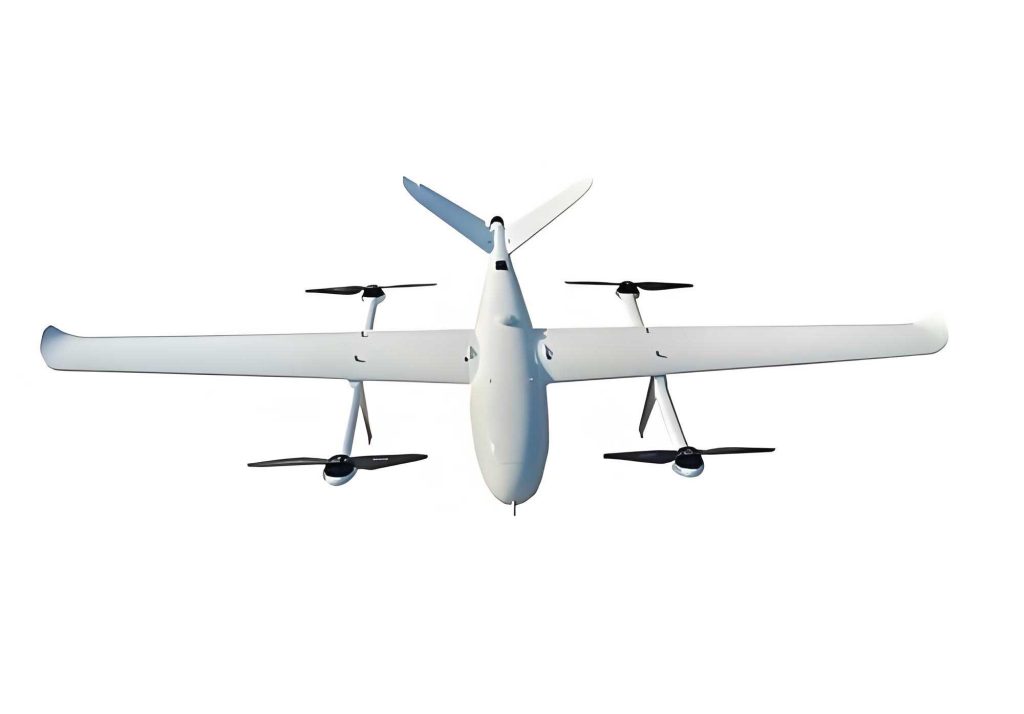
To validate the controller, I conduct simulations for a transition maneuver involving vertical take-off, lateral agility, and cruise. The scaled VTOL UAV parameters are: mass 5 kg, wing span 1.57 m, engine thrust 2.6 kg each, lift fan thrust 3.8 kg, cruise speed 20 m/s. The reference trajectory includes sinusoidal lateral motion at low speed. The control bandwidths are set with time-scale separation: fast loops at 10 rad/s, slow loops at 2 rad/s. Results show accurate tracking of position and velocity commands, as summarized in Table 1.
| Flight Phase | Duration (s) | Max Velocity Error (m/s) | Max Position Error (m) | Direct Force Usage |
|---|---|---|---|---|
| Vertical Take-off | 0-20 | 0.5 | 0.2 | High |
| Lateral Maneuver | 20-80 | 1.2 | 0.8 | Medium |
| Cruise | 80-120 | 0.3 | 0.1 | Low |
During vertical take-off, the VTOL UAV relies heavily on direct lift from thrust vectoring, with nozzle deflections near 80° and high fan thrust. As speed increases, aerodynamic lift compensates, reducing direct force dependency. In lateral maneuvers, the VTOL UAV employs combined bank-to-turn (BTT) and skid-to-turn (STT) strategies, achieved through differential thrust and fan舵 deflections. This showcases the agility enabled by control allocation. In cruise, thrust vectoring minimizes, saving energy. The control allocation weights adapt smoothly; for example, when direct force usage is prioritized, weights shift to favor thrust terms, resulting in smaller aerodynamic angles as seen in Table 2.
| Condition | Weight for \( T_x \) (\( w_4 \)) | Weight for \( \alpha \) (\( w_1 \)) | Resulting \( \alpha \) (deg) | Thrust Magnitude (N) |
|---|---|---|---|---|
| Normal | 0.5 | 1.0 | 8.2 | 15.6 |
| High Direct Force | 0.1 | 2.0 | 2.3 | 24.8 |
| Energy Saving | 1.0 | 0.5 | 10.5 | 10.2 |
Robustness is tested by adding disturbances: periodic random forces and moments up to 2 N and 0.1 Nm, plus ±50% variations in aerodynamic coefficients. The VTOL UAV maintains stability, with tracking errors bounded within 1.5 m/s and 1 m. The dynamic inversion controller’s inherent robustness, combined with adaptive allocation, handles these perturbations effectively. This is crucial for real-world VTOL UAV operations where wind gusts and model uncertainties are common.
The two-stage allocation reduces computational load compared to monolithic optimization. For instance, SQP in the first stage converges within 5 iterations on average, thanks to relaxed constraints. The chain increment in the second stage is straightforward, ensuring real-time feasibility. This efficiency is vital for onboard implementation in VTOL UAVs. Furthermore, the method scales to other VTOL configurations, such as tilt-rotors or tail-sitters, by adjusting the thrust model and allocation weights.
In conclusion, I have presented a unified control framework for tandem-wing VTOL UAV transition maneuver flight. The nonlinear dynamic inversion provides global linearization, while the two-stage progressive control allocation optimally manages redundancy between aerodynamic and direct force controls. Simulations confirm that the VTOL UAV can track high-agility trajectories, perform lateral maneuvers at low speeds, and withstand disturbances. Key insights include the importance of adaptive weighting for mission flexibility and the benefits of hierarchical allocation for computational efficiency. Future work will focus on flight testing with the scaled prototype and extending the controller to multi-VTOL UAV formations. This research underscores the potential of advanced control strategies to unlock new capabilities for VTOL UAVs in complex environments.
To further elaborate, the mathematical formulation of the control allocation can be generalized. Let \( u = [u_{\text{aero}}, u_{\text{thrust}}]^T \) be the control vector, and \( B \) the control effectiveness matrix. The allocation solves \( B u = v \), where \( v \) is the desired virtual control from dynamic inversion. For the VTOL UAV, \( B \) is state-dependent due to nonlinearities. The SQP stage handles this by linearizing around the current state, minimizing \( J = u^T W u \) subject to \( B u = v \) and constraints. The chain increment stage then partitions \( u \) based on priority. This systematic approach ensures that the VTOL UAV exploits all actuators synergistically.
Another aspect is the impact of actuator limits. During aggressive transitions, saturations can occur, but the allocation strategy re-distributes efforts seamlessly. For example, if aerodynamic surfaces saturate, thrust vectoring takes over, maintaining controllability. This fault-tolerant characteristic enhances the reliability of VTOL UAVs. Additionally, the use of offline databases for weight tuning reduces online computation, making it suitable for embedded systems.
In summary, the integration of dynamic inversion and advanced control allocation offers a robust solution for VTOL UAV transition maneuvers. By embracing direct force control, the VTOL UAV achieves unparalleled agility, bridging the gap between hover and cruise. As VTOL UAV technology evolves, such control paradigms will be pivotal for applications in urban air mobility, search and rescue, and defense. I hope this work inspires further innovation in the field, pushing the boundaries of what VTOL UAVs can accomplish.