
The proliferation of drone technology has fundamentally altered the landscape of emergency response. Within fire and rescue services, drones are no longer novel gadgets but essential operational assets. They perform critical functions such as aerial reconnaissance, thermal imaging in fire scenes, forest fire monitoring, assisting in extinguishing operations, search and rescue support, emergency illumination, communication relay, aerial broadcasting, and precision payload delivery. However, the effectiveness of this advanced equipment is intrinsically linked to the proficiency of its operators. The current landscape reveals a significant gap: a shortage of properly trained personnel. While personnel have obtained various civil certifications, these generic programs lack the specific operational context and skill sets required for high-stakes fireground and disaster response scenarios. This disparity between equipment quantity and operator capability severely limits operational efficacy and underscores an urgent need. Therefore, the development of a standardized, comprehensive, and application-centric drone training system tailored explicitly for fire and rescue services is not merely beneficial—it is imperative for mission success and personnel safety.
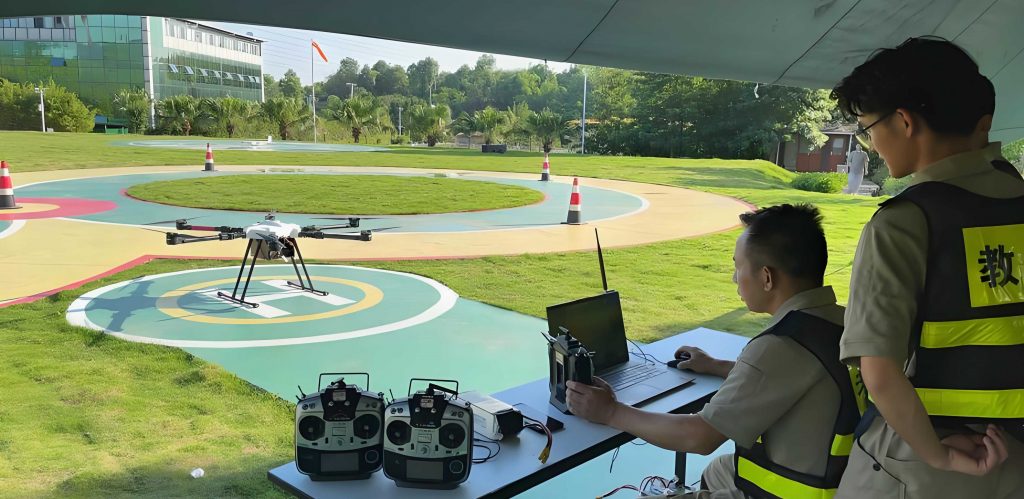
Current drone training and certification for operators predominantly exists within the civil aviation framework, with several parallel systems in operation. Analyzing these provides a foundation for constructing a specialized program.
- National Vocational Skill Level Certificate (COSL): Instituted following national vocational education reforms, this system certifies competencies like “Drone Pilot” and “Drone Surveying Operator” based on standardized national skill assessments. It represents a formal state-recognized qualification pathway.
- Civil Aviation Administration of China (CAAC) Pilot License: This is the primary regulatory license for unmanned aircraft systems in China, managed directly by the aviation authority. It is the fundamental legal document for compliant flight operations.
- Pilot Certificates (e.g., AOPA, CHALPA): Issued by industry associations, these certificates often run parallel to the CAAC license. They typically reflect similar competency tiers (Visual Line of Sight, Beyond Visual Line of Sight, Instructor) but are administered by non-governmental bodies.
- Aeronautical Model Pilot License (ASFC): Focused on sport and model aviation, this certification emphasizes pure flight maneuver skills. It is recognized for hobbyist and sports purposes but lacks operational application modules for professional domains.
- Unmanned Aircraft System Operator Certificate (UTC): Often associated with specific manufacturers or application centers (e.g., DJI), this certificate provides targeted training for particular platforms and specific commercial applications like aerial photography, inspection, or surveying.
While these existing systems provide a necessary foundation in general aviation rules, flight theory, and basic piloting skills, they share a common limitation for fire service application: the training content and final assessment are decoupled from the extreme, dynamic, and mission-specific environments of firefighting and technical rescue. A fire service operator must not only fly but do so effectively while integrating the drone’s capabilities into a broader tactical plan under stress. This gap necessitates a dedicated drone training ecosystem.
The proposed Fire and Rescue Drone Operator Training System is designed to build upon, but specialize beyond, existing civil frameworks. It defines a new category of operator: the Fire and Rescue Drone Operator. This professional is qualified to operate unmanned aircraft systems to directly complete or assist in fire suppression and emergency rescue tasks. Their work environment is explicitly defined as including interiors and exteriors, forests, grasslands, and conditions featuring dense smoke, high temperatures, low temperatures, or hazardous chemicals. Consequently, the required aptitude includes not only standard piloting skills but also quick reaction, analytical judgment under pressure, excellent spatial awareness, and crucially, a foundational understanding of firefighting tactics, rescue operations, and scene safety protocols. The system proposes three distinct, progressive qualification levels: Operator (Pilot), Commander (Lead Pilot), and Instructor.
| Qualification Level | Definition & Core Responsibility | Prerequisite Experience & Certification | Minimum Training Duration (Standard Hours) |
|---|---|---|---|
| Operator (Pilot) | Executes defined flight missions under supervision, operates payloads for basic data collection and direct task support (e.g., lighting, broadcast). | 1+ year in fire/rescue; holds a basic CAAC or equivalent civil drone pilot certificate. | 120 |
| Commander (Lead Pilot) | Plans and leads complex missions, conducts BVLOS operations, is responsible for data processing for decision-support, and manages mission risk. | Holds Fire Operator cert for 1+ year; holds advanced CAAC/other cert; has provided UAS support for 5+ significant incidents. | 160 |
| Instructor | Trains and assesses Operators and Commanders, develops curricula and standards, evaluates new equipment/tactics for fire service application. | Holds Fire Commander cert for 1+ year; holds Instructor-level CAAC/other cert; has provided UAS support for 10+ significant incidents. | 100 |
A robust assessment methodology is critical for validating competency. The proposed evaluation is multi-faceted, progressing in complexity with each level.
- Theoretical Knowledge Exam: A closed-book test covering aviation regulations, meteorology, flight principles, UAS systems, and, distinctly, fireground safety, incident command system integration, and specific operational protocols for hazardous environments.
- Basic Flight Skill Evaluation: A practical flight test demonstrating manual control proficiency, standard maneuvers, and response to simulated in-flight emergencies.
- Fire & Rescue Application Skill Evaluation: The defining component. This practical test requires executing realistic scenario-based tasks using relevant payloads (e.g., conducting a search pattern, creating a quick 2D map, performing a precision water drop).
- Comprehensive Review (For Instructors): An assessment of instructional capability, curriculum development skills, and advanced operational knowledge through material review and interview.
Each component is scored individually, with a minimum passing threshold. The required time for each evaluation increases with level, ensuring thorough assessment. For example:
$$ T_{total-eval} = T_{theory} + T_{basic-flight} + T_{app-skill} $$
Where for a Commander candidate, $T_{theory} \geq 90$ min, $T_{basic-flight} \geq 30$ min, and $T_{app-skill} \geq 30$ min (with additional time for complex mapping tasks).
The core of the drone training syllabus is a structured matrix of competencies. These are divided into foundational knowledge, core operational skills, and specialized fire rescue application skills.
Foundational Knowledge
This module provides the essential theoretical bedrock. It extends beyond standard civil curriculum to include fire service-specific contexts.
| Knowledge Module | Key Topics Covered | Training Weight (Example) |
|---|---|---|
| UAS Fundamentals & Classification | Definitions, characteristics, types of platforms (multi-rotor, fixed-wing, hybrid) and their fire service suitability. | ~10% |
| Aerodynamics & Flight Principles | Lift, thrust, drag, weight; effects of wind and weather on small UAS, performance limitations. | ~15% |
| UAS Systems & Technology | Flight controller, propulsion, communication datalinks, navigation systems (GNSS, IMU), payload integration. | ~20% |
| Aviation Meteorology | Reading weather reports, understanding microclimates, recognizing hazardous conditions (wind shear, icing potential). | ~10% |
| Regulations & Airspace | National UAS regulations, airspace classification, NOTAMs, obtaining flight authorizations for emergency operations. | ~15% |
| Safety & Risk Management | Pre-flight checklists, emergency procedures, human factors, risk assessment matrices for fire scenes. | ~15% |
| Fireground Fundamentals | Incident Command System (ICS), personnel accountability, thermal and toxic hazards, operational periods. | ~15% |
Core Operational Skills (Tiered)
These skills represent the practical ability to plan, execute, and maintain missions. The required depth scales with the operator level.
Operator (Pilot) Skills: Focus on task execution under guidance.
| Skill Category | Competency Examples |
|---|---|
| Mission Planning & Prep | Select appropriate platform/payload for a given task; perform pre-flight checks and calibrations. |
| Flight Operation | Perform manual flight maneuvers (orbiting, tracking, ascent/descent); monitor system status; execute emergency procedures (RTL, landing). |
| Payload Operation | Control gimbal/camera to acquire visual/thermal imagery; activate auxiliary payloads (light, speaker). |
| Data Handling | Download and perform basic organization of captured image/video data. |
| Basic Maintenance | Perform routine cleaning, inspections, and firmware updates per manufacturer guidelines. |
Commander (Lead Pilot) Skills: Encompass Operator skills and add mission management, planning, and analysis.
| Skill Category | Competency Examples |
|---|---|
| Advanced Planning | Conduct site-specific risk assessment; develop contingency and abort plans; plan complex BVLOS flight routes. |
| Mission Management | Supervise a flight team; coordinate with incident command; manage communication protocols. |
| Data Processing & Analysis | Process imagery into 2D orthomosaics or 3D models; perform basic analysis (area calculation, change detection). |
| System Optimization | Develop standard operating procedures (SOPs) for specific mission types; optimize maintenance schedules. |
Instructor Skills: Encompass Commander skills and focus on pedagogy, evaluation, and advancement.
| Skill Category | Competency Examples |
|---|---|
| Curriculum Development | Design lesson plans and practical exercises; create evaluation rubrics for all skill levels. |
| Instruction & Assessment | Effectively deliver theoretical and practical training; provide constructive feedback; conduct certification evaluations. |
| Technical Evaluation | Test and evaluate new UAS platforms, sensors, or software for potential fire service integration. |
A quantitative representation of the focus shift across levels can be modeled. Let $W_{cat, level}$ represent the weighting of a skill category (like Mission Execution) for a given level. The progression shows increasing emphasis on management and instruction.
| Skill Category | Operator Weight ($W_{op}$) | Commander Weight ($W_{cm}$) | Instructor Weight ($W_{in}$) |
|---|---|---|---|
| Mission Planning | 10% | 20% | – |
| Mission Preparation | 30% | 10% | – |
| Mission Execution | 40% | 40% | 20% |
| System Maintenance | 20% | 30% | 20% |
| Technical Management | – | – | 20% |
| Training & Instruction | – | – | 40% |
This can be summarized as a shift vector. The overall competency $C_{level}$ for a level is the sum of weighted category proficiencies $P_{cat}$:
$$ C_{level} = \sum (W_{cat, level} \cdot P_{cat}) $$
where $P_{cat}$ is assessed on a scale from 0 to 1. The evolution of $W_{cat}$ across levels defines the career pathway in this drone training system.
Specialized Fire & Rescue Application Skills
This is the cornerstone that differentiates this drone training program. It translates general piloting skill into life-saving operational capability.
| Application Scenario | Operator (Pilot) Skill | Commander (Lead Pilot) Skill |
|---|---|---|
| Aerial Reconnaissance & Mapping | Perform VLOS visual/thermal inspection; capture basic photo/video for situational awareness. | Plan and execute BVLOS mapping missions; process imagery into 2D/3D models for incident action plans; perform change detection between flights. |
| Search & Rescue | Use drone spotlight and speaker for area illumination and audible guidance in a defined sector. | Plan systematic search patterns using waypoint automation; use thermal imaging to locate persons in complex terrain (e.g., rubble, forest). |
| Communication Support | Deploy a tethered drone to establish a temporary elevated communication relay as directed. | Analyze terrain and signal propagation to optimally position one or more aerial relay platforms to cover a large incident area. |
| Indirect Fire Attack & Support | Safely deliver water/foam cans or fire retardant balls to a target area from altitude. | Execute precision drops on specific hotspots identified via thermal imaging; coordinate drops with ground crew advancement. |
| Logistics & Delivery | Transport lightweight essential supplies (e.g., medical kits, radios) to inaccessible points. | Perform precision delivery using winch or release mechanisms (e.g., delivering a life vest to a flood victim); manage multi-drop logistics. |
| Hazardous Environment Monitoring | Use drone to visually assess a chemical leak or structural collapse from a safe stand-off distance. | Deploy specialized sensors (e.g., gas detectors, radiation monitors) via drone and interpret real-time data to define hazard perimeters. |
The complexity of application skills can be modeled. For a given mission type $m$, let $D_{op}(m)$ represent the difficulty for an Operator and $D_{cm}(m)$ for a Commander. Typically, $D_{cm}(m) > D_{op}(m)$. The skill required $S$ might be a function of environmental factors $E$ (e.g., wind, visibility), payload complexity $L$, and required precision $\rho$:
$$ S(m) = f(E, L, \rho) $$
Drone training must systematically increase the trainee’s ability to handle missions where $S(m)$ is high, particularly in variable and adverse $E$.
In conclusion, the construction of a formalized Fire and Rescue Drone Operator Training System is a strategic necessity. It moves beyond adapting generic civilian drone training and instead engineers a curriculum from the ground up, rooted in the operational realities of firefighting and technical rescue. By defining clear qualification tiers, implementing a robust multi-domain assessment strategy, and—most importantly—codifying the specialized application skills that turn a remote pilot into a force multiplier on the incident scene, this system provides a coherent pathway for professional development. The next critical phases involve the granular development of standardized lesson plans, practical exercise modules, standardized evaluation checklists, and tailored training materials. Ultimately, the goal is to institutionalize this drone training framework, ensuring that every drone deployed in service of fire and rescue is operated by a professional whose skills are as advanced and reliable as the technology they command. This is the foundation for safe, effective, and integrated unmanned systems operations in modern emergency response.