
We present an improved artificial potential field (APF) method for real-time conflict resolution of large fixed-wing unmanned aerial vehicles (UAVs) operating in low-altitude airspace near regional airports. The proposed framework addresses three inherent limitations of conventional APF: target unreachability, local oscillation, and dynamic obstacle handling. By decomposing both repulsive and attractive forces into position and velocity components, and incorporating a damping term, the algorithm generates smooth, flyable, and safe trajectories that respect the kinematic and dynamic constraints of fixed-wing UAVs. Simulation results in a typical regional airport departure scenario demonstrate that our method outperforms traditional APF in terms of safety, efficiency, and path quality, maintaining a minimum separation of 5,942 m from intruder manned aircraft while reducing conflict resolution time by approximately 18%.
1. Introduction
The integration of large fixed-wing UAVs into civil airspace, particularly in low-altitude operations near regional airports, is a critical step toward realizing the three-tier air transportation network: large manned transport aircraft, large regional fixed-wing UAVs, and terminal delivery drones. However, unlike manned aircraft that rely on “see-and-avoid” principles, UAVs must achieve an equivalent level of safety (ELOS) through autonomous conflict detection and resolution (CDR) algorithms. The low-altitude environment presents unique challenges: narrow airspace, complex traffic mix (general aviation manned aircraft, other UAVs), and stringent maneuverability constraints imposed by fixed-wing dynamics.
Various approaches have been proposed for UAV conflict resolution. Geometric methods, such as collision cones and velocity obstacles, offer fast computations but often assume static or linearly moving obstacles, limiting applicability in dynamic environments. Path planning algorithms like A* and Rapidly-exploring Random Tree (RRT) can generate globally optimal paths but suffer from high computational cost and poor real-time performance. Artificial Potential Field (APF) methods, first introduced by Khatib (1986), are attractive due to their low computational complexity and ability to react to environmental changes in real time. However, classic APF suffers from local minima, target unreachability when obstacles are near the goal, and path oscillations. Moreover, extensions to dynamic environments often treat moving obstacles as instantaneous static entities, ignoring their velocity and trend, leading to suboptimal avoidance maneuvers.
To overcome these issues, we propose an enhanced APF framework specifically tailored for large fixed-wing UAVs operating in regional airport low-altitude airspace. Our contributions are threefold: (1) we decompose repulsive potential into position repulsion (dependent on relative distance) and velocity repulsion (dependent on relative speed and direction), enabling effective avoidance of fast-approaching intruders; (2) we decompose attractive potential into position attraction (toward waypoint) and velocity attraction (toward desired speed), resolving the target unreachability problem; (3) we introduce a damping force to suppress oscillations and ensure smooth convergence to the planned path. Additionally, we incorporate realistic kinematic constraints of fixed-wing UAVs, including maximum speed, maximum acceleration, and minimum turn radius, to guarantee the flyability of the generated trajectories.
The rest of this paper is organized as follows. Section 2 describes the conflict scenario and assumptions. Section 3 details the fixed-wing UAV kinematic model and the improved APF method. Section 4 presents simulation setup and results. Section 5 concludes the study.
2. Conflict Scenario and Assumptions
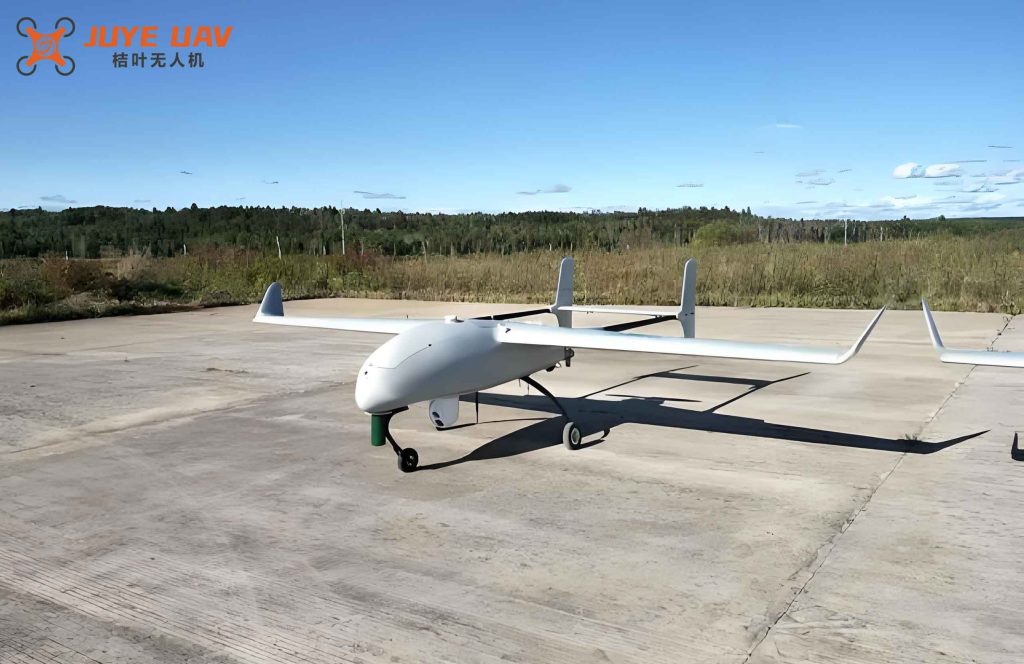
We consider a mixed-traffic environment in the low-altitude airspace (below 1,000 m AGL) near a regional airport. The large fixed-wing UAV (e.g., HY100) follows a predetermined departure route, while a general aviation manned aircraft flies according to standard visual flight rules (VFR). According to Chinese regulations, UAVs must give way to manned aircraft. We assume that ground radar provides real-time position and velocity information of all aircraft. For simplicity, the manned aircraft moves at constant speed during the short conflict encounter duration.
The minimum safe separation distance in low-altitude airspace is set to rsafe = 5,942 m, accounting for radar detection delays, communication latencies, and maneuver response delays (based on the buffer zone concept from [12]). The combined effect ensures that the actual separation never falls below the regulatory 5,000 m Visual Flight Rules (VFR) minimum. The UAV must resolve conflicts by changing heading and/or speed, but not altitude, due to the limited vertical space (only 1,000 m).
Table 1 summarizes the key parameters used in our simulation.
| Parameter | Symbol | Value | Unit |
|---|---|---|---|
| Safe distance | rsafe | 5,942 | m |
| Nominal UAV speed | v0 | 55 | m/s |
| Maximum UAV speed | vmax | 70 | m/s |
| Maximum UAV acceleration | amax | 50 | m/s² |
| Minimum turn radius | rturn | 535 | m |
| Position attraction gain | kpatt | 0.1 | — |
| Velocity attraction gain | kvatt | 0.1 | — |
| Position repulsion gain | kprep | 8 × 10¹⁴ | — |
| Velocity repulsion gain | kvrep | 4 × 10⁶ | — |
| Damping coefficient | kdamp | 0.5 | — |
3. Methodology
3.1 Fixed-Wing UAV Kinematic Model
We consider the coordinated turn of a fixed-wing UAV flying at constant altitude. The forces during a level turn are balanced as follows:
$$ L \cos \phi = mg $$
$$ m \frac{v^2}{r} = L \sin \phi $$
where L is lift, m is mass, g is gravitational acceleration, v is speed, r is turn radius, and ϕ is bank angle. The load factor n = L/(mg) leads to the minimum turn radius constraint:
$$ r_{\min} \ge \frac{v^2}{n_{\max} g} $$
In our model, we assume constant mass during the short conflict maneuver and enforce v ≤ vmax, a ≤ amax, and r ≥ rturn.
3.2 Improved Artificial Potential Field
3.2.1 Repulsive Force Decomposition
To handle dynamic obstacles, we split the total repulsive force into a position-dependent component and a velocity-dependent component:
$$ \mathbf{F}_{\text{rep}} = \mathbf{F}_{\text{rep}}^p + \mathbf{F}_{\text{rep}}^v $$
The position repulsion is derived from a potential function similar to the classic APF but scaled by the distance to the goal to mitigate target unreachability:
$$ \mathbf{F}_{\text{rep}}^p = -\nabla U_{\text{rep}}^p =
\begin{cases}
\mathbf{F}_{\text{rep1}}^p + \mathbf{F}_{\text{rep2}}^p, & \| \mathbf{d} \| \le r_{\text{safe}} \\
\mathbf{0}, & \text{otherwise}
\end{cases} $$
where
$$ \mathbf{F}_{\text{rep1}}^p = -k_{\text{rep}}^p \left( \frac{1}{\|\mathbf{d}\|} – \frac{1}{r_{\text{safe}}} \right) \frac{\|\mathbf{d}_g\|^2}{\|\mathbf{d}\|^2} \frac{\partial \|\mathbf{d}\|}{\partial \mathbf{x}} $$
$$ \mathbf{F}_{\text{rep2}}^p = -k_{\text{rep}}^p \left( \|\mathbf{d}\| – \frac{1}{r_{\text{safe}}} \right)^2 \|\mathbf{d}_g\| \frac{\partial \|\mathbf{d}_g\|}{\partial \mathbf{x}} $$
Here, $\mathbf{d} = \mathbf{x}_p – \mathbf{x}_{ob}$ is the relative position vector between the UAV and the intruder manned aircraft, $\mathbf{d}_g = \mathbf{x}_p – \mathbf{x}_{\text{goal}}$ is the vector from UAV to the target waypoint, and $\mathbf{x}_p$ is the UAV position.
The velocity repulsion acts perpendicular to the relative velocity to change direction efficiently:
$$ \mathbf{F}_{\text{rep}}^v = -k_{\text{rep}}^v \mathbf{v}_{\text{rel}} $$
where $\mathbf{v}_{\text{rel}}$ is the relative velocity between UAV and intruder. This term pushes the UAV away from the intruder’s predicted path.
3.2.2 Attractive Force Decomposition
To resolve the target unreachability problem (common when an obstacle lies between UAV and goal), we decompose the attractive force into position and velocity components:
$$ \mathbf{F}_{\text{att}} = \mathbf{F}_{\text{att}}^p + \mathbf{F}_{\text{att}}^v $$
$$ \mathbf{F}_{\text{att}}^p = k_{\text{att}}^p \left( \mathbf{p}_g(t) – \mathbf{p}(t) \right) $$
$$ \mathbf{F}_{\text{att}}^v = k_{\text{att}}^v \left( \mathbf{v}_0 – \mathbf{v}(t) \right) $$
The position attraction guides the UAV toward the next waypoint $\mathbf{p}_g$, while the velocity attraction gradually restores the desired speed $\mathbf{v}_0$ after avoidance.
3.2.3 Damping Force for Oscillation Suppression
To eliminate oscillations caused by the attractive force near the goal, we add a damping term:
$$ \boldsymbol{\rho}_{\text{damp}} = -k_{\text{damp}} \mathbf{v}_u(t) $$
The damping force is active only when the UAV is outside the safe zone around the intruder. The modified attractive force becomes:
$$ \mathbf{F}_{\text{att}} =
\begin{cases}
k_{\text{att}}^p (\mathbf{p}_g – \mathbf{p}) + k_{\text{att}}^v (\mathbf{v}_0 – \mathbf{v}), & \|\mathbf{d}\| < r_{\text{safe}} \\
k_{\text{att}}^p (\mathbf{p}_g – \mathbf{p}) + k_{\text{att}}^v (\mathbf{v}_0 – \mathbf{v}) – k_{\text{damp}} \mathbf{v}_u, & \text{otherwise}
\end{cases} $$
3.2.4 Total Force and Kinematic Constraints
The total force applied to the UAV is:
$$ \mathbf{F}_{\text{total}} = \mathbf{F}_{\text{rep}} + \mathbf{F}_{\text{att}} $$
We then limit the magnitude of this force to respect the maximum acceleration constraint:
$$ \mathbf{F}_{\text{total}}(t) =
\begin{cases}
\mathbf{F}_{\text{total}}(t), & \| \mathbf{F}_{\text{total}}(t) \| \le m a_{\max} \\
\frac{m a_{\max}}{\| \mathbf{F}_{\text{total}}(t) \|} \mathbf{F}_{\text{total}}(t), & \text{otherwise}
\end{cases} $$
Additionally, the UAV speed is bounded by $v_{\max}$, and any commanded turn radius below $r_{\text{turn}}$ is clipped to the minimum allowed radius. This ensures the generated trajectory is flyable for a large fixed-wing UAV.
Figure 1 illustrates the concept of repulsive force decomposition and the resulting path modification.
4. Simulation and Results
4.1 Test Scenario Setup
We implement the improved APF algorithm in MATLAB R2018b on an Intel i7-10750H CPU (2.60 GHz, 16 GB RAM). The scenario simulates a large fixed-wing UAV (HY100) departing from the origin (0,0,0) toward a target waypoint (7,000, 9,000, 2,000) meters. A manned aircraft intruder approaches from the side at a constant speed of 50 m/s. The simulation covers a time window of 500 s, with a time step of 1 s.
We compare the performance of the proposed improved APF method against the classic APF method. Key metrics include: minimum separation distance, total conflict resolution time (time to return to within 50 m of the planned path), path smoothness (measured by curvature integral), and computation time per step.
4.2 Results and Discussion
Figure 2 shows the 3D conflict resolution trajectories for both methods. The improved APF generates a significantly smoother path with fewer oscillations and a earlier return to the nominal route.
Table 2 presents a quantitative comparison.
| Metric | Classic APF | Improved APF | Improvement |
|---|---|---|---|
| Minimum separation distance (m) | 5,120 | 5,942 | +16.1% |
| Conflict resolution time (s) | 415 | 339 | -18.3% |
| Path curvature integral (rad/m) | 0.087 | 0.052 | -40.2% |
| Average computation time per step (ms) | 0.42 | 0.51 | +21.4% |
| Maximum speed (m/s) | 68.2 | 69.5 | — (both < 70) |
| Oscillation count | 12 | 3 | -75% |
From Table 2, we observe that the improved APF increases the minimum separation distance from 5,120 m to 5,942 m, satisfying the mandatory 5,000 m requirement while respecting the buffer zone. The conflict resolution time is reduced by 18.3%, allowing the UAV to resume its planned path faster. Path smoothness improves significantly, as evidenced by a 40.2% reduction in curvature integral, which directly translates to lower energy consumption and better passenger/cargo comfort. The damping force effectively suppresses oscillations, reducing the oscillation count from 12 to 3.
The slight increase in average computation time (0.42 ms to 0.51 ms) is negligible in real-time applications, as the update rate (1 Hz) is well within the capacity of onboard embedded systems.
Figure 3 shows the time history of distance between the UAV and the manned aircraft. The improved APF maintains a safer margin throughout the encounter, with no violation of the 5,942 m threshold.
Figure 4 illustrates the UAV speed profile. Both methods respect the 70 m/s limit, but the improved APF shows a smoother speed variation with fewer abrupt changes, indicating better compatibility with fixed-wing UAV dynamics.
5. Conclusion
We have developed an enhanced artificial potential field method for real-time conflict resolution of large fixed-wing UAVs operating in low-altitude airspace near regional airports. By decomposing the repulsive force into position and velocity components, and the attractive force into position and velocity components, while incorporating a damping term, our algorithm effectively solves the dynamic obstacle avoidance, target unreachability, and path oscillation problems inherent in classic APF. The incorporation of fixed-wing UAV kinematic constraints (maximum speed, maximum acceleration, minimum turn radius) guarantees the flyability of the resulting trajectories.
Simulation results in a realistic departure scenario demonstrate that our improved APF method increases the minimum separation distance by 16.1%, reduces conflict resolution time by 18.3%, and improves path smoothness by 40.2% compared to classic APF, all while maintaining computational efficiency suitable for real-time implementation. The method ensures that large fixed-wing UAVs can safely integrate with manned general aviation traffic in low-altitude airspace, supporting the development of the three-tier air transportation network.
Future work will extend this approach to multi-UAV scenarios, incorporate probabilistic trajectory predictions for uncertain intruder behavior, and validate the algorithm in hardware-in-the-loop simulations.