
The integration of Unmanned Aerial Vehicles (UAVs) into firefighting and emergency response operations marks a significant technological advancement. Among their various capabilities, the reconnaissance function stands out as a critical tool for situational awareness. This article, from my perspective as a researcher synthesizing current practices and innovations, delves deeply into the methodologies for realizing, optimizing, and coordinating the侦察 capabilities of fire UAVs. I will explore implementation paradigms, advanced collaborative strategies, and essential flight quality optimizations, utilizing formulas and tables to encapsulate key concepts.
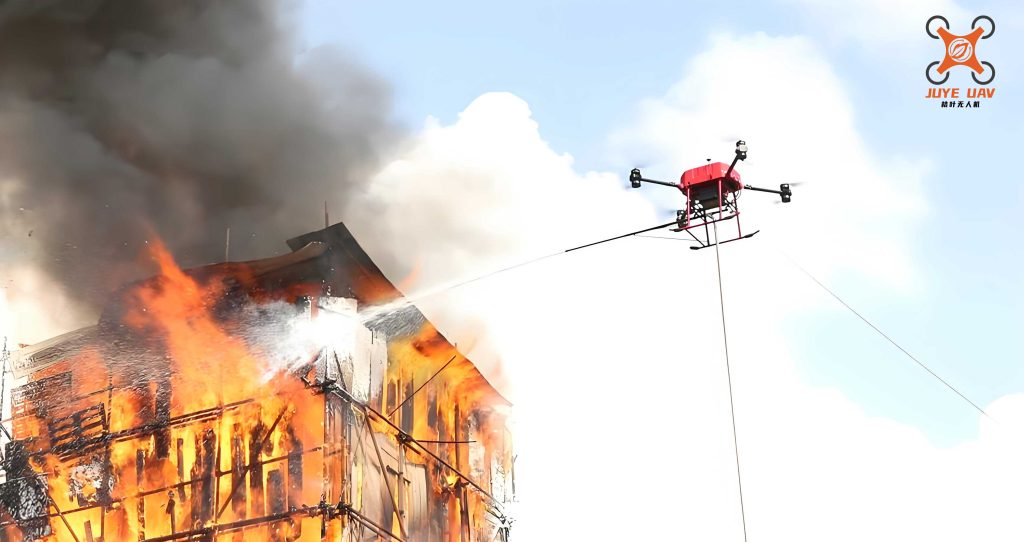
The operational environment for fire UAVs is exceptionally demanding, characterized by intense heat, turbulent airflow, dense smoke, and complex urban or industrial topography. Traditional reconnaissance methods are often slow, hazardous, and provide limited perspectives. The deployment of a fire UAV overcomes these limitations, offering a rapid, aerial vantage point. However, merely having a flying camera is insufficient. The true value lies in systematic, efficient, and intelligent data acquisition. The core challenge I address is transforming the basic capability of a fire UAV into a reliable, autonomous, and synergistic侦察 asset that can deliver actionable intelligence under severe constraints.
1. Implementation and Optimization of Fire UAV Reconnaissance Functions
Effective reconnaissance is not a passive activity; it requires active planning and methodical execution. For a fire UAV, this involves two foundational pillars: intelligent path planning and the strategic application of proven搜索 methodologies adapted from other fields.
1.1 Autonomous Path Planning for Rapid Deployment
Fire UAV operations typically commence with two control modes: manual remote control and autonomous flight. Manual control, while offering direct human oversight, is susceptible to operator skill, signal latency, and visual obstruction—factors that are unreliable in chaotic emergency scenes. Consequently, I advocate for and focus on autonomous航迹规划 as the superior mode for initial response and en-route scouting.
The field of path planning is rich with algorithms, each with strengths and weaknesses. For the specific context of a fire UAV navigating complex urban airspace to a known incident location, a single algorithm often proves inadequate. Therefore, I propose a hybrid approach that synergizes the strengths of multiple methods:
- Spatial Modeling with Grid Methods: The operational airspace is discretized using a 3D grid. Cell states (free, occupied, risky) are determined by integrating static data (building heights from GIS, no-fly zones) and real-time updates. This creates a navigable model for the fire UAV.
- Heuristic Guidance with the A* Algorithm: To efficiently find a path through the grid, the A* algorithm is employed. It uses a cost function $$f(n) = g(n) + h(n)$$, where $$g(n)$$ is the actual cost from the start node to node $$n$$, and $$h(n)$$ is a heuristic estimate of the cost from $$n$$ to the goal. For a fire UAV, $$h(n)$$ must account for not just distance but also potential hazards like updrafts near structures.
- Path Refinement with Ant Colony Optimization (ACO): The initial path from A* is often sub-optimal. ACO, a bio-inspired algorithm, is applied for refinement. “Ants” probabilistically explore the vicinity of the initial path, depositing “pheromones” on shorter routes. Over iterations, the fire UAV’s optimal or near-optimal path emerges, balancing distance, safety, and energy consumption. The pre-processing by A* significantly reduces the search space for ACO, enabling fast convergence even in large-scale scenarios.
A comparative summary of major algorithm categories relevant to fire UAV path planning is provided below:
| Algorithm Category | Key Examples | Advantages for Fire UAV | Disadvantages for Fire UAV |
|---|---|---|---|
| Traditional Algorithms | Dijkstra, A*, D* | Provably optimal/shortest path; predictable performance. | Can be computationally slow in large 3D spaces; may not handle dynamic obstacles well. |
| Graph-Based Methods | Voronoi Diagram, Visibility Graph | Creates paths that maximize distance from obstacles. | Graph construction can be complex; paths may be longer than necessary. |
| Intelligent Bionic Algorithms | Genetic Algorithm (GA), Particle Swarm Optimization (PSO), Ant Colony Optimization (ACO) | Excellent for complex, non-linear optimization; can handle multiple objectives (e.g., path length, safety, time). | Computationally intensive; solution is not guaranteed to be globally optimal. |
| Sampling-Based Methods | Rapidly-exploring Random Tree (RRT), Probabilistic Roadmap (PRM) | Very effective in high-dimensional spaces; good for real-time planning. | Paths can be jerky and require smoothing; probabilistic completeness. |
1.2 Adaptation of Military Search Patterns for Fire Scenarios
The reconnaissance process—detect, identify, confirm—parallels military搜索 operations. I have adapted three fundamental military搜索 patterns to the specific needs of fire UAV deployment, which can be used singly or in combination.
- Area Search/Reconnaissance: The fire UAV is tasked with covering a broad, defined geographical area to locate targets or assess general conditions. This is ideal for large-scale disasters like earthquakes, forest fires, or floods, where the overall extent of damage is unknown. The area is logically subdivided (e.g., residential sector, industrial sector, road network sector) and systematically covered by one or multiple fire UAVs. This ensures comprehensive coverage and orderly data collection.
- Route Search/Reconnaissance: The fire UAV follows a linear feature, such as a road, pipeline, or railway, scouting a corridor extending several hundred meters on either side. This is highly effective for traffic accident responses, hazardous material (HazMat) leaks along transport routes, or fires in linear industrial facilities. It provides focused intelligence along critical infrastructure.
- Point Search/Reconnaissance: The fire UAV concentrates on a small, known area of high interest. This follows an initial broader search or is based on prior intelligence. For example, after a general assessment of a chemical plant fire, a fire UAV might be dedicated to continuously monitoring a specific storage tank or reactor vessel, tracking its structural integrity and flame spread.
The strategic selection and sequencing of these patterns allow incident commanders to deploy their fire UAV assets with precision, moving from general awareness to specific, tactical intelligence.
2. Advanced探究 into Collaborative Fire UAV Reconnaissance
As incidents grow in complexity, a single fire UAV may be insufficient. Collaborative, or swarm, reconnaissance using multiple fire UAVs is the logical evolution. This involves two core problems: task area partitioning and intra-subarea path planning.
2.1 Collaborative Reconnaissance over Regular (Rectangular) Areas
For large, relatively regular search areas (e.g., a warehouse complex, a farmland fire), efficient coverage is key. After evaluating methods like precise cell decomposition, I find the Boustrophedon (Lawnmower) Pattern with Area Partitioning to be most effective for a fleet of fire UAVs.
In this approach, the total search area of length $$L$$ and width $$W$$ is partitioned into $$N$$ parallel tracks, or “lanes.” The number of lanes is determined by the effective sensor swath width $$S_w$$ of the fire UAV’s payload (e.g., thermal camera field of view at a given altitude). To ensure full coverage without gaps, the lanes must slightly overlap. The formula for the number of lanes is:
$$N = \lceil \frac{W}{S_w \cdot (1 – \rho)} \rceil$$
where $$\rho$$ is the desired overlap ratio (e.g., 0.2 for 20% overlap). The total area is then divided among $$M$$ available fire UAVs. If the UAVs are homogeneous, each fire UAV covers approximately $$N/M$$ contiguous lanes. The flight path within each lane is the standard back-and-forth Boustrophedon pattern. This method maximizes coverage efficiency and minimizes missed areas, making it superior to random or simple spiral searches for systematic fire UAV deployment.
2.2 Collaborative Reconnaissance over Irregular Polygonal Areas
Fire scenes are rarely perfect rectangles. Irregular shapes—caused by terrain, wind-driven fire spread, or building layouts—require a more sophisticated partitioning strategy. I propose and elaborate on the AHP-Performance Index Vector Method for this purpose. This method accounts for the heterogeneous capabilities of different fire UAVs in a fleet (e.g., different flight endurance, sensor types, cruising speeds).
2.2.1 Performance Index Determination via Analytic Hierarchy Process (AHP)
The core idea is to assign sub-areas to each fire UAV proportional to its “performance index” for the specific reconnaissance task. This index is calculated using AHP, a multi-criteria decision-making tool.
- Construct the Evaluation Hierarchy: The goal is “Task Performance for Fire UAV Reconnaissance.” Criteria influencing this are identified, such as Cruise Speed (C1), Operational Altitude Range (C2), Sensor Swath Width (C3), Endurance (C4), and Onboard Processing Capability (C5).
- Develop Pairwise Comparison Matrices: For the criteria, a matrix is built where each element $$a_{ij}$$ represents the relative importance of criterion $$i$$ over criterion $$j$$ (using a scale like 1-9). A similar matrix is built for comparing the fire UAVs themselves against each criterion.
Criteria C1: Speed C2: Altitude C3: Swath … C1: Speed 1 3 2 … C2: Altitude1/3 1 1/2 … C3: Swath 1/2 2 1 … … … … … … - Calculate Weights and Consistency: The principal eigenvector of the matrix provides the relative weights $$w_i$$ for each criterion. Consistency Ratio (CR) is calculated to ensure judgments are logically coherent. A CR < 0.1 is acceptable.
$$CR = \frac{CI}{RI}, \quad \text{where } CI = \frac{\lambda_{max} – n}{n-1}$$
Here, $$\lambda_{max}$$ is the principal eigenvalue, $$n$$ is matrix size, and RI is the Random Index. - Determine Composite Performance Index (K): The weights from the criteria matrix are combined with the scores from the UAV comparison matrices to yield a global priority score $$K_m$$ for each fire UAV $$m$$, normalized such that $$\sum_{m=1}^{M} K_m = 1$$. This $$K_m$$ is its performance index.
2.2.2 Area Partitioning and Sub-Area Path Planning
Given a total irregular area $$A_{total}$$ and performance indices $$K_m$$ for $$M$$ fire UAVs, the area assigned to fire UAV $$m$$ is:
$$A_m = K_m \cdot A_{total}$$
The geometric challenge is to partition the irregular polygon into $$M$$ sub-polygons with these specific areas. Algorithms like weighted Voronoi diagrams or recursive splitting can be used. Once a sub-polygon is assigned, the fire UAV must plan an efficient coverage path within it. For convex sub-polygons, a proven method is to align the Boustrophedon scan lines parallel to one of the polygon’s edges, minimizing turns. The required number of scan lines $$N_m$$ within the sub-polygon of width $$W_m$$ is:
$$N_m = \lceil \frac{W_m}{S_{w,m} \cdot (1 – \rho)} \rceil$$
where $$S_{w,m}$$ is that specific fire UAV’s sensor swath width. Flight time must be constantly checked against the fire UAV’s endurance, with provisions for automatic return-to-charge points if the sub-area cannot be covered in a single flight.
3. Optimization of Flight Quality for Reliable Fire UAV Reconnaissance
Acquiring usable data requires the fire UAV to maintain stable, purposeful flight. Two critical aspects are altitude calculation for optimal viewing and stability control in turbulent environments.
3.1 Optimal Flight Altitude for Targeted Inspection
For inspecting a specific point, like a window on a high-rise building, an ad-hoc altitude adjustment is inefficient. A calculated approach is better. Consider a fire UAV with a gimbaled sensor. Let:
– $$\alpha$$ be the sensor installation angle (tilt from vertical).
– $$\theta$$ be the sensor’s vertical field of view (FOV).
– $$q$$ be the known vertical distance from the UAV’s flight plane reference to the target point (e.g., window sill height).
– The desired imaging range on the building facade is $$Z$$.
The geometry yields the following relationship for the horizontal distance $$x$$ from the building facade and the altitude $$h$$ above the target reference point:
$$x = q \cdot \tan(\alpha – \frac{\theta}{2})$$
$$h = Z \cdot \sin(\alpha – \frac{\theta}{2}) + q$$
For example, if a fire UAV needs to image a 10m vertical span (Z=10m) of a building with a sensor having $$\alpha = 60^\circ$$ and $$\theta=30^\circ$$, and the window sill is at $$q=2m$$ relative to the UAV’s plane, then:
$$x \approx 2 \cdot \tan(45^\circ) = 2 \text{ m}$$
$$h \approx 10 \cdot \sin(45^\circ) + 2 \approx 9.07 \text{ m}$$
This gives the pilot or autonomous system a precise starting point for positioning the fire UAV.
3.2 Enhanced Stability Control in Dynamic Fire Environments
Fire-induced thermal plumes create severe wind shear and turbulence, challenging the flight stability of a fire UAV. Relying on standard PID controllers may be inadequate. I propose a two-layer approach for a fire UAV’s flight control system:
- Adaptive or Robust Control Layer: This core controller should adapt to changing dynamics. Techniques like Linear-Quadratic-Gaussian (LQG) control, $$H_\infty$$ robust control, or model reference adaptive control (MRAC) can be designed to account for estimated wind gusts and turbulence models specific to fire environments. The controller uses inputs from IMUs and GPS to maintain a reference attitude and position.
- Disturbance Estimation and Rejection Layer: An observer, such as a Kalman Filter or a Disturbance Observer (DOB), is run in parallel. It estimates the external wind forces and moments acting on the fire UAV based on the discrepancy between the control inputs and the actual motion. This estimated disturbance is then fed forward into the control loop to actively cancel it out before it significantly deviates the vehicle.
The performance of such a system for a fire UAV can be evaluated by metrics like attitude hold error ($$e_\phi, e_\theta$$ in radians), position drift (in meters), and control effort. The goal is to minimize error and drift while maintaining feasible actuator commands, ensuring the fire UAV’s sensor platform remains stable enough to capture clear, actionable imagery.
4. Conclusion and Future Perspectives
In this comprehensive exploration, I have detailed the transformation of the basic fire UAV into a sophisticated reconnaissance system. The journey begins with implementing robust autonomous path planning through hybrid algorithms and strategically applying adapted military search patterns. The true power is unlocked through collaborative missions, where methods like the AHP-Performance Index Vector法 enable heterogeneous fire UAV fleets to intelligently partition and conquer irregular search areas. Finally, mission success hinges on flight quality, necessitating calculated operational parameters and advanced stability control to withstand the harsh fireground environment.
The future of fire UAV reconnaissance lies in increasing autonomy and resilience. Key research directions include:
– Real-Time Dynamic Re-planning: Algorithms that allow a fire UAV to instantly recalculate its path or a swarm to re-partition tasks in response to a collapsing structure or a sudden change in wind direction.
– Multi-Modal Sensor Fusion: Developing algorithms to seamlessly fuse data from thermal, visual, LiDAR, and gas sensors on a fire UAV to create rich, multi-layered situational maps.
– Fully Autonomous Swarm Intelligence: Moving beyond pre-defined partitions to emergent, self-organizing swarm behaviors where fire UAVs dynamically share information and allocate侦察 tasks based on real-time findings and fuel states.
– Resilient Communication in Denied Environments: Ensuring robust data links and swarm coordination for fire UAVs operating in areas with dense smoke or significant electromagnetic interference from the incident.
– Standardized Data Protocols and Integration: Creating common data frameworks so that intelligence gathered by a fire UAV can be automatically ingested and visualized by command center software, accelerating the decision-making cycle.
By addressing these challenges, the next generation of fire UAVs will evolve from being mere remote eyes in the sky to becoming intelligent, cooperative partners in firefighting, fundamentally enhancing responder safety and operational efficacy.