
In my extensive experience as a drone training specialist within the power utility sector, I have witnessed a transformative shift in how distribution networks are inspected and maintained. The integration of unmanned aerial vehicles, or drones, has revolutionized traditional methods, offering unprecedented safety, efficiency, and cost-effectiveness. However, this technological adoption hinges critically on the availability of skilled personnel. The core challenge lies not in the technology itself, but in cultivating a workforce proficient in its application. This has made “drone training” the central pillar of modernizing grid operations. In this article, I will elaborate on the current landscape, the pressing need for structured “drone training,” and present a detailed, seven-phase training model I have developed and refined. This model is designed to systematically transform a traditional line worker into a competent distribution network drone pilot, capable of executing precise inspection and验收 tasks.
The application of drones in power distribution, often referred to as “distribution network drone operations,” has expanded rapidly. Initially focused on basic aerial reconnaissance, their role now encompasses critical functions such as overhead line inspection,工程验收 of new assets, and even live-line detection activities. The primary advantages are compelling: enhanced safety by reducing the need for climbers and elevated work platforms, significant speed in covering vast line distances, accessibility to challenging terrains like mountains and rivers, and a favorable return on investment compared to traditional crew-based methods. Consequently, utility companies are increasingly mandating the use of drones for routine grid surveillance. This strategic push, however, has exposed a acute shortage of qualified pilots. Many existing personnel lack the necessary piloting skills and, equally importantly, the contextual knowledge to apply these skills specifically to power system assets. Therefore, the demand for specialized “drone training” programs tailored to the utility industry’s unique needs has become overwhelmingly evident.
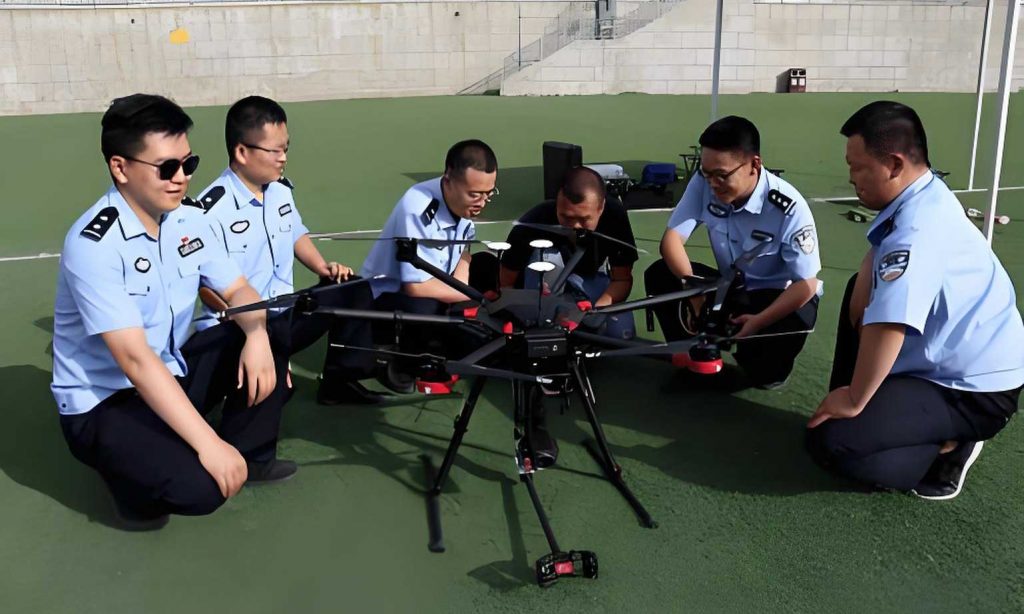
Let me delve into the specific applications that define our “drone training” objectives. The two cornerstone tasks are overhead line inspection and project acceptance. Distribution network drone line inspection involves using a drone to photograph and record video of poles, towers, and their surroundings. The goal is to identify foreign objects, vegetation encroachment, and the general condition of hardware and the right-of-way. Drone-based project验收, on the other hand, is a more精细化 process. It requires the drone to capture high-resolution images of specific components—such as cross-arms, insulators, connectors, and pole-mounted switches—to verify that installation meets engineering standards and specifications. Both tasks demand not just飞行 proficiency, but also a deep understanding of what to look for and how to frame the shot effectively. According to civil aviation regulations, notably the “Civil UAV Pilot Management Regulations,” these operations typically fall within the Visual Line Of Sight (VLOS) category for Class I and II drones, meaning the operational responsibility lies with the operator and does not strictly require a full civil aviation pilot license. This regulatory context shapes our “drone training” scope, focusing on competency-based certification rather than just licensure.
Unfortunately, existing “drone training” offerings have often fallen short. Many programs, offered by manufacturers or generic institutions, suffer from two critical flaws. First, they frequently neglect to screen trainees for essential foundational knowledge. Sending a trainee with no experience in distribution network components to a “drone training” course is counterproductive; they may learn to fly but will not know how to apply that skill to inspect a disconnect switch. Second, these programs tend to over-emphasize basic飞行操纵 skills while giving scant attention to domain-specific application scenarios. The result is a pilot who can maneuver a drone in an open field but is utterly unprepared to conduct a systematic, safe, and effective inspection of a live distribution line. This gap between generic skill and job-ready competence is what my proposed “drone training” model aims to bridge definitively.
The ultimate goal of our “drone training” program is to equip personnel with comprehensive theoretical knowledge, familiarize them with the structure and performance of distribution network drones, enable them to operate the aircraft smoothly and skillfully, and most importantly, train them to capture the required images and videos according to strict operational protocols. To achieve this, I have designed a sequential, seven-phase training model. Each phase is a prerequisite for the next, ensuring a structured buildup of competence and minimizing training waste. The model can be summarized by the following formula, representing the cumulative competence $C$ acquired through training:
$$ C = \sum_{i=1}^{7} (T_i \cdot P_i) $$
Where $C$ is the total competence, $T_i$ represents the theoretical knowledge weight for phase $i$, and $P_i$ represents the practical skill mastery for phase $i$. This additive model underscores that each phase contributes uniquely to the final outcome.
| Phase Number | Phase Name | Core Objective | Key Activities | Assessment Criterion |
|---|---|---|---|---|
| 1 | Trainee Screening & Selection | Ensure foundational grid knowledge | Review work history, verify experience in distribution运维 | Minimum 3 years in distribution utility work |
| 2 | Theoretical Learning | Establish comprehensive knowledge base | UAV principles, regulations, safety protocols, emergency procedures | Pass written theory examination |
| 3 | Simulator Practice | Develop basic control muscle memory and flight awareness | Using flight sim software to practice hover, yaw, translation | Stable hover in all orientations on simulator |
| 4 | Trainer Aircraft Flight Operation | Transfer skills to physical, low-cost aircraft in a safe environment | Hands-on flying of durable trainer drones with instructor override capability | Controlled flight and hover with trainer aircraft |
| 5 | Equipment Performance & Configuration | Understand and handle real UAV hardware | Assembly/disassembly, battery management, camera setup, transmitter-receiver binding | Demonstrated proficiency in pre-flight setup and checks |
| 6 | Basic UAV Operational Skills | Master fundamental flight maneuvers with actual mission drone | Pre-flight checklist, take-off, landing, square pattern flight, in-flight adjustments | Pass practical flight test on basic maneuvers |
| 7 | UAV Job Application Training | Apply飞行 skills to specific distribution utility tasks | Line inspection protocols, project验收 procedures, image capture techniques | Ability to perform simulated inspection/验收 and deliver合格 imagery |
Now, let me expand on each phase from my first-person perspective as a trainer. Phase 1: Trainee Screening and Selection. This is the critical gatekeeper function. Our “drone training” investment is only worthwhile if the trainee can later apply the skills. Therefore, we mandate that all candidates have at least three years of hands-on experience in distribution network operation and maintenance. This ensures they already understand the components they will be inspecting—what a healthy insulator looks like versus a cracked one, the configuration of a transformer台区, etc. Without this, the subsequent application-focused “drone training” would be meaningless. We reject any candidate not meeting this criterion, preserving the program’s integrity.
Phase 2: Theoretical Learning. Solid theory is the bedrock of safe and effective practice. Our “drone training” curriculum covers aerodynamics basics relevant to multi-rotors, national and corporate regulations governing UAV use in utility corridors, and crucially, the “Distribution Network UAV Operation Safety规程.” We also delve deeply into emergency procedures—what to do in case of signal loss, high wind, or approaching aircraft. The knowledge is assessed via a rigorous exam. The pass score $S_{pass}$ is set high, typically 85%, governed by:
$$ S_{actual} \ge S_{pass} = 0.85 \times S_{max} $$
where $S_{actual}$ is the trainee’s score and $S_{max}$ is the maximum possible. Only upon passing can a trainee proceed, ensuring everyone shares a common safety and operational knowledge foundation.
Phase 3: Simulator Practice. Before touching a physical drone, trainees spend hours on flight simulators. This phase of “drone training” is invaluable for building instinctive control reflexes without risk. The key metric here is hover stability. We define a stability index $H$ for a hover maneuver as:
$$ H = 1 – \frac{\int_{0}^{T} |\Delta x(t) + \Delta y(t)| dt}{T \cdot D_{max}} $$
where $\Delta x(t)$ and $\Delta y(t)$ are deviations from the target position over time $T$, and $D_{max}$ is a maximum allowable deviation. Trainees must achieve an $H > 0.9$ for sustained hovers facing north, south, east, and west. This rigorous simulation-based “drone training” drastically reduces early-stage accidents and builds confidence.
Phase 4: Trainer Aircraft Flight Operation. Transitioning to real hardware, we use robust, inexpensive trainer drones. These allow trainees to experience real physics—wind, inertia, battery discharge—while the instructor retains master transmitter control to instantly take over if needed. This safety net is crucial for early实机 “drone training.” The focus is on basic control and spatial awareness. The cost-benefit is clear: crashing a $200 trainer is a learning experience; crashing a $20,000 inspection drone is a significant loss. Trainees must demonstrate consistent oval and figure-eight patterns.
Phase 5: Equipment Performance and Configuration. Here, trainees get hands-on with the actual inspection-grade drones they will use in the field. This segment of “drone training” is highly practical: assembling propellers, managing LiPo batteries (understanding voltages $V_{cell}$ and capacity $C$ in mAh), calibrating sensors, configuring the gimbal and camera settings (ISO, shutter speed $t_s$, aperture $f$ for optimal clarity), and pairing controllers. We emphasize that a well-configured drone is a reliable tool. A standard pre-flight checklist, often represented as a set of conditional checks, is drilled:
$$ \text{Pre-Flight Status} = \{ \text{Battery} > 90\%, \quad \text{GPS Fix} \ge 12, \quad \text{IMU Calibrated} = True, \quad \text{Propeller Secure} = True \} $$
All conditions must be TRUE before any flight.
Phase 6: Basic UAV Operational Skills. Now, trainees fly the mission drone. Skills include precise take-off and landing, maintaining altitude $h$ within a tolerance $\delta h$, flying rectangular survey patterns, and executing controlled yaw rotations. Wind compensation becomes a key lesson. We introduce a simple compensation model where the control input $U_{actual}$ is a sum of the command input $U_{cmd}$ and a wind correction factor $K_w \cdot V_{wind}$:
$$ U_{actual} = U_{cmd} + K_w \cdot \hat{V}_{wind} $$
where $\hat{V}_{wind}$ is the estimated wind vector and $K_w$ is a learned gain. Mastery is assessed through a practical test requiring a flawless sequence of maneuvers.
Phase 7: UAV Job Application Training. This is the culmination of our “drone training” program, where operational flight meets professional utility work. We simulate real-world scenarios. For line inspection, trainees learn systematic patrolling patterns, such as the “lawnmower” search pattern for corridor surveys or focused orbital inspection around a suspect pole. For project验收, the training is even more meticulous. Trainees must follow a strict photographic sequence to ensure every component is documented from the correct angle. We use a compliance score $Q_{验收}$ for an acceptance mission:
$$ Q_{acceptance} = \frac{N_{captured}}{N_{required}} \times \frac{1}{MSE(I_{ref}, I_{captured}) + \epsilon} $$
where $N_{captured}$ is the number of required shots taken, $N_{required}$ is the total shots needed, $MSE$ is the mean squared error of image clarity compared to a reference, and $\epsilon$ is a small constant to prevent division by zero. Trainees must achieve a high $Q_{acceptance}$ on practice runs. This phase deeply integrates “drone training” with distribution engineering standards.
| Application Task | Training Modules | Technical Skills Emphasized | Domain Knowledge Required | Final Deliverable |
|---|---|---|---|---|
| Overhead Line Inspection | 1. Pre-flight site assessment. 2. Autonomous grid patrol programming. 3. Manual inspection of缺陷 points. 4. Data logging and incident reporting. |
Waypoint navigation, dynamic zoom control, video recording while in motion, spot hover stability. | 识别 of conductor sag, corrosion, insulator flashover damage, hardware wear. | Geotagged photo set and video report highlighting anomalies with GPS coordinates. |
| Project Acceptance (验收) | 1. Verification against construction drawings. 2. Systematic component photography sequence. 3. Close-up inspection imaging techniques. 4. Compliance checklist completion. |
Precision positioning for close-ups, gimbal control for nadir and oblique angles, consistent lighting adjustment. | Knowledge of correct installation standards for bolts, gaps, alignments, and clearances. | Complete digital asset portfolio with every component documented from multiple angles, tagged by pole# and component ID. |
The effectiveness of this phased “drone training” model can be modeled. If we consider skill retention $R$ and job readiness $J$ as functions of training quality $Q_{train}$ and time $t$, we might posit:
$$ J(t) = R(t) \cdot Q_{train} = e^{-\lambda t} \cdot \left( \alpha \cdot \text{Theory} + \beta \cdot \text{Sim} + \gamma \cdot \text{Flight} + \delta \cdot \text{Application} \right) $$
Here, $\alpha, \beta, \gamma, \delta$ are weighting coefficients for each training phase, with $\delta$ (application) being the largest. $\lambda$ is the skill decay rate without practice. Our model maximizes $J(0)$ at course completion by ensuring a high-weight, practical application phase and encourages continuous practice to minimize skill decay (reduce $\lambda t$).
In practice, implementing this “drone training” model has yielded remarkable results. Trainees who were seasoned linemen but complete novices with drones have, within a focused training period, transitioned into confident UAV operators. They not only fly safely but also understand the “why” behind each flight path and image capture. The two key measures of success—post-training deployment rate and operational incident rate—have shown significant improvement compared to ad-hoc training approaches. The structured progression builds competence cumulatively, and the strict gateway at Phase 1 ensures that the expensive application training is delivered to those who can best utilize it. This “drone training” philosophy aligns perfectly with the industry’s shift towards predictive maintenance and smart grid analytics, where high-quality drone-collected data is the feedstock.
In conclusion, the accelerating integration of drones into distribution network management is inevitable. The primary bottleneck is human capital—specifically, the shortage of pilots who are both skilled aviators and knowledgeable utility technicians. A haphazard approach to “drone training” is insufficient and wasteful. The seven-phase model I have presented provides a rigorous, systematic, and efficient framework for “drone training.” It starts by vetting the human material, builds a solid theoretical and practical skill foundation in low-risk environments, and culminates in intense, job-specific application training. By making “drone training” both deep and broad, we ensure that the substantial investment in drone technology is fully leveraged by an equally competent workforce, ultimately accelerating the journey towards a fully intelligent, inspectable, and reliable distribution grid.
Future enhancements to this “drone training” paradigm may involve advanced modules on data processing, automated defect recognition using machine learning (where the drone training extends to data analysis), and operations beyond VLOS. However, the core seven-phase structure will remain the essential backbone for producing safe, effective, and mission-ready distribution network drone pilots. The formula for success is clear: specialized, phased, and application-centric “drone training.”