
Contemporary battlefields are undergoing a profound transformation, largely driven by the proliferation and tactical maturation of unmanned aerial vehicles (UAVs). Recent conflicts have vividly demonstrated that drone swarm operations present an unprecedented and asymmetric threat to traditional position air defense systems. The shift from single, high-value platforms to decentralized, cooperative swarms of low-cost drones fundamentally challenges established defense paradigms centered on kinetic interception. This evolution necessitates a fundamental rethinking of defensive strategies. In this context, I argue that cyber-electronic countermeasures (CECM) represent the most effective and economically viable core for a modern anti-drone defense architecture. By targeting the inherent vulnerabilities within a swarm’s information and control fabric, CECM forces can achieve a “soft-kill” superiority that neutralizes the swarm’s advantages before it ever reaches its target.
The tactical landscape has been irrevocably altered. Historical precedents, from the use of decoy UAVs in the Bekaa Valley to the coordinated assaults on airbases in Syria, have evolved into sophisticated swarm tactics witnessed in Nagorno-Karabakh and the ongoing conflict in Ukraine. These swarms, potentially comprising hundreds of small or micro-UAVs, can execute complex missions including ISR (Intelligence, Surveillance, and Reconnaissance), saturation attacks, electronic warfare, and precision strikes. Their low radar cross-section (RCS), minimal infrared signature, and cooperative behaviors make them elusive targets for conventional radar-guided missiles and gun systems. The U.S. military’s focused research into projects like “Gremlins,” “OFFSET,” and “Coyote” underscores the strategic importance assigned to this capability, aiming to realize concepts like Distributed Operations and accelerate the OODA (Observe, Orient, Decide, Act) loop. Therefore, developing robust counter-swarm strategies is not a future contingency but a present imperative for effective position defense.
Analyzing the Swarm’s Achilles’ Heel: Inherent Vulnerabilities
The very characteristics that grant drone swarms their tactical edge also constitute their critical vulnerabilities. A successful anti-drone strategy must be designed to exploit these systemic weaknesses, which can be categorized into three primary domains.
1. Platform Limitations: The drive for low cost, deployability, and swarm size imposes severe constraints on individual drone capabilities. This leads to a fundamental trade-off between endurance, payload capacity, and performance. Micro-UAVs often rely on short-range batteries or small fuel supplies, limiting mission duration and operational radius. Their payload capacity restricts the power, sophistication, and resilience of onboard sensors (EO/IR, radar), communication links, and navigation systems. For instance, their Global Navigation Satellite System (GNSS) receivers typically lack advanced anti-jamming capabilities, and their data links are often narrowband and susceptible to interception or disruption.
2. Control and Coordination Complexity: The “swarm intelligence” enabling complex behaviors is also a source of fragility. Real-time coordination of numerous dynamic agents in a contested environment is a computationally intensive challenge. Swarm algorithms for collision avoidance, formation keeping, and task allocation are sensitive to perturbations. The loss or erratic behavior of even a few nodes due to environmental factors or defensive actions can trigger cascading failures, leading to mid-air collisions or a complete breakdown of the swarm’s cohesion and mission objective.
3. Network-Centric Dependency: The swarm’s cohesion and effectiveness are entirely dependent on robust intra-swarm and command & control (C2) communications, often implemented via ad-hoc mesh networks. These networks, while resilient to node loss in theory, present a large and vulnerable attack surface in practice. Key vulnerabilities include:
- Lack of Centralized Security: Ad-hoc networks have no clear perimeter, making traditional security mechanisms difficult to implement on resource-constrained nodes.
- Susceptibility to Cyber-Exploitation: The network is vulnerable to injection attacks, spoofing, jamming, and route poisoning. A malicious node injected into the swarm can disseminate false data or commands, corrupting the swarm’s shared situational awareness.
- Electromagnetic Signature: The constant communication between drones creates a detectable electronic signature, providing a targeting cue for electronic support (ES) systems.
The table below summarizes the core swarm weaknesses and the corresponding anti-drone exploitation opportunities.
| Swarm Characteristic | Associated Weakness | CECM Exploitation Method |
|---|---|---|
| Small Size / Low Cost | Weak GNSS/GPS receivers; Low-power comms; Limited processing | GNSS Jamming/Spoofing; Comms Jamming; Cyber Injection |
| Large Numbers | Complex coordination; Cascading failure risk | Introduce control chaos via spoofing; Target key relay nodes |
| Network-Centric | Exposed communication links; Ad-hoc network vulnerabilities | Signal Intelligence (SIGINT); Network Attack; Protocol Exploitation |
| Autonomous Control | Algorithm predictability; Sensor dependence | Sensor Deception (e.g., false targets); Adversarial AI attacks |
Building the Cyber-Electronic Counter-Swarm Force
The operational concept for an integrated anti-drone CECM force follows the logical sequence of Detect, Disrupt, and Destroy. This multi-layered approach creates a defensive depth that engages the threat as early as possible and with the most appropriate effect.
Layer 1: Integrated Sensing – “Seeing the Swarm”
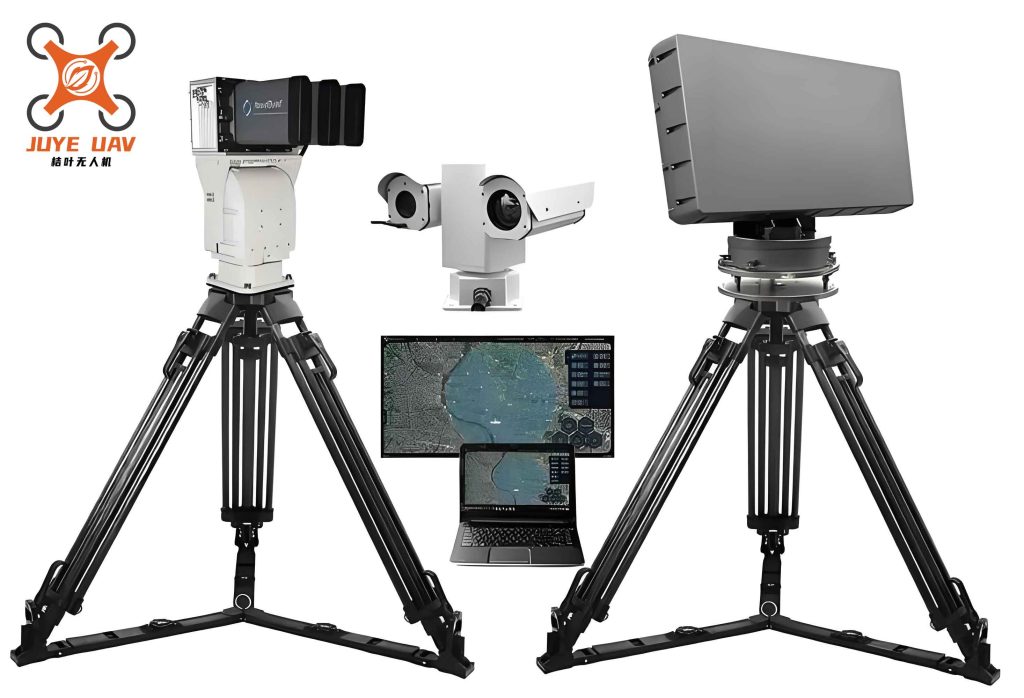
The first and most critical layer is a networked, multi-domain sensing grid designed to achieve early detection and continuous tracking of low-signature UAV swarms. No single sensor is sufficient. The solution lies in data fusion from a heterogeneous mix:
- Radar: Deploying a mix of long-range surveillance radars (for detecting carrier platforms), medium-range air defense radars, and specialized low-altitude, low-slow-small (LSS) target detection radars. Bistatic/multistatic radar configurations can enhance detection against stealthier profiles. The probability of detection $P_d$ can be modeled by the radar range equation, but must be adjusted for swarm-specific clutter and low RCS:
$$P_d = f\left(\frac{P_t G_t G_r \lambda^2 \sigma}{(4\pi)^3 R^4 k T_s B F L}\right)$$
where $\sigma$ (RCS) is extremely small for micro-UAVs. - Electronic Support Measures (ESM)/SIGINT: Passive detection systems that listen for the RF emissions from drone command links, telemetry, and intra-swarm communications. These systems provide long-range detection, classification, and direction-finding without emitting, making them covert and crucial for cueing other sensors. They are key for identifying the swarm’s communication patterns and network topology.
- Electro-Optical/Infrared (EO/IR): Provide positive visual identification and tracking, especially effective at shorter ranges and against RF-silent drones. Wide-area persistent surveillance systems and networked cameras can create an optical detection fence.
- Acoustic Sensors: Can detect and classify the unique acoustic signature of small UAV motors, useful for perimeter defense and final verification.
The fusion of data from these disparate sources in a Common Operational Picture (COP) is paramount. It allows for track initiation and maintenance even when individual sensors lose lock, significantly raising the probability of detecting the swarm early in its approach.
Layer 2: Multi-Domain Soft-Kill – “Disrupting the Swarm”
Once detected, the primary objective is to degrade or dismantle the swarm’s functionality through non-kinetic means. This layer targets the vulnerabilities outlined earlier and is the most cost-effective phase of anti-drone engagement.
| Target System | Countermeasure | Mechanism & Effect |
|---|---|---|
| Navigation (GNSS) | Jamming / Spoofing | Jamming overpowers the weak satellite signal, causing loss of position. Spoofing broadcasts false GNSS signals, feeding incorrect coordinates to the drone, leading it off-course or into a controlled crash. Effective against the vast majority of commercial and militarized commercial drones. |
| Command & Control Links | Communications Jamming | Disrupts the uplink (control) and downlink (telemetry) between the operator and the swarm. Can be barrage jamming (wideband) or more efficient spot/swept jamming targeting specific frequencies used by common drone protocols (e.g., Wi-Fi, 4G, proprietary). The jamming-to-signal ratio (J/S) required is often low due to weak drone transmitters: $$ \frac{J}{S} = \frac{P_j G_j R_s^2 B_s}{P_s G_s R_j^2 B_j} L $$ where $P_j, G_j$ are jammer power and gain, and $R_s$ is the range to the defended asset. |
| Intra-Swarm Comms | Protocol Exploitation & Cyber-Attack | The most sophisticated method. Involves protocol reverse-engineering to inject malicious packets into the swarm’s mesh network. This can include spreading disinformation (false target data), initiating a denial-of-service (DoS) attack, issuing “land” or “return-to-home” commands, or even attempting to seize partial control of the network. This represents a true “hack” of the swarm. |
| Onboard Sensors | Electro-Optical Countermeasures (EOCM) | Uses high-intensity directed light (dazzling lasers) to saturate or damage the drone’s camera or IR sensor, blinding it and preventing target acquisition or navigation via visual means. Can be combined with smoke or aerosol screens for area denial. |
Layer 3: Directed Energy Hard-Kill – “Destroying the Residual Threat”
Despite effective soft-kill measures, a fraction of the swarm may penetrate. For these leakers, directed energy weapons (DEWs) offer a precise, scalable, and low-cost-per-shot kinetic solution.
- High-Power Microwave (HPM) Systems: These are area-effect weapons ideal for counter-swarm missions. An HPM emitter generates a short, powerful burst of microwave energy directed at the approaching swarm. The intense electromagnetic field induces damaging voltages and currents in the drones’ electronic circuitry, causing permanent damage (frying chips, burning out connections). A single HPM shot can disable multiple drones within its beam cone simultaneously. The energy density $W$ at range $R$ is given by:
$$ W = \frac{P \cdot G}{4 \pi R^2} $$
where $P$ is peak power and $G$ is antenna gain. The goal is to exceed the drone’s susceptibility threshold. - High-Energy Laser (HEL) Systems: These provide point defense with pinpoint accuracy. A laser beam is focused on a single drone’s critical component (e.g., battery, motor, flight control surface). The concentrated thermal energy rapidly heats the material, causing melting, combustion, or structural failure. Modern systems feature fast beam steering and can engage multiple targets in rapid sequence. The engagement time $t$ to achieve a lethal effect depends on laser power $P_l$, spot size $A_s$, and material properties:
$$ t \propto \frac{A_s \cdot \Delta T}{P_l \cdot \alpha} $$
where $\Delta T$ is the required temperature rise and $\alpha$ is absorptivity.
The synergy is clear: soft-kill systems degrade and disorganize the bulk of the swarm at range, while DEWs provide the final, economical layer of physical destruction for any remaining threats that reach close proximity.
Operational Employment and Force Integration Strategy
The effective deployment of a CECM anti-drone force requires careful orchestration within the broader air defense architecture. The operational sequence can be visualized as follows:
- Early Warning & Cueing: Long-range radar and airborne early warning (AEW) assets detect the carrier platform (e.g., transport aircraft, launch vehicle). SIGINT assets monitor for pre-launch communication activity. This information establishes a threat axis and provides initial cueing.
- Detection & Tracking: As the swarm is launched and approaches, the integrated sensor network (LSS radars, ESM, EO/IR) acquires and tracks individual and cluster targets. Data fusion creates a composite track on the swarm’s location, speed, and density.
- Electronic Attack Initiation: Based on the tracked parameters and identified RF emissions, the electronic attack (EA) layer is activated. GNSS jammers and communicatons jammers are directed towards the swarm’s approach path. Concurrently, cyber-electronic warfare systems attempt to probe and exploit the swarm’s data network.
- Effect Assessment & Escalation: The COP is continuously monitored to assess the effect of soft-kill measures. Is the swarm dispersing? Are drones losing control or crashing? This assessment informs the decision to engage with hard-kill systems.
- Directed Energy Engagement: If the swarm continues its approach, HPM systems engage first to achieve wide-area neutralization. Finally, laser systems are employed against any surviving drones that breach the HPM engagement zone or pose an immediate threat to a high-value point asset.
The force must be organized into a resilient network where sensors, effectors, and command nodes are interconnected but can also operate in a degraded mode if parts of the network are attacked. Mobility and redundancy are key to surviving against an intelligent adversary who may target the anti-drone systems themselves.
| Defense Layer | Primary Systems | Engagement Range | Desired Effect |
|---|---|---|---|
| Integrated Sensing | Radar (various), ESM/SIGINT, EO/IR, Acoustic | Very Long to Medium | Early Detection, Tracking, Classification |
| Soft-Kill / Disruption | GNSS Jammers, Comms Jammers, Cyber EW, EOCM | Long to Medium | Navigation Loss, Comms Disruption, Network Corruption, Sensor Blindness |
| Hard-Kill / Neutralization | High-Power Microwave (HPM), High-Energy Laser (HEL) | Medium to Point-Blank | Physical Destruction of Electronics (HPM) or Structure (HEL) |
Conclusion and Future Challenges
The threat posed by intelligent, cooperative drone swarms is a defining challenge for 21st-century air defense. Relying solely on expensive kinetic interceptors is economically and tactically unsustainable. A paradigm shift towards integrated cyber-electronic countermeasures is essential. By constructing a multi-layered defense that leverages networked sensing, multi-domain electronic attack, and directed energy weapons, defenders can systematically exploit the inherent vulnerabilities of the swarm—its dependence on communication, navigation, and coordinated control. This CECM-centric approach achieves the crucial “left-of-launch” and “soft-kill” effects that break the swarm’s coherence long before it can unleash its collective power, providing a high-efficacy, high-efficiency solution for the anti-drone mission.
However, the technological race continues. Future swarms will incorporate improved anti-jamming GPS, frequency-hopping or cognitive radios, laser communications, and more robust, AI-driven autonomy that can adapt to lost communications or corrupted data. Therefore, anti-drone CECM strategies must also evolve. Research must focus on advanced techniques like machine learning for predictive swarm behavior analysis, more sophisticated protocol-level exploits for next-generation mesh networks, and the integration of non-RF sensing (e.g., quantum sensing) for detection. The ultimate goal is to maintain decision superiority within the electromagnetic and information spectrums, ensuring that our defensive OODA loop remains tighter and more effective than the offensive swarm’s. The era of drone swarms has begun, and the era of intelligent, integrated cyber-electronic counter-swarms must match its pace.