
As I walked through the bustling exhibition halls of the 15th Zhuhai Airshow in November 2024, one theme dominated my observations: the rapid evolution and systemic integration of ground-based anti-drone capabilities. The airshow showcased a dazzling array of anti-drone solutions tailored for various military echelons, reflecting a deep understanding of modern battlefield challenges. From small-unit jammers to brigade-level directed energy weapons, the Chinese defense industry presented a holistic approach to countering the growing threat of unmanned aerial systems. In this article, I will delve into the details of these anti-drone systems, employing tables and formulas to summarize their technical aspects and operational roles. The keyword “anti-drone” will be frequently emphasized to highlight the focus on counter-unmanned aerial vehicle (UAV) technologies.
The proliferation of drones and loitering munitions has fundamentally altered ground warfare, as evidenced by conflicts in Nagorno-Karabakh and Ukraine. These “low, slow, and small” (LSS) targets pose significant challenges for traditional detection and interception methods. The diffusion of drone technology, including modified commercial drones and DIY assemblies, has further complicated electronic countermeasures. Consequently, there is a burgeoning global demand for integrated anti-drone systems. At Zhuhai, this demand was met with a suite of solutions designed for different tactical levels, ensuring that ground forces can effectively neutralize UAV threats. My analysis will explore these systems from platoon to division level, underscoring how each contributes to a layered anti-drone defense network.
For platoon and company-level units, the anti-drone requirement centers on affordability, mobility, and ease of integration. These units lack dedicated platforms, so solutions often involve retrofitting existing vehicles with software-defined radios (SDRs) and passive sensors. A key exhibit was the vehicle-mounted detection-jamming-deception integrated system, which combines radio detection, navigation spoofing, and suppression jamming. It can detect, identify, and handle multiple drones simultaneously, operating 24/7 with flexible deployment—fixed or mobile—without vehicle modification. To quantify its effectiveness, consider the detection range formula for passive sensors: $$R_d = \sqrt{\frac{P_{drone} G_{drone} G_r \lambda^2}{(4\pi)^2 S_{min}}}$$ where \(R_d\) is the detection range, \(P_{drone}\) is the drone’s emitted power, \(G_{drone}\) is its antenna gain, \(G_r\) is the receiver gain, \(\lambda\) is the wavelength, and \(S_{min}\) is the minimum detectable signal. This system enhances \(S_{min}\) through advanced signal processing, enabling early warning against LSS targets. Another critical aspect is the jamming effectiveness, often modeled by the jamming-to-signal ratio: $$J/S = \frac{P_j G_j G_{r(drone)} \lambda^2 R_d^2}{P_{drone} G_{drone} G_{r(j)} \lambda^2 R_j^2}$$ where \(P_j\) is the jammer power, \(G_j\) is the jammer antenna gain, \(G_{r(drone)}\) is the drone receiver gain relative to the jammer, \(R_j\) is the distance from jammer to drone, and \(G_{r(j)}\) is the receiver gain for the drone’s signal. By optimizing these parameters, platoon-level systems can disrupt drone communications and navigation, providing a cost-effective anti-drone shield.
| Unit Level | Anti-Drone Systems | Key Capabilities | Integration Method |
|---|---|---|---|
| Platoon | Vehicle-mounted SDR jammers, passive sensors | Electronic attack, GNSS jamming, directional interference | Retrofitting existing vehicles, no modification needed |
| Company | Mast-mounted passive/EO sensors, lightweight vehicles | Detection and classification, distributed sensing | Add-on systems for enhanced situational awareness |
At the battalion level, anti-drone operations shift toward dedicated platforms and specialized units. I was particularly impressed by the VE37 integrated electronic reconnaissance and jamming vehicle and the VE38 terminal guidance comprehensive protection vehicle, both exhibited by China North Industries Group. The VE37 focuses on network-electronic situational awareness and electromagnetic interference, targeting drone communication links, tactical radios, and navigation terminals. Its antenna array includes a rising mast for communication jamming and radar countermeasures. The VE38, on the other hand, provides terminal interference and spoofing against incoming munitions, drones, and helicopters. It features radar detection, electro-optical tracking, laser suppression, and radio-controlled improvised explosive device (RCIED) protection. These systems exemplify how battalions can deploy standalone anti-drone vehicles rather than relying on armored vehicle defenses. The effectiveness of such systems can be expressed through the probability of kill (\(P_k\)) for electronic warfare: $$P_k = 1 – e^{-\alpha J/S}$$ where \(\alpha\) is a system-specific constant. For instance, the VE37’s jamming power ensures a high \(J/S\) ratio, increasing \(P_k\) against commercial drones. Additionally, the PLB625E gun-missile integrated system offers hard-kill capabilities with a 6-barrel 25mm cannon and short-range missiles. Its fire control computer automates tracking and engagement, with programmable ammunition for enhanced anti-drone performance. The kill probability for kinetic systems is often modeled as: $$P_k = \frac{1}{1 + \left(\frac{R}{R_0}\right)^n}$$ where \(R\) is the engagement range, \(R_0\) is the characteristic range, and \(n\) is a shaping parameter. For the PLB625E, \(R_0\) is optimized for LSS targets, ensuring high \(P_k\) within 4-5 kilometers.
| Battalion System | Primary Role | Targets | Key Technologies |
|---|---|---|---|
| VE37 Electronic Reconnaissance Vehicle | Network-electronic warfare, jamming | Drone comms, radars, GNSS | SDR, rising antenna mast, signal intelligence |
| VE38 Terminal Protection Vehicle | Terminal interference, spoofing | Precision-guided munitions, drones, RCIEDs | Radar, EO tracking, laser suppression, RF jamming |
| PLB625E Gun-Missile System | Hard-kill interception | UAVs, helicopters, low-altitude threats | 25mm programmable ammo, missiles, automated FCS |
Brigade and division-level units require more robust anti-drone capabilities, including area defense and integration with higher echelon networks. The HQ-17AE field air defense system stood out, with its optimized anti-drone design. It includes a radar-equipped vehicle and unmanned fire support variants, such as the HQ-17AE unmanned fire support vehicle, which packs 72 micro-missile launchers for swarm interception. This aligns with brigade needs for persistent defense against medium-altitude ISR drones. The system’s detection performance can be analyzed using the radar range equation: $$R_{max} = \sqrt[4]{\frac{P_t G_t G_r \sigma \lambda^2}{(4\pi)^3 k T_0 B F_n (S/N)_{min}}}$$ where \(P_t\) is transmit power, \(G_t\) and \(G_r\) are antenna gains, \(\sigma\) is target radar cross-section (RCS), \(k\) is Boltzmann’s constant, \(T_0\) is noise temperature, \(B\) is bandwidth, \(F_n\) is noise figure, and \((S/N)_{min}\) is minimum signal-to-noise ratio. For drones with small \(\sigma\) (e.g., 0.01 m²), the HQ-17AE enhances \(R_{max}\) through low-frequency bands and advanced processing. Another innovative exhibit was the mobile integrated anti-drone system, which uses passive detection akin to passive radar. It monitors perturbations in broadcast radio signals caused by drones, providing silent detection—a crucial advantage against anti-radiation threats. This system’s detection probability \(P_d\) follows: $$P_d = 1 – \exp\left(-\frac{SNR \cdot T_{int}}{Threshold}\right)$$ where \(SNR\) is signal-to-noise ratio, \(T_{int}\) is integration time, and \(Threshold\) is a system constant. By leveraging urban RF noise, it achieves high \(P_d\) without emitting signals, enhancing survivability in contested environments.
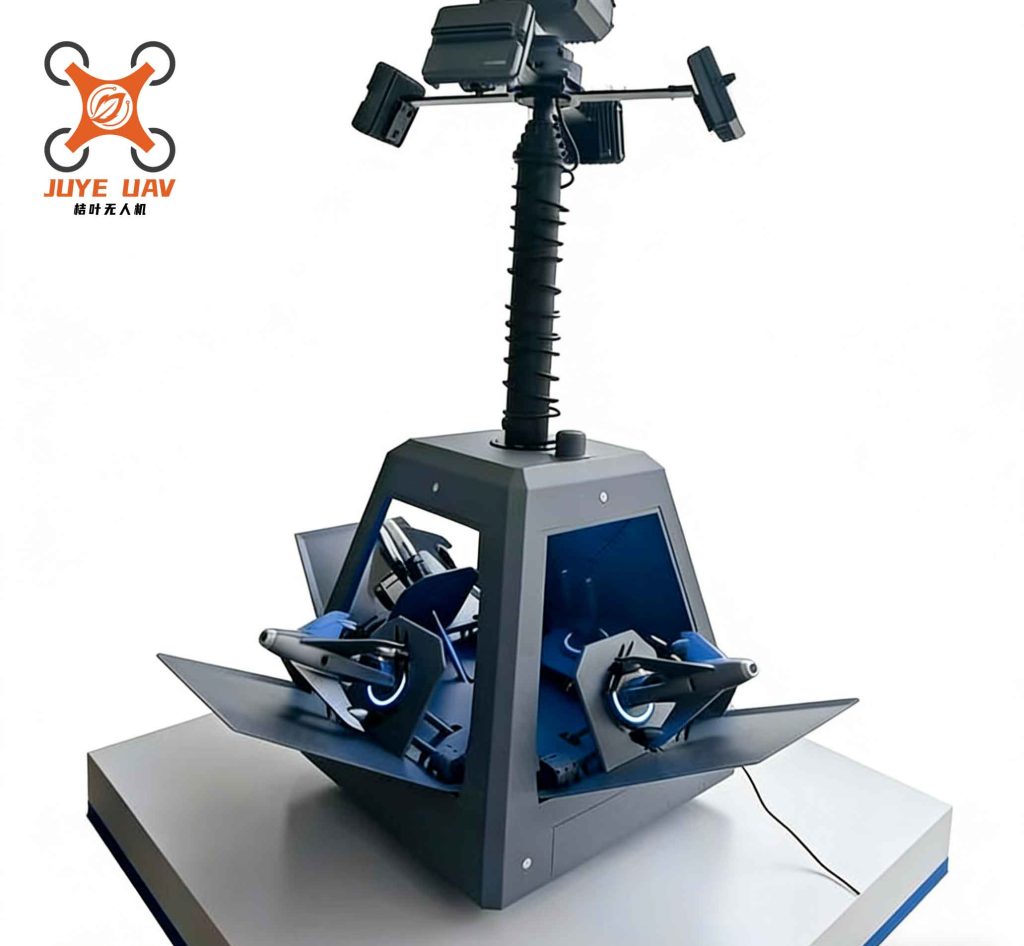
Directed energy weapons (DEWs) represent the cutting edge of anti-drone technology, prominently featured at the airshow. For division-level units, protecting key sites demands systems capable of countering swarms and saturated attacks. The LW-60 laser defense system, with a hard-kill range of over 6 km and electro-optical interference beyond 10 km, offers precise, cost-effective engagement. Its effectiveness is governed by the laser power density at the target: $$I = \frac{P_l G_l}{\pi \left(\frac{\theta R}{2}\right)^2} e^{-\beta R}$$ where \(I\) is intensity (W/m²), \(P_l\) is laser power, \(G_l\) is beam focusing gain, \(\theta\) is beam divergence, \(R\) is range, and \(\beta\) is atmospheric attenuation coefficient. For anti-drone applications, \(I\) must exceed a threshold \(I_{th}\) for thermal damage, typically around 1-10 kW/cm² for small drones. The LW-60’s design minimizes \(\theta\) and \(\beta\) effects, ensuring lethal \(I\) at tactical ranges. Similarly, high-power microwave (HPM) systems like the “Hurricane” 3000 and PLB-625E (Hurricane 2000) provide wide-area coverage. The HPM kill mechanism relies on field coupling into drone electronics, with the power density given by: $$P_d = \frac{P_{HPM} G_{HPM}}{4\pi R^2}$$ where \(P_{HPM}\) is peak power (e.g., 2000 MW for Hurricane 3000) and \(G_{HPM}\) is antenna gain. The induced voltage \(V_{ind}\) in a drone circuit can be approximated as: $$V_{ind} = k \cdot P_d \cdot A_{eff}$$ where \(k\) is a coupling constant and \(A_{eff}\) is effective antenna area. When \(V_{ind}\) surpasses component tolerances, permanent damage occurs. These DEWs excel against swarms due to their “deep magazine” and speed-of-light engagement, with cost-per-shot as low as $1—a stark contrast to expensive missiles. The anti-drone swarm efficacy can be modeled using Lanchester’s laws for aimed fire: $$\frac{dD}{dt} = -\gamma A \cdot D$$ where \(D\) is drone swarm density, \(A\) is number of anti-drone systems, and \(\gamma\) is engagement rate. For DEWs, \(\gamma\) is high due to rapid retargeting, enabling swift swarm neutralization.
| Directed Energy System | Type | Power/Range | Anti-Drone Role | Advantages |
|---|---|---|---|---|
| LW-60 Laser Defense | High-energy laser | >6 km hard-kill, >10 km soft-kill | Point defense, precision strike | Low cost per shot, stealthy engagement |
| Hurricane 3000 HPM | High-power microwave | 2000 MW peak, area coverage | Swarm suppression, area denial | Multiple target engagement, all-weather use |
| Hurricane 2000 HPM | High-power microwave | Lower power, mobile platform | Mobile escort, forward defense | Better mobility, integration with sensors |
The evolution of anti-drone swarm tactics is critical, as drones become more autonomous and collaborative. Swarms exhibit emergent behavior, where collective capability surpasses the sum of individual units. To counter this, anti-drone systems must integrate detection, tracking, and multi-effect engagement. The Zhuhai exhibits covered all technical paths: detection (e.g., passive RF sensors), hard-kill (e.g., missiles, lasers), interference (e.g., jammers), and deception (e.g., navigation spoofing). A generalized model for swarm interception success probability \(P_s\) is: $$P_s = P_{det} \cdot P_{track} \cdot P_{eng} \cdot P_{kill}$$ where \(P_{det}\) is detection probability, \(P_{track}\) is tracking probability, \(P_{eng}\) is engagement probability, and \(P_{kill}\) is kill probability per engagement. For layered anti-drone systems, these probabilities are enhanced through sensor fusion and networked command-and-control. For instance, combining radar, EO, and passive RF increases \(P_{det}\) to near 1 for LSS targets. Moreover, the cost-effectiveness of anti-drone measures can be evaluated using the cost exchange ratio: $$CER = \frac{C_{anti-drone}}{C_{drone} \cdot N_{kill}}$$ where \(C_{anti-drone}\) is system cost per engagement, \(C_{drone}\) is drone cost, and \(N_{kill}\) is number of drones killed per engagement. DEWs achieve favorable CERs (e.g., <0.001 for lasers vs. commercial drones), making them sustainable for prolonged conflicts.
Internationally, anti-drone technology is advancing rapidly. The U.S., for example, has tested systems like THOR and “Leonidas” HPM weapons, focusing on swarm defense. However, the Zhuhai displays demonstrate that China’s defense industry is competitive, offering holistic solutions across the spectrum. A comparison of key parameters highlights this:
| Parameter | Zhuhai Systems (e.g., HQ-17AE, LW-60) | International Counterparts (e.g., U.S. HEL, THOR) | Implications for Anti-Drone Ops |
|---|---|---|---|
| Detection Range | Up to 30 km for radar, passive RF for stealth | 20-50 km for integrated sensors | Early warning crucial for layered defense |
| Engagement Range | 6-10 km for lasers, 1-5 km for HPM | 5-15 km for lasers, 1-3 km for HPM | Balancing power and mobility |
| Swarm Capacity | 72 micro-missiles per vehicle, wide-area HPM | 30-50 drones per engagement for DEWs | High capacity needed for saturation attacks |
| System Mobility | Wheeled/Tracked vehicles, rapid deployment | Similar, with emphasis on Stryker integration | Essential for dynamic frontline support |
In conclusion, the 15th Zhuhai Airshow presented a comprehensive and mature anti-drone ecosystem, tailored for modern asymmetric threats. From platoon to division level, the systems on display addressed detection, identification, and interception challenges with innovative technologies. The integration of directed energy weapons, especially high-power microwaves and lasers, marks a paradigm shift in cost-effective swarm defense. As I reflect on the exhibits, it is clear that the future of ground-based anti-drone operations will rely on networked, multi-layered approaches—a vision fully embodied at Zhuhai. The emphasis on “anti-drone” capabilities across all echelons underscores a strategic commitment to dominating the electromagnetic and physical battlespaces. With continued advancements, these systems will not only enhance national defense but also strengthen the global competitiveness of Chinese defense exports in an era where drone threats are ubiquitous.
To further illustrate the technical depth, consider the optimization of anti-drone sensor networks. The effective coverage area \(A_{cov}\) for a network of \(N\) sensors is given by: $$A_{cov} = N \cdot \pi R_d^2 \cdot \eta_{overlap}$$ where \(\eta_{overlap}\) is the overlap efficiency factor (0 < \(\eta_{overlap}\) ≤ 1). For battalion-level systems like the VE37, networking multiple vehicles increases \(A_{cov}\), ensuring seamless anti-drone surveillance. Additionally, the reliability of an anti-drone system over time \(t\) can be modeled with a Weibull distribution: $$R(t) = e^{-(t/\alpha)^\beta}$$ where \(\alpha\) is scale parameter (related to mean time between failures) and \(\beta\) is shape parameter. Ruggedized designs for field use, as seen in PLB625E, yield high \(\beta\) (>1), indicating increasing reliability with use. These mathematical insights reinforce the sophistication behind the showcased anti-drone solutions.
Finally, the human factor in anti-drone operations cannot be overlooked. Training for operators involves simulating drone threats using software-defined environments. The skill retention rate \(S_r\) after training decays exponentially: $$S_r = S_0 \cdot e^{-\lambda t}$$ where \(S_0\) is initial proficiency, \(\lambda\) is decay constant, and \(t\) is time since training. Regular drills with systems like the mobile integrated anti-drone system help reduce \(\lambda\), maintaining high readiness. This holistic approach—combining hardware, software, and human expertise—ensures that anti-drone capabilities remain robust against evolving threats. As drones continue to proliferate, the lessons from Zhuhai will undoubtedly shape global defense strategies, making “anti-drone” a cornerstone of modern military planning.