
The increasing frequency and severity of forest fires globally present a formidable challenge to ecological conservation, public safety, and economic stability. Traditional methods of fire patrol and monitoring, reliant on ground personnel, watchtowers, and limited satellite imagery, are often hampered by inefficiency, high costs, and significant safety risks, especially in rugged, inaccessible terrain. In this context, the emergence and rapid technological advancement of Unmanned Aerial Vehicles (UAVs) have opened a transformative pathway for forest fire management. This article delves into the integrated application of fire UAV systems, exploring their operational frameworks, key technological components, and multifaceted roles in pre-fire, active-fire, and post-fire phases. We will synthesize these aspects using technical models, comparative tables, and practical insights to underscore the paradigm shift enabled by aerial intelligence.
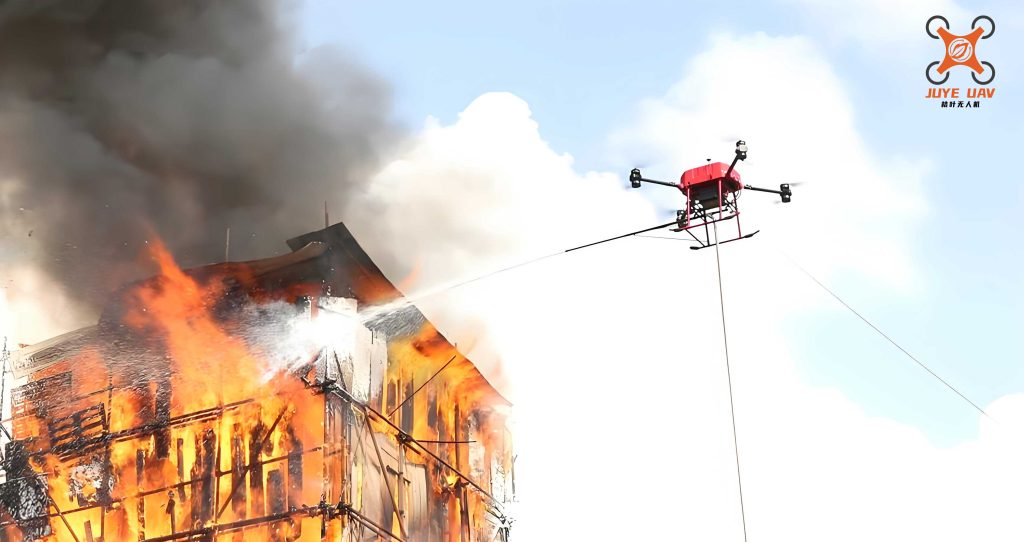
The core of a modern fire UAV solution lies in its integrated system architecture, which moves beyond simple remote-controlled flight. A robust system typically comprises the aerial platform, a suite of sensors, a ground control station (GCS), and a data communication and processing backbone. Multi-rotor UAVs are favored for their vertical take-off and landing (VTOL) capability, hovering stability, and maneuverability in complex environments, making them ideal for detailed inspection and hot-spot identification. For covering vast forest areas, fixed-wing or hybrid VTOL fixed-wing fire UAV platforms offer greater endurance and speed.
The sensor payload is the critical differentiator. A dual- or multi-sensor gimbal often combines:
1. A high-resolution visible-light camera for general surveillance, damage assessment, and creating orthomosaic maps.
2. A thermal infrared (TIR) camera, which is indispensable for detecting heat anomalies through smoke, canopy, and even at night. It identifies active flames and latent hotspots invisible to the naked eye.
3. Additional sensors like multispectral cameras can assess vegetation health and moisture stress, serving as pre-ignition risk indicators.
The data link ensures real-time transmission of video and telemetry. For beyond-visual-line-of-sight (BVLOS) operations, which are crucial for large-scale forest patrol, employing cellular networks (4G/5G) or satellite communication links is essential. The processed data integrates into Geographic Information Systems (GIS), providing spatial context for fire behavior modeling and resource deployment. This entire ecosystem enables what we term the “Air-Ground Integrated Protection Network.”
The operational workflow of a fire UAV system can be modeled in distinct phases, each with specific objectives and technological requirements. The following table summarizes this operational continuum:
| Phase | Primary Objective | Key UAV Functions & Technologies | Data Output & Purpose |
|---|---|---|---|
| Pre-Fire: Prevention & Patrol | Risk assessment, early detection of ignitions. | Automated grid patrols using waypoint navigation. TIR scanning for abnormal heat. Multispectral analysis for fuel moisture mapping. | Heat anomaly alerts. Fuel risk maps. High-resolution baseline imagery of the area. |
| Active-Fire: Response & Reconnaissance | Real-time situational awareness, fire perimeter mapping, aiding suppression. | Live TIR and RGB video feed. On-the-fly photogrammetry for 3D fire scene modeling. Meteorological sensor payloads (wind, temp). | Real-time fire front location and direction. Perimeter and hot-spot maps. Wind data for spread prediction. Evacuation route identification. |
| Post-Fire: Assessment & Mop-up | Confirming fire extinction, damage evaluation, monitoring for re-ignition. | Detailed TIR scans of the burn scar. High-resolution mapping for damage quantification. | Residual hotspot maps for mop-up crews. Detailed burn severity and area assessment reports. |
The mathematical foundation for early warning often involves analyzing thermal data. A simple model for identifying a potential fire pixel compares its radiance to the background. Let \( T_{pixel} \) be the brightness temperature of a pixel detected by the fire UAV‘s thermal sensor, and \( T_{background} \) be the average temperature of the surrounding non-fire pixels. An alarm can be triggered based on a threshold difference \( \Delta T_{threshold} \):
$$ \Delta T = T_{pixel} – T_{background} $$
$$ \text{Fire Alert Condition: } \Delta T > \Delta T_{threshold} $$
More advanced algorithms may use contextual analysis, considering factors like the pixel’s spatial relationship to others and temporal persistence of the heat signature to reduce false alarms from sun-heated rocks or other non-fire hot objects.
For fire spread prediction, which is critical during the active-fire phase, simplified models can be integrated into the fire UAV data pipeline. Rothermel’s surface fire spread model, while complex, illustrates the dependency on environmental factors a fire UAV can measure. The rate of spread (ROS) is influenced by fuel, slope, and wind. A fire UAV equipped with an anemometer can provide real-time wind velocity \( U \), significantly updating spread predictions. The relationship often follows a form such as:
$$ ROS \propto f(\text{fuel}) \cdot e^{k \cdot \text{slope}} \cdot U^{\beta} $$
where \( k \) and \( \beta \) are constants, and \( f(\text{fuel}) \) represents fuel model coefficients. Real-time data from the fire UAV allows for dynamic, spatially explicit forecasting of fire progression.
The advantages of deploying a fire UAV system over traditional methods are quantifiable across several dimensions. The following table provides a comparative analysis:
| Evaluation Dimension | Traditional Ground Patrol / Watchtowers | Satellite Monitoring | Integrated Fire UAV System |
|---|---|---|---|
| Detection Speed & Frequency | Slow (hours to days), limited by mobility and shift schedules. | Slow (revisit times can be 6-24 hours), often missed small ignitions. | Very Fast (minutes from launch). Can perform scheduled daily or even multiple patrols per day. |
| Spatial Resolution & Coverage | Very high but extremely localized. Large blind spots. | Low to moderate (e.g., 10m-1km pixels). Covers vast areas but misses detail. | High (cm-level). Can efficiently cover large, targeted areas and focus on high-risk zones. |
| Operational Cost (Per Survey) | Very High (personnel, vehicles, infrastructure). | Low (data cost only), but limited control. | Moderate (initial investment) to Low (recurring sortie cost). High return on investment. |
| Personnel Safety | High Risk. Personnel exposed to terrain, wildlife, and potential fire. | No risk. | Very Low Risk. Operators are remote from the hazard zone. |
| Data Richness & Functionality | Subjective observations, limited geospatial data. | Primarily spectral data for hotspot detection. | Rich: Real-time HD/TIR video, precise GIS maps, 3D models, micro-meteorological data. |
| Night & Low-Visibility Operation | Severely limited or impossible. | Limited to specific infrared satellites. | Excellent. TIR sensors are equally effective day and night, penetrating smoke. |
Beyond patrol and detection, the fire UAV acts as a multi-role platform during a crisis. It can serve as an airborne communication relay, deploying a miniature transceiver to re-establish connectivity for ground crews in terrain-blocked or infrastructure-damaged areas. This function is modeled by extending the communication range. If the line-of-sight distance between two ground units is obstructed, a fire UAV at altitude \( h \) can act as a relay. The radio horizon \( d \) from the UAV extends the effective range significantly:
$$ d \approx \sqrt{2k \cdot h} $$
where \( k \) is a factor accounting for atmospheric refraction. This simple model highlights how a strategically positioned fire UAV can create a vital communication bubble over the incident area.
Furthermore, payload versatility allows a fire UAV to directly assist in suppression and evacuation. While large-scale water or retardant dropping is typically the domain of manned aircraft, fire UAV systems can execute precision tasks such as:
– Delivering emergency supplies (e.g., respirators, radios) to trapped personnel.
– Using loudspeakers to broadcast evacuation instructions or commander’s orders directly to scattered ground teams.
– Deploying incendiary capsules for backfiring operations in a controlled manner, a technique used in expert firefighting.
The operational effectiveness is best validated through practical application. In a controlled exercise simulating a forest fire scenario, an integrated fire UAV system demonstrated its end-to-end capability. The fire UAV, equipped with a TIR camera, was launched from a command post several kilometers away. It autonomously navigated to the target area, where visual obscuration was simulated with smoke generators. Within minutes, the fire UAV‘s live feed identified the exact coordinates and perimeter of simulated “hotspots” (using heated panels), data which was invisible to ground observers due to smoke. The command center vectored resources precisely to these locations, drastically reducing simulated “response and containment time.” Post-“containment,” the same fire UAV performed a meticulous mop-up scan, identifying residual heat signatures to prevent “re-ignition,” showcasing a complete mission lifecycle from detection to verification.
In conclusion, the integration of fire UAV systems into forest management protocols represents a significant leap forward in proactive and responsive wildfire defense. By synthesizing advanced aeronautics, sensor technology, and real-time data analytics, these systems deliver unprecedented situational awareness. They transform the paradigm from reactive, ground-bound, and high-risk operations to one that is proactive, aerial, data-driven, and safe. The models and comparisons presented illustrate not just incremental improvement, but a foundational shift in capability. The future of forest firefighting lies in the intelligent coordination of these aerial assets within a broader IoT and AI-enabled framework, creating a resilient, automated shield for our vital forest ecosystems.