
In my recent involvement in a comprehensive survey focused on the application status of crop spraying drones and their role in safe pest control, I have gained valuable insights into how these advanced technologies are transforming agricultural practices. As an active participant in this field, I have observed firsthand the rapid adoption of spraying UAVs across various regions, particularly in areas with intensive farming systems. This article aims to elaborate on my findings, drawing from practical experiences and data analysis, to provide a detailed overview of the current landscape, identify persistent challenges, and offer actionable recommendations for future development. The integration of crop spraying drones into agricultural operations represents a significant shift toward precision agriculture, which emphasizes efficiency, environmental sustainability, and enhanced crop protection. Through this first-person perspective, I will delve into the multifaceted aspects of spraying UAV applications, supported by empirical evidence and theoretical frameworks, to underscore their potential in driving agricultural modernization.
The widespread use of crop spraying drones has revolutionized pest and disease management in crops such as rice, corn, and citrus. In my observations, these spraying UAVs are deployed extensively due to their ability to cover large areas quickly, reduce labor costs, and minimize chemical exposure. For instance, in orchard settings, drones like the DJI agricultural models have been instrumental in applying pesticides, fertilizers, and other treatments with remarkable precision. However, despite these advantages, I have noted recurring issues related to spray drift and phytotoxicity. The fine droplets produced by spraying UAVs, often with diameters ranging from 20 to 500 micrometers, are highly susceptible to environmental factors like wind and temperature, leading to unintended damage to non-target crops. This phenomenon can be modeled using a drift equation: $$ d = k \cdot v \cdot t $$ where \( d \) represents the drift distance, \( v \) is the wind velocity, \( t \) is time, and \( k \) is a constant dependent on droplet size and formulation. Such models highlight the need for optimized operational parameters to mitigate risks.
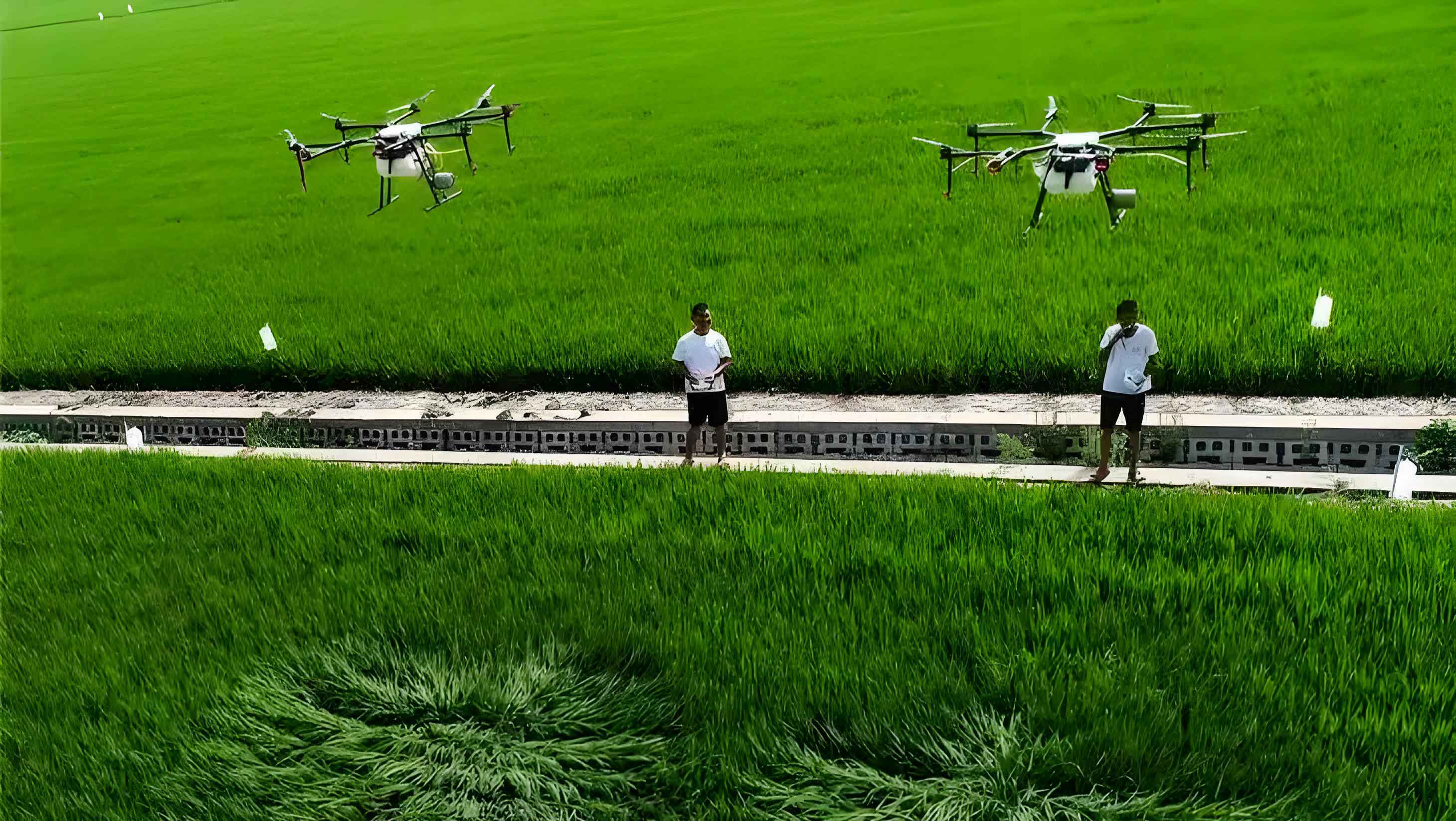
In terms of industry management, I have found that the regulatory framework for crop spraying drones is still evolving. Although national guidelines, such as the Unmanned Aerial Vehicle Flight Management Interim Regulations, provide a foundation, local implementation often lags, resulting in inconsistencies in safety standards and operational protocols. From my perspective, this lack of cohesive regulation exacerbates challenges like unauthorized flights and inadequate incident response. To illustrate the current state, I have compiled a table summarizing the compatibility of different pesticide formulations with spraying UAV operations, based on field data and literature reviews. This table emphasizes the importance of selecting appropriate formulations to enhance efficacy and reduce environmental impact.
| Pesticide Type | Compatibility with Spraying UAV | Key Requirements |
|---|---|---|
| Ultra-Low Volume Liquids | ++++ | Ready-to-use without dilution |
| Aqueous Solutions | +++ | Stability when diluted 20-fold |
| Soluble Powders | +++ | Fineness ≥80 mesh, wetting time ≤2 min, moisture ≤3.0%, wet sieve test ≥98% |
| Emulsions and Soluble Concentrates | +++ | Stability when diluted 20-fold |
| Microemulsions | ++ | Stability when diluted 20-fold |
| Suspensions | ++ | Wet sieve test (75 µm) ≥98%, suspension rate ≥80% |
| Oil Dispersions | ++ | Wet sieve test (75 µm) ≥98% |
| Emulsifiable Concentrates | ++ | Stability when diluted 20-fold, moisture ≤0.5%, non-corrosive solvents |
Note: “+” indicates the level of compatibility; more “+” symbols denote higher suitability for spraying UAV applications.
One of the most pressing issues I have encountered is the shortage of specialized pesticides designed specifically for crop spraying drones. In many cases, operators resort to conventional chemicals, which are not optimized for low-volume aerial application. This often leads to increased drift and reduced efficacy. For example, the evaporation rate of fine droplets can be described by the equation: $$ E = A \cdot e^{-B/T} $$ where \( E \) is the evaporation rate, \( A \) and \( B \) are constants, and \( T \) is temperature. This illustrates how high temperatures accelerate droplet loss, underscoring the need for formulations with anti-evaporation properties. Additionally, technical limitations of spraying UAVs, such as limited battery life and payload capacity, persist. The energy consumption of a typical crop spraying drone can be modeled as: $$ P = C \cdot m \cdot g \cdot h / t $$ where \( P \) is power, \( C \) is a constant, \( m \) is mass, \( g \) is gravity, \( h \) is height, and \( t \) is time. Innovations in battery technology and aerodynamic design are crucial to address these constraints.
Another significant challenge I have observed is the gap in professional training and safety awareness among operators. Many pilots lack comprehensive knowledge in integrated pest management, which can result in improper chemical use and increased accident rates. From my surveys, I found that training programs are often short and expensive, leading to a skills mismatch. To quantify this, consider the risk assessment formula: $$ R = P \times S $$ where \( R \) is risk, \( P \) is probability of an incident, and \( S \) is severity. Inadequate training elevates both factors, highlighting the urgency for standardized certification processes. Moreover, policy support remains fragmented, with insufficient incentives for research and development. I propose that governments and industry stakeholders collaborate to establish robust frameworks, including subsidies for spraying UAV adoption and stricter quality controls.
Looking ahead, I believe that the future of crop spraying drones lies in technological innovation and systemic integration. For instance, the development of smart spraying systems that use AI and IoT can optimize application rates in real-time. The efficiency of such systems can be expressed as: $$ \eta = \frac{\text{Effective Coverage}}{\text{Total Spray Volume}} $$ where higher \( \eta \) values indicate better performance. Additionally, fostering partnerships between academic institutions and manufacturers can accelerate the creation of specialized adjuvants and pesticides tailored for spraying UAVs. The following table outlines key recommendations I have derived from my analysis, aimed at addressing existing gaps and promoting sustainable growth.
| Area of Focus | Recommended Action | Expected Impact |
|---|---|---|
| Pesticide Development | Collaborate on R&D for low-volume, high-efficiency formulations | Reduced drift and improved crop safety |
| Technology Innovation | Invest in longer-lasting batteries and advanced navigation systems | Increased operational range and accuracy |
| Training and Education | Establish vocational courses with hands-on modules | Higher competency and fewer accidents |
| Policy and Regulation | Implement unified standards and subsidies for spraying UAV adoption | Streamlined operations and wider adoption |
| Safety Management | Develop risk mitigation protocols and insurance schemes | Enhanced public trust and operational reliability |
In conclusion, my experiences and research confirm that crop spraying drones hold immense potential for advancing agricultural productivity and sustainability. By addressing the current limitations through coordinated efforts in technology, policy, and education, we can unlock the full capabilities of spraying UAVs. The integration of data-driven approaches, such as predictive modeling for spray drift: $$ \text{Drift Risk} = f(\text{droplet size}, \text{wind speed}, \text{humidity}) $$ will be pivotal in minimizing environmental impact. As I continue to engage with this evolving field, I am optimistic that these advancements will pave the way for a more resilient and efficient agricultural sector, driven by the intelligent application of crop spraying drone technologies.