
In recent years, the integration of advanced technology in agriculture has revolutionized pest and disease management, particularly in perennial crops like mangoes. As a researcher deeply involved in precision agriculture, I have witnessed firsthand the challenges faced by mango growers, including excessive pesticide use, uneven application, and low operational efficiency. These issues not only impact crop yields but also pose environmental and health risks. To address these concerns, our team embarked on a comparative study to evaluate the droplet deposition performance of two modern sprayers: a six-rotor agricultural drone and a caterpillar mist sprayer. This article presents our findings from a field experiment conducted in a mango orchard, focusing on droplet coverage, density, deposition uniformity, and penetration within the canopy. Our goal is to contribute to the development of smart mango orchards by optimizing spray technologies.
The global mango industry is vital for tropical and subtropical regions, with China being a major producer. However, mango cultivation is plagued by frequent pest and disease outbreaks, such as anthracnose, bacterial angular leaf spot, powdery mildew, thrips, and weevils, due to the humid climatic conditions. Traditional spraying methods, like backpack sprayers and high-pressure gun systems, often result in poor pesticide utilization rates, non-uniform coverage, and high labor costs. These methods rely heavily on manual operation, leading to inconsistent application and increased chemical runoff. In response, agricultural drones have emerged as a promising solution, offering advantages like terrain adaptability, high operational speed, and reduced human exposure. Yet, agricultural drones face limitations, including poor droplet uniformity, inadequate deposition on leaf undersides, and significant drift, which can cause phytotoxicity and environmental contamination. Conversely, ground-based mist sprayers, widely used in standardized orchards in Western countries, provide better drift control and improved distribution uniformity but struggle with accessibility in complex terrains and limited penetration into dense canopies. Our study aims to bridge this gap by systematically comparing these two technologies in a real-world mango orchard setting.
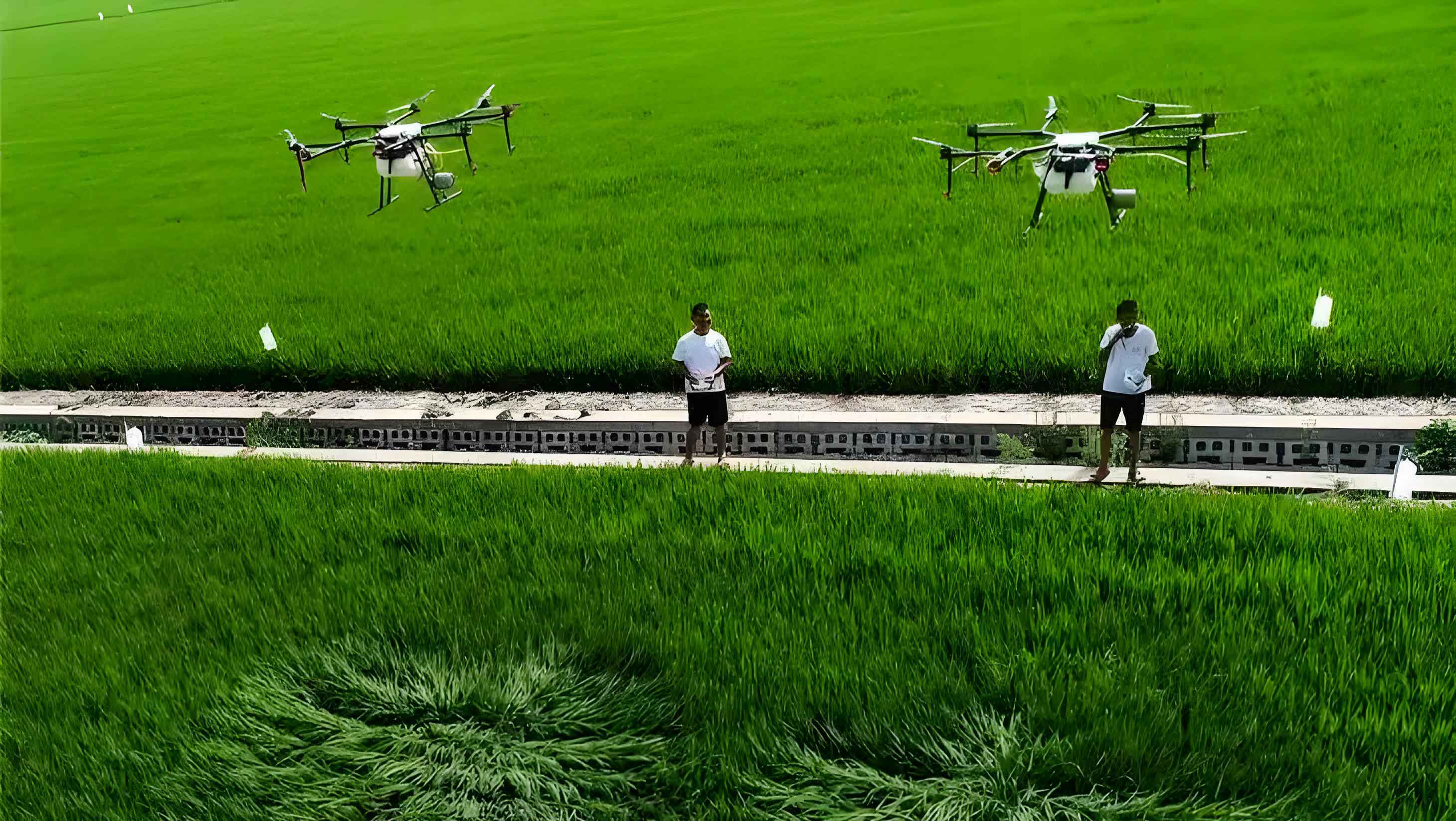
To conduct this experiment, we selected a flat, open mango orchard in a tropical region, with trees aged 7-8 years, variety ‘Guifei’, spaced at 4.5 m between plants and 5 m between rows. The average tree height was 2.8 m, with a canopy diameter of 3.2 m, characterized by a伞-shaped distribution where leaves are concentrated externally, leaving the trunk center sparse. We used two sprayers: a DJI T30 six-rotor agricultural drone and a 3WDZ-200D remote-controlled caterpillar mist sprayer. The agricultural drone was equipped with 16 TEEJET 11002VS nozzles, a maximum payload of 30 L, and an operating speed of up to 7 m/s, while the ground mist sprayer had 6 nozzles (4 XR45/01S and 2 XR95/02S), a 200 L tank, and a maximum speed of 1.25 m/s. Key parameters for both sprayers are summarized in Table 1. We employed tartrazine as a tracer, dissolved in water, to facilitate droplet analysis. The spray solutions were prepared at concentrations of 4.20 g/L for the agricultural drone and 0.40 g/L for the mist sprayer, based on their respective application rates of 0.4 L/ha and 2.27 L/ha. The agricultural drone operated in an autonomous waypoint mode, flying at 2.5 m/s and 3 m above ground along the tree rows, whereas the ground mist sprayer was remotely controlled to spray between rows at 1.25 m/s.
| Sprayer Type | Dimensions (mm) | Max Tank Capacity (L) | Nozzle Type & Quantity | Max Flow Rate (L/min) | Max Operating Speed (m/s) |
|---|---|---|---|---|---|
| Agricultural Drone | 2858 × 2685 × 790 | 30 | TEEJET 11002VS × 16 | 8.5 | 7 |
| Ground Mist Sprayer | 1935 × 1140 × 690 | 200 | XR45/01S × 4, XR95/02S × 2 | 16 | 1.25 |
We divided the mango canopy into three vertical layers: upper, middle, and lower. Each layer was further segmented into outer and inner positions, except for the upper layer and canopy center due to the tree’s growth habit. Samples were collected using high-definition water-sensitive papers and filter papers (7 cm diameter) placed on both adaxial (upper) and abaxial (lower) leaf surfaces. The sampling points were labeled as O1 (lower outer), I1 (lower inner), O2 (middle outer), I2 (middle inner), and O3 (upper outer). Additionally, four filter papers were positioned on the ground beneath the lower outer samples to quantify ground loss. Each treatment was replicated twice. After spraying, samples were collected within 5 minutes, stored in sealed bags with desiccants, and analyzed in the laboratory. Droplet coverage and density were assessed using DepositScan software on scanned images of the water-sensitive papers, while deposition volume was determined by eluting the tracer from filter papers and measuring absorbance at 450 nm with a microplate reader.
Data analysis involved calculating key metrics to evaluate deposition performance. The droplet coverage rate (C, %) and droplet density (N, droplets/cm²) were derived from image analysis. Deposition volume per unit area (β, μL/cm²) was computed using the formula: $$ \beta = \frac{C \times V}{a \times A} $$ where C is the tracer concentration (μg/mL), V is the elution volume (mL), a is the filter paper area (cm²), and A is the mother solution concentration (g/L). Uniformity of deposition was expressed as the coefficient of variation (CV, %), with lower values indicating better distribution. We also defined penetration coefficients: horizontal penetration coefficient (K_H, %) as $$ K_H = \frac{\beta_I}{\beta_O} \times 100\% $$ where β_I and β_O are deposition volumes in inner and outer canopy positions, respectively; and vertical penetration coefficient (K_V, %) as $$ K_V = \frac{\beta_a}{\beta_{b\&c}} \times 100\% $$ where β_a represents deposition in a specific vertical layer (upper for mist sprayer, lower for agricultural drone) and β_{b&c} is the average deposition in the other layers. The vertical distribution percentage (R_V, %) was calculated to assess the proportion of deposition in each canopy layer relative to the total.
Our results revealed significant differences in droplet deposition between the agricultural drone and ground mist sprayer. In terms of droplet coverage on leaf surfaces, the agricultural drone achieved significantly higher coverage on the upper canopy adaxial surfaces compared to the mist sprayer, with no significant differences in the middle and lower canopy. The average coverage rates for both adaxial and abaxial surfaces in the agricultural drone treatment were 1.5 to 2 times higher than those of the mist sprayer, indicating that the agricultural drone provided better protection on leaf undersides. However, the mist sprayer produced significantly higher droplet density on adaxial surfaces, with an overall average of 61.1 droplets/cm², meeting the recommended threshold of 20 droplets/cm² for pest control, whereas the agricultural drone had an average density of only 9.2 droplets/cm², failing to meet this requirement. This suggests that while the agricultural drone excels in coverage, its larger droplet size (DV50 of 631 μm after spreading on cards) limits density, whereas the mist sprayer’s finer droplets (DV50 of 171 μm) enhance density but may reduce coverage uniformity. The deposition volumes further highlighted these disparities, as shown in Table 2.
| Parameter | Agricultural Drone | Ground Mist Sprayer |
|---|---|---|
| Average Adaxial Coverage, C_upp (%) | 7.03 ± 1.26 | 4.96 ± 0.83 |
| Average Abaxial Coverage, C_und (%) | 2.72 ± 10.3 | 1.01 ± 0.34 |
| Overall Coverage, C̄ (%) | 4.88 | 2.99 |
| Average Adaxial Density, N_upp (droplets/cm²) | 12.25 ± 1.8 | 101.5 ± 11.1 |
| Average Abaxial Density, N_und (droplets/cm²) | 6.09 ± 1.3 | 20.7 ± 4.8 |
| Overall Density, N̄ (droplets/cm²) | 9.2 | 61.1 |
| Average Adaxial Deposition, β_upp (μL/cm²) | 0.20 ± 0.04 | 0.88 ± 0.13 |
| Average Abaxial Deposition, β_und (μL/cm²) | 0.13 ± 0.03 | 0.45 ± 0.10 |
| Overall Deposition, β̄ (μL/cm²) | 0.16 | 0.67 |
| Droplet Size, DV50 (μm) | 631.4 ± 63.1 | 170.6 ± 8.6 |
| Coverage Uniformity, CV (%) | 148.5 | 165.9 |
| Abaxial Coverage Ratio, R_c (%) | 38.7 | 20.4 |
| Inner Canopy Deposition Ratio, R_d (%) | 18.0 | 37.1 |
| Horizontal Penetration, K_H (%) | 25.5 | 48.6 |
| Vertical Penetration, K_V (%) | 33.4 | 27.8 |
| Ground Loss Ratio, R_Groundloss (%) | 21.2 | 21.8 |
The deposition distribution within the canopy varied notably. The ground mist sprayer concentrated 61.1% of its deposition in the middle and lower canopy outer regions, with only 17% in the upper canopy, indicating limited upward penetration. In contrast, the agricultural drone deposited 43.0% in the upper canopy, leveraging its downwash airflow to spread droplets over the top layers. The horizontal penetration coefficient was higher for the mist sprayer (48.6%) than for the agricultural drone (25.5%), meaning the mist sprayer better reached inner canopy areas. This is attributed to its finer droplets and pressure-assisted spray, which facilitated movement through the dense foliage. However, both sprayers showed poor deposition uniformity, with CV values exceeding 100%, due to the mango canopy’s complex structure—high leaf area index, long and hard leaves with varied inclination angles, and mutual shading among leaves. These factors caused uneven droplet accumulation, with outer leaves receiving more spray than inner ones. The ground loss ratios were similar at around 21%, but the agricultural drone is more susceptible to environmental drift, which could exacerbate chemical wastage and environmental impact.
From a practical standpoint, our findings suggest distinct application scenarios for each sprayer. The ground mist sprayer is well-suited for controlling pests and diseases in the middle and lower canopy, such as soil-borne pathogens or insects hiding in inner foliage. Its high droplet density makes it effective for applying contact insecticides or protective fungicides like Bordeaux mixture, where thorough coverage is critical. However, its inability to deposit adequately in the upper canopy limits its use for pests like thrips or anthracnose that infest flowers and young shoots at the top. The agricultural drone, on the other hand, excels in upper canopy coverage, making it ideal for targeting external pests and diseases. Its ability to operate in difficult terrains and at high speeds enhances efficiency, but its low droplet density and poor inner canopy penetration require optimization. For instance, using finer nozzles or centrifugal atomizers on the agricultural drone could improve droplet size and distribution. Moreover, the agricultural drone’s advantage in abaxial coverage is valuable for managing pests that reside on leaf undersides, though its overall performance needs enhancement to meet standard pest control thresholds.
Looking ahead, we propose the development of an integrated aerial-ground cooperative plant protection system. This system would combine the strengths of both sprayers: the agricultural drone for upper canopy coverage and inaccessible areas, and the ground mist sprayer for middle and lower canopy penetration. By sequentially applying pesticides with optimized ratios, we could achieve uniform deposition across the entire canopy while reducing chemical usage. Such a smart system could incorporate real-time sensors, machine learning algorithms, and variable-rate technology to adapt to canopy characteristics and environmental conditions. For example, LiDAR or vision-based systems could map canopy density and guide spray adjustments, minimizing waste and maximizing efficacy. Our experiment underscores the need for further research on droplet dynamics in complex canopies, perhaps using computational fluid dynamics (CFD) simulations to model airflow and droplet trajectories. Additionally, field trials with different mango varieties and orchard layouts would help generalize our results. The adoption of agricultural drones in precision agriculture is rapidly growing, and by addressing current limitations, we can unlock their full potential for sustainable mango production.
In conclusion, our comparative study highlights that both the agricultural drone and ground mist sprayer have unique advantages and limitations in mango orchard spraying. The agricultural drone offers superior coverage on upper canopy surfaces and better abaxial deposition, but suffers from low droplet density and poor inner canopy penetration. The ground mist sprayer provides high droplet density and effective inner canopy reach, yet lacks upper canopy deposition and uniformity. To build smart mango orchards, we recommend tailoring sprayer choice to specific pest targets and canopy zones, and exploring hybrid systems for comprehensive protection. As we continue to innovate in agricultural technology, the role of agricultural drones will undoubtedly expand, driven by advancements in automation, sensing, and eco-friendly formulations. Through collaborative efforts, we can enhance food security, reduce environmental footprints, and promote the sustainable development of the mango industry worldwide.