
In modern rice cultivation, managing grass weeds, particularly barnyardgrass (Echinochloa crus-galli) and sprangletop (Leptochloa chinensis), remains a critical challenge. These weeds compete aggressively for nutrients, light, and space, while also acting as hosts for various pests and diseases, ultimately threatening crop yield and quality. Chemical control is a fundamental and economically effective strategy. However, the application techniques traditionally employed, such as boom sprayers or knapsack sprayers, often suffer from inconsistencies. Issues like uneven spray distribution, overlapping application, and missed spots are common, leading to suboptimal weed control efficacy, potential phytotoxicity, or even the accelerated development of herbicide resistance in weed populations.
The emergence of agricultural UAV (Unmanned Aerial Vehicle) technology presents a promising alternative for precise agrochemical application. An agricultural UAV offers the potential for highly uniform spray deposition, reduced labor intensity, and the ability to operate in terrain that is challenging for ground-based machinery. This study was conducted to evaluate and compare the weed control performance of herbicide applications via an agricultural UAV against conventional machinery in direct-seeded rice fields. The primary objective was to scientifically assess whether agricultural UAV spraying can achieve comparable or superior efficacy while optimizing resource use, thereby providing a data-driven basis for its wider adoption in integrated weed management programs.
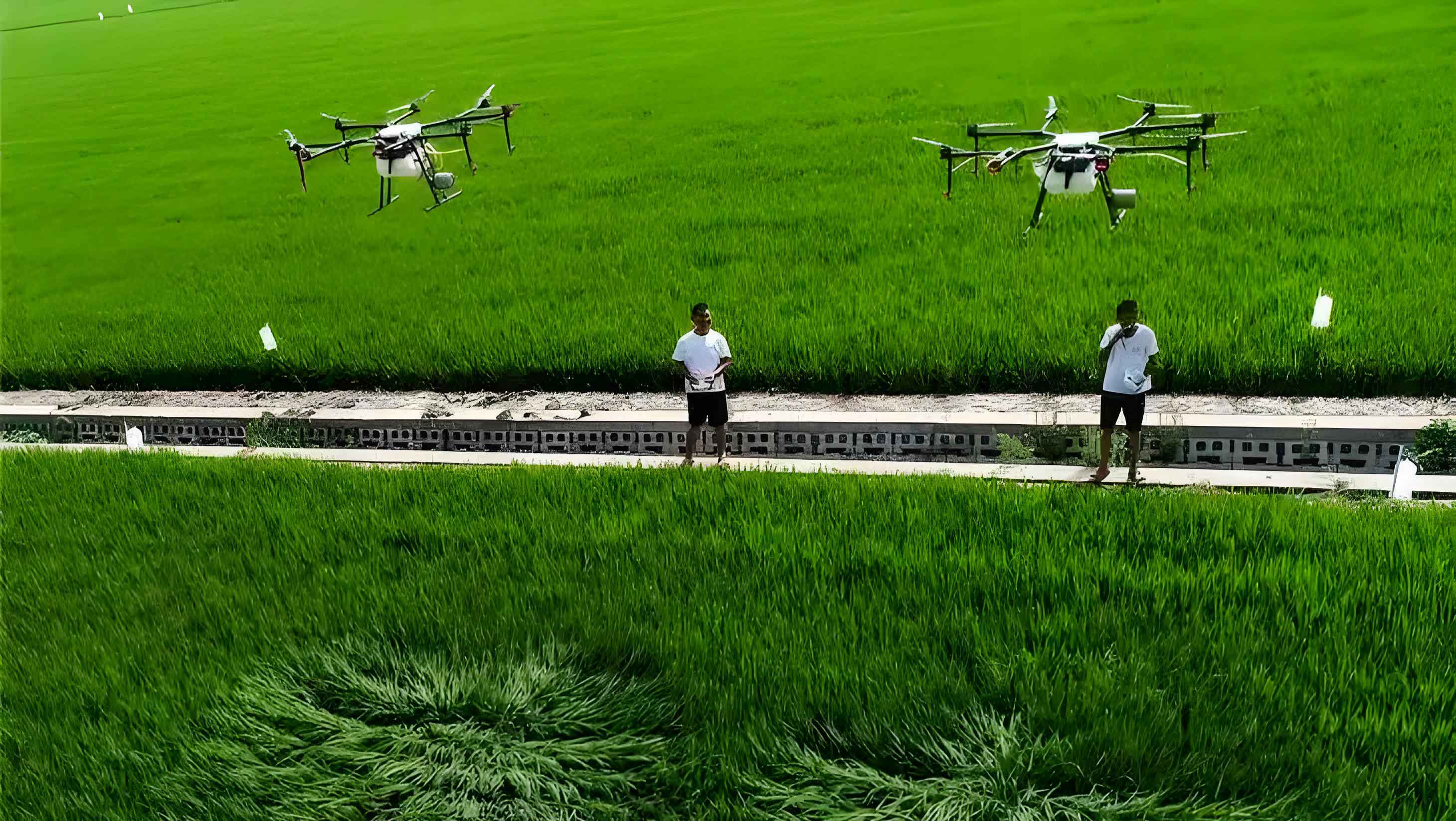
The core hypothesis was that the precise navigation and spray system of an agricultural UAV could deliver herbicide with greater uniformity, allowing for a potential reduction in spray volume and, possibly, herbicide dosage while maintaining effective weed control. The experiment was designed as a side-by-side comparison, focusing on a commonly used grass herbicide, cyhalofop-butyl, applied at different rates using the two distinct application technologies.
Experimental Methodology and Design
The field trial was established in a direct-seeded rice production area. The field was prepared using deep tillage and maintained under good irrigation management. The rice was at the 3-leaf stage at the time of application, while the target grass weeds (barnyardgrass and sprangletop) were at the 2-3 leaf stage, which is considered the optimal timing for post-emergence control.
The herbicide selected for the trial was 40% Cyhalofop-butyl OD (Oil Dispersion), a systemic herbicide highly effective against a broad spectrum of grass weeds in rice. The treatments were designed to compare not only the machinery but also the dosage efficiency. The experimental layout followed a randomized complete block design with three replications. Each plot measured 6,670 m² to ensure practical operational scale and minimize edge effects. The treatments are detailed in Table 1.
| Treatment Code | Herbicide & Rate (mL/667 m²) | Application Machinery | Spray Volume (L/667 m²) | Key Application Parameter |
|---|---|---|---|---|
| T1 (Conventional High) | 40% Cyhalofop-butyl OD @ 200 mL | Knapsack Power Sprayer (4 nozzles) | 30 | Ground-based, high-volume |
| T2 (Conventional Standard) | 40% Cyhalofop-butyl OD @ 150 mL | Knapsack Power Sprayer (4 nozzles) | 30 | Ground-based, high-volume |
| T3 (UAV Low Rate) | 40% Cyhalofop-butyl OD @ 100 mL | Multi-rotor Agricultural UAV (P-20 model) | 1 | Aerial, ultra-low-volume |
| T4 (UAV Standard Rate) | 40% Cyhalofop-butyl OD @ 120 mL | Multi-rotor Agricultural UAV (P-20 model) | 1 | Aerial, ultra-low-volume |
| T5 | Untreated Control | – | – | – |
All applications were made on the same day under consistent weather conditions. The conventional knapsack sprayer delivered a high volume of spray mixture, typical of ground applications. In stark contrast, the agricultural UAV applied the herbicide in an ultra-low volume (ULV) mode. This represents a reduction in carrier volume of approximately 96.7%, a significant decrease with implications for water usage, logistical burden, and potential environmental runoff.
The fundamental difference in application physics between the two methods can be partially described by the relationship governing droplet deposition density. For a given application rate, the number of droplets deposited per unit area ($N_d$) is inversely proportional to the cube of the droplet diameter ($D_v$) and the spray volume ($Q$) per area:
$$N_d \propto \frac{Q}{D_v^3}$$
An agricultural UAV typically generates a finer droplet spectrum to ensure coverage with minimal volume. While this increases $N_d$ for a given $Q$, it also increases drift risk, making precise flight control and adjuvant use critical. The downwash airflow from the UAV rotors also aids in canopy penetration and deposition, a factor absent in ground sprayers.
Assessment of Weed Control Efficacy
Weed density was assessed prior to application (initial infestation) and at 15 and 30 days after treatment (DAT). Within each plot, five fixed quadrats of 0.2 m² each were used for counting surviving barnyardgrass and sprangletop plants. At 30 DAT, above-ground weed biomass from these quadrats was harvested and fresh weight was recorded. Efficacy was calculated using standard formulas:
Weed Reduction Rate (WRR, %): This measures the change in population within a treated plot.
$$WRR = \left( \frac{N_i – N_f}{N_i} \right) \times 100\%$$
where $N_i$ is the initial weed count and $N_f$ is the final weed count at the assessment timing.
Adjusted Control Efficacy (ACE, %): This calculation corrects for any natural population changes observed in the untreated control, providing the true effect of the herbicide treatment.
$$ACE = \left( \frac{WRR_t – WRR_c}{100 – WRR_c} \right) \times 100\%$$
where $WRR_t$ is the weed reduction rate in the treatment plot and $WRR_c$ is the weed reduction rate in the control plot.
Fresh Weight Inhibition Efficacy (FWIE, %): This is a direct measure of the treatment’s effect on weed growth and biomass accumulation.
$$FWIE = \left( \frac{W_c – W_t}{W_c} \right) \times 100\%$$
where $W_c$ is the fresh weight of weeds from the control plot and $W_t$ is the fresh weight from the treatment plot.
All collected data were subjected to analysis of variance (ANOVA), and treatment means were separated using Duncan’s New Multiple Range Test (DMRT) at the 5% ($p=0.05$) and 1% ($p=0.01$) significance levels.
Results: Performance of Agricultural UAV vs. Conventional Sprayer
The results clearly demonstrated the effectiveness of cyhalofop-butyl and highlighted the efficiency of the agricultural UAV application system. The data for barnyardgrass and sprangletop control are summarized in Table 2 and Table 3, respectively.
| Treatment | Initial Density (plants/m²) | Adjusted Control Efficacy (%) | Fresh Weight Inhibition (%) | Statistical Significance (p=0.05) |
|---|---|---|---|---|
| T1: Conv. @ 200 mL | 24.0 | 98.25 a | 98.00 a | A |
| T2: Conv. @ 150 mL | 21.5 | 95.47 ab | 95.25 ab | AB |
| T4: UAV @ 120 mL | 23.2 | 93.17 ab | 93.81 ab | AB |
| T3: UAV @ 100 mL | 18.5 | 89.49 b | 87.97 b | B |
| T5: Control | 24.9 | – | – | – |
| Treatment | Initial Density (plants/m²) | Adjusted Control Efficacy (%) | Fresh Weight Inhibition (%) | Statistical Significance (p=0.05) |
|---|---|---|---|---|
| T1: Conv. @ 200 mL | 31.3 | 97.68 a | 97.57 a | A |
| T2: Conv. @ 150 mL | 28.5 | 96.47 a | 96.59 a | A |
| T4: UAV @ 120 mL | 23.1 | 91.91 a | 91.83 a | A |
| T3: UAV @ 100 mL | 29.7 | 78.04 b | 81.17 b | B |
| T5: Control | 34.3 | – | – | – |
The analysis revealed several key findings. Firstly, both conventional sprayer treatments (T1 and T2) provided excellent control (>95%) of both grass weed species. Secondly, and most notably, the agricultural UAV application at 120 mL/667 m² (T4) achieved statistically equivalent control efficacy to the conventional sprayer applications. There was no significant difference between T4 and T1/T2 for either species in terms of final plant control or biomass reduction. This demonstrates that the agricultural UAV can deliver the herbicide with sufficient precision and coverage to match the performance of a high-volume ground sprayer, even with a 20% lower spray volume and a massive 96.7% reduction in water usage.
Thirdly, the lower dosage applied via the agricultural UAV (100 mL/667 m², T3) resulted in a significant drop in efficacy, particularly against sprangletop, where control fell to around 78-81%. This indicates a dosage threshold for effective control when using ULV agricultural UAV application, below which performance becomes suboptimal. The overall efficacy against total grass weeds is consolidated in Table 4.
| Treatment | Total Adjusted Control Efficacy (%) | Total Fresh Weight Inhibition (%) | Statistical Significance (p=0.05) |
|---|---|---|---|
| T1: Conv. @ 200 mL | 97.88 a | 97.73 a | A |
| T2: Conv. @ 150 mL | 96.13 a | 96.10 a | A |
| T4: UAV @ 120 mL | 92.28 a | 92.56 a | A |
| T3: UAV @ 100 mL | 82.11 b | 83.67 b | B |
Throughout the observation period, no visual symptoms of phytotoxicity (e.g., chlorosis, necrosis, or growth retardation) were observed on the rice plants in any treatment plot. This confirms that both application methods, when used with the appropriate herbicide and dosage, are safe for the rice crop.
Discussion: Advantages and Operational Insights for Agricultural UAV Spraying
The equivalent efficacy achieved by the agricultural UAV at a reduced water volume underscores its core advantage: application uniformity. Conventional boom or knapsack sprayers are prone to human error, leading to streaks of over-application and under-application. The agricultural UAV, guided by pre-programmed flight paths and real-time kinematic (RTK) positioning, ensures consistent swath width and application rate across the entire field. This uniformity minimizes the “skip and miss” phenomenon, ensuring each weed receives a lethal dose, which is likely why the 120 mL rate via UAV matched the 150-200 mL rate applied via ground.
The drastic reduction in water usage (from 30,000 L/ha to 1,000 L/ha) is a transformative benefit. It translates to fewer tank refills, reduced labor for water hauling, lower fuel consumption, and the ability to treat fields when they are too wet for ground machinery to enter. Most importantly, it directly contributes to reducing agricultural non-point source pollution. Less runoff volume means potentially less herbicide loss into waterways, aligning with sustainable agriculture goals. The efficiency of an agricultural UAV operation can be modeled by its field capacity ($C_f$, ha/hr):
$$C_f = W \times V \times E$$
where $W$ is the effective swath width (m), $V$ is the flight speed (m/s), and $E$ is the operational efficiency factor (accounting for turns and reloading). Modern agricultural UAV systems can achieve $C_f$ values significantly higher than manual sprayers for large, contiguous fields.
The finding that the 100 mL rate was insufficient highlights a critical consideration for agricultural UAV deployment: dosage calibration. The optimal rate for ULV application may not be a simple linear reduction from high-volume rates. Factors such as droplet size, adjuvant use, flight altitude, and weather conditions interact to influence final deposition. The relationship between the applied rate ($R_a$), the concentration in the tank ($C_t$), and the spray volume ($Q$) is fundamental:
$$R_a = C_t \times Q$$
For an agricultural UAV using ULV, $Q$ is very small, so $C_t$ must be correspondingly high to deliver the necessary active ingredient per unit area. This requires precise calibration and high-quality spraying systems to prevent nozzle clogging and ensure accurate metering.
Furthermore, the aerodynamic effect of the UAV’s rotors creates a downward air current that pushes droplets into the crop canopy, potentially improving coverage on the lower leaves and stems where weeds germinate. This is an advantage over traditional sprayers that rely primarily on droplet ballistic trajectories. The airflow can be approximated as a function of rotor thrust, which aids in droplet transport and deposition stability even in mild, unfavorable wind conditions.
Conclusion and Future Perspectives
This comparative field trial provides compelling evidence that agricultural UAV technology is a viable and highly efficient tool for herbicide application in direct-seeded rice. The key conclusion is that an agricultural UAV applying 40% cyhalofop-butyl OD at 120 mL per 667 m² can deliver grass weed control efficacy statistically on par with a conventional knapsack power sprayer applying 150-200 mL of the same herbicide, while simultaneously reducing water consumption by 96.7%. This represents a major stride towards precision agriculture, enhancing resource-use efficiency and environmental stewardship.
The successful deployment of an agricultural UAV hinges on several factors: proper calibration to determine the minimum effective dosage for the target weeds, selection of appropriate nozzles and adjuvants to optimize droplet spectrum and deposition, and operation within suitable meteorological windows to minimize drift. Future research should focus on integrating agricultural UAV spraying with other technologies, such as remote sensing for weed mapping to enable variable-rate, spot-application strategies. This would further optimize herbicide use, reduce input costs, and delay herbicide resistance evolution.
In summary, the agricultural UAV is more than just a novel gadget; it is a transformative platform for precise crop protection. Its ability to apply agrochemicals uniformly at ultra-low volumes offers a sustainable pathway to effective weed management, reducing the environmental footprint of rice cultivation while maintaining high standards of efficacy and crop safety.