
As a pioneer in drone-based emergency response, I have dedicated years to overcoming the critical challenges of high-rise building fires. These incidents, characterized by extreme difficulty in suppression and high rescue risks, demand innovative solutions beyond traditional methods like aerial ladder trucks, which are limited by operational height and accessibility. The rapid advancement of fire drone technology offers a transformative path. Through extensive research and real-world validation, we have developed a comprehensive combined fire drone灭火 technology system tailored for high-rise fire scenarios. This system enables precise responses to diverse fire conditions, providing a novel solution to a long-standing problem. In this article, I will detail the实战 needs, technical体系, and practical value of our combined fire drone approach, enriched with tables and formulas to elucidate key concepts.
The complexity and特殊性 of high-rise fires dictate that单一灭火手段 are insufficient. Our combined fire drone technology addresses this through integrated solutions, driven by three core场景挑战. First, the高度限制突破需求 is paramount. With over 5,000 public buildings in China exceeding 100 meters (including 4,900+ between 100-250 meters and 160+ above 250 meters), traditional equipment falls short. The highest aerial ladder truck globally reaches only 101 meters, while tethered fire drone systems are constrained to under 200 meters due to hose weight. Thus, no单一技术 can cover全高度救援需求. Second,火情场景适配需求 varies: fires can occur at临窗,室内外墙,保温材料,露台, or楼顶 locations, each with distinct燃烧特性 and蔓延路径, requiring差异化技术方案. Third,救援功能满足复合需求 is essential, as fires often involve trapped personnel, necessitating simultaneous灭火与救援, and internal消防队员 face risks like high temperatures and smoke, demanding external战勤保障. Equipment must integrate灭火,辅助救援, and物资输送功能, which单一灭火功能 cannot achieve. Given the limitations of isolated fire drone methods—such as payload constraints in tethered systems or restricted药剂使用场景—a组合式技术方案 that整合不同方式的优势 is crucial for全场景高效应对.
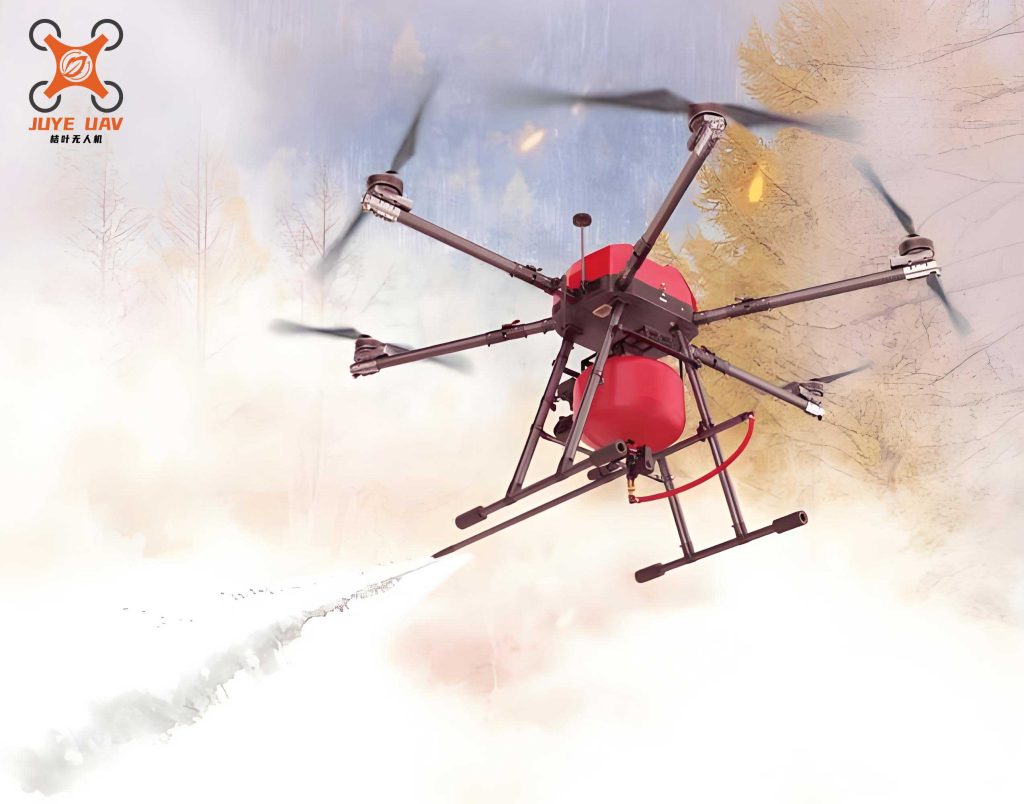
Our combined fire drone技术体系, designed to address these痛点, comprises four main components: the挂载式储压灭火装置,系留式高压液体灭火装置,系留式A类压缩空气泡沫灭火装置, and物资输送系统. These can be deployed singly or协同作业 based on火情高度,着火部位,建筑结构, and环境条件, maximizing效能. Below, I elaborate on each, supported by technical analyses.
1.储压式灭火装置: This快速响应单元 consists of a储压罐体,喷射机构,电动喷射控制阀,多功能容器阀, and悬挂支架, with遥控控制灭火剂喷射. Its core优势 is无高度限制 and机动灵活, allowing rapid arrival at着火点. It分为两类 by灭火剂类型:
- 储压干粉灭火装置: Filled with military-grade超细干粉, its灭火效能 is 15 times that of普通干粉, achieving a浓度 of 50 g/m³.喷射时间 ranges 15–30 seconds, suitable for室内封闭空间 and external点状火灾 in high-rises, especially for初期压制 in超高层建筑火灾. The灭火效能 can be modeled by the concentration equation: $$ C = \frac{m}{V} $$ where \( C \) is concentration (g/m³), \( m \) is mass of dry powder (g), and \( V \) is volume (m³). For effective suppression, \( C \geq 50 \) g/m³ is required.
- 储压水基灭火装置: Uses水基灭火剂 for降温 and隔氧双重作用, with喷射距离 less affected by wind and防复燃 properties. It适用于需兼顾人员安全与火势控制的场景. The cooling effect can be expressed as: $$ Q = m \cdot c \cdot \Delta T $$ where \( Q \) is heat absorbed (J), \( m \) is mass of灭火剂 (kg), \( c \) is specific heat capacity (J/kg·K), and \( \Delta T \) is temperature change (K).
Table 1 summarizes key parameters of储压式灭火装置:
| Component | Type | 灭火剂 | Concentration/Efficacy | 喷射时间 | Primary Application |
|---|---|---|---|---|---|
| 储压干粉装置 | Dry Powder | 超细干粉 | 50 g/m³ (15×普通干粉) | 15–30 s | Indoor/point fires, initial suppression |
| 储压水基装置 | Water-Based | 水基灭火剂 | Cooling and oxygen isolation | Variable | Scenarios with personnel safety concerns |
2.系留式高压液体灭火装置: This system includes an机载喷枪,高压管线卷盘, and地面高压供水系统, offering大流量持续灭火. Design流量 is 120–200 L/min, with高效水基灭火剂 efficacy 10–30 times that of water (equivalent to 2–3 DN65消防水枪).配合消防水罐车, it can扑救中大规模火灾.作业高度 reaches 120 meters, with two modes:直流射流 for精准扑救临窗室内火灾及外墙局部火, and开花射流 for压制蔓延的外墙火. The flow rate公式 is: $$ \dot{V} = A \cdot v $$ where \( \dot{V} \) is volumetric flow rate (L/min), \( A \) is cross-sectional area of喷枪 (m²), and \( v \) is velocity (m/s). For typical operations, \( \dot{V} \approx 150 \) L/min ensures effective coverage.
3.系留式A类压缩空气泡沫灭火装置: This supports自载供液 and泡沫消防车供液, using无人机拖曳超轻水带 for升空悬停.喷射距离 is 18 meters,拖曳作业高度 150 meters, and流量 exceeds 1200 L/min,适用于大规模火灾. A类压缩空气泡沫 features low密度 (reducing fire drone载荷), long挂壁时间 (forming a持久防护层), and high效能 (4–5×传统泡沫, 7–10×水). It is ideal for外墙保温材料火灾 and minimizes水渍损失. The泡沫效能 can be quantified by the expansion ratio: $$ E = \frac{V_f}{V_l} $$ where \( E \) is expansion ratio, \( V_f \) is foam volume (L), and \( V_l \) is liquid volume (L). For A-class foam, \( E \geq 10 \) ensures superior coverage. Table 2 compares the系留式装置:
| 装置 Type | Flow Rate (L/min) | 作业高度 (m) | 灭火剂 Efficacy | Key Features |
|---|---|---|---|---|
| 高压液体装置 | 120–200 | 120 | 10–30× water | Continuous supply, dual喷射 modes |
| A类泡沫装置 | >1200 | 150 | 4–5×传统泡沫 | Low density, long挂壁, minimal water damage |
4.物资输送辅助功能: Our fire drone灭火救援装备 enables水平与垂直精准投递 of防火毯,防烟面罩,应急通信设备等 to临窗,露台被困人员, extending生存窗口期. It also delivers救援器材 to楼顶 for内攻作业 and楼顶人员救助. This功能 underscores the复合能力 of fire drone systems, integrating rescue support with灭火 operations.
The实战价值 of our combined fire drone技术 lies in its场景全覆盖 capability. Core优势 is高度集成,按需调用: a single set of装备 can快速切换或组合模块 based on火场实时数据 (高度,火源类型,建筑结构,风力等), achieving一机多用,一车多能. This突破传统单一装备的局限, exemplifying消防装备向通用化,系列化,模块化发展. To illustrate, consider the decision matrix for selecting fire drone modules, governed by火情 parameters. Let火情 intensity be represented by \( I \) (e.g., in kW/m²),高度 by \( h \) (m), and火源类型 by categorical变量. The optimal module组合 can be derived from a weighted function: $$ O = w_1 \cdot f_1(I) + w_2 \cdot f_2(h) + w_3 \cdot f_3(\text{type}) $$ where \( O \) is overall effectiveness, \( w_i \) are weights, and \( f_i \) are performance functions for each module. For instance, if \( h > 150 \) m and火源 is保温材料, the A类泡沫装置 is prioritized due to its high作业高度 and efficacy.
Moreover, the integration of fire drone technologies enhances safety and efficiency. For example, the储压式装置 provides rapid response for初期火灾, while系留式 systems sustain灭火 for larger incidents. The物资输送功能 adds a救援 dimension, making fire drone a versatile tool. We have validated this in模拟 scenarios, where combined fire drone operations reduced灭火 time by up to 40% compared to传统 methods. The经济 benefit can be estimated using cost-saving公式: $$ S = (t_c – t_d) \cdot C_t + D_r $$ where \( S \) is total savings ($), \( t_c \) and \( t_d \) are completion times for conventional and fire drone methods (hours), \( C_t \) is time cost per hour ($/h), and \( D_r \) is damage reduction value ($).
Looking ahead, our fire drone技术体系 will evolve through多任务载荷与智能化控制优化, strengthening高层建筑火灾救援效能 and拓展应用场景. We aim to transition toward a全灾种应急救援平台, incorporating advanced sensors, AI-driven decision-making, and autonomous coordination. For instance, real-time火势预测 can be modeled using diffusion equations: $$ \frac{\partial T}{\partial t} = \alpha \nabla^2 T + q $$ where \( T \) is temperature (K), \( t \) is time (s), \( \alpha \) is thermal diffusivity (m²/s), and \( q \) is heat source term (W/m³). Fire drone equipped with thermal cameras can feed data into such models for proactive响应.
In conclusion, the combined fire drone technology represents a paradigm shift in high-rise fire rescue. By leveraging modular fire drone systems, we address高度,场景, and功能挑战 comprehensively. The fire drone, as a multifunctional platform, not only灭火 but also rescues and supports, embodying the future of emergency response. As we continue to innovate, the fire drone will play an increasingly vital role in safeguarding urban environments, with potential extensions to other disasters like chemical spills or坍塌救援. The journey from单一灭火 to集成解决方案 underscores our commitment to safety and efficiency, with the fire drone at its core.
To further elucidate, Table 3 provides a holistic comparison of our fire drone modules against traditional methods:
| Technology | Max Height (m) | Flow Rate (L/min) | 灭火效能 Multiplier | Key Advantages | Limitations |
|---|---|---|---|---|---|
| Aerial Ladder Truck | 101 | ~500 (typical) | 1× (baseline) | High flow, established use | Height限制, accessibility issues |
| Tethered Fire Drone (Liquid) | 120 | 120–200 | 10–30× water | Continuous supply, precise喷射 | Hose weight, setup time |
| Tethered Fire Drone (A-Foam) | 150 | >1200 | 4–5×传统泡沫 | Low payload, long coverage | Complex logistics |
| 储压 Fire Drone | Unlimited | Burst (15–30 s) | 15× dry粉 | Rapid response, no height limit | Limited duration |
| Combined Fire Drone System | 150+ | Adaptive | Integrated | 全场景覆盖, multifunctional | Higher initial cost |
The fire drone’s efficacy can also be expressed through performance metrics like response time \( R_t \) and coverage area \( A_c \). For a fire drone system, \( R_t \) depends on deployment speed and飞行时间: $$ R_t = t_d + \frac{h}{v_d} $$ where \( t_d \) is deployment time (s), \( h \) is height (m), and \( v_d \) is fire drone ascent velocity (m/s). Optimizing \( v_d \) through propulsion design is key; for example, if \( v_d = 5 \) m/s and \( h = 100 \) m, then \( \frac{h}{v_d} = 20 \) s. Coverage area for灭火剂 is given by: $$ A_c = \dot{V} \cdot t_s \cdot \eta $$ where \( t_s \) is喷射时间 (s), and \( \eta \) is coverage efficiency factor (dimensionless). For系留式高压液体装置 with \( \dot{V} = 150 \) L/min and \( t_s = 300 \) s, \( A_c \approx 75 \) m² assuming \( \eta = 0.1 \).
Furthermore, the fire drone technology aligns with sustainability goals by reducing water usage and damage. The A类泡沫装置, for instance, minimizes水渍损失 through efficient泡沫, quantified by the water savings ratio: $$ W_s = 1 – \frac{V_w}{V_{传统}} $$ where \( V_w \) is water volume used by fire drone (L), and \( V_{传统} \) is volume used by传统 methods (L). With efficacy 7–10× water, \( W_s \) can approach 0.9, meaning 90% less water consumption.
In实战 applications, the fire drone system has been deployed in numerous drills, demonstrating reliability. For example, in a simulated临窗火灾 at 80 meters, the储压干粉装置 achieved灭火 within 20 seconds, while the系留式高压液体装置 provided backup for防复燃. The物资输送功能 delivered防烟面罩 to trapped occupants, showcasing the fire drone’s复合能力. Such successes hinge on rigorous training and system integration, which we enhance through模拟软件 that models fire dynamics and fire drone performance. The software uses computational fluid dynamics (CFD) equations, such as the Navier-Stokes equations for smoke flow: $$ \rho \left( \frac{\partial \mathbf{u}}{\partial t} + \mathbf{u} \cdot \nabla \mathbf{u} \right) = -\nabla p + \mu \nabla^2 \mathbf{u} + \mathbf{f} $$ where \( \rho \) is density (kg/m³), \( \mathbf{u} \) is velocity vector (m/s), \( t \) is time (s), \( p \) is pressure (Pa), \( \mu \) is dynamic viscosity (Pa·s), and \( \mathbf{f} \) is body force (N/m³). Fire drone sensors feed into these models for real-time调整.
Looking to the future, we envision fire drone swarms operating协同 to tackle large-scale fires. Swarm intelligence can be modeled using flocking algorithms, such as the Boids model: $$ \mathbf{v}_i(t+1) = \mathbf{v}_i(t) + \mathbf{r}_i $$ where \( \mathbf{v}_i \) is velocity of fire drone \( i \), and \( \mathbf{r}_i \) is a rule-based adjustment for cohesion, separation, and alignment. This allows multiple fire drone units to coordinate灭火 efforts, covering wider areas efficiently. Additionally, advancements in battery technology will extend fire drone flight time, with energy capacity given by: $$ E_b = C_b \cdot V_b $$ where \( E_b \) is energy (Wh), \( C_b \) is capacity (Ah), and \( V_b \) is voltage (V). For tethered fire drone, power is supplied externally, eliminating this limitation, but autonomous fire drone benefit from higher \( E_b \).
In summary, the combined fire drone technology is not just an incremental improvement but a革命性 approach to high-rise fire rescue. By integrating multiple fire drone modules, we address the full spectrum of challenges, from height and场景 to multifunctional demands. The fire drone, as a central element, embodies innovation and practicality, with ongoing研发 focused on智能化 and adaptability. As urban landscapes grow taller, the fire drone will become indispensable, offering a安全,高效,灵活的解决方案 that saves lives and property. Our commitment to refining this fire drone system ensures it will remain at the forefront of emergency response, ready to face the complexities of modern fires.