
The extensive deployment of UAV drones for inspecting and maintaining overhead power lines has revolutionized grid management. These UAV drones offer unparalleled efficiency, significantly reducing the time, cost, and risk associated with manual patrols in challenging terrain. However, the operational environments for these power line UAV drones are notoriously hostile. Persistent challenges include high-voltage electromagnetic interference that disrupts control signals, unpredictable strong wind gusts, complex mountainous topography, and the ever-present risk of sudden mechanical failures like motor or power system faults. These factors collectively contribute to a high risk of uncontrolled descents or crashes, leading to equipment loss, operational downtime, and potential secondary damage to the grid infrastructure itself. Therefore, enhancing the safety and robustness of UAV drones in these conditions is paramount. This article presents a comprehensive multi-level collaborative control strategy, integrating intelligent onboard systems with ground operator oversight, designed specifically to mitigate fall risks for UAV drones operating in transmission and distribution corridors.
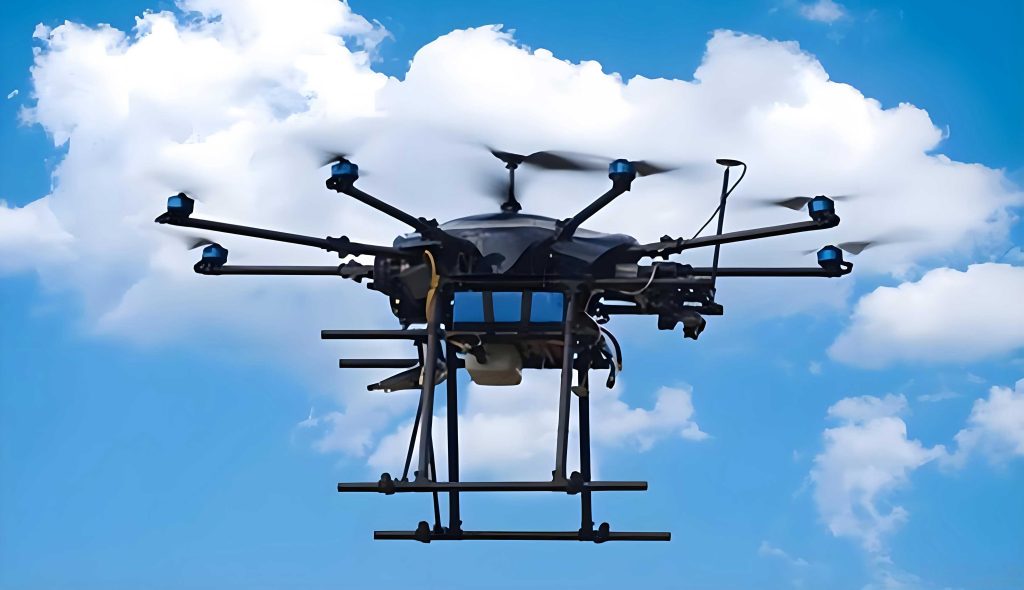
The core philosophy of our approach is to establish a closed-loop safety mechanism: “real-time monitoring – risk identification – collaborative intervention – safe execution.” We move beyond purely autonomous systems or purely manual control, instead creating a synergistic partnership where the UAV drone and the human operator complement each other’s strengths. The UAV drone handles high-frequency data processing and instant stabilization, while the human operator provides high-level judgment, strategic decision-making, and intervention in complex, unforeseen scenarios. This human-UAV collaboration is the bedrock of our proposed fall-prevention framework.
System Architecture for Collaborative Safety
The proposed collaborative fall-prevention control system is built upon three tightly integrated core components: the UAV drone End, the Ground Control End, and the central Synergistic Decision-Making Module. Their interplay is designed to ensure seamless operation and fault tolerance.
| System Component | Key Sub-modules & Hardware | Primary Functions |
|---|---|---|
| UAV Drone End | Fall-Prevention Device, Multi-sensor Suite (IMU, Anemometer, EMF Sensor, RGB/IR Camera), Embedded Processing Unit, Power Management System. | Data acquisition, real-time environmental perception, preliminary risk assessment, execution of low-level stabilization commands, and monitoring of own health status (battery, vibration, load). |
| Ground Control End | Graphical User Interface (GUI), Data Visualization Engine, Multi-level Alert System, Manual Override Console. | Real-time mission monitoring, risk visualization (trajectory, heat maps), alerting the operator, providing tools for manual intervention and high-priority command input (e.g., forced return-to-home). |
| Synergistic Decision-Making Module | Data Fusion Layer, Risk Identification Layer (AI & Rule-based), Decision Execution Layer. | Fusing multi-source sensor data, assessing and ranking risk levels, triggering appropriate intervention strategies, and adapting parameters based on historical mission data. |
The Synergistic Decision-Making Module acts as the system’s brain. Its data fusion layer employs weighted algorithms and Bayesian inference models to combine inputs from potentially noisy or failing sensors, producing a robust state estimate. For instance, if GPS data degrades under power lines, the fusion algorithm relies more heavily on IMU and visual odometry data. The risk identification layer uses a combination of pre-defined safety rules (e.g., “if tilt angle > θ_max for t > Δt, then risk=high”) and lightweight machine learning models to classify threats. The decision execution layer then selects the appropriate response protocol, balancing autonomy and human input.
Integrated Fall-Prevention Device and Sensor Fusion
A dedicated fall-prevention device forms the hardware backbone of our safety system. It employs a dual-mechanism approach: Passive Mechanical Protection and Active Electronic Protection.
The mechanical design focuses on energy dissipation during an impact. It uses a redundant support structure made from carbon-fiber-reinforced polymer composites. The energy-absorbing buffers have a graded design: a softer outer layer for initial impact absorption and a stiffer inner layer to protect core flight components. The electronic protection system is proactive, continuously monitoring flight status to prevent a fall from occurring. Key to this is a sensor fusion mechanism. Raw data from various sensors are processed to create a reliable picture of the UAV drone’s state. The fusion algorithm can be conceptually represented as finding the most probable state estimate \(\hat{X}\) given multiple sensor observations \(Z_i\):
$$ \hat{X} = \arg\max_X P(X | Z_1, Z_2, …, Z_n) $$
In practice, a weighted fusion approach is used, where the weight \(w_i\) for each sensor \(i\) is dynamically adjusted based on its estimated reliability \(r_i\) (e.g., GPS reliability drops in high-EMF areas) and relevance \(c_i\) to the current safety metric:
$$ \text{Fused Output} = \frac{\sum_{i=1}^{n} w_i \cdot z_i}{\sum_{i=1}^{n} w_i}, \quad \text{where } w_i = f(r_i, c_i) $$
This ensures that the system’s perception remains stable even if one sensor stream degrades or fails.
Three-Tier Human-UAV Collaborative Intervention Strategy
The intervention strategy is structured into three escalating tiers, defining clear roles for the autonomous system and the human operator at different risk levels. This graduated response ensures that human cognitive resources are reserved for situations where they are most needed.
| Intervention Tier | Trigger Conditions (Examples) | UAV Drone Autonomous Action | Operator Role & Action |
|---|---|---|---|
| Tier 1: Alert & Monitoring | Minor attitude deviation, Gusts below moderate threshold, Initial EMF noise. | Issues visual/auditory alerts to ground station. Logs event. Continues normal flight with basic PID stabilization. | Monitors alerts and flight status. Acknowledges warning. May prepare for manual input. |
| Tier 2: Semi-Autonomous Intervention | Sustained attitude error, Rising wind speeds, Intermittent control link. | Shares control authority. Provides continuous stabilization assist (“parallel control”) to smooth operator commands. Suggests corrective actions. | Takes primary control for trajectory or altitude adjustment. Makes strategic decisions based on UAV’s suggested actions and visual feed. |
| Tier 3: Automatic Takeover | Critical motor failure, Severe uncontrolled spin, Loss of communication, Commanded emergency. | Immediately seizes full control. Executes pre-programmed fail-safe: forced hover, emergency landing, or controlled descent away from lines. Activates redundant backup logic. | Monitors the automated procedure. Cannot directly intervene until safe state is reached. Receives status updates upon link restoration. |
This tiered strategy ensures that the UAV drone is never completely passive nor unpredictably autonomous. The transition between tiers is managed by the Synergistic Decision-Module based on the quantified risk level \(R\), calculated from fused sensor data:
$$ R(t) = \alpha \cdot \text{AttitudeError}(t) + \beta \cdot \text{WindSeverity}(t) + \gamma \cdot \text{EMF\_Disruption}(t) + \delta \cdot \text{SystemHealth}(t) $$
where \(\alpha, \beta, \gamma, \delta\) are adaptive coefficients tuned by the module’s learning component from historical mission data.
Control Algorithm Design and Implementation
At the heart of the UAV drone’s autonomous stability control is a hybrid algorithm combining an Adaptive PID controller with a Fuzzy Logic controller. The Adaptive PID handles precise trajectory following and disturbance rejection under nominal conditions. Its parameters are not fixed but adjust in real-time based on the error \(e(t)\) and its derivatives:
$$ u_{PID}(t) = K_p(e(t)) \cdot e(t) + K_i(e(t)) \cdot \int_0^t e(\tau) d\tau + K_d(e(t)) \cdot \frac{de(t)}{dt} $$
The gain scheduling for \(K_p, K_i, K_d\) is governed by a rule-set that considers current flight mode and environmental factors provided by the sensor fusion module.
The Fuzzy Logic controller complements this by managing high uncertainty and non-linearities, such as turbulent airflow patterns around power lines or complex EMF-induced torque effects. It uses linguistic rules (e.g., “IF wind_gust is Strong AND altitude is Low THEN apply_negative_pitch is Medium”) to determine control adjustments. The final control output \(u(t)\) is a weighted blend of both controllers’ outputs, with the weighting factor \(\lambda\) determined by the current risk tier and the confidence in the sensor-fused state estimate:
$$ u(t) = \lambda \cdot u_{Fuzzy}(t) + (1 – \lambda) \cdot u_{PID}(t), \quad \lambda \in [0, 1] $$
In Tier 1, \(\lambda\) is near 0 (PID dominant). As risk escalates to Tier 2, \(\lambda\) increases, allowing the fuzzy system to contribute more to handle increased environmental uncertainty. This hybrid approach provides the precision of PID with the robustness of fuzzy logic, essential for the dynamic environments where these UAV drones operate.
Experimental Validation and Performance Analysis
A comprehensive field test was conducted in a representative high-voltage transmission corridor to validate the proposed collaborative control strategy. Tests were designed progressively: establishing baseline performance, introducing single risk factors, and finally combining multiple hazards to simulate worst-case scenarios.
| Test Scenario | Key Performance Indicator (KPI) | Result with Basic Autonomy | Result with Collaborative Control | Improvement |
|---|---|---|---|---|
| High Wind Gusts | Trajectory Deviation Rate (%) | 15.2% | 10.6% | >30% reduction |
| High-Voltage EMF Interference | Communication Packet Loss Rate (%) | 23.1% | 12.0% | ~48% reduction |
| Induced Communication Latency (200ms) | Mission Completion Rate (%) | 78.5% | 96.3% | Maintained >96% |
| Simulated Single Motor Failure | Safe Landing Success Rate (%) | 65.0% (if no crash) | 97.1% | ~97% success |
| Combined: Wind + EMF + Latency | Overall Mission Success Rate (%) | ~60% (Est.) | 86.5% | High robustness in complex setting |
The data clearly demonstrates the efficacy of the strategy. Under high winds, the hybrid control algorithm effectively dampened oscillations, significantly reducing deviation. In high-EMF zones, the collaborative protocol, which included switching to more robust communication frequencies and anticipatory positioning by the operator in Tier 2, drastically cut data loss. The system’s ability to handle communication latency highlights the value of the UAV drone’s onboard intelligence; it could maintain stable hover and execute pre-agreed contingency plans while awaiting delayed commands. The most critical result is the 97.1% safe landing success rate during simulated motor failure, showcasing the flawless activation of Tier 3 automatic takeover and the reliability of the fall-prevention device’s emergency logic.
The performance in combined risk scenarios is particularly noteworthy. While there was a expected degradation compared to single-risk tests, the system maintained an 86.5% mission success rate by dynamically re-assessing risk and shifting between Tiers 1 and 2 more frequently, leveraging both the UAV drone’s adaptive control and the operator’s strategic oversight.
Conclusion and Future Perspectives
This research has successfully designed, implemented, and validated a multi-level human-UAV collaborative control strategy specifically for enhancing the safety of UAV drones in perilous power line inspection environments. By integrating an intelligent onboard system with a structured ground operator intervention protocol, the strategy creates a resilient safety net that significantly reduces fall risks. The experimental results confirm substantial improvements in flight stability, communication reliability, and mission success rates under a wide array of typical and compounded hazards.
The future evolution of this system lies in deepening the intelligence of the collaboration. The next research phase will focus on implementing reinforcement learning algorithms within the Synergistic Decision Module, allowing the system to learn optimal intervention strategies from vast amounts of operational data, potentially predicting failures before they occur. Furthermore, scaling this approach to manage coordinated fleets of UAV drones, where operator collaboration extends to managing multiple vehicles simultaneously, presents a challenging but necessary frontier for large-scale grid maintenance automation. The proven framework of tiered, risk-based human-UAV collaboration provides a solid foundation for these advanced developments in robotic grid stewardship.