
With the rapid advancement of technology, civil drones have become integral to various sectors due to their speed, intelligence, and reduced human risk. The civil drone industry is expanding uncontrollably, and ground stations serve as the command center for operators to control drones remotely, ensuring mission completion and safe recovery. This article examines the current state of civil drone ground stations, their composition, classification, and key technologies, while proposing recommendations for future development to enhance intelligence and promote high-quality growth in the civil drone sector. As a researcher in this field, I have observed that civil drone ground stations are evolving to meet diverse application needs, and their significance cannot be overstated.
The development of civil drone ground stations has progressed significantly over the decades. In the 1950s to 1970s, initial systems emerged, primarily for military use, laying the foundation for modern civil drone applications. By the 1990s, ground stations like those for the “Predator” drone became more clustered and intelligent, and in the 21st century, the miniaturization of military drones spurred the civil drone market, leading to rapid advancements. Today, civil drone ground stations are tailored for specific industries, such as agriculture, highway monitoring, urban inspections, and bridge detection, highlighting their versatility. For instance, in agriculture, ground stations enable automated route planning for crop spraying, reducing manual effort and improving efficiency. Similarly, in urban settings, civil drone ground stations facilitate traffic monitoring and emergency response, demonstrating their broad applicability. The future will likely see even more specialized ground stations for civil drones, catering to niche markets like scientific research and public safety.
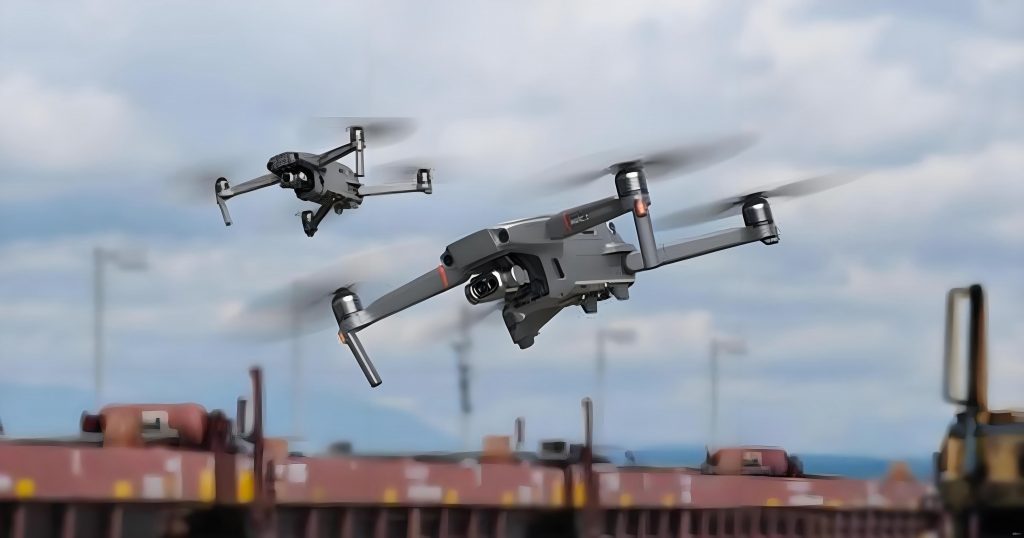
Civil drone ground stations consist of both hardware and software components, which work together to enable seamless operation. The hardware forms the physical interface between operators and civil drones, typically including elements like remote controllers, switches, and wireless data transmission units. These components are designed for outdoor use, featuring high-resolution displays visible in sunlight. The hardware can be broken down into layers: display, operation, and communication. The display layer shows critical information such as flight parameters, routes, and alert messages, while the operation layer involves devices like joysticks and keyboards for controlling civil drone takeoff, landing, and payload operations. The communication layer uses antennas to transmit commands and receive telemetry data, ensuring real-time interaction between the ground station and civil drones. A summary of hardware functions is provided in Table 1.
| Layer | Components | Functions |
|---|---|---|
| Display | High-performance screens | Show flight data, routes, images, and alerts |
| Operation | Joysticks, keyboards, mice | Control drone flight and payload (e.g., camera angles) |
| Communication | Antennas, transmitters, receivers | Transmit commands and receive telemetry data |
| Other | Power supplies, enclosures | Support system operation and portability |
The software component of civil drone ground stations is equally crucial, providing the interface for operators to monitor and manage civil drones. It includes modules for displaying drone status, such as attitude, position, speed, and battery level, as well as handling key alerts for issues like low battery or communication loss. Additionally, the software supports geographic information visualization and mission planning, allowing operators to design and adjust flight paths in real-time. The interaction between civil drones and ground stations follows a cyclic process: commands are sent from the ground station, executed by the drone, and status data is fed back for display. This ensures that civil drone operations remain safe and efficient, even in dynamic environments. The software architecture can be represented mathematically; for example, the state of a civil drone at time \( t \) can be modeled as \( \vec{s}(t) = [x(t), y(t), z(t), \theta(t), \phi(t), \psi(t)] \), where \( x, y, z \) denote position coordinates and \( \theta, \phi, \psi \) represent attitude angles. The ground station software updates this state based on incoming data, enabling precise control.
Civil drone ground stations are classified based on system complexity and application scope, as detailed in Table 2. In terms of complexity, they range from portable stations, which are handheld and ideal for field use, to deployable stations with multiple operator consoles, and distributed stations that separate components like launch and command units. For application scope, civil drone ground stations divide into consumer-grade systems for activities like aerial photography and professional-grade systems for specialized tasks such as surveying and inspection. This classification helps users select appropriate ground stations for their civil drone needs, ensuring optimal performance and cost-effectiveness.
| Basis | Type | Features | Applications |
|---|---|---|---|
| Complexity | Portable | Handheld, lightweight, single operator | Outdoor missions, quick deployments |
| Deployable | Multiple consoles, supports team operation | Complex missions requiring coordination | |
| Distributed | Separated components (e.g., launch and command) | Large-scale operations, tactical use | |
| Application Scope | Consumer-grade | User-friendly, compact, affordable | Entertainment, filming, hobbyist use |
| Professional-grade | Robust, high safety, specialized functions | Mapping, inspection, emergency monitoring |
Key technologies underpin the functionality of civil drone ground stations, with communication being paramount. To maintain reliable links between civil drones and ground stations, technologies like 5G networks are employed, offering high-speed, long-range data transmission with minimal latency. For example, the data rate \( R \) in a communication system can be expressed as \( R = B \log_2(1 + \frac{S}{N}) \), where \( B \) is bandwidth and \( \frac{S}{N} \) is the signal-to-noise ratio, illustrating how 5G enhances performance. Anti-interference techniques, wireless image transmission, and modulation methods (e.g., converting signals to high-frequency carriers) are also critical, ensuring that civil drone operations remain stable even in noisy environments. Additionally, trajectory planning technology uses algorithms to optimize flight paths, considering factors like terrain and weather. A common approach involves minimizing the total path length \( L = \sum_{i=1}^{n-1} d(p_i, p_{i+1}) \), where \( d \) is the distance between waypoints \( p_i \), and applying heuristic methods like artificial potential fields for dynamic obstacle avoidance. Electronic map technology provides visualizations of geographic data, enabling intuitive navigation for civil drones. These maps support features like information retrieval and interactive planning, with algorithms such as compressed grid methods reducing storage requirements while maintaining accuracy.
Protocols like MAVLink and SBUS are essential for communication in civil drone systems. MAVLink is an open-source protocol used in many civil drone ground stations, but it faces security challenges, such as vulnerability to eavesdropping. Enhancements often involve encryption to protect data integrity. SBUS, on the other hand, allows multiple devices to connect via a single bus, facilitating control of several civil drones from one station. The integration of these technologies ensures that civil drone ground stations can handle complex tasks efficiently.
Looking ahead, civil drone ground stations are trending toward longer endurance, modular designs, and multi-drone coordination. For instance, extending battery life addresses limitations in remote areas, while modular stations improve compatibility across different civil drone models. Moreover, advancements in swarm control enable ground stations to manage formations of civil drones, enhancing mission capabilities. These developments promise to make civil drone operations more scalable and adaptable, driving innovation in the industry. In summary, the evolution of civil drone ground stations hinges on continuous improvement in technology and design, ensuring they meet the growing demands of various applications.
In conclusion, civil drone ground stations are pivotal to the success of unmanned aerial systems, integrating hardware, software, and advanced technologies to enable remote control and monitoring. Through detailed classification and the application of key technologies like 5G communication and trajectory planning, these stations support a wide range of civil drone activities. Future trends, such as extended endurance and modularity, will further enhance their utility, solidifying the role of civil drones in modern society. As we continue to research and develop these systems, the focus remains on creating intelligent, reliable, and versatile ground stations that propel the civil drone industry forward.