
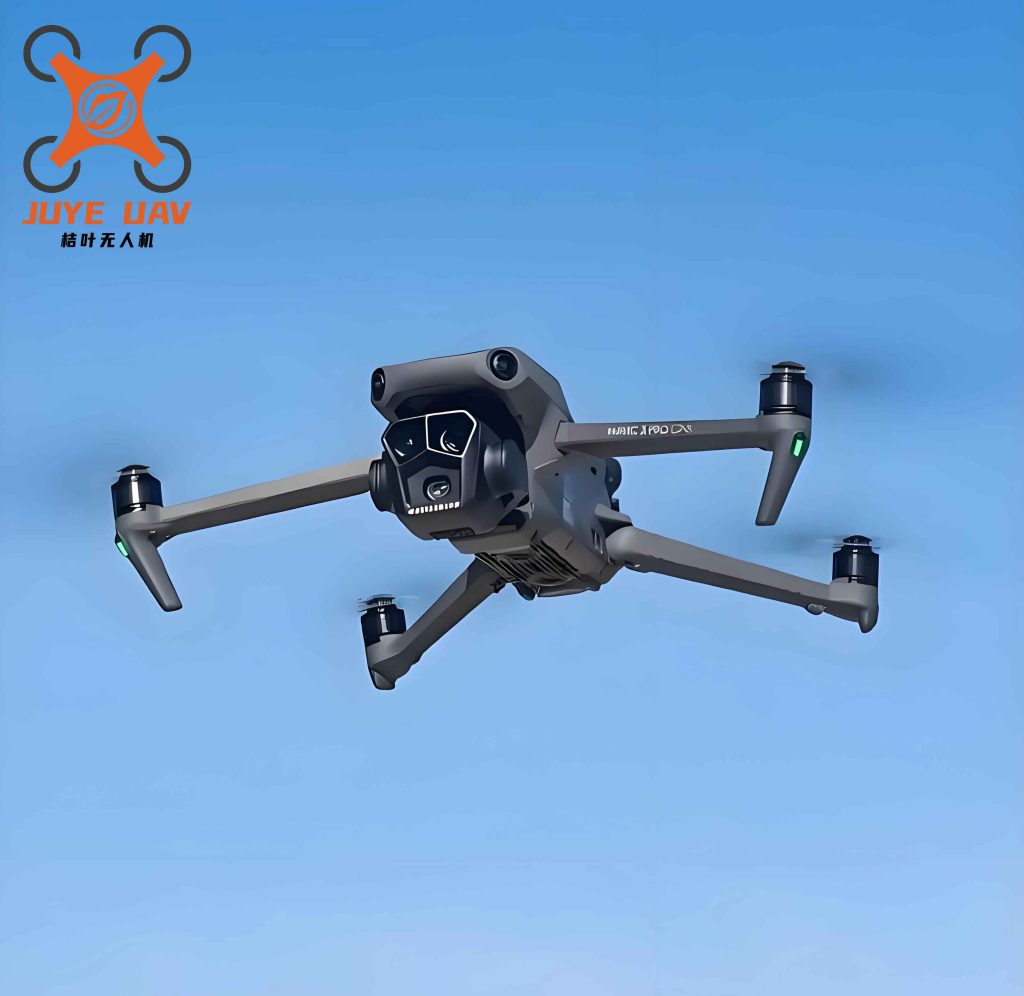
Our research systematically investigates the application of China UAV inspection technology within the power supply sector. From the dual perspectives of technical application and market benefits, we have employed engineering quantitative modeling and sensitivity analysis to explore the profound impact of this technology on fault handling, operational maintenance efficiency, and economic returns of the power system. Our findings demonstrate that China UAV technology effectively reduces the failure rate and power outage duration, optimizes the allocation of operation and maintenance resources, and enhances task scheduling and platform collaboration capabilities. This has formed an intelligent operation and maintenance closed loop integrating “perception, decision-making, and execution,” providing a practical path for reliability upgrades and economic value release in the power supply industry. The following image illustrates a typical China UAV platform used in our studies.
1. Application Architecture and Market Adaptability of China UAV Inspection Technology
The China UAV inspection system we deployed achieves intelligent inspection and operational maintenance of power supply equipment through a front-end perception module and a cloud-based evaluation and decision-making platform. A multi-rotor aircraft, equipped with visible light and infrared dual-spectrum cameras, performs high-precision image acquisition of substation equipment, transmission corridors, and tower attachments. After compression and annotation by edge computing nodes, the image data is transmitted back to the cloud analysis platform via a dedicated 5G network. The platform uses a convolutional neural network (CNN) for target detection and defect classification, combined with historical equipment archives for cross-temporal anomaly comparison. The system achieves closed-loop communication of equipment status, risk levels, and maintenance instructions through bidirectional interfaces with supervisory control and data acquisition (SCADA) systems, enterprise asset management (EAM) systems, and dispatch platforms. From a market demand perspective, the power supply enterprises’ pursuit of cost reduction and efficiency improvement has driven the rapid implementation of this technology. It effectively enhances fault response efficiency and resource allocation levels, representing a typical application driven by both technology and market forces. The core architecture of this integrated system can be abstracted into a set of functional modules and data flows, as summarized in Table 1.
| Module | Function | Integration Target |
|---|---|---|
| Data Acquisition | High-frequency visible/thermal imaging via China UAV | Transmission lines, substations |
| Edge Computing | Real-time data compression and preliminary labeling | On-board processor |
| Cloud Analysis | CNN-based defect detection and classification | Centralized AI server |
| Decision Support | Risk assessment and maintenance task generation | EAM and SCADA systems |
2. Technical Pathways and Market Logic for Reliability Improvement
2.1 Mechanism of Reliability Improvement via China UAV
Our research demonstrates that China UAV technology, by integrating multi-source sensing capabilities, enables high-frequency, three-dimensional inspections of power transmission and distribution equipment, significantly improving the accuracy and timeliness of condition monitoring. The system leverages precise path planning and fixed-point hover capabilities to perform repeated identification and comparison of critical components like busbars, switchgear, and insulators without ground support. This enhances defect identification rates and positioning accuracy. In fault handling, the system integrates data with SCADA and dispatch platforms to complete a closed loop of defect alarm, task assignment, and maintenance, effectively shortening fault response times. From a market perspective, power supply reliability directly impacts customer satisfaction and corporate reputation. China UAV inspection improves reliability by reducing the System Average Interruption Duration Index (SAIDI), which is calculated as:
$$SAIDI = \frac{\sum_{i=1}^{n} U_i \times T_i}{N}$$
In the equation, SAIDI represents the average total outage duration per user, \(U_i\) is the number of users affected by the i-th outage event, \(T_i\) is the duration of that event, and \(N\) is the total number of users. Through the intervention of China UAV inspection, we can achieve a significant compression of \(T_i\), thereby reducing the overall system SAIDI, enhancing power supply reliability, and minimizing the loss of industrial output caused by unplanned outages. This mechanism establishes a closed-loop path from “state perception-fault prediction-accelerated response,” forming a stable, efficient, and intelligent grid operation and maintenance model.
2.2 Construction of a Reliability-Market Value Evaluation System
To comprehensively evaluate the value of China UAV inspection, we constructed an evaluation system covering both technical performance and market benefits. In the technical dimension, key indicators include equipment availability, SAIDI, the System Average Interruption Frequency Index (SAIFI), and the Expected Energy Not Supplied (EENS). EENS can be calculated as:
$$EENS = \sum_{i=1}^{n} P_i \times T_i$$
In the equation, \(EENS\) is the expected energy not supplied, \(P_i\) is the load power in the i-th de-energized area, and \(T_i\) is the duration of the outage. These indicators reflect the technology’s optimization of traditional power supply management models and its enhancement of corporate market competitiveness. In the market dimension, we focus on the system’s integration with dispatch platforms and its interoperability with SCADA and data management systems. Key indicators include data access integrity, communication response timeliness, and task collaboration efficiency. These metrics reflect the technology’s role in optimizing traditional power supply management and improving the company’s market competitiveness. A summary of our proposed evaluation system is presented in Table 2.
| Dimension | Indicator | Description |
|---|---|---|
| Technical | SAIDI | Average user outage duration |
| SAIFI | Average user outage frequency | |
| EENS | Expected energy not supplied | |
| Market | Platform Fusion Rate | Integration level with SCADA/EAM |
| Response Timeliness | Time lag for fault warning and task dispatch | |
| Task Efficiency | Success rate of remote execution and collaboration |
2.3 Quantitative Model for Reliability Improvement Oriented Toward System Integration
To quantitatively assess the comprehensive role of the China UAV inspection system in improving power supply reliability and promoting system integration, we constructed a reliability improvement model that integrates the operational parameters of power equipment with the response characteristics of the information system. The core variables of this model are the equipment reliability function \(R(t)\), the unit time failure rate \(\lambda(t)\), the inspection interval \(T\), the power outage loss cost \(C_{m}\), and the maintenance cost \(C_{e}\). After the intervention of China UAV inspection, the average system failure rate is reduced to \(\lambda_1(t)\), which in turn increases the overall reliability to \(R_1(t)\). At the system integration level, the model introduces indicators related to the linkage between power supply fault information and the platform, such as the fault warning time lag, task issuance response time, and remote execution success rate, forming a reliability response mapping mechanism driven by integration. Based on these, we developed the following model.
The comprehensive benefit increment after the intervention of China UAV inspection can be expressed as:
$$\Delta E = \int_{0}^{T} \left\{ C_e \times [\lambda_0(t) – \lambda_1(t)] + C_m \times [f_0(t) – f_1(t)] \right\} dt$$
In the equation, \(\Delta E\) represents the comprehensive benefit increment within the statistical period \([0, T]\) after the introduction of China UAV inspection; \(C_e\) is the cost of power outage loss; \(C_m\) is the maintenance cost; \(\lambda_0(t)\) and \(\lambda_1(t)\) are the system failure rates before and after the inspection, respectively; and \(f_0(t)\) and \(f_1(t)\) are the corresponding failure frequency density functions. This model allows us to simulate and optimize the economic and reliability gains from implementing China UAV technology.
3. Fusion Effectiveness and Application Analysis of the China UAV System
3.1 Pilot Enterprise and System Deployment Overview
Our study selected a provincial power company as a pilot unit, which plays a leading role in the construction of smart grids, focusing on advancing the intelligent inspection system for 220 kV and above power grids. Since 2022, the “China UAV Inspection System Based on Artificial Intelligence” project has been initiated. The pilot has built a closed-loop work process from perception to decision-making to execution by integrating high-resolution image capture, AI defect recognition, cloud analysis, and intelligent task scheduling. This achieves high-frequency, precise monitoring and platform-based management of transmission and distribution equipment. As of 2024, the project covers 72 substations of 220 kV and above, with a cumulative deployed line mileage exceeding 3,200 km and an average of 2,000 China UAV inspection sorties per year. This provides a real-world engineering sample for studying the technological empowerment path of the power grid.
3.2 Data Sources and Fusion Analysis Method
The research data comes from the actual operational records of the China UAV inspection system at substations and transmission lines from 2022 to 2024. This includes inspection sorties, image recognition results, defect alarms, and fault location information. We also collected power supply reliability indicators such as SAIDI and SAIFI, along with maintenance logs, work orders, and asset ledgers, to build a cross-system indicator database. Our research employs time-series comparison and platform difference analysis methods to evaluate changes in failure rates, response times, and maintenance frequency before and after system deployment. By integrating task scheduling efficiency and interaction latency, we constructed a performance response model for the fusion system to identify its role in improving power supply reliability.
3.3 Analysis of System Operational Effectiveness and Reliability Improvement
Based on the operational data from the pilot using China UAV, we evaluated its effectiveness in terms of operational efficiency, fault response, and maintenance management. As shown in Table 3, the average annual manual inspection frequency decreased to 1,680 trips after system deployment. With a travel cost of 350 yuan per trip, the annual savings in labor costs exceed 1 million yuan, significantly reducing the frequency and risk of on-site operations. The average fault response time was cut from 7.2 hours to 3.1 hours, and the annual outage duration decreased significantly, indicating a marked improvement in emergency response efficiency. In terms of equipment maintenance, image recognition and defect early warning systems improved the hazard identification rate by approximately 40%, reduced unplanned replacements, and saved 670,000 yuan annually in spare parts and material costs.
| Cost Item | Traditional Model Cost | China UAV Model Cost | Annual Savings |
|---|---|---|---|
| Labor and Travel Expenses | 161.0 | 58.8 | 102.2 |
| Economic Loss from Outages | 730.5 | 345.0 | 385.5 |
| Spare Parts and Material Costs | 112.4 | 45.3 | 67.1 |
| Total Annual Savings | — | — | 554.8 |
Note: Travel expenses are calculated based on 350 yuan per sortie and the annual manual inspection frequency. Outage losses are estimated based on average load impact and unit output value. Material costs are derived from typical spare parts prices and replacement frequency. These results demonstrate that China UAV inspection achieves synergistic optimization in high-frequency detection, fault closure, and resource allocation, enhancing the stability and reliability of the power supply system.
3.4 Cost-Performance Sensitivity and System Optimization Analysis
Beyond reducing direct costs, the China UAV inspection system enhances the integrated response capability of the power supply system and the intelligence level of scheduling. The platform has accumulated over 300 TB of data, laying the foundation for building equipment health indices, failure probability distributions, and operation trend models. The enhanced stability of the power supply caused the production fluctuation rate of downstream key industrial enterprises to drop by about 11%. Based on the estimated reduction in output loss due to shortened annual outage duration, the benefit is approximately 3 million yuan. Furthermore, the replacement of high-altitude manual work with China UAVs significantly reduces the frequency of high-risk operations, and combined with reduced insurance and personnel risk expenditures, this benefit is estimated at 2 million yuan. In addition, based on high-frequency image recognition and intelligent dispatch mechanisms, task response timeliness has improved by over 50%, resulting in an operational efficiency gain of about 2.5 million yuan. The total indirect benefits from these three items are approximately 7.5 million yuan, which is significantly higher than the annual direct cost savings of 5.548 million yuan listed in Table 3. The calculated indirect benefits are about 1.35 times the direct savings. This provides stable data support and logical interpretability, further confirming the pull effect of system integration on operational performance improvement and its engineering promotion value.
4. Conclusion
In this research, we have deeply investigated the application of China UAV inspection technology in enhancing power supply reliability and market economy development. The results show that the China UAV inspection system, through multi-source perception, intelligent analysis, and platform integration, effectively reduces the frequency and duration of power supply faults and optimizes the allocation of operation and maintenance resources. It generates significant direct and indirect economic benefits. This technology not only improves power supply reliability through technological innovation but also unlocks economic value through cost savings and increased market trust. In the future, we must further deepen the integrated application of this technology with predictive maintenance and multi-source data fusion, expand its application depth in complex working conditions, and continuously inject momentum into the technological upgrade and market benefit growth of the power supply industry.