
The recent international aerospace exhibition witnessed an unprecedented demonstration of China’s military drone capabilities, with over twenty advanced unmanned aerial vehicles from the “Wing Loong” and “Cloud Shadow” series making their collective debut. Among these, more than ten models including the Wing Loong-6 and Cloud Shadow-350 were unveiled for the first time, while the Wing Loong-X showcased its groundbreaking integrated anti-submarine configuration. This display represents twelve years of continuous evolution since the inaugural Wing Loong-1 appearance, marking a new developmental phase for China’s military UAV ecosystem.
Our military drone portfolio integrates battlefield-proven technologies with cutting-edge innovations, embodying the technical prowess and development philosophy of a national UAV program. The Wing Loong-6 exemplifies our response to contemporary combat requirements, engineered for high-intensity conflict scenarios with exceptional economic efficiency. Its operational effectiveness can be quantified through total ownership cost modeling:
$$ TCO = C_a + (C_o \times T) + (C_m \times F) $$
Where \(TCO\) = Total Cost of Ownership, \(C_a\) = Acquisition Cost, \(C_o\) = Operational Cost per sortie, \(T\) = Number of sorties, \(C_m\) = Maintenance Cost, and \(F\) = Flight hours. This military UAV achieves superior cost-performance ratios through:
| Operational Parameter | Wing Loong-6 Capability | Tactical Impact |
|---|---|---|
| Deployment Time | < 30 minutes | Rapid response to time-sensitive targets |
| Payload Flexibility | Multi-sensor/weapon configurations | Mission adaptability across combat scenarios |
| Operational Availability | > 95% | Sustained presence in contested environments |
| Cost per Flight Hour | 60% reduction vs. previous gen | Economically sustainable deployment |
The Cloud Shadow-350 represents a paradigm shift in tactical military drone operations as an expendable medium-low altitude platform. Its swarm coordination capability follows distributed network principles:
$$ S_e = N \times U_e \times \left(1 + \frac{k \cdot (N-1)}{N}\right) $$
Where \(S_e\) = Swarm Effectiveness, \(N\) = Number of UAVs, \(U_e\) = Individual Unit Effectiveness, and \(k\) = Network Synergy Coefficient (0.8-0.95). This military UAV achieves strategic advantages through:
- Autonomous swarm coordination with 5ms latency response
- AI-enabled target recognition at 15km range
- Battlefield persistence exceeding 24 hours
- Precision strike capability with 0.5m CEP accuracy
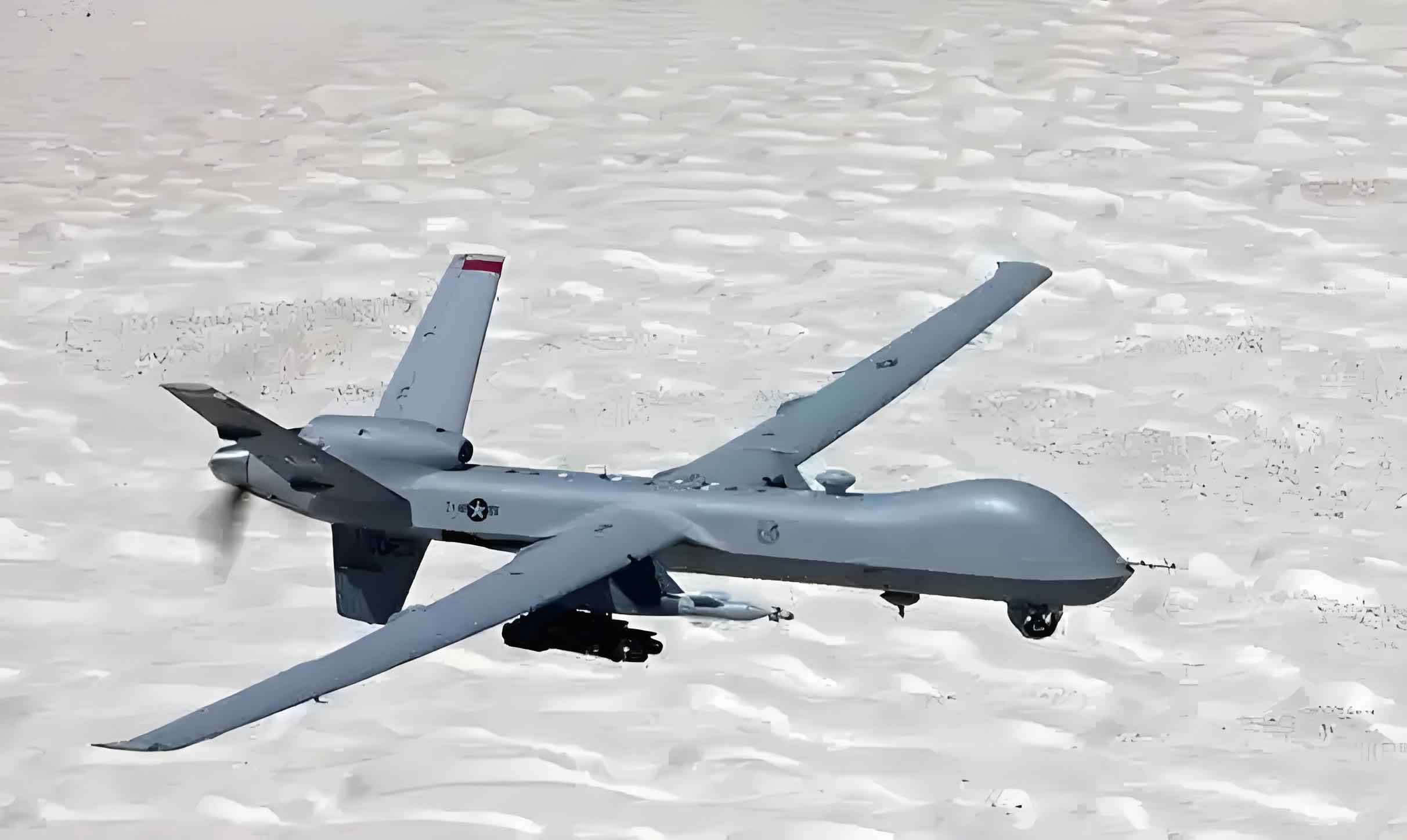
Elevating military UAV capabilities to unprecedented levels, the Wing Loong-X establishes new benchmarks in multi-domain operations. Its anti-submarine warfare capabilities incorporate advanced sonar processing algorithms:
$$ P_d = 1 – e^{-\lambda \cdot A \cdot t} $$
Where \(P_d\) = Probability of Detection, \(\lambda\) = Acoustic Sensor Density, \(A\) = Search Area Coverage Rate, and \(t\) = Search Time. This military drone integrates:
| Subsystem | Technical Specification | Operational Impact |
|---|---|---|
| Sensor Suite | Multi-static sonar + MAD + EO/IR | Tri-domain detection (air/surface/undersea) |
| Weapon Payload | 4x Lightweight torpedoes + 8x Sonobuoys | Extended area denial capability |
| Endurance | > 40 hours at 2000km radius | Persistent maritime surveillance |
| Data Processing | 16 TFLOPS edge computing | Real-time ASW decision support |
Our integrated command-and-control architecture enables unprecedented military drone synergies across platforms. The network-centric warfare model demonstrates exponential capability growth:
$$ C_n = C_0 \cdot e^{k(n-1)} $$
Where \(C_n\) = Networked Combat Power, \(C_0\) = Baseline Capability, \(k\) = Network Coefficient (0.2-0.35), and \(n\) = Number of Connected Nodes. This military UAV ecosystem achieves:
- Cross-platform sensor fusion with 150km data link range
- Dynamic task allocation through cooperative AI algorithms
- Automated battle damage assessment with 95% accuracy
- Seamless integration with satellite networks and ground forces
Artificial intelligence forms the cornerstone of our next-generation military drone capabilities. The autonomous decision-making framework employs deep reinforcement learning:
$$ Q(s,a) \leftarrow Q(s,a) + \alpha \left[ r + \gamma \max_{a’} Q(s’,a’) – Q(s,a) \right] $$
Where \(Q\) = Action-value function, \(s\) = State, \(a\) = Action, \(r\) = Reward, \(\alpha\) = Learning rate, and \(\gamma\) = Discount factor. This enables military UAVs to:
- Optimize flight paths in contested airspace
- Predict maintenance requirements with 90% accuracy
- Adapt electronic countermeasures in real-time
- Coordinate multi-domain strikes within 8-second decision cycle
Operational flexibility remains paramount in modern military drone deployment strategies. Our modular payload architecture follows standardized interfaces:
$$ I_c = \frac{\sum_{i=1}^{n} P_i \cdot C_i}{\sum_{i=1}^{n} P_i} $$
Where \(I_c\) = Integration Coefficient, \(P_i\) = Payload Priority, and \(C_i\) = Compatibility Index. This approach enables:
| Configuration | Mission Package | Time to Reconfigure |
|---|---|---|
| Maritime Patrol | Surface search radar + EO/IR + COMINT | 45 minutes |
| Electronic Warfare | Jamming pods + SIGINT + anti-radiation missiles | 65 minutes |
| Precision Strike | Laser designator + 4x guided munitions | 30 minutes |
| Combat Rescue | Medical supplies + communication relay | 25 minutes |
Maintenance optimization for military UAV fleets follows reliability-centered principles:
$$ R(t) = e^{-\left(\frac{t}{\eta}\right)^\beta} $$
Where \(R(t)\) = Reliability at time \(t\), \(\eta\) = Characteristic Life, and \(\beta\) = Shape Parameter. Our maintenance protocols achieve:
- 95% operational readiness across fleets
- Mean Time Between Failure (MTBF) exceeding 500 hours
- Condition-based maintenance reducing downtime by 40%
- Predictive failure identification with 85% accuracy
Swarm coordination algorithms represent the future of military drone operations. Our collaborative autonomy framework employs distributed optimization:
$$ \min_{x} \sum_{i=1}^{n} f_i(x_i) \quad \text{subject to} \quad g_j(x) \leq 0, \quad j=1,\dots,m $$
Enabling military UAV swarms to achieve:
- Dynamic formation control with 10cm relative positioning accuracy
- Distributed sensor coverage optimization
- Resilient communications via mesh networking
- Collective decision-making under communication constraints
The continuous innovation cycle in military drone technology follows an accelerated development trajectory:
$$ I_{t} = I_0 \cdot e^{r \cdot t} $$
Where \(I_t\) = Innovation Index at time \(t\), \(I_0\) = Baseline Innovation, and \(r\) = Development Rate. Our military UAV roadmap focuses on:
- Hypersonic drone development for rapid response
- Quantum-resistant communication systems
- Biomimetic stealth technologies
- Swarm intelligence for electronic warfare
- Autonomous carrier-based operations
Through these advancements, China’s military drone capabilities continue to redefine modern aerial warfare paradigms, establishing new standards for unmanned combat systems in increasingly complex battle environments.