
For over three decades, the field of bio-inspired robotics has been captivated by the flight of insects. Among this diverse group, the butterfly stands out with its unique and mesmerizing flight pattern. Unlike many insects capable of precise hovering, or birds that utilize tail feathers for control, butterflies possess a distinct, low-frequency, graceful flapping motion. This very distinctiveness, coupled with the inherent advantages of low noise and potentially efficient low-power operation, has driven significant research interest. This article, from our perspective as researchers deeply immersed in this field, synthesizes the progress, confronts the ongoing challenges, and envisions the future of Butterfly Inspired Flapping Wing Air Vehicles (BIFAVs), which we often refer to as bionic butterfly drone platforms.
The pursuit of a functional bionic butterfly drone rests on two foundational pillars: first, understanding and replicating the mechanisms that generate sufficient lift and thrust to overcome gravity and propel forward flight; and second, devising methods to achieve stable and controllable flight. We begin our exploration here, at the core of their flight mechanics.
The lift and thrust generation in butterflies is primarily governed by a “drag-based” principle. During the powerful downstroke, the wings are fully extended, presenting a large area to the oncoming air. This creates a massive transient drag force. Research, including numerical simulations solving Navier-Stokes equations, has shown that this downstroke generates a strong vortex ring consisting of a leading-edge vortex, wingtip vortices, and a starting vortex. The reaction force to the jet of air entrained in this vortex ring provides the crucial lift. The aerodynamic forces can be described by:
$$ V = d\cos\beta + l\sin\beta $$
$$ T = -d\sin\beta + l\cos\beta $$
where $V$ is the vertical lift force, $T$ is the horizontal thrust force, $d$ is the drag force, $l$ is the lift force from circulation (though minimal in this mode), and $\beta$ is the body angle of attack. The lift coefficient $C_V$ is given by:
$$ C_V = \frac{V}{0.5 \rho U^2 S} $$
where $\rho$ is air density, $U$ is reference velocity, and $S$ is wing area. In contrast, the upstroke is key for forward propulsion. The body pitches up, and the wings are swept upwards and backwards. Crucially, butterflies exhibit wing flexibility and clap-and-peel or lead-and-lag motion between forewings and hindwings, reducing the projected area during the upstroke to minimize negative lift while still producing useful thrust. This asymmetric force generation between half-strokes is the fundamental cycle for a bionic butterfly drone.
Stability is another fascinating aspect. Without a tail or the ability for ultra-rapid wing reversals like flies, butterflies employ a coupled body-wing strategy. High-speed videography has revealed that abdominal oscillations play a critical role. The abdomen acts as a movable mass, dynamically adjusting the vehicle’s center of gravity and moment of inertia. This coupling between thoracic (wing) motion and abdominal undulation provides a passive-active stabilization mechanism. Studies modeling the butterfly as a multi-hinged rigid body have demonstrated that abdominal motion expands the region of attraction for stable periodic flight, improves convergence to a desired trajectory, and can even enhance energy efficiency. Implementing this body articulation presents a sophisticated control opportunity for a bionic butterfly drone to achieve robust flight.
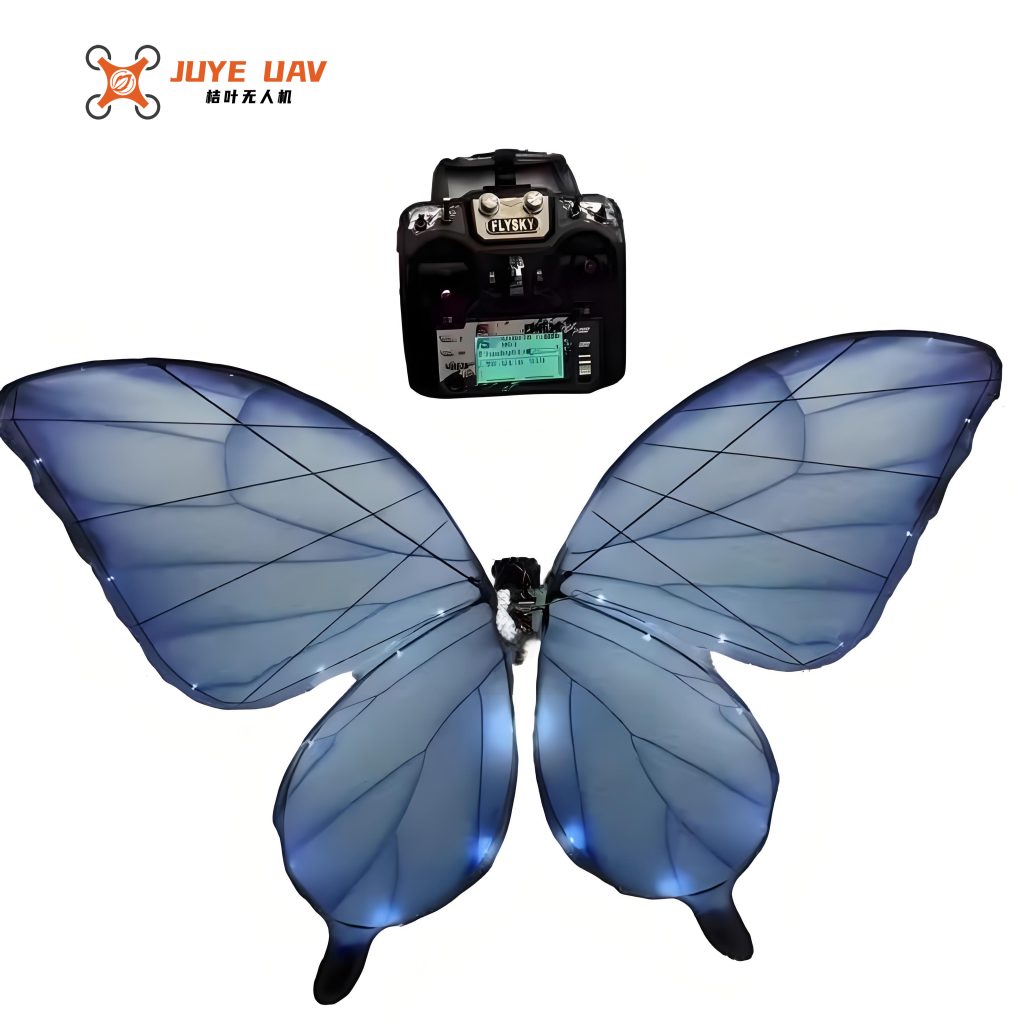
The physical manifestation of these principles lies in the structural design and manufacturing of the bionic butterfly drone. Two primary structural paradigms have emerged: the four-wing (biplane-inspired) design and the two-wing (monoplane-inspired) simplification. The four-wing design more closely mimics nature, with separate forewings and hindwings that can interact. A prominent example is the eMotionButterfly by Festo, with a 50 cm wingspan and a mass of 32 g. Its wings use a carbon fiber frame covered with an elastic capacitive film. Other groups have developed similar prototypes, often featuring a flexible hinge between the forewing and hindwing to facilitate the area-changing “clap and fling” motion. The two-wing design simplifies the mechanical complexity by treating the left and right wings as single, continuous membranes. While less biomimetic in detail, it reduces manufacturing hurdles and has yielded functional prototypes with wingspans around 50-65 cm and masses between 38-50 g.
The manufacturing of these large, lightweight, yet durable wings is a craft in itself. The wing frame or venation pattern is typically constructed from ultra-high modulus carbon fiber rods or pre-preg strips to achieve maximum strength-to-weight ratio. The wing membrane is often a thin polyester (PET) or polyimide film. The critical challenge is bonding the membrane to the frame. Methods range from simple adhesive tapes (for simple geometries) to using micro-sleeves and cyanoacrylate glue, to advanced vacuum-bag curing processes for carbon fiber pre-pregs. The latter results in a monolithic, lightweight wing with excellent membrane-frame adhesion. The airframe and mechanical linkages are frequently fabricated using laser-cut carbon fiber sheets or 3D-printed polymers. A summary of key structural parameters from notable bionic butterfly drone projects is presented below.
| Designation | Wingspan (cm) | Mass (g) | Wing Configuration | Flapping Freq. (Hz) | Wing Mass Fraction (%) |
|---|---|---|---|---|---|
| eMotionButterfly | 50.0 | 32.0 | Four-wing | ~3 | N/A |
| IBA Prototype A | 49.8 | 32.2 | Four-wing | ~1 | N/A |
| IBA Prototype B | 64.8 | 38.6 | Two-wing | ~2 | ~21 |
| USTButterfly-S | 50.0 | 50.0 | Four-wing | 1-5 | ~34 |
Actuation and control are what breathe life into the bionic butterfly drone. Given the relatively large wingspan and high drag forces, the drive system must deliver high torque at low rotational speeds. Servo motors (geared DC motors with feedback) have become the de facto standard for direct drive, where each wing is connected to a servo output shaft. This elegantly solves the need for high torque and low frequency (1-5 Hz) but adds mass. The relationship between actuator technology and vehicle scale is clear: electromagnetic motors dominate at the gram to hundreds of gram scale, where our bionic butterfly drone currently resides, while piezoelectric and electrostatic actuators are more suited for sub-gram micro-robots.
Beyond direct drive, researchers have explored various transmission mechanisms to convert rotary motor motion into the desired flapping kinematics. Four-bar linkages, crank-slider mechanisms, and even novel designs to produce a figure-eight wingtip trajectory have been investigated. For instance, a specialized “8-shaped” mechanism was developed to potentially increase lift compared to simple arc-like flapping. Another innovative approach for a bionic butterfly drone uses a single coreless motor with a gearbox to drive both wings symmetrically, while a separate micro-servo controls steering via tendons (wires) that differentially adjust wing roots. This decouples thrust generation from attitude control. The power source is almost invariably a high-energy-density lithium polymer battery, though concepts using elastic energy storage (like rubber bands) for short demonstrations have been explored.
Flight control for a tailless bionic butterfly drone is inherently challenging. Inspired by insect flight control, the primary method is to generate asymmetric forces between the left and right wings. This is directly achievable in servo-driven designs by commanding different amplitudes or mid-stroke angles to each servo. Rolling is induced by a sustained difference in lift. Pitching can be controlled by shifting the net lift vector fore or aft, often by collectively changing the wing stroke angle or root pitch. Yaw control is more subtle, requiring a differential in horizontal drag or thrust, which can be modulated by asymmetrically changing the wing’s angle of attack during parts of the stroke. The control loop is typically closed using an onboard inertial measurement unit (IMU) for attitude feedback, with an STM32-class microcontroller running PID or more advanced nonlinear control algorithms. More advanced systems integrate external motion capture or onboard cameras for navigation.
The drive system is paramount for achieving lift-off. The required servo torque $ au_{req}$ must overcome the aerodynamic drag torque on the wing, which scales with the square of the flapping frequency $f$, the cube of the wing length $R$, and the drag coefficient $C_D$:
$$ au_{req} propto rac{1}{2} ho C_D f^2 R^3 c $$
where $c$ is the mean chord length. This highlights the critical trade-off: reducing size ($R$) drastically reduces torque requirements, but maintaining sufficient lift area becomes harder. The following table analyzes drive parameters from existing prototypes, underscoring the importance of sufficient torque-to-weight ratio in the actuator.
| Prototype | Drive Type | Actuator Mass (g) | Stall Torque (kgf·cm) | Drive Mass Fraction (%) | Sustained Flight |
|---|---|---|---|---|---|
| IBA Prototype A | Servo Direct-Drive | ~7.4 | ~0.55 | ~23 | No |
| IBA Prototype B | Servo Direct-Drive | ~15.0 | ~3.3 | ~39 | Yes |
| USTButterfly-S | Motor + Tendon | ~15.3 | N/A | ~31 | Yes |
Despite inspiring progress, the development of a fully capable bionic butterfly drone faces significant research challenges that must be overcome to transition from laboratory curiosities to practical platforms.
1. Scale: Current prototypes are “miniature” rather than “micro.” With wingspans around 50 cm and masses of 30-50 g, they are orders of magnitude larger than a real butterfly. True insect-scale operation (wingspan < 15 cm, mass < 5 g) requires a revolutionary integration of lightweight materials, micro-actuators, and micro-electronics. The actuator challenge is particularly acute, as the torque scaling laws are unforgiving.
2. Flight Agility and Robust Control: While basic forward flight and gentle turns have been demonstrated, the agile, darting, and wind-resistant flight of a real butterfly remains elusive. Achieving rapid roll, pitch, and yaw maneuvers requires high-bandwidth control actuators and sophisticated dynamic models that account for unsteady aerodynamics and body-wing coupling. Furthermore, current control systems often lack robustness to external disturbances like gusts, limiting outdoor operation. Implementing robust sensor fusion and adaptive control for the bionic butterfly drone is an open area.
3. Endurance: Flight times are typically limited to 3-5 minutes, primarily constrained by battery energy density and the efficiency of the drive train. Improving aerodynamic efficiency through optimized wing kinematics and flexible wing structures that passively store and release energy could extend endurance. Co-designing the wing structure, transmission, and motor for peak efficiency is essential for a practical bionic butterfly drone.
4. Biomimetic Fidelity and Functional Morphology: Most current designs are biomimetic only in gross form. The intricate venation patterns of a butterfly wing, which provide tailored stiffness distribution leading to complex, beneficial deformations, are often simplified to a perimeter frame. The synergistic interaction between forewing and hindwing is rarely fully captured. There is vast potential in exploring “functional biomimetics,” where the detailed morphological features are reproduced not for aesthetics but for measurable aerodynamic or structural benefit. This includes graded stiffness wings and dynamic wing area control.
The future trajectory for bionic butterfly drone research is therefore multi-faceted and demanding. We anticipate efforts will concentrate on several key frontiers:
First, miniaturization and integration will be a primary driver. This involves developing custom, high-torque-density micro-actuators, perhaps using novel materials like shape memory alloys or twisted and coiled polymers (TCPs). Advanced composite manufacturing, possibly using additive manufacturing for graded stiffness wings, will be crucial. The goal is a bionic butterfly drone that genuinely matches the scale of its biological counterpart.
Second, research will push towards enhanced autonomy and agility. This encompasses the integration of lightweight, low-power sensors for onboard state estimation and environment perception (e.g., optic flow sensors). It also requires the development of nonlinear and adaptive flight control algorithms that can handle the inherently unstable, nonlinear dynamics of flapping flight and exploit the stabilizing role of body articulation, like abdominal movement.
Third, a deeper dive into functional biomimetics will occur. Instead of simply copying the shape, future work will focus on reverse-engineering the functional principles of the butterfly’s wing structure, material composition, and kinematic patterns. Computational co-design tools combining aerodynamic simulation, structural mechanics, and optimization algorithms will be used to create wings that are not just light, but intelligently flexible, providing passive stability and efficiency benefits.
Finally, the ultimate aim is to transition the bionic butterfly drone from a research platform to an application-ready system. Potential use cases are in areas where their low acoustic signature and bird-like appearance are advantageous: discreet environmental monitoring, pollination assistance in controlled agriculture, or crowd-friendly aerial displays. Realizing these applications will require solving the challenges of durability, operational reliability, and swarm coordination in unstructured environments.
In conclusion, the journey to create a truly autonomous, efficient, and agile bionic butterfly drone is a profound interdisciplinary challenge, spanning fluid dynamics, materials science, robotics, and control theory. While significant strides have been made in understanding the flight mechanics and constructing first-generation prototypes, the path ahead requires innovations at the intersection of these fields. By embracing deeper biomimicry, advancing micro-scale engineering, and developing intelligent control systems, the vision of a robotic butterfly seamlessly blending into and interacting with our world moves closer to reality. The continued exploration of this fascinating bio-inspired platform promises not only technological advancement but also a deeper appreciation for the elegant complexity of natural flight.