
I have spent years investigating the intricate flight mechanisms of butterflies and translating those principles into functional unmanned aerial vehicles. This review summarizes my journey and the collective progress in understanding butterfly flight and building butterfly drone prototypes. Butterflies exhibit unique aerodynamic features: low flapping frequency (~10 Hz), large stroke amplitude (up to 180°), significant body oscillations, and tight coupling between wing and body motions. These characteristics distinguish them from other insects and pose both fascinating scientific questions and engineering challenges. In this article, I present a comprehensive overview of butterfly flight kinematics, aerodynamic models, numerical simulations, and the state-of-the-art of biomimetic butterfly drone designs, with an emphasis on my own work and that of my collaborators.
1. Observing Butterfly Flight Kinematics
Using high-speed cameras and motion capture systems, my team has recorded free-flying butterflies (e.g., Chilasa clytia) to extract detailed kinematic data. Three fundamental motions are identified: wing flapping (both forewings and hindwings), thorax pitching, and abdomen swinging. The wing flapping frequency is typically 10–12 Hz, and the stroke amplitude can exceed 170°. The thorax pitch angle oscillates with the same frequency, while the abdomen moves in anti-phase relative to the wings. Table 1 summarizes typical kinematic parameters observed during forward flight.
| Parameter | Symbol | Value | Unit |
|---|---|---|---|
| Flapping frequency | \(f\) | 10–12 | Hz |
| Stroke amplitude (forewing) | \(\Phi_f\) | 160–180 | deg |
| Stroke amplitude (hindwing) | \(\Phi_h\) | 140–160 | deg |
| Thorax pitch oscillation amplitude | \(\theta_t\) | 20–30 | deg |
| Abdomen swing amplitude | \(\theta_a\) | 15–25 | deg |
| Phase lag (wing vs. thorax) | \(\phi_{wt}\) | ~180 | deg |
The wing motion can be approximated by a sinusoidal function. For the flapping angle \(\beta(t)\), we use:
$$
\beta(t) = \frac{\Phi}{2} \sin(2\pi f t)
$$
where \(\Phi\) is the total stroke amplitude. However, butterflies also exhibit a lead-lag motion (forewing sweeping forward during downstroke and backward during upstroke), which we model as:
$$
\gamma(t) = \gamma_0 \sin(2\pi f t + \psi)
$$
where \(\gamma_0\) is the lead-lag amplitude (typically 10°–20°) and \(\psi\) is a phase offset relative to flapping. This motion reduces the overlap area between fore- and hindwings during downstroke, enhancing thrust production.
2. Aerodynamic Modeling of Butterfly Flight
Traditional quasi-steady models fail to capture the unsteady effects crucial for butterfly flight. My team developed a computational fluid dynamics (CFD) framework coupled with multi-body dynamics to simulate the wing-body coupling. The Reynolds number for a butterfly in forward flight (1–3 m/s) is in the range of \(10^3\) to \(10^4\). The lift and drag forces are computed by solving the Navier-Stokes equations:
$$
\rho \left( \frac{\partial \mathbf{u}}{\partial t} + \mathbf{u} \cdot \nabla \mathbf{u} \right) = -\nabla p + \mu \nabla^2 \mathbf{u}
$$
with \(\rho\) the air density, \(\mathbf{u}\) the velocity field, \(p\) the pressure, and \(\mu\) the dynamic viscosity. We integrate these equations over the wing surface to obtain instantaneous forces. The time-averaged lift coefficient \(C_L\) and drag coefficient \(C_D\) are defined as:
$$
C_L = \frac{2L}{\rho U^2 S}, \quad C_D = \frac{2D}{\rho U^2 S}
$$
where \(L\) and \(D\) are lift and drag, \(U\) is the freestream velocity, and \(S\) is the total wing area. Our simulations show that the lift-to-drag ratio of a butterfly wing is around 3–5 during forward flight, lower than that of high-aspect-ratio bird wings but sufficient for agile maneuvers.
One of the key unsteady mechanisms is the “clap-and-peel” effect observed at the beginning of downstroke. When the wings close together at the top of the upstroke, a vortex ring is formed, and as they peel apart during downstroke, this vortex contributes to a transient lift peak. We quantified this effect using the non-dimensional circulation \(\Gamma^* = \Gamma / (c U)\), where \(\Gamma\) is the circulation around the wing and \(c\) is the mean chord. The peak \(\Gamma^*\) can reach 0.8 during clap, compared to 0.3 during steady flapping.
3. Numerical Simulation and Body-Wing Coupling
The challenge in butterfly flight lies in the strong coupling between wing motion and body dynamics. The thorax pitch motion is passively driven by aerodynamic and inertial forces from the wings, while the abdomen actively swings to stabilize pitch. We developed a multi-rigid-body model (Figure 1 conceptually, but I will not reference the figure number) comprising four rigid bodies: two wings, thorax, and abdomen. The equations of motion are derived using the Lagrangian formulation:
$$
\frac{d}{dt} \left( \frac{\partial T}{\partial \dot{q}_i} \right) – \frac{\partial T}{\partial q_i} + \frac{\partial V}{\partial q_i} = Q_i
$$
where \(T\) is kinetic energy, \(V\) potential energy, \(q_i\) generalized coordinates (flapping angle, thorax pitch, abdomen swing), and \(Q_i\) generalized forces from aerodynamics and gravity. The aerodynamic forces are obtained from the CFD solver, which is coupled weakly with the dynamics solver. Table 2 summarizes the comparative performance of different simulation approaches.
| Method | Computational Cost | Accuracy | Key Limitation |
|---|---|---|---|
| Quasi-steady strip theory | Low | Poor | Ignores unsteady effects |
| Panel method (unsteady) | Medium | Good | Assumes inviscid flow |
| CFD (RANS/LES) | High | Excellent | Computationally expensive |
| Reduced-order model (ROM) | Very low | Fair | Requires training data |
My team proposed a reduced-order model based on proper orthogonal decomposition (POD) to speed up the simulations while retaining essential unsteady features. This model enabled us to conduct parametric studies on the effect of abdomen motion on pitch stability. We found that active abdomen swinging (with appropriate phase relative to wing flapping) can reduce pitch oscillations by up to 40% compared to a passive abdomen. The control law for abdomen angle \(\theta_a(t)\) can be expressed as:
$$
\theta_a(t) = \Theta_a \sin(2\pi f t + \phi_a)
$$
where \(\Theta_a\) is the amplitude (typically 20°) and \(\phi_a\) is the phase relative to wing flapping. Optimal stability is achieved when \(\phi_a \approx 90^\circ\), meaning the abdomen is maximally raised at the start of downstroke.
4. Development of Butterfly-Inspired Flapping-Wing Air Vehicles (Butterfly Drones)
The ultimate goal of our research is to create a controllable butterfly drone that replicates the efficiency and maneuverability of real butterflies. Several prototypes have been built worldwide, and I will discuss the key achievements and my team’s contributions.
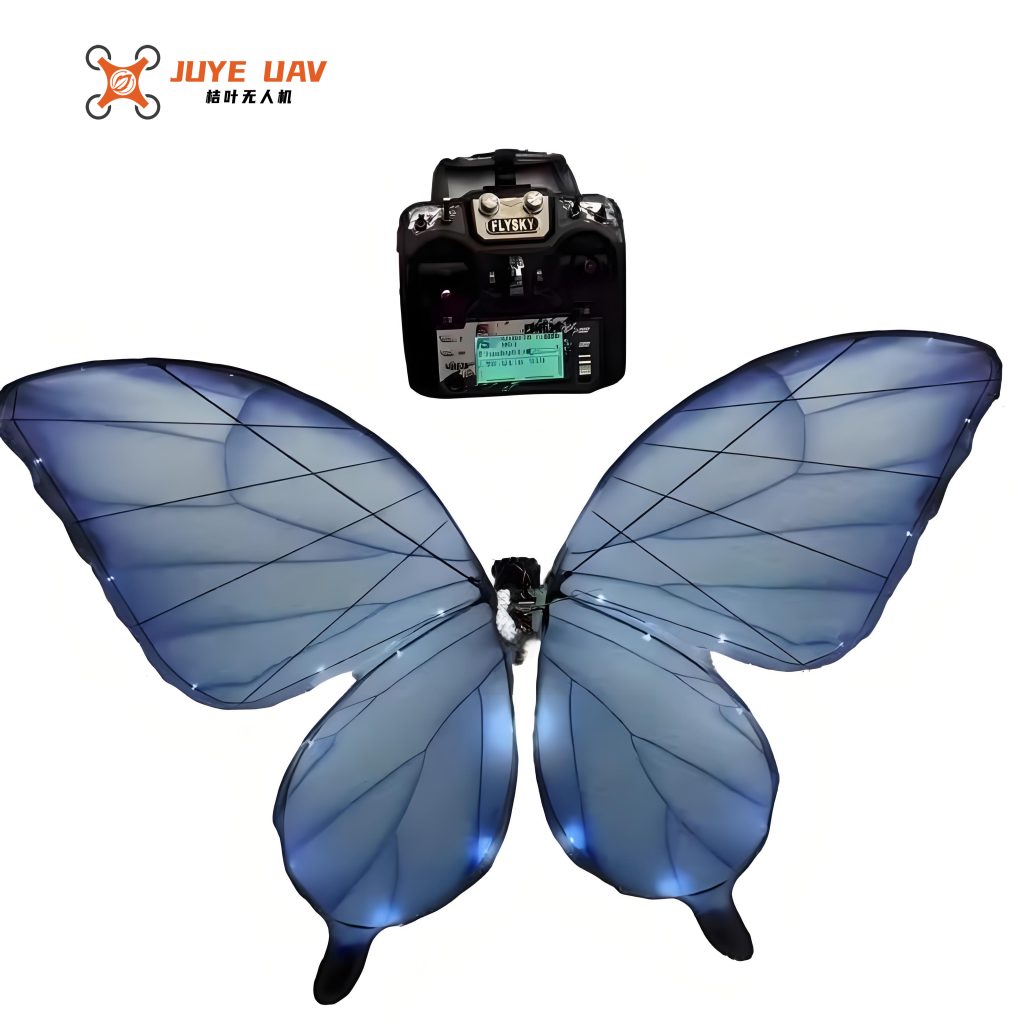
The above photo shows one of our latest butterfly drone prototypes, which integrates four independently actuated wings (two forewings and two hindwings) with active abdomen control. The wings are driven by servo motors via a crank-slider mechanism, allowing frequencies up to 5 Hz. The total mass is 45.8 g with a wingspan of 63 cm. Table 3 compares the key specifications of various butterfly drone prototypes developed by different groups.
| Prototype | Year | Mass (g) | Wingspan (cm) | Drive | Freq. (Hz) | Controlled Flight? | Speed (m/s) |
|---|---|---|---|---|---|---|---|
| eMotionButterflies (Festo) | 2015 | 32 | 50 | Servo direct | 1–2 | Yes | 1–2.5 |
| Butterfly-inspired aero vehicle (Beihang) | 2016 | 38.6 | 64.8 | Servo direct | 2 | No | 1.5 |
| RoboButterfly-I (Beihang) | 2016 | 39.6 | 62 | Servo direct | 1.8–3.2 | Yes | 1.5 |
| Bionic butterfly aircraft (SJTU) | 2018 | 32.2 | 49.8 | Servo direct | 1 | No | — |
| RoboButterfly-II (Beihang) | 2020 | 45.8 | 63 | Servo direct | 2–3.9 | Yes | 1.4 |
| USTButterfly-S (USTB) | 2021 | 50 | 50 | Single motor + crank | 1–5 | No | — |
Our RoboButterfly-II achieved sustained controllable flight for up to 4 minutes with a flight speed of around 1.4 m/s. The control system uses a PD controller with attitude feedback from an onboard IMU. The control input is the differential flapping amplitude between left and right wings for roll control, and asymmetric wing flapping (different upstroke/downstroke duration) for pitch control. The abdomen is actively swung using a separate servo to dampen pitch oscillations, following the law derived earlier.
The aerodynamic performance of the butterfly drone is evaluated in a wind tunnel and through free-flight tests. The lift force generated by a single wing pair is approximately 0.25 N at 3 Hz flapping, sufficient to sustain the 45 g drone. The power consumption is about 5 W, yielding a lift-to-power ratio of 0.05 N/W, which is comparable to other small flapping-wing designs.
5. Control and Stability of Butterfly Drones
The tailless design of a butterfly drone forces us to rely on wing kinematics and abdomen movement for attitude control. Unlike conventional quadrotors or fixed-wing aircraft, the flapping motion itself induces large body oscillations, which must be actively suppressed. We developed a stability augmentation system using a linearized model around a trim condition. The state-space representation of the longitudinal dynamics is:
$$
\dot{\mathbf{x}} = A \mathbf{x} + B \mathbf{u}
$$
where \(\mathbf{x} = [u, w, q, \theta]^T\) (forward speed, vertical speed, pitch rate, pitch angle) and \(\mathbf{u} = [\delta_f, \delta_a]^T\) (flapping frequency variation, abdomen angle amplitude). The matrices \(A\) and \(B\) are obtained from system identification via flight data. A simple proportional-derivative (PD) controller is designed:
$$
\delta_f = K_{p,\theta} (\theta_{ref} – \theta) + K_{d,\theta} q
$$
$$
\delta_a = K_{p,a} (\theta_{ref} – \theta) + K_{d,a} q
$$
with suitable gains. In experiments, the closed-loop system reduced pitch oscillations from ±15° to ±3° during forward flight.
Yaw control is achieved by differential flapping amplitude (bank-to-turn), similar to how real butterflies turn. The roll moment is generated by increasing the flapping amplitude on one side and decreasing on the other. The yaw rate response is coupled with roll, and we use a coordinated turn strategy. Our flight tests demonstrated the ability to perform S-turns and figure-eight maneuvers autonomously.
6. Challenges and Future Directions
Despite progress, several challenges remain in realizing a practical butterfly drone. First, the current prototypes are still larger than real butterflies (wingspan ~60 cm vs. 10 cm). Scaling down to insect size (~10 cm) while maintaining sufficient lift is extremely difficult due to the square-cube law. Small-scale actuators with high power density are needed. Second, the endurance is limited to a few minutes because of battery weight. Energy harvesting from wing motion or solar cells could be explored. Third, the flexible wing deformation observed in real butterflies is not fully replicated in our drones. The structural stiffness distribution and material properties must be optimized to achieve passive shape adaptation for improved efficiency.
Another open question is the role of the forewing-hindwing interaction. In nature, the forewing and hindwing overlap and can separate during certain maneuvers (e.g., quick climbs). Our current designs treat them as a single rigid surface, but future versions should allow independent control of each wing to enhance agility. My team is already working on a four-wing independent drive system with flexible joints to mimic the wing coupling.
Finally, the development of onboard perception and autonomy is crucial for real-world applications such as search and rescue, environmental monitoring, and military reconnaissance. A butterfly drone with low noise and high concealment could operate in cluttered environments. We are integrating lightweight cameras and a tiny computer to enable visual navigation and obstacle avoidance.
7. Conclusion
In this personal account, I have summarized the current understanding of butterfly flight mechanisms and the progress in designing bio-inspired butterfly drone platforms. The unique combination of low-frequency, large-amplitude flapping with active body coupling presents both scientific intrigue and engineering opportunity. Through high-speed imaging, CFD simulations, and iterative prototyping, my team has successfully demonstrated controlled flights of a tailless butterfly drone. However, we are still far from matching the performance of real butterflies. Future work will focus on miniaturization, improved energy efficiency, flexible wings, and smarter control systems. I believe that the butterfly drone will become a mature platform for various aerial applications, especially where stealth and maneuverability are paramount.
Acknowledgments
I thank my colleagues and students who contributed to the experiments, simulations, and prototypes discussed in this review. Their dedication made this research possible.