
The rapid socioeconomic development in our region has precipitated an unprecedented surge in electricity demand. This, in turn, has driven the large-scale expansion of high-voltage, extra-high-voltage, and ultra-high-voltage power transmission lines. However, these critical assets often traverse vast, geographically complex, and environmentally hostile terrains, making their maintenance a formidable challenge. In recent years, the synergistic integration of unmanned aerial vehicles (UAVs) with manual patrols has emerged as a transformative solution. This collaborative inspection paradigm is pivotal for ensuring the safety and stable operation of modern power systems. Utilizing drones for power line inspection effectively overcomes the limitations of traditional methods—high difficulty, exorbitant cost, and low efficiency. It propels the精细化 management of daily transmission equipment and lines, elevates the stability of power supply networks, and aligns perfectly with the development needs of contemporary grid infrastructure.
Nevertheless, drone inspection technology is relatively nascent. Its procedures for protection, maintenance, and calibration are numerous, and flight operations are intricate. Any operational error can lead to significant economic losses, thereby imposing stringent requirements on the technical proficiency of flight control operators. The traditional path for power line maintenance personnel—from complete novices to qualified drone pilots—is characterized by a protracted learning cycle, high complexity, voluminous content, and numerous critical注意事项. Therefore, constructing a comprehensive drone training system to cultivate pilots with exceptional flight control capabilities and refined technical skills has become an urgent imperative. Our organization has embarked on a systematic initiative to address this very challenge.
From our first-hand experience and extensive analysis, we have identified several critical bottlenecks in the current state of drone training. The explosive growth in demand for skilled operators has overwhelmed our central patrol operations center. The capacity to deliver standardized, high-quality training is strained. Specifically, we face three core systemic issues that hinder the scalability and effectiveness of our drone training programs.
Analysis of Current Drone Training Challenges
Our internal assessment reveals a tripartite challenge that stymies efficient drone training scalability.
| Challenge Area | Key Manifestations | Impact on Drone Training |
|---|---|---|
| 1. Inadequate Training Faculty | Lack of systematic selection, training, and evaluation for instructors; high dependency on limited experienced personnel; no formalized competency model for trainers. | Inconsistent training quality, inability to scale instructor workforce rapidly, and subjective evaluation of trainee progress. |
| 2. Unstandardized Curriculum System | Significant disparity in skill levels and experience across regional teams; absence of a unified, legally compliant training curriculum; prevalence of non-standardized (“black flight”) training practices. | Non-uniform skill output, safety and regulatory compliance risks, and inefficient knowledge transfer. |
| 3. Insufficient Training Base Capacity | Mismatch between theoretical (indoor) and practical (outdoor) training space requirements and actual available facilities; long training cycles occupying limited space; inability to meet projected demand (e.g., 2000+ trainees vs. 60 per batch capacity). | Bottleneck in trainee throughput, compromised practical flight training quality due to overcrowding, and delayed certification timelines. |
These challenges are interrelated. A weak faculty cannot deliver a robust curriculum, and insufficient facilities constrain both theory and practice. To formalize the demand-supply gap, we can model the training system capacity constraint. Let \( D \) represent the total trainee demand, \( C_b \) the batch capacity of a training base, \( T_c \) the training cycle duration, and \( N_b \) the number of operational bases. The system’s annual throughput \( P \) is approximated by:
$$ P = N_b \cdot \frac{C_b}{T_c} $$
The identified problem is that for our current main base, \( C_b \) is low and \( T_c \) is high, making \( P \ll D \). This simple model underscores the necessity for a multi-pronged approach to enhance \( C_b \), reduce \( T_c \) through efficient curricula, and potentially increase \( N_b \).
Constructing an Integrated Drone Training System
To systematically address these gaps, we propose and are implementing a holistic drone training ecosystem. This system is architected around three interdependent pillars: a standardized faculty development mechanism, a competency-based curriculum体系, and a scalable training infrastructure. Each pillar is designed with feedback loops to ensure continuous improvement.
Pillar 1: Systematic Faculty Development for Drone Training
The cornerstone of effective drone training is a competent and well-managed instructor corps. Our framework is built upon a faculty competency model and revolves around five core processes: Selection, Evaluation, Development, Management, and Utilization (the “SEDMU” cycle).
Selection (“S”) – Establishing Instructor Recruitment Standards: We have defined clear criteria for selecting both internal and external instructors. The selection object includes senior pilots with exceptional operational records and pedagogical aptitude. The conditions encompass minimum flight hours, incident-free records, demonstrated communication skills, and a foundational understanding of educational principles. The process involves a multi-stage筛选: application screening, technical skill assessment, and a simulated teaching demonstration. This ensures that our drone training faculty possesses both expertise and the ability to impart it.
Evaluation (“E”) – Building Instructor Assessment Criteria: Evaluation is two-tiered: pre-engagement and post-engagement. Pre-engagement assessment uses our Faculty Competency Model, which evaluates three dimensions: Professional Knowledge (drone systems, grid topology), Instructional Skill (curriculum delivery, feedback provision), and Developmental Potential (adaptability, technological acuity). We quantify this using a weighted scoring model:
$$ F_{score} = w_p \cdot \sum_{i=1}^{n_p} K_i + w_i \cdot \sum_{j=1}^{n_i} S_j + w_d \cdot \sum_{k=1}^{n_d} P_k $$
Here, \( F_{score} \) is the total faculty score. \( w_p, w_i, w_d \) are weights for Professional, Instructional, and Potential dimensions, summing to 1. \( K_i, S_j, P_k \) are normalized scores for individual competencies within each dimension. Post-engagement evaluation relies on trainee satisfaction surveys, 360-degree feedback from peers and supervisors, and analysis of trainee certification pass rates. This data feeds into a continuous improvement loop for each instructor’s drone training methods.
| Competency Dimension | Key Indicators (Examples) | Assessment Method | Target Weight (\(w\)) |
|---|---|---|---|
| Professional Knowledge (P) | UAV Aerodynamics, Grid Emergency Protocols, Sensor Data Interpretation | Technical Written Exam, Scenario Analysis | 0.40 |
| Instructional Skill (I) | Clarity of Explanation, Adaptive Teaching, Safety Emphasis | Teaching Demonstration, Trainee Feedback Scores | 0.35 |
| Developmental Potential (D) | Learning Agility, Technology Adoption, Curriculum Innovation | Psychometric Tests, Contribution to Training Material Updates | 0.25 |
Development (“D”) – Fostering a Culture of Continuous Learning for Trainers: Based on the competency gaps identified through evaluation, we have developed a dedicated Training-of-Trainers (ToT) curriculum. This curriculum maps directly to the competency model. For instance, a module on “Advanced Pedagogical Techniques for Drone Training” addresses the Instructional Skill dimension. The resources include not just theoretical content but rich practical case studies from actual inspection missions. The implementation is personalized; an instructor weak in data analysis might receive targeted modules on LiDAR point cloud interpretation, thereby enhancing the technical depth of our drone training.
Management (“M”) – Digital Faculty Repository and Credentialing: We are building a centralized, digital Faculty Repository. This system manages all internal and external instructor profiles, their competency evaluation histories, certification status, and assignment records. It ensures transparent tracking of qualifications and enables optimal resource allocation for drone training sessions across different locations. Digital management also streamlines the renewal of piloting and instructor credentials, a critical aspect of regulatory compliance.
Utilization (“U”) – Creating Effective Incentives and Career Pathways: To attract and retain top talent, we have defined clear career development channels for专职 (full-time) and兼职 (part-time) instructors. This includes a ladder of seniority (e.g., Assistant Trainer, Lead Trainer, Master Trainer) with associated responsibilities, compensation, and privileges. Performance-based incentives linked to the “E” evaluation outcomes are integral. This structured utilization mechanism ensures that our most valuable drone training assets are motivated, recognized, and deployed effectively.
Pillar 2: Competency-Centric Curriculum System for Drone Training
A standardized, yet flexible, curriculum is the vehicle through which drone training competencies are transferred. Our curriculum development follows a four-step, iterative process: Framework Design, Competency Mapping, Course Construction, and System Integration.
Step 1: Framework Design: We constructed a two-dimensional matrix that forms the skeleton of our drone training curriculum. One axis represents the professional drone type (e.g., Multi-rotor, Fixed-wing), and the other axis decomposes the training into structural modules, competency requirements, corresponding courses, content details, learning modes, and assessment methods.
| Professional Category | Structure Module | Competency Requirement | Course Title | Core Content | Learning Mode | Assessment Method |
|---|---|---|---|---|---|---|
| Multi-rotor UAV | Basic Theory | Understand aerodynamics, components, and regulations. | UAV Fundamentals & Regulations | Flight physics, parts glossary, national airspace rules. | E-learning, Classroom | Online Quiz |
| Simulated Flight | Develop basic muscle memory and control reflexes. | Precision Control Simulator Training | Take-off, hover, landing, basic maneuvering in sim software. | Simulator Lab | Simulator Skill Test | |
| Practical Outdoor Flight | Execute standardized inspection maneuvers in real-world conditions. | Line-of-Sight Power Corridor Inspection | Pre-flight checklist, grid pattern flying, emergency procedures. | Field Practice | Practical Flight Test, Mission Checklist Review | |
| Data Acquisition & Analysis | Operate payloads (visible light, IR, UV) and process data. | Payload Operation & Defect Identification | Camera settings, thermal anomaly detection, photo tagging. | Hybrid (Lab + Field) | Data Processing Assignment | |
| Fixed-wing UAV | Endurance Flight Planning | Plan long-distance, autonomous inspection routes. | Advanced Mission Planning & BVLOS Concepts | Waypoint planning, fuel/battery management, contingency planning. | Classroom, Software Lab | Mission Plan Submission & Defense |
Step 2: Competency Mapping: Each competency from our operator model is deconstructed into its constituent “knowledge atoms.” For example, the competency “Perform accurate hover in gusty conditions” involves knowledge atoms of wind dynamics, throttle control sensitivity, and compensatory control inputs. These atoms are then clustered logically to form course learning objectives. This ensures every element of our drone training is traceable to a required on-the-job skill.
Step 3: Course Construction: For each course in the framework, we develop detailed course description files. These include standardized lesson plans, trainee manuals, instructor guides, and assessment rubrics. The content sequence follows a pedagogical logic: from simple to complex, and from theory to practice. For the “Simulated Flight” course, the syllabus is meticulously structured:
- Phase 1 – Pre-Simulation Briefing: Review of flight principles and simulator interface.
- Phase 2 – Guided Simulation: Structured exercises on take-off, hover, and landing, with progressive difficulty.
- Phase 3 – Post-Simulation Assessment: Evaluation based on control smoothness, stability maintenance, and adherence to procedures.
The completion standard is quantitatively defined: “The trainee must maintain a hover within a ±1 meter cube in simulated moderate turbulence for 120 seconds consecutively.” This objectivity is crucial for effective drone training.
Step 4: System Integration & Dynamic Updates: The entire curriculum is packaged into an implementable “Drone Training Playbook.” This living document includes not just the courses but also guidelines for delivery, methods for collecting trainee feedback, and a formal process for periodic curriculum review. The update cycle is triggered by technological advancements (new drone models), regulatory changes, or analysis of post-training performance data. The improvement rate of the curriculum’s effectiveness \( \eta_{curr} \) can be modeled as a function of feedback frequency \( f_{fb} \) and update agility \( \alpha_{update} \):
$$ \eta_{curr}(t) = \eta_0 + \alpha_{update} \int_0^t f_{fb}(\tau) \cdot Q_{feedback}(\tau) \, d\tau $$
where \( Q_{feedback} \) represents the quality of ingested trainee and instructor feedback. This emphasizes our commitment to an evolving, data-informed drone training curriculum.
Pillar 3: Strategic Training Base Development for Scalable Drone Training
The physical and digital infrastructure is the platform upon which faculty and curriculum converge. Our approach to base development is methodical, starting with a needs assessment and culminating in a phased investment plan.
Phase 1: Comprehensive Needs Analysis: We first quantified the gap. Based on workforce planning, the total demand \( D_{total} \) for certified drone pilots over the next five years is over 2,500. Our existing primary base, with a batch capacity \( C_{b0} = 60 \) and a cycle time \( T_{c0} = 6 \) weeks, yields an annual throughput of only about 520. The deficit is clear. We then analyzed resource requirements per trainee for both theory (classroom seats, simulators) and practice (secured outdoor airspace, various terrain mock-ups).
Phase 2: Holistic Base Planning: The planning involves both the central hub and regional spoke facilities. We devised a functional zoning plan for the central training hub. The formula for calculating the required area for a functional zone \( A_{zone} \) is:
$$ A_{zone} = (N_{sim} \cdot A_{sim}) + (N_{class} \cdot A_{class}) + (N_{storage} \cdot A_{storage}) + A_{buffer} $$
where \( N \) represents the number of units (simulators, classrooms, etc.), \( A \) the area per unit, and \( A_{buffer} \) a safety and circulation buffer. For outdoor fields, we consider factors like line-of-sight requirements and the need for diverse training scenarios (e.g., mountain, river, and urban corridor simulations).
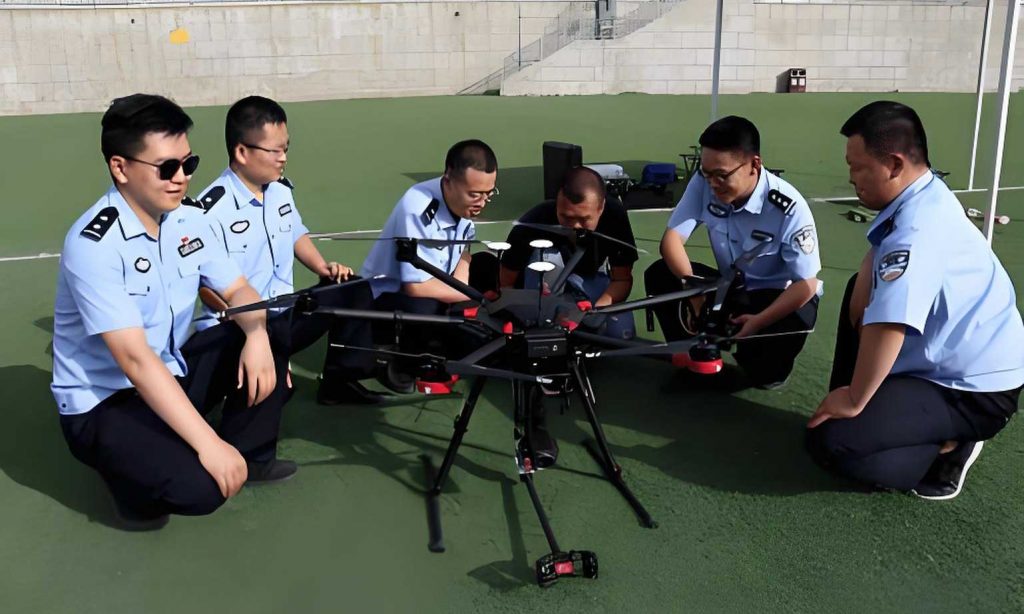
The image above conceptually represents the integrated learning environment we aim for, combining theoretical instruction with hands-on, practical drone training in controlled settings before advancing to actual field operations.
| Functional Zone | Primary Training Module | Key Facilities & Equipment | Concurrent Trainee Capacity | Annual Throughput Target |
|---|---|---|---|---|
| A – Core Theory & Simulation | Fundamentals, Regulations, Sim Flight | Classrooms (x5), Flight Simulators (x20), Computer Lab | 100 | 1,200 |
| B – Basic Practical Flight | Line-of-Sight Maneuvers, Basic Payload Use | Netted Outdoor Field (200m x 200m), Beginner Drone Fleet, Weather Station | 40 (in rotation) | 480 |
| C – Advanced & BVLOS Training | Long-endurance Missions, Complex Inspection Scenarios | Extended Flight Corridor (5km), Fixed-wing Launch/Recovery Area, Mission Control Room | 20 | 240 |
| D – Data Processing & Analysis | Defect Identification, Report Generation | High-Performance Computing Lab, Specialist Software Licenses | 50 | 600 |
Phase 3: Phased Investment and Implementation: The construction and upgrade plan is phased over multiple years, aligned with budget cycles and demand projections. Year 1 focuses on expanding Zone A and B capacity. Year 2 invests in the advanced Zone C. We also encourage and guide regional units to develop smaller, standardized training facilities for recurrent practice and basic certification, creating a distributed drone training network. The total system capacity \( P_{system} \) becomes the sum of central and regional contributions:
$$ P_{system} = P_{hub} + \sum_{j=1}^{m} P_{regional_j} $$
This distributed model enhances resilience and accessibility of drone training.
Synthesis and Continuous Evolution of the Drone Training System
The three pillars—Faculty, Curriculum, and Base—do not operate in isolation. They are interconnected through data and feedback. Trainee performance data from the curriculum informs faculty development needs. Facility usage data from the base influences curriculum scheduling and faculty assignment. This integrated system is governed by a master feedback equation aimed at optimizing overall drone training effectiveness \( E \):
$$ E(t) = \beta_F \cdot Q_F(t) + \beta_C \cdot Q_C(t) + \beta_B \cdot Q_B(t) – \gamma \cdot L(t) $$
Here, \( Q_F, Q_C, Q_B \) represent the quality metrics of the Faculty, Curriculum, and Base subsystems at time \( t \), with \( \beta \) coefficients denoting their relative importance. \( L(t) \) represents systemic latency or inefficiency (e.g., administrative delays), and \( \gamma \) is its damping factor. Our operational goal is to maximize \( E(t) \) over time through continuous monitoring and adjustment of each subsystem.
In conclusion, the journey from identifying critical gaps in drone training to constructing a robust, scalable ecosystem is complex but essential. By implementing a systematic faculty development cycle based on a clear competency model, designing a dynamic and competency-mapped curriculum, and strategically planning our physical and digital training infrastructure, we are building a foundation for sustainable excellence. This comprehensive drone training system is not merely about producing pilots; it is about cultivating a community of practice capable of ensuring the reliability and safety of our nation’s critical power infrastructure amidst evolving technological and environmental challenges. The iterative, data-driven nature of this system ensures its relevance and effectiveness long into the future, solidifying the role of advanced drone training as a cornerstone of modern utility asset management.