
As I reflect on the rapid evolution of agricultural technology, I am struck by how drone training has become a cornerstone for empowering farmers and revolutionizing crop management. The integration of unmanned aerial vehicles (UAVs) into precision agriculture is not just a trend; it is a transformative shift driven by the urgent need to enhance productivity, sustainability, and food security. In my experience participating in and organizing various drone training programs, I have witnessed firsthand how structured education can bridge the gap between technological potential and practical application. This article delves into the comprehensive framework of drone training for agricultural purposes, emphasizing the critical role of skill development in fostering rural revitalization and technological adoption.
The concept of drone training encompasses far more than mere flight operation. It involves a holistic approach that includes regulatory compliance, safety protocols, agricultural science, data analysis, and maintenance logistics. In recent years, the demand for skilled drone operators in agriculture has surged, paralleling the increased deployment of UAVs for tasks such as crop spraying, monitoring, and mapping. However, this growth has exposed significant gaps in standardized training and certification, leading to inefficiencies and safety concerns. Through my involvement, I have seen how systematic drone training programs can address these challenges by equipping individuals with the knowledge and hands-on experience needed to excel in this field.
To understand the scope of effective drone training, let me outline the core modules typically covered in a comprehensive curriculum. These modules are designed to build competency from foundational principles to advanced applications, ensuring that trainees become proficient in both theory and practice. The table below summarizes the key components of a standard drone training program for agricultural use, which I have helped develop and implement in various workshops.
| Module | Description | Key Skills Acquired | Duration (Hours) |
|---|---|---|---|
| Regulatory and Legal Framework | Covers national and international aviation regulations, licensing requirements, and airspace management for UAV operations. | Compliance with laws, risk assessment, permit acquisition | 10 |
| Drone Flight Mechanics and Control | Focuses on aerodynamics, battery management, remote piloting techniques, and emergency procedures. | Precision maneuvering, flight planning, troubleshooting | 30 |
| Agricultural Science Integration | Teaches crop biology, pest management, pesticide properties, and environmental impact assessment. | Targeted spraying, dosage calculation, sustainable practices | 20 |
| Data Collection and Analysis | Involves using sensors (e.g., multispectral cameras) for imaging, data processing software, and interpretation for decision-making. | Image analysis, yield prediction, health monitoring | 25 |
| Maintenance and Repair | Details routine checks, component replacement, software updates, and longevity strategies for UAV systems. | Diagnostic skills, cost-effective upkeep, safety audits | 15 |
| Field Application and Simulation | Provides hands-on practice in real or simulated environments, including mock missions and scenario-based exercises. | Operational readiness, teamwork, adaptive problem-solving | 40 |
This structured approach to drone training ensures that participants not only learn to operate drones but also understand the agricultural context, thereby maximizing the efficacy of UAV applications. In my view, the synergy between technology and agronomy is what makes drone training so impactful. For instance, when trainees grasp the science behind pesticide usage, they can optimize spraying patterns to reduce waste and environmental harm. This is where mathematical models come into play, enhancing the precision of drone-assisted farming.
One of the most critical aspects of drone training is the calculation of pesticide mixtures and application rates. Improper configuration can lead to crop damage, resource depletion, or ecological issues. Through drone training, operators learn to use formulas that ensure accuracy. For example, the required volume of pesticide per unit area can be expressed as:
$$ V = \frac{A \times R}{C} $$
Where \( V \) is the volume of pesticide solution needed (in liters), \( A \) is the area to be treated (in hectares), \( R \) is the recommended application rate (in liters per hectare), and \( C \) is the concentration of the active ingredient in the solution. This formula, often reinforced in drone training sessions, helps operators calibrate their equipment effectively. Additionally, flight efficiency can be modeled using equations that account for battery life and coverage speed. Consider the following relationship for flight time optimization:
$$ T = \frac{D}{S} + \frac{B}{E} $$
Here, \( T \) represents total operational time (in minutes), \( D \) is the distance covered (in meters), \( S \) is the drone’s speed (in meters per minute), \( B \) is the battery capacity (in watt-hours), and \( E \) is the energy consumption rate (in watts). Such calculations are integral to drone training, enabling operators to plan missions that maximize productivity while minimizing downtime.
Beyond formulas, drone training emphasizes practical skills through iterative practice. I recall my own early days in drone training, where simulated flights allowed me to hone my control abilities without risking equipment or crops. The progression from virtual environments to real-field operations is a hallmark of quality drone training programs. As trainees advance, they learn to handle variables like wind conditions, terrain obstacles, and equipment malfunctions—all crucial for reliable service delivery. The following table illustrates a competency assessment matrix used in drone training evaluations, which I have utilized to track trainee progress.
| Skill Category | Beginner Level | Intermediate Level | Advanced Level | Assessment Method |
|---|---|---|---|---|
| Flight Stability | Maintains hover in calm conditions | Executes smooth turns and altitude changes | Performs precise maneuvers in adverse weather | Practical flight test with scoring rubric |
| Pesticide Calibration | Follows basic mixing instructions | Adjusts ratios for different crop types | Designs custom formulations based on sensor data | Written exam and hands-on configuration task |
| Data Interpretation | Identifies basic crop stress from images | Analyzes multispectral data for nutrient deficits | Integrates data with farm management systems | Case study analysis and report submission |
| Maintenance Proficiency | Performs pre-flight checks | Replaces common parts (e.g., propellers) | Diagnoses complex electrical issues | Tool-based practical assessment |
| Safety Compliance | Knows basic regulations | Implements emergency protocols | Trains others in safety standards | Scenario-based oral examination |
This matrix highlights how drone training evolves from foundational competence to mastery, ensuring that operators can adapt to diverse agricultural scenarios. In my journey, I have seen trainees transform from novices to confident professionals capable of leading their own drone training initiatives. The emphasis on continuous learning is vital, as technology advances rapidly; thus, drone training must be an ongoing process rather than a one-time event.
The impact of drone training extends beyond individual skill acquisition to broader economic and social benefits. For example, in regions where labor shortages plague farming communities, drone training empowers local workers to take on high-tech roles, fostering job creation and reducing urban migration. Moreover, by improving crop yields through precision agriculture, drone training contributes to food security and income stability for smallholders. I have collaborated with cooperatives where drone training programs led to a 20% increase in efficiency for crop spraying operations, as measured by reduced input costs and higher coverage accuracy. These outcomes underscore the value of investing in comprehensive drone training ecosystems.
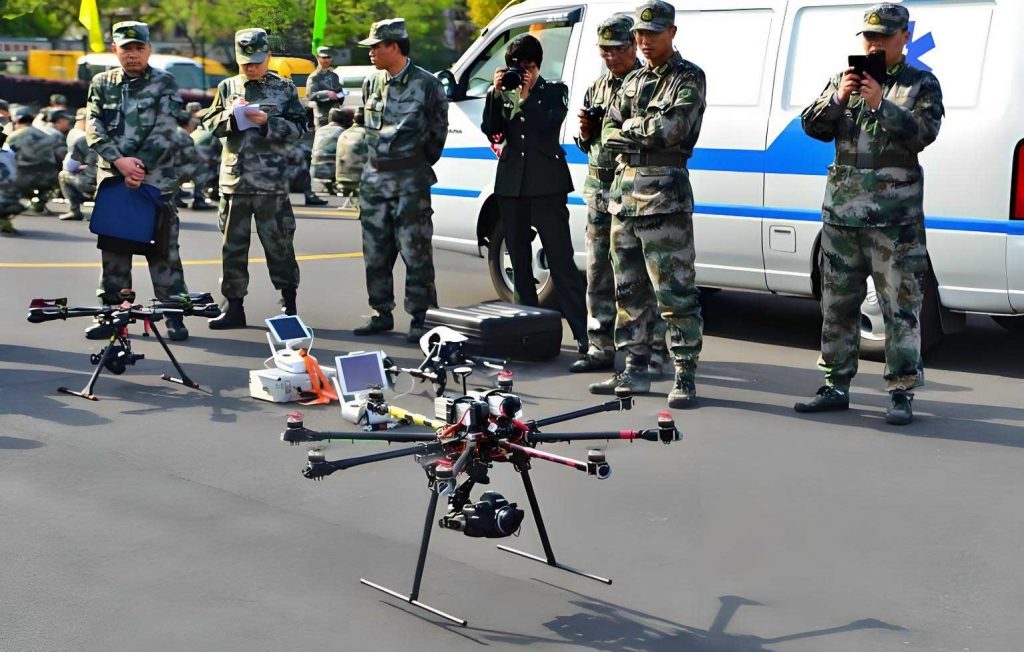
As depicted in the image above, hands-on drone training sessions often involve field exercises where trainees apply their knowledge in real-world settings. Such immersive experiences are crucial for building confidence and competence. In my role, I have facilitated numerous such sessions, observing how practical exposure solidifies theoretical concepts from drone training curricula. The visual of drones in action serves as a powerful reminder of technology’s potential when coupled with proper education.
Looking ahead, the future of drone training hinges on innovation and collaboration. Emerging technologies like artificial intelligence and Internet of Things (IoT) are being integrated into UAV systems, necessitating updated drone training modules that cover data analytics and automation. For instance, autonomous flight algorithms can be optimized using machine learning models, which require operators to understand basic programming—a skill that modern drone training should incorporate. The relationship between drone performance and algorithmic efficiency can be expressed as:
$$ P = \alpha \log(1 + \beta \cdot D) $$
Where \( P \) is the performance metric (e.g., coverage accuracy), \( \alpha \) and \( \beta \) are constants derived from drone and software specifications, and \( D \) is the data input quality from sensors. This formula, though simplified, illustrates the mathematical underpinnings of advanced drone operations, a topic gaining prominence in drone training programs.
Furthermore, the scalability of drone training initiatives depends on standardized certification frameworks. I advocate for industry-wide credentials that validate competency across regions, similar to those piloted in recent workshops. By establishing clear benchmarks, drone training can ensure consistency and quality, thereby boosting stakeholder trust. The table below proposes a tiered certification system for drone training outcomes, based on my analysis of global best practices.
| Certification Level | Prerequisites | Core Competencies | Renewal Cycle |
|---|---|---|---|
| Basic Operator | Completion of foundational drone training course | Safe flight operations, basic maintenance, regulatory awareness | 2 years |
| Specialist in Agricultural Applications | Basic certification plus 50 hours of field experience | Pesticide calibration, data collection, crop-specific strategies | 3 years |
| Master Trainer | Specialist certification plus teaching experience | Curriculum development, advanced troubleshooting, mentorship | 5 years |
Such a system would formalize the progression in drone training, encouraging lifelong learning and specialization. In my discussions with policymakers, I have emphasized that drone training should be embedded in national agricultural strategies to amplify its impact. By subsidizing training costs and providing access to equipment, governments can accelerate the adoption of drone technology, especially in underserved rural areas.
In conclusion, drone training is not merely about teaching people to fly drones; it is about cultivating a new generation of agriculturists who leverage technology to solve pressing challenges. Through structured programs that blend theory, practice, and continuous evaluation, drone training can unlock immense potential for sustainable farming. As I continue to engage in this field, I am committed to refining drone training methodologies and advocating for their widespread implementation. The journey from novice to expert in drone training is a testament to human ingenuity and the relentless pursuit of progress in agriculture. Let us embrace this transformative path, ensuring that every drone operator is equipped not just with skills, but with the wisdom to harness technology for the greater good.