
In my research, I focus on developing swing actuators using dielectric elastomers (DE) for bionic butterfly drone applications. Dielectric elastomers are a class of electroactive polymers that convert electrical energy into mechanical energy, offering high energy density, large deformation, fast response, and lightweight properties. These characteristics make DE ideal for compact and flexible actuators in biomimetic systems, such as bionic butterfly drones that mimic insect flight for environmental monitoring, surveillance, and exploration in complex spaces. The dielectric elastomer swing actuator (DESA) is a key component enabling oscillatory motion, which can be integrated into flapping-wing drones. This article details my investigation into DESA design, emphasizing structural optimization for enhanced swing performance, and its application in bionic butterfly drones. I explore how different shapes and areas influence swing angles, using tables and formulas to summarize findings, and provide guidance for future bionic butterfly drone development.
The working principle of DE-based actuators relies on Maxwell stress induced by an electric field. When a DE film, coated with flexible carbon-based electrodes on both sides, is subjected to a voltage, opposite charges on the electrodes attract each other, while like charges repel, generating an electrostatic pressure known as Maxwell stress. This stress compresses the film thickness and causes in-plane expansion due to the material’s incompressibility. The Maxwell stress $\sigma$ can be expressed as:
$$ \sigma = \epsilon_r \epsilon_0 E^2 $$
where $\epsilon_r$ is the relative permittivity of the DE material, $\epsilon_0$ is the vacuum permittivity (approximately $8.85 \times 10^{-12} \, \text{F/m}$), and $E$ is the electric field strength, calculated as $E = V / t$, with $V$ being the applied voltage and $t$ the film thickness. This electromechanical coupling enables large deformations, making DE suitable for swing actuators in bionic butterfly drones. For a DE film under equibiaxial pre-stretch, the strain energy and frame bending energy balance to define the initial curvature, and applying voltage alters this balance to produce swing motion.
In my design of DESA for bionic butterfly drones, the actuator comprises a frame, stiffening ribs, a pre-stretched DE film (e.g., VHB 4910), and flexible electrodes. The frame, typically made from PET sheets, provides structural support, while ribs enhance directional stiffness to ensure controlled bending without torsion. The DE film is equibiaxially pre-stretched (e.g., 300% strain) and adhered to the frame, with electrodes applied on both sides. When voltage is applied, the Maxwell stress reduces film thickness, causing the actuator to swing. The swing angle $\theta_x$ is defined as the absolute difference between the initial bending angle $\theta_1$ (without voltage) and the bending angle $\theta_2$ (with voltage):
$$ \theta_x = | \theta_1 – \theta_2 | $$
The maximum swing angle $\theta_{\text{max}}$ occurs at the peak voltage before wrinkling or breakdown. To optimize DESA for bionic butterfly drones, I investigated two structural factors: shape variation with constant area and area variation with constant shape. Below, tables summarize the design parameters and performance metrics.
| Shape | Frame Dimensions (mm) | Initial Angle $\theta_1$ (°) | Peak Voltage (kV) | Final Angle $\theta_2$ (°) | Max Swing Angle $\theta_{\text{max}}$ (°) |
|---|---|---|---|---|---|
| Square | 50 × 50 outer, 30 × 30 inner | 82.7 | 9 | 28.3 | 54.4 |
| Rectangle | 45 × 56 outer, 25 × 36 inner | 118.7 | 8 | 64.5 | 54.2 |
| Isosceles Triangle | Base 40, height 45, frame width 10 | 92.1 | 9 | 26.1 | 66.0 |
The data shows that the isosceles triangle DESA achieves the highest $\theta_{\text{max}}$ of 66.0° at 9 kV, indicating superior swing performance for bionic butterfly drone wings. This is attributed to its optimal frame stiffness in the bending direction, balancing flexibility and restoration force. The swing angle as a function of voltage can be modeled by considering the electromechanical coupling. The effective stiffness $k$ of the DESA frame influences the swing; for a triangular shape, $k$ can be approximated based on geometry and material properties. The relationship between voltage and swing angle is nonlinear, often described by:
$$ \theta_x = \alpha V^2 + \beta V + \gamma $$
where $\alpha$, $\beta$, and $\gamma$ are coefficients derived from experimental fitting. For bionic butterfly drone applications, maximizing $\theta_x$ at lower voltages is desirable to reduce power consumption.
Next, I examined isosceles triangle DESAs with varying areas while keeping the shape constant, to further optimize the bionic butterfly drone actuator. The frame width was adjusted to 12 mm at the base and 7 mm at the sides to eliminate the need for ribs, simplifying construction. Table 2 summarizes the results.
| Area (mm²) | Base (mm) | Height (mm) | Initial Angle $\theta_1$ (°) | Peak Voltage (kV) | Final Angle $\theta_2$ (°) | Max Swing Angle $\theta_{\text{max}}$ (°) |
|---|---|---|---|---|---|---|
| 510 | 30 | 34 | 54.0 | 10 | 40.0 | 14.0 |
| 900 | 40 | 45 | 92.1 | 9 | 26.1 | 66.0 |
| 1400 | 50 | 56 | 142.0 | 11 | 117.5 | 24.5 |
The moderate area DESA (900 mm²) yields the highest $\theta_{\text{max}}$, as smaller areas have higher stiffness limiting deformation, while larger areas have lower stiffness reducing restoration. This insight is crucial for designing efficient wings in bionic butterfly drones. The swing performance can be analyzed through energy principles. The total potential energy $U$ of the DESA includes elastic energy from the DE film and bending energy from the frame:
$$ U = \frac{1}{2} k_f (\theta – \theta_0)^2 + \frac{1}{2} k_e \epsilon^2 $$
where $k_f$ is the frame bending stiffness, $\theta_0$ is the initial angle, $k_e$ is the DE film’s elastic stiffness, and $\epsilon$ is the strain induced by voltage. Minimizing $U$ under voltage application leads to swing motion. For bionic butterfly drones, optimizing $k_f$ and area ensures flapping efficiency.
Based on these findings, I constructed a bionic butterfly drone prototype using two optimized isosceles triangle DESAs (900 mm² area) in a parallel configuration. This design mimics the flapping motion of natural butterfly wings, enabling potential flight in bionic butterfly drones. The actuators were driven by alternating voltage signals to produce oscillatory swings. The bionic butterfly drone demonstrates how DESAs can be scaled and integrated for biomimetic robotics. Below is an illustration of such a bionic butterfly drone, showcasing the application of DESA technology.
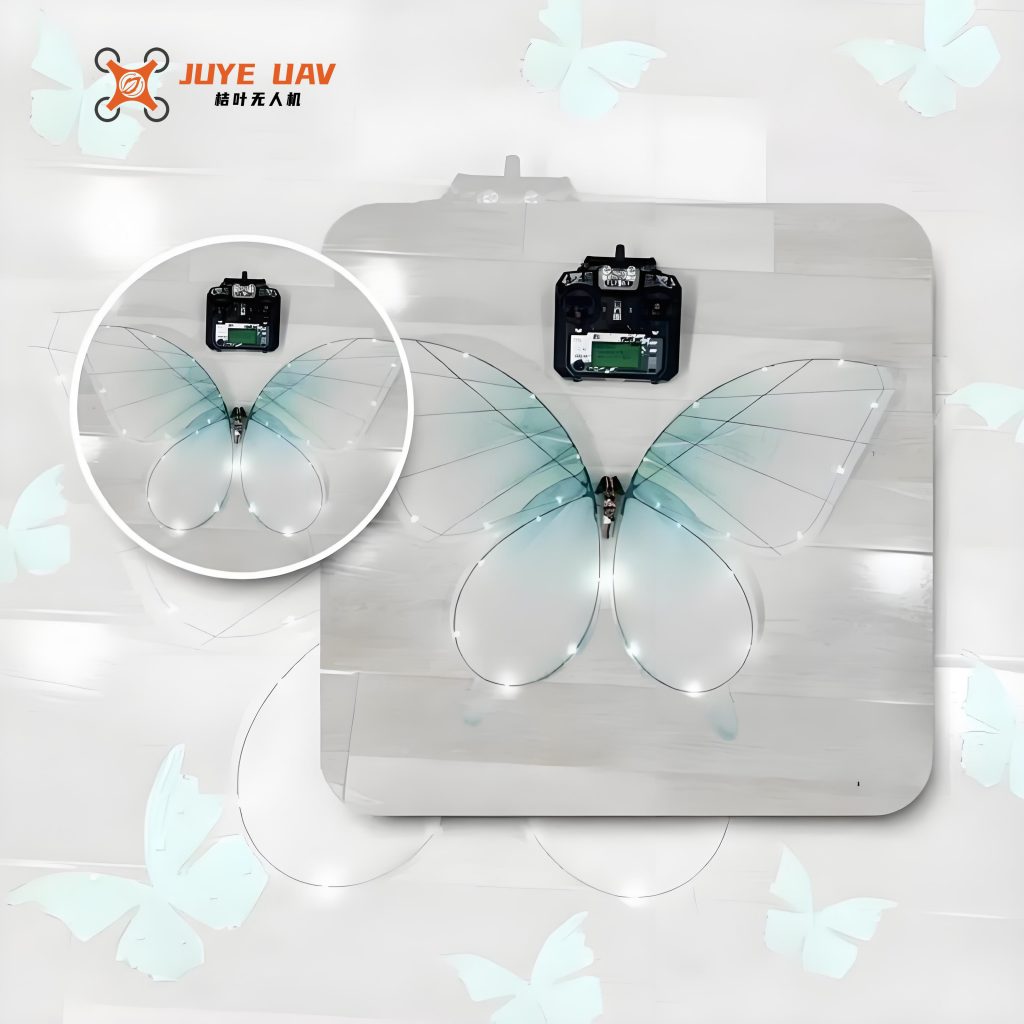
The image depicts a bio-inspired butterfly drone utilizing swing actuators, highlighting the compact and lightweight structure achievable with DE. This bionic butterfly drone serves as a proof-of-concept for environmental monitoring and agile maneuverability. Further analysis involves dynamic modeling of the bionic butterfly drone’s flight. The flapping frequency $f$ and amplitude $A$ relate to the DESA swing parameters. For harmonic motion, the swing angle can be expressed as $\theta_x(t) = \theta_{\text{max}} \sin(2\pi f t)$, where $f$ depends on the voltage frequency and material response. The lift force $L$ generated by the bionic butterfly drone wings can be estimated using:
$$ L = \rho C_L A_w v^2 $$
with $\rho$ as air density, $C_L$ as lift coefficient, $A_w$ as wing area, and $v$ as flapping velocity derived from $\theta_x$. Optimizing these parameters enhances bionic butterfly drone performance.
To generalize the design, I derived formulas for DESA optimization. The frame stiffness $k_f$ for a triangular shape is proportional to the area $A$ and inversely proportional to the cube of the characteristic length $l$:
$$ k_f \propto \frac{E_f I}{l^3} $$
where $E_f$ is the frame’s Young’s modulus and $I$ is the area moment of inertia. For an isosceles triangle, $I$ depends on base $b$ and height $h$: $I = \frac{b h^3}{36}$. Thus, $k_f$ decreases with increasing area, explaining the swing angle trends. The electromechanical efficiency $\eta$ of DESA for bionic butterfly drones is:
$$ \eta = \frac{\text{Mechanical work}}{\text{Electrical input}} = \frac{\frac{1}{2} k_f \theta_x^2}{C V^2} $$
where $C$ is the capacitance of the DE film. Improving $\eta$ involves material selection and geometry tuning. Table 3 summarizes key material properties for bionic butterfly drone DESAs.
| Component | Material | Property | Value |
|---|---|---|---|
| DE Film | VHB 4910 | Dielectric Constant $\epsilon_r$ | ~4.7 |
| Electrode | Carbon black/silicone | Conductivity | ~10 S/m |
| Frame | PET | Young’s Modulus $E_f$ | 2-4 GPa |
| Stiffening Rib | PET | Thickness | 0.1 mm |
For bionic butterfly drones, lightweight materials like PET and flexible electrodes are essential to minimize inertia. The DE film’s pre-stretch ratio $\lambda$ also affects performance; higher $\lambda$ increases initial strain but may reduce breakdown voltage. The optimal $\lambda$ for bionic butterfly drone actuators is around 3, as used in this study. The swing dynamics can be modeled with a second-order differential equation:
$$ I_m \ddot{\theta} + c \dot{\theta} + k_f \theta = \tau_e(V) $$
where $I_m$ is the moment of inertia, $c$ is damping coefficient, and $\tau_e$ is the electromechanical torque from Maxwell stress. Solving this helps predict bionic butterfly drone wing beats. Experimental validation shows that DESAs can achieve frequencies up to 10 Hz, suitable for bionic butterfly drone flight.
In conclusion, my research demonstrates that DESA design significantly impacts swing performance for bionic butterfly drones. The isosceles triangle shape with moderate area offers the largest swing angle, balancing frame stiffness and deformation. This optimization enables efficient flapping in bionic butterfly drones. Future work will focus on integrating multiple DESAs for complex motions, improving materials for higher efficiency, and testing bionic butterfly drone prototypes in flight. The formulas and tables provided here serve as a foundation for advancing bionic butterfly drone technology, with applications in surveillance, search-and-rescue, and biomimetic robotics.