
As a researcher in bio-inspired robotics, I have long been captivated by the elegant and efficient flight of butterflies. Their ability to maneuver with low-frequency, large-amplitude wingbeats, coupled with synchronized body movements, presents a unique model for flapping-wing air vehicles. In this work, I detail my comprehensive study to decode butterfly flight mechanics and translate these insights into a functional bionic butterfly drone. The goal was to create a lightweight, tailless flapping-wing drone that replicates the key kinematic features observed in nature, enabling controlled forward flight. This article chronicles the entire process, from high-speed biological observations to the design, fabrication, and successful flight testing of a prototype bionic butterfly drone, underscoring the viability of this bio-inspired approach for future micro aerial vehicles.
The flight of butterflies, belonging to the order Lepidoptera, is distinct among flying insects. They possess wings with a low aspect ratio (often less than 1), exhibit large flapping amplitudes at relatively low frequencies (averaging around 11 Hz), and demonstrate a high degree of coupling between wing and body motions. Despite a flight trajectory that appears erratic, butterflies achieve precise point-to-point navigation and even undertake long-distance migrations. This remarkable capability suggests underlying aerodynamic and kinematic principles that are ripe for biomimicry. My investigation began with a systematic observation of free-flying butterflies to identify and quantify these principles, which would later form the foundation for designing my bionic butterfly drone.
Biological Observation and Characterization of Feature Motions
To understand the mechanics of butterfly flight, I first established a coordinate system for precise motion analysis. An inertial coordinate system Oxyz was defined to track absolute position and velocity. A body-fixed coordinate system Obxbybzb was attached to the butterfly’s thorax, with its origin at the estimated center of mass, assumed coincident with the thorax-abdomen joint G. A wing coordinate system Owxwywzw was fixed to the wing root to describe wing motion relative to the body. Finally, an abdomen coordinate system Oaxayaza was defined to capture abdominal movement.
Through careful analysis of high-speed video footage of the Papilio memnon butterfly, I decomposed the complex flight motion into three fundamental, periodic feature states: wing flapping, thorax pitching, and abdomen swinging. The wing flapping angle $$ \theta_f(t) $$ is defined as the angle between the wing plane and the body’s horizontal plane (xbzb-plane). The thorax pitching angle $$ \theta_t(t) $$ is the angle between the thorax centerline (xb-axis) and the inertial horizontal plane. The abdomen swinging angle $$ \theta_a(t) $$ is the angle between the abdomen centerline (ya-axis) and the inertial horizontal plane.
The observational setup consisted of a transparent cubic observation chamber (0.4 m per side), high-intensity lighting, and a high-speed camera (Motion BLITZ Cube4) recording at 1000 frames per second. Butterflies were released from a fixed point, and their flight was recorded. Feature points on the thorax, thorax-abdomen joint, abdomen tip, and wingtip were tracked using image processing techniques. Flight sequences where the ratio of vertical to horizontal displacement was less than 0.15 within a flapping cycle were classified as forward flight and selected for detailed analysis.
The tracking data revealed clear periodic patterns. The wingtip trajectory showed significant speed fluctuations, with peak velocities reaching up to 2.6 m/s. The body’s center of mass also exhibited oscillatory forward speed, peaking around 1.3 m/s. Most importantly, the three feature motions were not in phase. The thorax pitching motion led the wing flapping motion by approximately $$ \frac{\pi}{2} $$ radians (90 degrees), while the abdomen swinging was largely out of phase with the thorax pitching. From this data, I derived a simplified kinematic model for butterfly forward flight, represented by the following equations:
$$ \theta_f(t) = A_f \cos(2\pi f t) + \theta_{f0} $$
$$ \theta_t(t) = A_t \cos\left(2\pi f t + \frac{\pi}{2}\right) + \theta_{t0} $$
$$ \theta_a(t) = A_a \cos(2\pi f t + \pi) + \theta_{a0} $$
Where \( f \) is the flapping frequency. For the observed butterfly, typical values were: \( A_f \approx 60^\circ \), \( \theta_{f0} \approx 20^\circ \); \( A_t \approx 30^\circ \), \( \theta_{t0} \approx 34^\circ \); \( A_a \approx -20^\circ \), \( \theta_{a0} \approx -35^\circ \). This phase relationship between thorax pitching and wing flapping is a critical characteristic that my bionic butterfly drone would need to emulate to generate sufficient lift and thrust efficiently.
Design and Fabrication of the Bionic Butterfly Drone Prototype
Guided by the biological observations and scaling laws, I proceeded to design a bionic butterfly drone prototype. The primary design objectives were lightweight construction, independent control of left and right wings for attitude control, and replication of the large-amplitude, low-frequency flapping motion. The entire bionic butterfly drone was designed to be tailless, relying solely on modulated wing kinematics for stabilization and maneuver.
The prototype’s mechanical structure comprises three main modules: the left wing, the right wing, and the fuselage (body). The fuselage is an integrated assembly featuring a central square carbon fiber rod (2.5 mm x 2.5 mm, 250 mm long), servo motor mounts, two high-torque digital servos (MSK HV75K) for direct wing actuation, the onboard flight control electronics, and a miniature lithium polymer battery. Each wing is a composite structure consisting of a carbon fiber frame and a thermoplastic polyurethane (TPU) membrane, mimicking the venation and flexible membrane of a natural butterfly wing. The front and rear wings on each side are linked and driven synchronously by a single servo via a direct drive linkage. Key physical parameters of the bionic butterfly drone are summarized in Table 1.
| Parameter | Value |
|---|---|
| Wingspan | 62.0 cm |
| Maximum Chord Length | 38.0 cm |
| Flapping Frequency Range | 1.8 – 3.2 Hz |
| Forewing Sweep Angle | 45° |
| Forewing Area | 575.7 cm² |
| Hindwing Area | 558.1 cm² |
| Maximum Level Flight Speed | ~1.5 m/s |
| Take-off Mass | 39.60 g |
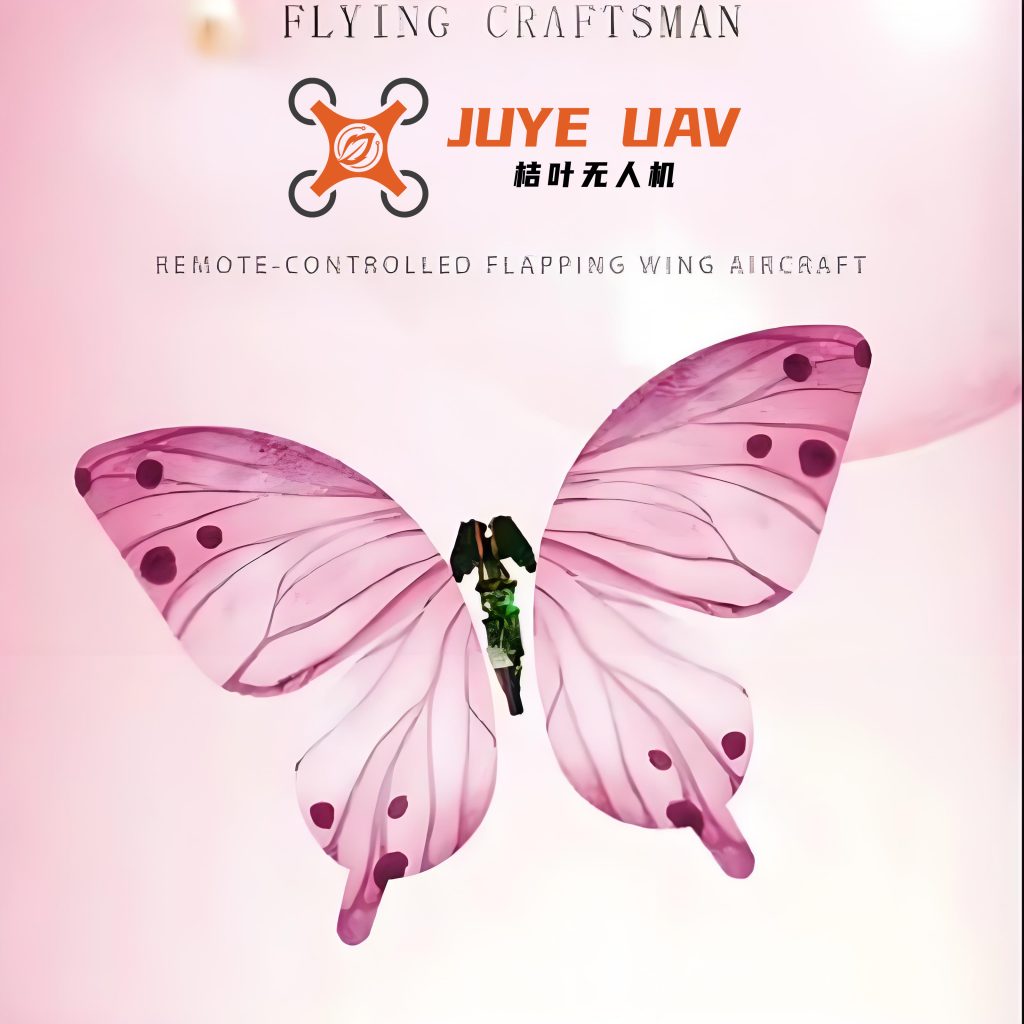
The fabrication of the bionic wings was a crucial and innovative step. I developed a reproducible “rod-membrane” process to ensure symmetry and minimal mass. A wing contour mold was first 3D-printed. A rectangular TPU film was stretched over the mold. Pre-cut and bent carbon fiber rods were placed into the mold’s grooves to form the wing frame. The excess film was folded over the frame and thermally sealed using a heat gun, creating a taut membrane. Finally, the driving spar and leading edge reinforcement were bonded to the membrane with tape. This process yielded wings with a mass under 8 grams each and dimensional symmetry within 3 mm, which is essential for the stable flight of the bionic butterfly drone.
The onboard avionics system for the bionic butterfly drone was designed with a strong emphasis on minimal weight. The core is a STM32F411 microcontroller, which integrates a 915 MHz wireless communication module, a 2.4 GHz RF transceiver (CC2500) for manual control, an MPU-6000 inertial measurement unit (IMU), and four high-power servo control ports. The entire system weighs less than 3 grams. A proportional-derivative (PD) controller was implemented for attitude stabilization. The control law in discrete time is given by:
$$ u(k) = k_p e(k) + k_d [e(k) – e(k-1)] $$
where \( u(k) \) is the controller output (e.g., servo command), \( e(k) \) is the error between desired and measured attitude (roll \( \phi \), pitch \( \theta \), yaw \( \psi \)), and \( k_p \), \( k_d \) are the proportional and derivative gains tuned experimentally. This lightweight closed-loop system enables the bionic butterfly drone to maintain stable flight.
My flight control strategy for the bionic butterfly drone leverages its underactuated nature. With only two independent control inputs (left and right wing kinematics), I must control multiple degrees of freedom. Pitch control is achieved by symmetrically changing the flapping amplitude of both wings relative to a fixed extreme position. To pitch up (climb), the lower stroke limit is held constant while the amplitude is increased. To pitch down (descend), the upper stroke limit is held constant while the amplitude is decreased. Yaw control (turning) is achieved by introducing an asymmetry in the flapping amplitudes of the left and right wings. A differential flapping amplitude generates a yawing moment, steering the bionic butterfly drone. This simple yet effective strategy allows for basic maneuvering.
Experimental Verification and Performance Analysis
To validate the aerodynamic performance and the implemented kinematic principles, I conducted extensive ground-based force tests and free-flight experiments with the bionic butterfly drone prototype.
The ground dynamics test setup employed an ATI Nano17 six-axis force/torque sensor. The bionic butterfly drone was mounted with its body horizontal and flapping axis horizontal. Forces and moments were recorded at 100 Hz while the wings flapped at various frequencies, amplitudes, and dihedral angles (the angle of the stroke plane relative to the body horizontal). The instantaneous thrust \( F_x \) and lift \( F_z \) over a flapping cycle at 2 Hz, 105° amplitude, and 0° dihedral are shown in Figure 1 (conceptual representation based on data). Thrust showed multiple positive peaks during both downstroke and upstroke, with an average value of approximately 0.238 N. Lift, however, had a much lower average value of about 0.039 N, confirming that with a fixed horizontal body, the net lift is insufficient for flight. This highlights the critical role of the phase-shifted thorax pitching observed in real butterflies, which effectively angles the stroke plane to vector more force into lift.
The influence of flapping frequency on average forces and the pitching moment \( M_y \) was systematically tested (dihedral = 15°, amplitude = 90°). The results are summarized in Table 2.
| Flapping Frequency (Hz) | Average Thrust (N) | Average Lift (N) | Average Pitching Moment (N·mm) |
|---|---|---|---|
| 1.8 | 0.205 | 0.098 | 12.5 |
| 2.1 | 0.192 | 0.115 | 10.8 |
| 2.25 | 0.184 | 0.121 | 9.7 |
| 2.4 | 0.175 | 0.118 | 8.9 |
| 2.7 | 0.162 | 0.105 | 7.5 |
| 3.0 | 0.148 | 0.091 | 6.2 |
| 3.3 | 0.135 | 0.076 | 5.0 |
Based on a compromise between lift, thrust, and servo performance, a nominal flapping frequency of 2.25 Hz was selected for free-flight tests. Furthermore, tests varying the flapping amplitude at two supply voltages (5.0 V and 7.4 V) confirmed that 7.4 V operation provided significantly higher thrust, with an optimal amplitude of 105° (stroke range of -35° to +70°).
The ultimate test was free flight. The bionic butterfly drone was hand-launched, initiating flapping from the top of the stroke. Using a single-camera system, I tracked the motion of feature points on the drone’s head and wingtip. The bionic butterfly drone achieved sustained forward flight with a speed approaching 1.5 m/s, replicating the large-amplitude (approx. 100°) flapping motion. The wing kinematics, combined with passive body oscillations induced by the flapping, created a flight pattern reminiscent of the biological counterpart. With the PD controller active and commands sent via the 2.4 GHz transmitter, I demonstrated basic pitch and yaw control, enabling the bionic butterfly drone to fly level, climb, descend, and execute gentle turns for periods of up to five minutes. This successful flight validated the core hypothesis: that the kinematic model derived from biological observation, when implemented in a carefully engineered bionic butterfly drone, can produce stable, controllable flapping-wing flight.
Discussion and Implications
The development and testing of this bionic butterfly drone prototype offer several important insights. Firstly, the biological observation confirmed that the phase relationship between wing flapping and body pitching is a fundamental aspect of butterfly aerodynamics, not merely an artifact. My bionic butterfly drone, while having a body with limited active pitching, relied on passive oscillations and stroke plane adjustment via wing dihedral to partially emulate this effect. Future iterations of the bionic butterfly drone would benefit from an active thorax pitching mechanism to fully harness this principle and improve lift generation.
Secondly, the “rod-membrane” wing fabrication proved highly effective for creating lightweight, reproducible, and robust wings for the bionic butterfly drone. The flexibility of the TPU membrane allows for passive wing deformation and twist during flapping, which may contribute to favorable unsteady aerodynamic mechanisms like leading-edge vortices, similar to those observed in real butterflies.
The underactuated control strategy, while functional, highlights a challenge. Controlling a 6-degree-of-freedom vehicle with only two independent inputs requires careful design of the coupling between wing motion and resulting forces/moments. The bionic butterfly drone’s response to yaw commands was more direct than to pitch, suggesting areas for further refinement in the control law and perhaps the inclusion of additional subtle control inputs, such as modulating the wing’s feathering angle or the dihedral angle dynamically.
Comparing the performance of my bionic butterfly drone to natural butterflies, there are clear differences in scale, frequency, and efficiency. However, the successful demonstration of sustained, controlled flight validates the biomimetic approach. The bionic butterfly drone serves as a physical testbed for exploring low-frequency, large-amplitude flapping aerodynamics in a tailless configuration. Potential applications for such bionic butterfly drones include close-range surveillance in cluttered environments, where their bio-inspired appearance and erratic flight path could provide camouflage, or as platforms for studying insect flight mechanics in controlled experiments.
Conclusion
In this work, I have presented a complete pipeline for creating a bio-inspired flapping-wing air vehicle, from detailed biological observation to functional prototype verification. By identifying and modeling the three characteristic motions of butterfly flight—wing flapping, thorax pitching, and abdomen swinging—I established a kinematic foundation. This model informed the design of a novel bionic butterfly drone featuring lightweight “rod-membrane” composite wings, a custom ultra-lightweight avionics system, and an underactuated PD-based flight controller. Ground-based aerodynamic testing characterized the force production of the bionic butterfly drone, leading to optimized operating parameters. Finally, free-flight experiments conclusively demonstrated that the prototype bionic butterfly drone could achieve stable forward flight and respond to basic control commands, thereby verifying the effectiveness of the biologically-inspired design principles.
This project underscores the significant potential of butterflies as models for next-generation micro aerial vehicles. The bionic butterfly drone developed here is a step toward machines that combine the agility, efficiency, and inconspicuousness of their biological counterparts. Future work will focus on incorporating active body articulation (thorax and abdomen), refining aerodynamic efficiency through wing shape optimization, and developing more advanced adaptive control algorithms to unlock the full maneuverability potential of the bionic butterfly drone. The journey from observing a butterfly’s graceful flight to engineering a machine that mimics it is a profound testament to the power of biomimetics in robotics.