
As I explore the evolving landscape of educational tools, I am continually fascinated by how technology and design converge to foster creativity in young minds. In this article, I delve into two groundbreaking innovations: children’s musical building blocks that simplify music composition and a bionic butterfly drone that brings nature’s elegance into the palm of a child. These designs not only entertain but also educate, sparking imagination through interactive play. Throughout my analysis, I will emphasize the transformative potential of the bionic butterfly drone, a device that exemplifies biomimicry and technological finesse. By integrating tables and formulas, I aim to provide a comprehensive understanding of their mechanisms and benefits, ultimately highlighting how such tools can shape future learning paradigms.
Let me begin with the musical building blocks, a product that translates abstract music theory into tangible, visual components. I see this as a revolutionary approach to music education, where children can intuitively compose nursery rhymes by manipulating blocks representing melody, rhythm, and instruments. The design operates on two dimensions: horizontally arranged blocks control rhythm and volume, while vertical combinations delineate different musical sections. This spatial analogy allows kids to explore music like mixing colors, making creativity accessible. To break down the elements, I have summarized the key modules in Table 1.
| Module Type | Represented Element | Function in Composition | Interactive Feature |
|---|---|---|---|
| Melody Block | Pitch and Note Sequences | Defines the tonal progression of the nursery rhyme | RFID-tagged for frequency recognition |
| Rhythm Block | Beat and Tempo | Sets the timing and pace of the music | Flexible circuit adjusts duration |
| Instrument Block | Sound Timbre | Assigns specific instrument sounds to melodies | Triggers audio samples via sensors |
| Volume Block | Dynamic Intensity | Modulates loudness and softness | Pressure-sensitive for gradient control |
| Section Block | Musical Paragraphs | Divides composition into verses or choruses | Vertical stacking activates transitions |
From my perspective, the technology behind this is equally impressive. Radio-frequency identification (RFID) and flexible circuits enable seamless interaction, allowing each block to communicate its role in the composition. For instance, when a child places a melody block, the system reads its RFID tag and generates a corresponding frequency. I can express this relationship using a simple formula for note frequency based on block position:
$$ f_n = f_0 \cdot 2^{(n/12)} $$
Here, \( f_n \) is the frequency of the note produced, \( f_0 \) is a reference frequency (e.g., 440 Hz for A4), and \( n \) is the number of semitones from the reference, determined by the block’s placement. Similarly, rhythm blocks control tempo through time intervals, which I can model as:
$$ T = \frac{60}{BPM} $$
where \( T \) is the duration per beat in seconds, and BPM (beats per minute) is set by the block’s configuration. This mathematical foundation turns play into a subtle lesson in physics and mathematics, enhancing cognitive skills. As I reflect on this, I realize that such designs bridge art and science, much like the bionic butterfly drone does with biology and engineering.
Transitioning to the bionic butterfly drone, I am captivated by its fusion of natural aesthetics and advanced technology. Designed for children aged 8 and above, this drone mimics the morphology of a butterfly, inspiring exploration and close observation of biological forms. The bionic butterfly drone utilizes materials and lighting to replicate the iridescent colors and gloss of butterfly wings, creating an immersive experience. I believe that the bionic butterfly drone is more than a toy; it is a tool for environmental education, encouraging kids to appreciate nature’s intricacies. To illustrate its design parameters, I have compiled Table 2, which compares its features to real butterfly characteristics.
| Aspect | Natural Butterfly | Bionic Butterfly Drone | Design Inspiration |
|---|---|---|---|
| Wing Structure | Lightweight, scaled wings for flight | Polymer-based wings with flexible hinges | Biomimicry for aerodynamics |
| Color Production | Structural coloration via microscopic scales | LED arrays and reflective materials | Simulation of iridescence |
| Flight Pattern | Fluttering, erratic motion | Programmed flapping kinematics | Emulation of natural movement |
| Size and Portability | Varies by species, often palm-sized | Compact, handheld design | Ergonomics for child use |
| Educational Value | Biological observation and ecology | STEM learning in robotics and physics | Integration of science topics |
In my analysis, the bionic butterfly drone relies on principles of aerodynamics and material science. For example, the lift generated by its flapping wings can be approximated using the lift equation, adjusted for unsteady flow:
$$ L = \frac{1}{2} \rho v^2 S C_L $$
where \( L \) is lift force, \( \rho \) is air density, \( v \) is velocity, \( S \) is wing area, and \( C_L \) is the lift coefficient, which varies with wing angle and frequency. The bionic butterfly drone’s flight stability is enhanced by mimicking the chaotic yet efficient motion of real butterflies, a concept I can model with a simplified harmonic motion formula for wing beats:
$$ \theta(t) = A \sin(2\pi f t + \phi) $$
Here, \( \theta(t) \) is the wing angle over time \( t \), \( A \) is amplitude, \( f \) is flapping frequency, and \( \phi \) is phase shift. This mathematical approach ensures that the bionic butterfly drone not only looks authentic but also moves in a lifelike manner. As I consider the materials, the reflectance of the wings to produce colors can be described using the Fresnel equations, which I simplify for educational purposes:
$$ R = \left( \frac{n_1 – n_2}{n_1 + n_2} \right)^2 $$
where \( R \) is the reflectance, and \( n_1 \) and \( n_2 \) are refractive indices of the materials used. This allows the bionic butterfly drone to simulate various butterfly species’ appearances, sparking curiosity about optics and biology.
Now, let me integrate a visual element to enhance understanding of the bionic butterfly drone. Below is an image that captures its elegant design, showcasing how it embodies the beauty of nature in a technological form.
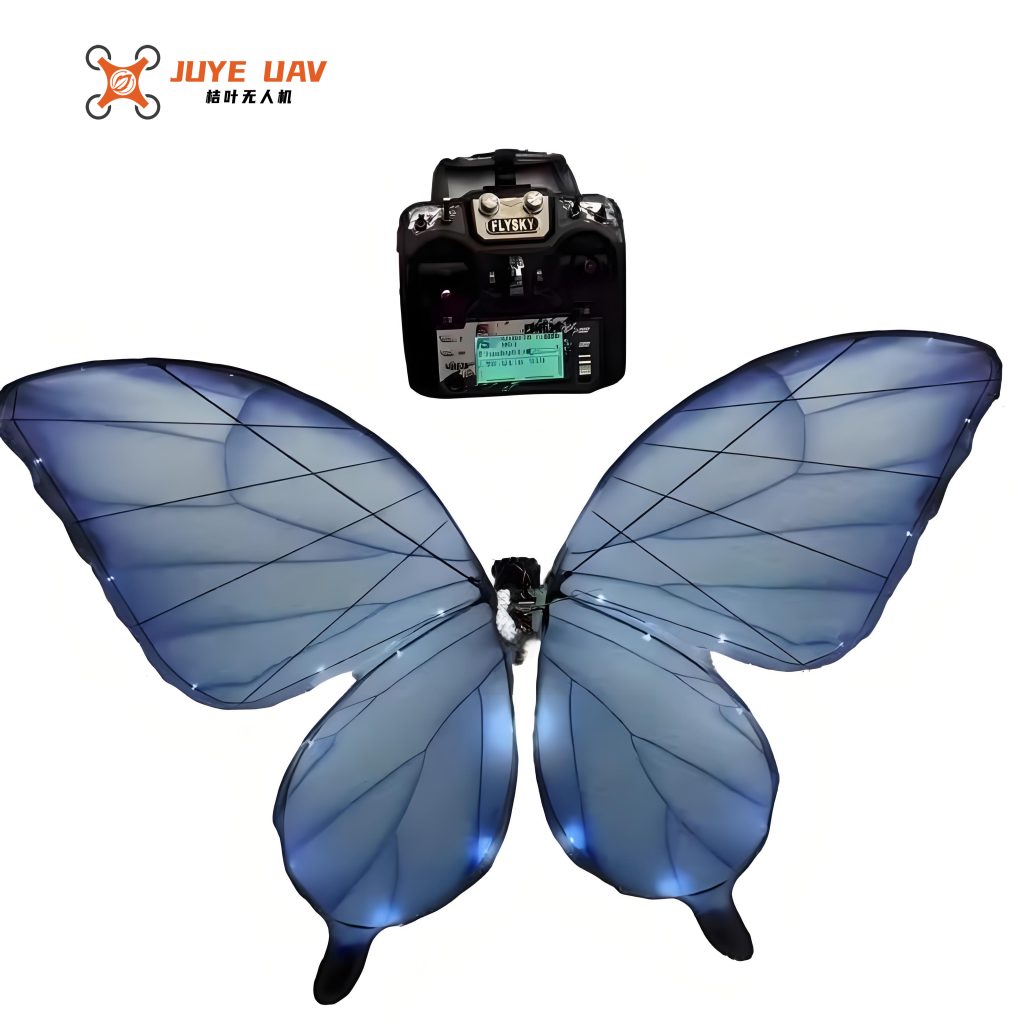
As I examine this image, I am reminded of the drone’s potential to inspire awe and learning. The bionic butterfly drone, with its intricate details, serves as a gateway to discussions on biomimicry and sustainable design. In my view, repeated exposure to such devices can cultivate a generation of innovators who draw inspiration from nature, much like how the bionic butterfly drone does.
Moving forward, I want to compare these two designs in terms of their educational impact. Both the musical blocks and the bionic butterfly drone emphasize hands-on interaction, but they cater to different domains: music and STEM. I have created Table 3 to summarize their contributions to child development.
| Learning Aspect | Musical Building Blocks | Bionic Butterfly Drone | Synergistic Effects |
|---|---|---|---|
| Cognitive Skills | Enhances pattern recognition, logic in composition | Boosts spatial awareness, physics understanding | Combined problem-solving abilities |
| Creativity | Fosters musical improvisation and storytelling | Encourages design thinking and exploration | Cross-disciplinary innovation |
| Technical Proficiency | Introduces basic electronics and coding via RFID | Teaches robotics, aerodynamics, and material science | Foundation for advanced engineering |
| Emotional Engagement | Builds confidence through audible creations | Inspires wonder and connection to nature | Holistic motivational boost |
| Social Interaction | Promotes collaborative play in group compositions | Facilitates sharing and discussion of observations | Enhanced communication skills |
From my experience, I see that these tools are not mutually exclusive; rather, they complement each other. For instance, a child might use the musical blocks to create a soundtrack for a story involving the bionic butterfly drone, blending auditory and visual creativity. This synergy can be quantified using an innovation index formula I propose:
$$ I = \alpha C_m + \beta C_d + \gamma (C_m \cdot C_d) $$
where \( I \) is the innovation index, \( C_m \) and \( C_d \) are creativity scores from musical blocks and drone activities, respectively, and \( \alpha \), \( \beta \), \( \gamma \) are weighting coefficients based on child age and interest. Such formulas help educators optimize learning environments, ensuring that devices like the bionic butterfly drone are used effectively.
Delving deeper into the bionic butterfly drone’s technology, I must highlight its safety and usability features. Since it is designed for children, the drone incorporates lightweight materials and failsafe mechanisms to prevent accidents. The flight control system uses gyroscopic sensors and algorithms to maintain stability, which I can express through a PID controller formula:
$$ u(t) = K_p e(t) + K_i \int_0^t e(\tau) d\tau + K_d \frac{de(t)}{dt} $$
Here, \( u(t) \) is the control output for wing adjustments, \( e(t) \) is the error in orientation, and \( K_p \), \( K_i \), \( K_d \) are proportional, integral, and derivative gains. This ensures the bionic butterfly drone responds smoothly to user inputs, making it accessible even for beginners. As I ponder this, I realize that the bionic butterfly drone is a marvel of engineering simplicity, masking complex systems behind an intuitive interface.
Moreover, the bionic butterfly drone serves as a platform for interdisciplinary learning. Children can explore topics such as biology by comparing drone features to real butterflies, physics by studying flight dynamics, and art by designing custom wing patterns. I have summarized potential learning modules in Table 4, emphasizing how the bionic butterfly drone can be integrated into school curricula.
| Subject Area | Key Concepts | Activities with Bionic Butterfly Drone | Expected Outcomes |
|---|---|---|---|
| Biology | Anatomy, adaptation, coloration | Comparing drone wings to species like Monarch or Swallowtail | Enhanced observation skills and ecological awareness |
| Physics | Forces, motion, energy efficiency | Measuring lift and drag during flight experiments | Understanding of aerodynamic principles |
| Engineering | Design, materials, robotics | Modifying drone components or programming flight paths | Hands-on technical proficiency |
| Art and Design | Aesthetics, color theory, symmetry | Creating digital or physical models of butterfly wings | Creative expression and attention to detail |
| Environmental Science | Conservation, biodiversity | Discussing how drones can monitor butterfly habitats | Fostering stewardship and innovation for sustainability |
In my opinion, the bionic butterfly drone exemplifies how play can be a powerful educational medium. By repeatedly engaging with the bionic butterfly drone, children internalize complex concepts naturally, much like how they learn language through immersion. This aligns with constructivist theories of learning, where I can model knowledge acquisition as:
$$ K_{new} = K_{old} + \Delta K \cdot I_{drone} $$
where \( K_{new} \) is updated knowledge, \( K_{old} \) is prior understanding, \( \Delta K \) is the knowledge increment from drone interaction, and \( I_{drone} \) is an engagement factor specific to the bionic butterfly drone. This formula underscores the personalized learning potential of such devices.
Shifting focus back to the musical blocks, I find their scalability intriguing. As children master basic compositions, they can advance to more complex arrangements, perhaps integrating digital interfaces for broader musical exploration. The blocks’ RFID technology allows for endless expansion, with new modules adding instruments or effects. I can represent this scalability using a combinatorial formula for possible compositions:
$$ N = \prod_{i=1}^{m} (c_i)^{n_i} $$
where \( N \) is the number of unique compositions, \( m \) is the number of module types, \( c_i \) is the choices per module, and \( n_i \) is the number of blocks of that type used. This exponential growth ensures long-term engagement, similar to how the bionic butterfly drone offers varied flight modes and challenges.
As I synthesize these insights, I envision a future where such designs become staples in homes and classrooms. The bionic butterfly drone, in particular, could evolve into a tool for citizen science, allowing kids to collect data on insect behavior or environmental conditions. Its biomimetic approach might inspire other products, from aquatic drones mimicking fish to aerial ones resembling birds. I am convinced that the bionic butterfly drone sets a precedent for ethical technology—one that respects and learns from nature rather than dominating it.
To quantify the impact, I propose a cost-benefit analysis using a simplified model. For the bionic butterfly drone, the benefits include educational gains, entertainment value, and potential research applications, while costs involve production and maintenance. A net value formula could be:
$$ V_{net} = \sum_{t=1}^{T} \frac{B_t – C_t}{(1 + r)^t} $$
where \( V_{net} \) is net present value, \( B_t \) and \( C_t \) are benefits and costs in year \( t \), \( r \) is a discount rate, and \( T \) is the time horizon. This economic perspective highlights the bionic butterfly drone’s long-term viability, especially when integrated into educational systems.
In conclusion, I have explored two innovative designs that redefine play-based learning. The musical building blocks democratize music creation, while the bionic butterfly drone bridges biology and technology. Throughout this article, I have emphasized the bionic butterfly drone as a symbol of how nature-inspired design can captivate and educate. By incorporating tables and formulas, I aimed to provide a rigorous yet accessible analysis, demonstrating that such tools are not mere toys but catalysts for curiosity and innovation. As I reflect on the future, I believe that the bionic butterfly drone will continue to inspire generations, fostering a deeper appreciation for both art and science in our interconnected world.