
The field of unmanned aerial vehicles (UAVs), or drones, is in a state of perpetual evolution, driven by demands for increased efficiency, stealth, maneuverability, and environmental integration. Traditional quadcopter and fixed-wing designs, while effective, often face limitations in agility, energy consumption, and visual signature. This has spurred significant interest in biologically inspired robotics, where solutions honed by millions of years of natural selection are decoded and translated into engineering principles. Among the most captivating sources of inspiration is the butterfly, an organism that masters flight, displays astonishing color phenomena, and exhibits efficient morphology. The concept of a bionic butterfly drone thus emerges not merely as an aesthetic pursuit but as a sophisticated interdisciplinary endeavor merging biology, materials science, computer vision, and aerodynamics to create the next generation of agile and adaptable micro-air vehicles (MAVs).
The development of a bionic butterfly drone encompasses multiple layers of biomimicry. The most apparent is the morphological and kinematic mimicry of the butterfly’s flight apparatus. Butterflies possess two pairs of large, flexible wings that flap in a complex figure-eight pattern, generating lift and thrust through unsteady aerodynamics and leading-edge vortices. This allows for exceptional hovering capability, rapid directional changes, and gust tolerance—features highly desirable for drones operating in cluttered, indoor, or turbulent environments. Emulating this requires research into compliant, lightweight wing structures, often using smart materials like shape-memory alloys or dielectric elastomers, and the development of control algorithms that can manage the inherently nonlinear and coupled dynamics of flapping-wing flight.
Beyond mechanics, a profound area of inspiration lies in the butterfly’s visual system, particularly its wing coloration and patterning. This is where the intersection with computational design and advanced manufacturing becomes critical for the bionic butterfly drone. Butterfly wing colors arise from two primary mechanisms: pigmentary colors (chemical absorption) and structural colors (physical interference, diffraction, and scattering of light from nanoscale architectures). Structural colors, responsible for the iridescent, metallic blues, greens, and purples seen in species like Morpho butterflies, are particularly intriguing. They are angle-dependent, durable, and achieved without pigments. For a bionic butterfly drone, replicating such nanostructures can serve multiple advanced functions: creating lightweight, non-fading camouflage that adapts to viewing angle; developing highly efficient, passive thermal management surfaces; or enabling novel optical communication or sensing modalities. The study of butterfly wing scales provides a blueprint for designing multi-functional meta-surfaces.
The process of translating these biological features into an engineered design, such as for the外壳 or “wing-skin” of a bionic butterfly drone, can be systematized using computational methods. A key step is the extraction and analysis of the butterfly’s color signature. This involves moving beyond subjective human perception to objective, quantitative analysis. One powerful technique is the use of clustering algorithms like K-means to statistically determine the dominant color palette from butterfly imagery.
The K-means algorithm partitions \( n \) observations (here, pixels from a butterfly image) into \( k \) clusters. Each pixel belongs to the cluster with the nearest mean (cluster center or centroid), serving as a prototype of the cluster. Given a set of pixels \( (x_1, x_2, …, x_n) \), where each pixel is a vector in a color space (e.g., RGB or HSV), K-means aims to find:
$$ \underset{S}{\arg\min} \sum_{i=1}^{k} \sum_{\mathbf{x} \in S_i} \|\mathbf{x} – \boldsymbol{\mu}_i\|^2 $$
where \( k \) is the number of clusters (e.g., 3-4 dominant colors), \( S_i \) are the clusters, and \( \boldsymbol{\mu}_i \) is the centroid (mean color) of cluster \( S_i \). Applying this to images of target butterfly species yields a quantitative color scheme, as shown in the table below for a hypothetical drone inspired by different butterfly types.
| Target Butterfly Species | Bionic Function | Dominant Color Palette (K-means Extraction) | Proposed Application on Drone |
|---|---|---|---|
| Morpho menelaus (Blue Morpho) | Structural Coloration / Iridescence | Iridescent Blue (#0-7-3C6CB), Dark Brown (#3C2F1E), White (#F5F5F5) | Upper wing surface for dazzling display or specific-angle signaling; underside for camouflage. |
| Papilio palinurus (Emerald Swallowtail) | Green Camouflage & Pattern Disruption | Emerald Green (#50C878), Black (#000000), Yellow-Green (#9ACD32) | Forest environment operation; disruptive coloration to break up silhouette. |
| Danaus plexippus (Monarch) | Aposematic (Warning) Coloration | Orange (#FFA500), Black (#000000), White (#FFFFFF) | High-visibility drones for safety/identification in shared airspaces. |
Once a target color/pattern scheme is identified, the next challenge is applying this scheme to the complex, non-uniform geometry of a drone’s wings or fuselage. This is a non-trivial style transfer problem. Traditional CAD methods require manual mapping. However, deep learning techniques, specifically Generative Adversarial Networks (GANs), offer a powerful alternative for automated design generation. The Cycle-Consistent Adversarial Network (CycleGAN) is particularly suited for this task in bionic butterfly drone design, as it learns to translate images from one domain (butterfly patterns) to another (drone component blueprints) without needing paired examples.
CycleGAN employs two mapping functions, \( G: X \rightarrow Y \) and \( F: Y \rightarrow X \), and associated adversarial discriminators \( D_Y \) and \( D_X \). The goal is for \( G \) to translate a butterfly image \( x \) (from domain \( X \)) into an image \( G(x) \) that looks like it belongs to the drone design domain \( Y \), and vice versa for \( F \). The cycle consistency loss ensures that translating back yields the original image: \( F(G(x)) \approx x \). The full objective combines adversarial losses and cycle consistency loss:
$$ \begin{aligned}
\mathcal{L}(G, F, D_X, D_Y) &= \mathcal{L}_{\text{GAN}}(G, D_Y, X, Y) + \mathcal{L}_{\text{GAN}}(F, D_X, Y, X) \\
&+ \lambda \mathcal{L}_{\text{cyc}}(G, F)
\end{aligned} $$
where \( \mathcal{L}_{\text{GAN}}(G, D_Y, X, Y) = \mathbb{E}_{y \sim p_{\text{data}}(y)}[\log D_Y(y)] + \mathbb{E}_{x \sim p_{\text{data}}(x)}[\log(1 – D_Y(G(x)))] \), and \( \mathcal{L}_{\text{cyc}}(G, F) = \mathbb{E}_{x \sim p_{\text{data}}(x)}[\|F(G(x)) – x\|_1] + \mathbb{E}_{y \sim p_{\text{data}}(y)}[\|G(F(y)) – y\|_1] \).
In practice, a dataset of butterfly wing images (Domain X) and a dataset of grayscale or simply shaded 3D renders of a drone’s wings (Domain Y) are prepared. The CycleGAN model is trained to apply the texture and color distribution from the butterflies onto the drone wing geometry. This process can generate a multitude of biologically plausible and aesthetically coherent camouflage or display patterns for the bionic butterfly drone that would be difficult to conceive manually.
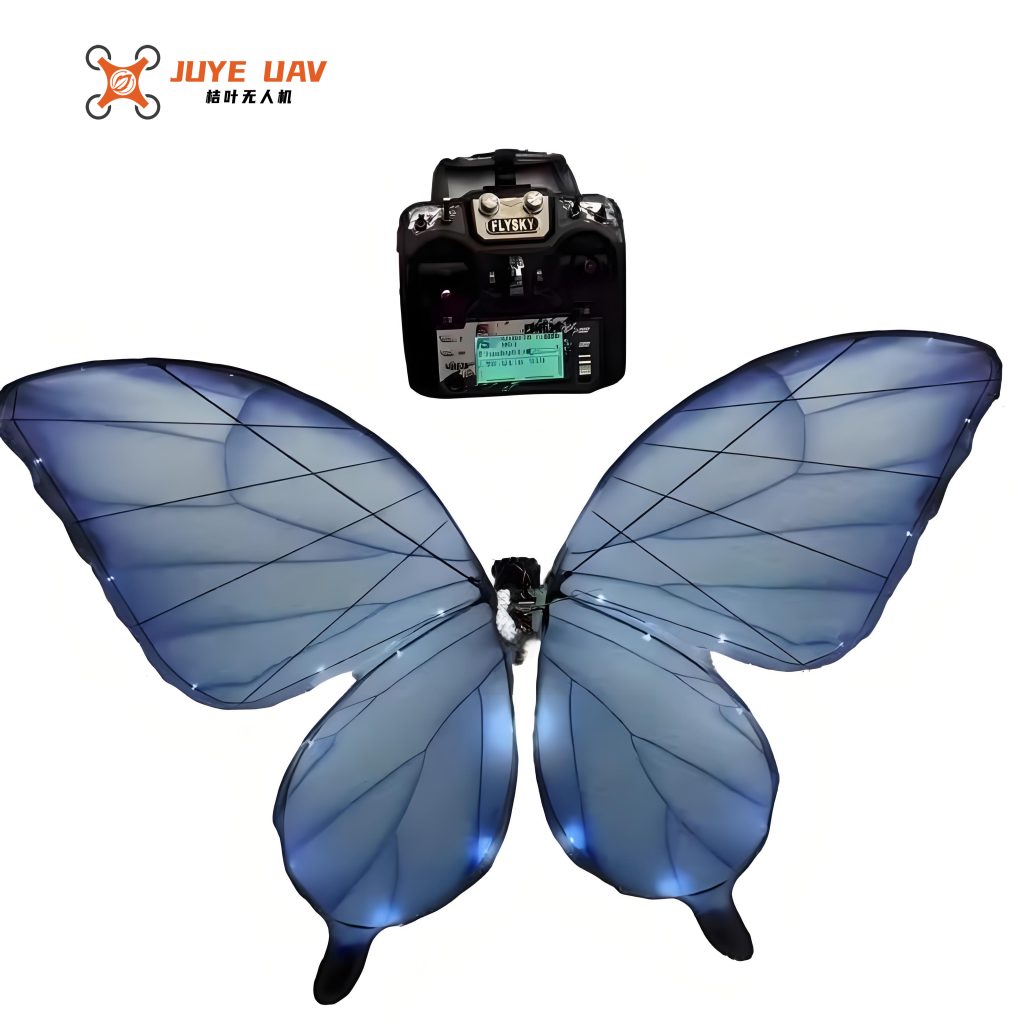
The ultimate realization of a bionic butterfly drone integrates these biomimetic principles into a functional system. The following table contrasts a traditional multi-rotor drone with the envisioned features of a butterfly-inspired drone.
| Aspect | Traditional Quadcopter Drone | Bionic Butterfly Drone (Vision) |
|---|---|---|
| Propulsion & Lift | Rigid rotors, independent motors. Efficient hover but poor gust rejection. | Flapping flexible wings. Unsteady aerodynamics enabling efficient forward flight, hover, and superior gust tolerance. |
| Maneuverability | Controlled by varying rotor speeds. Agile but limited in acrobatics. | Extreme agility via active wing morphing, body flexion, and tail adjustment. Capable of rapid 180° turns, backward flight. |
| Energy Efficiency | High power consumption for lift, especially in hover. Limited flight time. | Potentially more efficient in forward flight due to lift-generating wings and gliding ability. Hover remains energetically costly. |
| Stealth & Signature | High acoustic signature from rotors; distinct visual silhouette. | Quieter flapping sound; visual camouflage via biomimetic patterns and colors; potential for low radar cross-section from shape. |
| Materials & Structure | Carbon fiber, aluminum, plastics. Rigid airframe. | Lightweight composites, smart materials (SMA, DEA), flexible membranes. Compliant, damage-tolerant structure. |
| Coloration & Surface | Applied paint or decals. Static color, often for branding/visibility. | Engineered structural color薄膜 or nano-patterns for dynamic/adaptive camouflage, signaling, or thermal regulation. |
The design workflow for such a drone, incorporating the discussed computational tools, can be summarized as follows:
1. Biological Target Selection: Choose a butterfly species based on desired operational parameters (e.g., Morpho for forest canopy agility and communication, Kallima for ultimate leaf mimicry).
2. Morphological Analysis: Use 3D scanning and kinematic studies to model wing geometry, venation, and flapping kinematics.
3. Color-Pattern Extraction: Apply K-means clustering on a curated image set of the species to define the quantitative color palette and spatial distribution.
4. Computational Pattern Transfer: Train a CycleGAN model to transfer the extracted pattern onto the 3D model of the drone’s wings/fuselage, generating numerous design variants.
5. Multi-functional Material Integration: Specify materials that can achieve the target colors (e.g., photonic crystals for iridescence) while meeting structural, weight, and aerodynamic requirements.
6. Prototyping & Testing: Fabricate using advanced methods (3D printing, lithography for nano-features) and test in wind tunnels and real-world environments.
The potential applications for a mature bionic butterfly drone are vast. In environmental monitoring, its quiet operation and natural appearance would allow it to observe wildlife with minimal disturbance. In search and rescue within collapsed structures, its agility and ability to navigate tight, complex spaces could be lifesaving. For military and security, the combination of stealth, agility, and potential for adaptive camouflage presents a significant advantage. Furthermore, swarms of such drones, communicating via optical signals mimicked from butterfly interactions, could perform complex coordinated tasks.
In conclusion, the bionic butterfly drone represents a frontier in bio-inspired robotics, synthesizing insights from entomology, optics, and artificial intelligence. The journey from admiring a butterfly’s beauty to engineering a drone that encapsulates its essence involves rigorous quantitative analysis—using algorithms like K-means for color deconstruction and CycleGAN for creative pattern synthesis—coupled with breakthroughs in soft robotics and material science. While significant challenges remain in power density, control stability, and mass manufacturing of nano-features, the trajectory is clear. The future of micro-aerial vehicles will not merely be shaped by engineering constraints but will be brilliantly colored and elegantly formed by the timeless principles of nature, taking flight in the form of the sophisticated bionic butterfly drone.