
The pursuit of miniaturized, agile, and efficient aerial platforms has driven significant interest in biomimetic flapping-wing aircraft. Unlike conventional fixed-wing or rotary-wing systems, these drones, inspired by nature’s aviators such as insects and birds, offer unparalleled advantages in energy efficiency, maneuverability in confined spaces, and low acoustic signature. Among insect inspirations, the butterfly presents a unique and compelling model due to its distinctive two-pair wing configuration and graceful yet complex flight kinematics. This article details the comprehensive design, development, and analysis of a novel bionic butterfly drone, focusing on overcoming critical challenges in lightweight construction, high-performance actuation, and precise control.
The design philosophy for this bionic butterfly drone follows a rigorous bio-inspired engineering workflow. It begins with a meticulous study of lepidopteran morphology and aerodynamics, informing the mechanical architecture and motion patterns. This biological insight is then translated into engineering specifications through iterative conceptual design, kinematic and dynamic analysis, and parameter optimization. Advanced manufacturing techniques like 3D printing and laser cutting are employed for rapid prototyping. The final stage involves integrated system testing, data collection on flight performance, and refinement loops to achieve the desired balance of weight, efficiency, and stability. The core objective was to create a sub-40g drone capable of stable hovering, forward flight, and controlled turns.
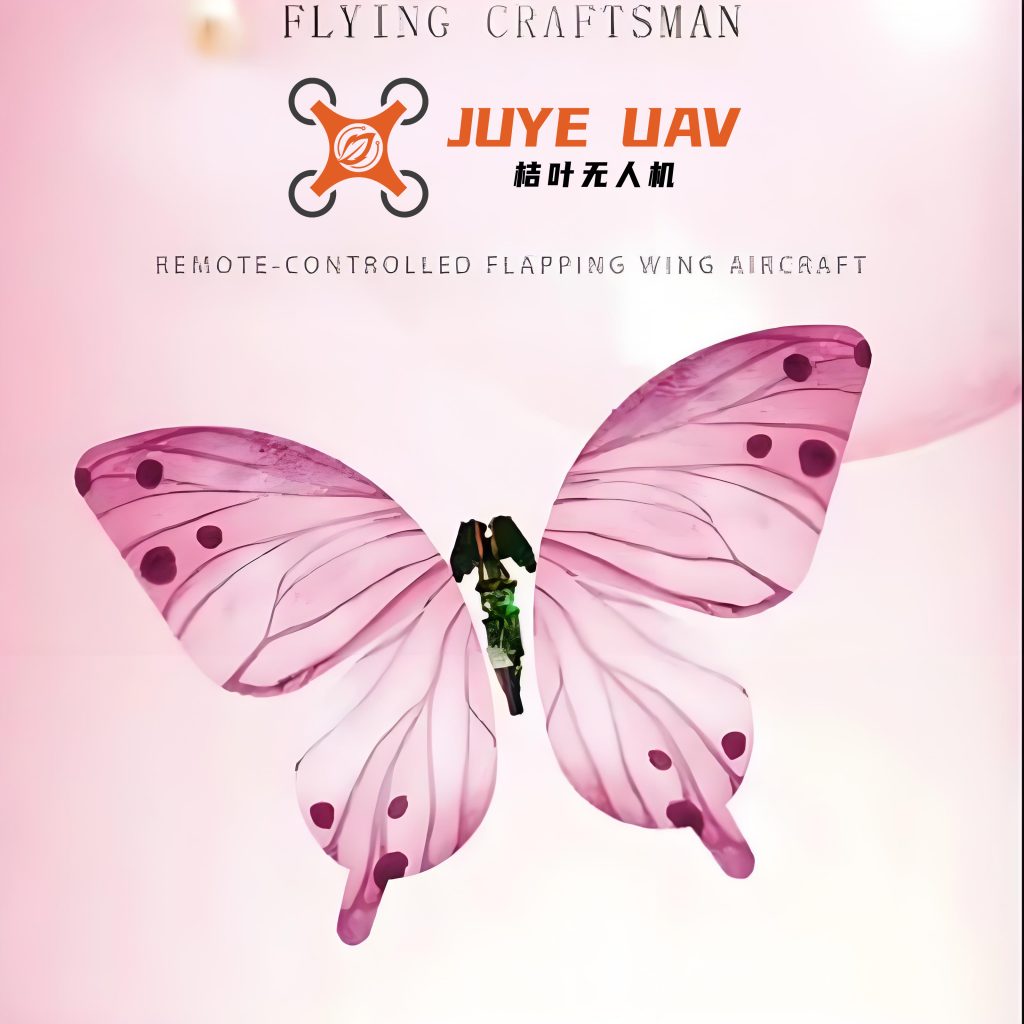
Morphological and Structural Design
The structural design of the bionic butterfly drone prioritizes an optimal strength-to-weight ratio. The airframe is decomposed into two primary subsystems: the flexible wings and the central body support structure.
Wing Design and Materials
The wings are the most critical components for generating lift and thrust. The design emulates the venation pattern and membrane structure of a true butterfly wing. Each side of the bionic butterfly drone features a main wing and a smaller forewing (or副翼), creating a combined aerodynamic surface. The wing skeleton, replicating the veins, is constructed from 0.8mm diameter high-strength carbon fiber rods. This material provides exceptional rigidity while allowing for passive, aeroelastic deformation during flapping, which is crucial for enhancing aerodynamic efficiency. The membrane is made from a lightweight, high-tensile P31n kite fabric. Its minimal mass and ability to withstand cyclic aerodynamic loads make it ideal for this application. The completed wing structure achieves remarkable lightness without compromising durability, a key factor for the bionic butterfly drone‘s flight performance.
| Parameter | Value | Unit |
|---|---|---|
| Total Wingspan | 41.4 | cm |
| Single Wing Area (approx.) | ~120 | cm² |
| Skeleton Material | Carbon Fiber (Ø0.8mm) | – |
| Membrane Material | P31n Kite Fabric | – |
| Wing Configuration | Main Wing + Forewing | – |
Central Body and Support Structure
The body acts as the backbone, housing the propulsion, control, and power systems. The core is a 3mm diameter carbon fiber rod, chosen for its superior stiffness and minimal weight. The primary actuation system consists of two high-performance micro digital servos. These servos are housed within a custom-designed, lightweight shell fabricated using Polylactic Acid (PLA) via 3D printing. This shell precisely aligns and secures the servos to the carbon fiber rod. The choice of a direct-drive configuration, where each servo independently controls one wing pair via a short linkage, eliminates the complexity, weight, and backlash associated with traditional gear trains. This direct-drive approach is fundamental to the high-fidelity motion control of the bionic butterfly drone.
| Component | Model/Specification | Key Parameters |
|---|---|---|
| Digital Servo | Micro High-Speed Type | Mass: 3.3g, Speed: 0.06s/60°, Torque: 0.18 N·m @7.4V |
| Servo Housing | Custom 3D-Printed (PLA) | Lightweight, ensures precise servo alignment |
| Main Support Beam | Carbon Fiber Rod | Diameter: 3mm |
| Drive Method | Dual-Servo Direct Drive | Independent wing control, no gearbox |
Actuation and Control System Design
The dynamic performance of the bionic butterfly drone is governed by its actuation and control systems. This involves the physical servo mechanisms, the electronic control unit, and the algorithms that translate pilot commands into precise wing motions.
Servo-Based Actuation Mechanism
Each wing of the bionic butterfly drone is directly connected to the shaft of a micro digital servo. The servo rotates back and forth within a defined angular range, typically ± 60°, converting this rotary motion into the oscillatory flapping of the wing. The primary kinematic equation governing the angular position of the servo (and thus the wing) as a function of time is a modulated cosine function:
$$ \theta(t) = \theta_{mid} \pm A \cdot \cos(\omega t + \phi) $$
Where:
- $\theta(t)$ is the instantaneous servo angle (wing position).
- $\theta_{mid}$ is the neutral or mid-position of the servo.
- $A$ is the flapping amplitude (half of the total angular stroke).
- $\omega$ is the angular frequency of flapping, related to the flapping frequency $f$ by $\omega = 2\pi f$.
- $\phi$ is the phase offset, critical for differential control between the two wings.
- The $\pm$ sign determines the direction of the cosine wave, affecting the wing’s stroke pattern.
The generated lift ($L$) and thrust ($T$) are complex functions of the flapping kinematics, involving parameters like frequency, amplitude, and the angle of attack profile. A simplified quasi-steady model can be expressed as:
$$ L \propto \rho S C_L(\alpha) \dot{\theta}^2, \quad T \propto \rho S C_D(\alpha) \dot{\theta}^2 $$
where $\rho$ is air density, $S$ is wing area, $C_L$ and $C_D$ are lift and drag coefficients dependent on the instantaneous angle of attack $\alpha$, and $\dot{\theta}$ is the angular velocity of the wing. The bionic butterfly drone modulates these parameters in real-time to achieve controlled flight.
Control Hardware and Algorithm
The control system is built around an Arduino-compatible microcontroller, which serves as the flight control unit (FCU). A compact 2.4GHz multi-channel receiver is connected to the FCU, providing command signals from a standard radio transmitter. The FCU reads the Pulse Width Modulation (PWM) signals from the receiver’s channels and maps them to specific flight control parameters for the bionic butterfly drone.
| Transmitter Channel | Mapped Control Function | Parameter Range (PWM µs) | Effect on Drone |
|---|---|---|---|
| Channel 1 (Aileron) | Yaw / Differential Offset ($\Delta$) | -100 to +100 | Induces turning by creating asymmetry between left and wing flapping amplitude or phase. |
| Channel 2 (Elevator) | Pitch / Mid-Position Offset | -250 to +250 | Adjusts the neutral wing angle, controlling climb or descent. |
| Channel 3 (Throttle) | Flapping Frequency ($f$) | ~3500 to 10000 (Period in µs) | Controls the power and primary lift. Lower period = higher frequency. |
| Channel 4 (Rudder) | Refined Differential | -100 to +100 | Provides additional yaw tuning. |
| Channel 5 (Aux 1) | Flapping Amplitude ($A$) | 400 to 700 | Controls the magnitude of the wing stroke. |
| Channel 6 (Aux 2) | Flight Mode Switch | >800 (Switch ON) | Engages special maneuvers or calibration modes. |
The core control algorithm implemented on the Arduino synthesizes the servo command signals in real-time. The code operates in a loop, calculating the desired position for each servo for every time step. A simplified pseudo-code representation of the core logic is as follows:
Read PWM inputs from all receiver channels.

Map Ch3 to flapping period T, calculate step angle increment.

Map Ch5 to amplitude A.

Map Ch1/Ch4 to differential term Δ.

If (flight mode is ACTIVE): {

  For each servo i (left, right): {

    phase_i = base_phase + differential_offset_i;

    target_angle_i = mid_position ± (A ± Δ) * cos(phase_i);

    command_servo(i, target_angle_i);

  }

  Increment phase_i for next loop iteration based on T.

}

Transmit servo commands via PWM.
This algorithm allows for independent and precise control over each wing. For forward flight, both servos operate symmetrically with a 180-degree phase difference for wing alternation. For a right turn, the algorithm can decrease the amplitude or introduce a phase lag on the right wing while increasing it on the left, creating a yawing moment. This sophisticated, software-driven control is what enables the bionic butterfly drone to perform complex aerial maneuvers.
System Integration and Flight Testing
Following the design and component selection, the bionic butterfly drone was fully integrated. The final prototype had a total mass of 30 grams, including a 7.4V, 200mAh Lithium-Polymer battery. The electronics payload consisted solely of the two servos, the receiver, and necessary wiring, keeping the avionics mass to an absolute minimum.
| Category | Specification | Value/Detail |
|---|---|---|
| Physical Dimensions | Wingspan | 41.4 cm |
| Total Mass (with battery) | 30 grams | |
| Power System | Battery | 7.4V, 200mAh Li-Po |
| Estimated Flight Endurance | ~4.5 minutes | |
| Actuation | Number of Servos | 2 (Direct Drive) |
| Operational Flapping Frequency | 8 – 12 Hz | |
| Control | Control Unit | Arduino-based FCU |
| Communication | 2.4 GHz, 10-channel receiver |
Flight tests were conducted in an indoor environment to evaluate stability, maneuverability, and performance. The bionic butterfly drone demonstrated stable lift-off and hover at a flapping frequency of approximately 10 Hz. By modulating the throttle (frequency) and pitch channel, transitions to forward flight were achieved. The differential yaw control via the aileron channel proved effective, allowing the drone to execute coordinated turns. The lightweight construction using carbon fiber and P31n fabric performed excellently, with no structural failures observed during testing. The direct-drive servo system provided crisp and immediate response to control inputs, validating the design choice over geared mechanisms. The primary limitation was the flight time, constrained by the battery capacity and the energy consumption of the high-performance servos.
Conclusion and Future Perspectives
This project successfully designed, fabricated, and tested a functional bionic butterfly drone. The key achievements include:
- Ultra-Lightweight Architecture: A total mass of 30g was achieved through strategic material selection (carbon fiber, P31n fabric, 3D-printed PLA) and minimalist design.
- High-Precision Direct Actuation: The dual digital servo direct-drive system eliminated gearing losses and backlash, enabling precise, independent control of each wing’s kinematics.
- Sophisticated Software-Based Control: An Arduino-implemented algorithm successfully mapped standard RC commands to the complex flapping parameters (frequency, amplitude, phase differential), allowing for stable flight and basic maneuvers.
The bionic butterfly drone serves as a compelling proof-of-concept for insect-scale flapping-wing MAVs. Future iterations of the bionic butterfly drone can focus on several advanced areas:
- Enhanced Energy Efficiency: Integrating brushless DC motors with specialized linkage mechanisms could improve power-to-weight ratio and extend endurance.
- Onboard Autonomy: Equipping the drone with micro sensors (IMU, optical flow) and implementing stability augmentation and autonomous navigation algorithms.
- Advanced Aerostructures: Exploring actively or passively morphing wing shapes to adapt to different flight regimes, further mimicking true insect flight.
- Swarm Intelligence: Developing communication protocols for multiple bionic butterfly drones to operate collaboratively.
The development pathway outlined here provides a foundational framework for the continued evolution of biomimetic drones, pushing the boundaries towards smaller, smarter, and more capable aerial systems.