
The coordinated flight of biological flocks, a mesmerizing spectacle of nature, has long served as a profound inspiration for engineers seeking to solve complex problems in multi-agent robotics and autonomous systems. Among the most iconic examples is the V-shaped formation adopted by migrating flocks of wild geese, a behavior refined through millennia of evolution to achieve remarkable energy efficiency over vast distances. This inherent elegance and efficiency present a compelling blueprint for the advancement of multi-unmanned aerial vehicle (UAV) systems. My research delves into this rich biological paradigm, translating the underlying principles of wild goose flocking into robust algorithms for UAV close formation control. The ultimate expression of this technological translation is found in the captivating domain of the formation drone light show, where hundreds of UAVs move as a single, luminous entity in the night sky. A formation drone light show is not merely an artistic display; it is a rigorous testbed for precision coordination, fault tolerance, and real-time trajectory planning, demanding the very same principles of stable, efficient, and adaptive grouping that we observe in nature. This article details the biomimetic mapping from biological mechanism to engineering solution, presents a comprehensive mathematical framework for close formation control, and explores its pivotal role in enabling the reliable and spectacular performances that define a modern formation drone light show.
The Biological Blueprint: Energy-Efficient Flight in Wild Geese
The migratory V-formation is a masterclass in aerodynamic cooperation. The primary mechanism underpinning its efficiency is the intelligent exploitation of induced airflow, specifically upwash vortices. As a bird flaps its wings, it generates a pair of counter-rotating trailing vortices. The core of this vortex system creates a downwash region directly behind the bird, but importantly, an upwash region is created laterally outward from the wingtips. A following bird, positioning itself within this upwash zone, experiences an effective increase in its angle of attack and, consequently, a gain in lift. This allows the follower to maintain altitude with reduced muscular effort or to convert the extra lift into a reduction in induced drag. Studies suggest the optimal lateral spacing to maximize this benefit is approximately one-tenth of the wingspan overlap, with the vortex cores spaced roughly at 0.78b, where $b$ is the wingspan. The optimal longitudinal separation is also critical for positioning the follower in the strongest part of the upwash field.
Beyond pure aerodynamics, the social behavior of the flock plays an equally vital role. The lead position in the formation is the most energetically costly, as the leader does not benefit from any preceding bird’s upwash. To ensure fairness and long-term endurance of the group, wild geese exhibit a behavior known as positional rotation. Individuals periodically and smoothly exchange positions, allowing the former leader to fall back into an energy-saving slot, while a rested individual takes over the leadership duty. This dynamic, reciprocal altruism ensures that the fatigue and energy cost are distributed across the entire flock, enabling journeys that would be impossible for a solitary individual. This combination of optimal spatial geometry and dynamic role allocation forms the core biological insight for my engineered system.
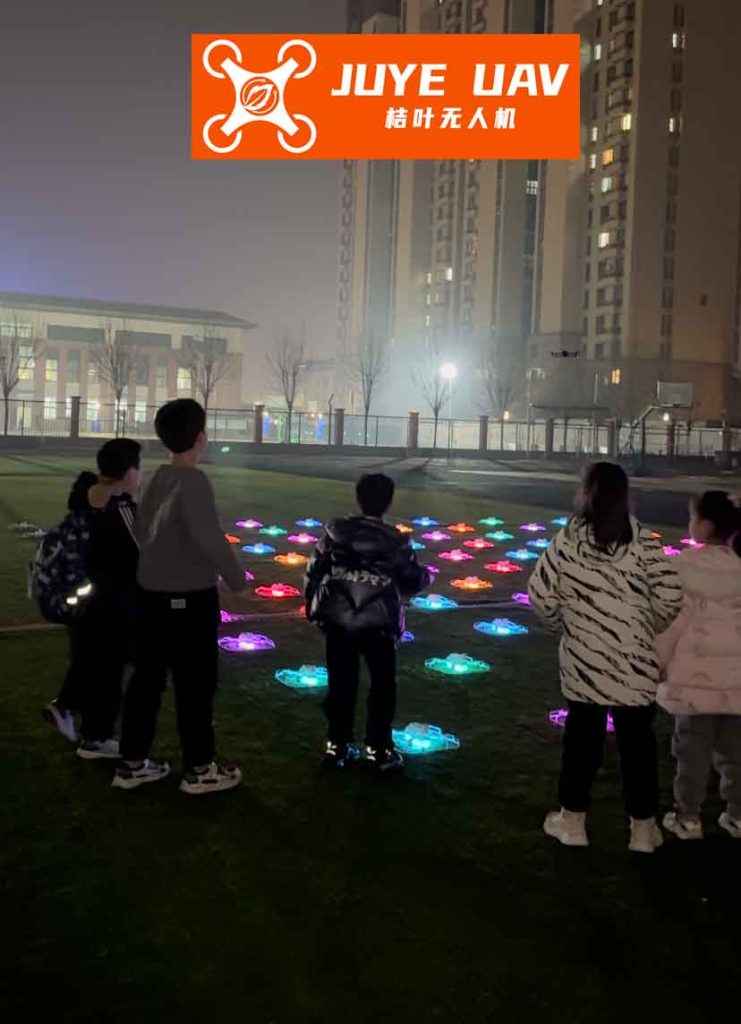
The visual spectacle of a coordinated formation drone light show directly mirrors this biological phenomenon. Each drone must hold its precise position within a moving lattice, akin to a bird in a flock, to create a coherent, large-scale image or motion. The failure of a single unit (analogous to a tired bird) must be seamlessly compensated for by its neighbors, and the entire formation must be capable of complex, synchronized maneuvers—precisely the challenges addressed by biomimetic close-formation control.
Biomimetic Mapping and Formation Architecture
The first step in the engineering process is to establish a clear mapping from biological observation to technical specification. For a multi-UAV system aiming to replicate the efficiency and stability of a goose flock, this involves defining a scalable formation topology and a dynamic reconfiguration protocol.
Formation Topology: A hierarchical Leader-Follower structure is adopted, arranged in a symmetric V-shape. This structure simplifies the control problem by establishing clear relational pairs. Let us define a formation of $N$ UAVs. One vehicle is designated as the global leader ($L$). A set of vehicles ($F_{1i}$) are assigned as direct followers of $L$, maintaining a specific relative offset. Subsequently, another set ($F_{2j}$) can be assigned as followers of the $F_{1i}$ group, creating a deeper, scalable hierarchy. For a classic V-formation with 5 UAVs, the topology can be defined as shown in Table 1.
| UAV ID | Role | Reference UAV | Desired Relative Position |
|---|---|---|---|
| 1 | Leader (L) | – | – |
| 2 | Follower Tier-1 (F₁₁) | UAV 1 (L) | $\Delta \mathbf{p}_{12} = [\Delta x_{12}, \Delta y_{12}, \Delta z_{12}]^T$ |
| 3 | Follower Tier-1 (F₁₂) | UAV 1 (L) | $\Delta \mathbf{p}_{13} = [\Delta x_{13}, -\Delta y_{13}, \Delta z_{13}]^T$ |
| 4 | Follower Tier-2 (F₂₁) | UAV 2 (F₁₁) | $\Delta \mathbf{p}_{24} = [\Delta x_{24}, \Delta y_{24}, \Delta z_{24}]^T$ |
| 5 | Follower Tier-2 (F₂₂) | UAV 3 (F₁₂) | $\Delta \mathbf{p}_{35} = [\Delta x_{35}, -\Delta y_{35}, \Delta z_{35}]^T$ |
Based on aerodynamic studies for fixed-wing aircraft, the desired offsets for minimal drag on the follower are often set at specific ratios of the wingspan $b$. A common optimal set is:
$$\Delta x^* = 2b, \quad \Delta y^* = \frac{\pi}{4}b \approx 0.78b, \quad \Delta z^* = 0$$
This lateral spacing ($\Delta y^*$) places the follower’s wingtip near the vortex core of the leader, maximizing upwash benefit, while the longitudinal spacing ($\Delta x^*$) ensures the follower is in a stable region of the wake.
Dynamic Topology Reconfiguration (Role Rotation): Mimicking the geese’s leadership rotation, a protocol for periodic reconfiguration is designed. The goal is to distribute the higher energy cost of the lead position. After a predefined time interval or upon reaching an energy threshold, the formation undergoes a scheduled re-shuffling. For example, the lead UAV (1) moves laterally and back to assume a follower position behind UAV 2, while UAV 2 accelerates to become the new leader. This maneuver must be planned as a smooth, collision-free transition where all UAVs continuously track time-varying relative setpoints until the new topology is established. This capability is crucial for long-endurance missions and is equally vital in a formation drone light show to achieve dynamic pattern morphing and to manage battery load across the swarm.
Mathematical Modeling of UAV Close Formation Flight
To design an effective controller, a mathematical model capturing both the individual UAV dynamics and the aerodynamic coupling between them is essential.
1. Individual UAV Model (Leader & Baseline Follower): Each fixed-wing UAV is modeled with three core autopilot loops for speed, heading, and altitude hold. These are typically represented as first or second-order systems that approximate the closed-loop behavior of the inner-loop flight control system.
- Speed Hold Autopilot: $$ \tau_V \dot{V} + V = V_c $$ where $V$ is actual speed, $V_c$ is commanded speed, and $\tau_V$ is the speed time constant.
- Heading Hold Autopilot: $$ \tau_\psi \dot{\psi} + \psi = \psi_c $$ where $\psi$ is actual heading, $\psi_c$ is commanded heading, and $\tau_\psi$ is the heading time constant.
- Altitude Hold Autopilot: $$ \tau_{h_a}\tau_{h_b} \ddot{h} + (\tau_{h_a}+\tau_{h_b}) \dot{h} + h = h_c $$ where $h$ is actual altitude, $h_c$ is commanded altitude, and $\tau_{h_a}, \tau_{h_b}$ are altitude time constants.
2. Aerodynamic Coupling Model (For Followers in Close Formation): A follower UAV in the wake of a leader experiences additional aerodynamic forces due to the leader’s vortices. These are modeled as disturbance forces and moments acting on the follower. For control design, we often consider the primary effects as modifications to the forces along the three body axes. The relative motion of a follower ($W$) with respect to its specific leader ($L$) in the horizontal plane can be described. The leader’s states ($V_L, \psi_L, h_L$) are treated as measurable disturbances. The follower’s dynamics are augmented to include coupling terms:
Longitudinal relative motion (x-direction is aligned with leader’s velocity vector):
$$ \dot{x} = V_W \cos(\psi_W – \psi_L) – V_L + \Delta V_{coupling} + d_x $$
The coupling term $\Delta V_{coupling}$ and disturbance $d_x$ incorporate the effect of the leader’s wake on the follower’s drag.
Lateral relative motion (y-direction):
$$ \dot{y} = V_W \sin(\psi_W – \psi_L) + \Delta L_{coupling} + d_y $$
Here, $\Delta L_{coupling}$ represents the side force induced by the lateral component of the vortex flow (sidewash).
Vertical relative motion (z-direction, where $z = h_W – h_L$):
$$ \dot{z} = \zeta_W + \Delta Z_{coupling} + d_z $$
$\Delta Z_{coupling}$ models the effect of upwash/downwash on the follower’s lift, and $\zeta_W$ is the follower’s vertical rate.
The coupling terms are complex functions of the relative positions ($x, y, z$). For control design, they can be linearized around the desired formation geometry or treated as bounded uncertainties to be rejected by the controller.
Design of the Biomimetic Formation Flight Controller
The controller’s objective is to maintain the desired relative position $[\Delta x^*, \Delta y^*, \Delta z^*]^T$ for each follower relative to its assigned leader, despite aerodynamic coupling and leader maneuvers. A decentralized approach is used, where each follower runs its own formation controller based on local measurements of its leader’s states and their relative position (e.g., from visual systems or precise relative GPS).
The controller is decomposed into three independent channels: longitudinal, lateral, and vertical. Each channel generates a command for the corresponding low-level autopilot (speed, heading, altitude) based on the error in its respective axis. A PID control structure provides robustness.
1. Longitudinal (X) Channel Controller: This channel controls the along-track separation. The error signal combines position error and velocity error for stable damping.
$$ e_x = k_{px} (x – \Delta x^*) + k_{dx} (\dot{x} – 0) + k_{v} (V_W – V_L) $$
The longitudinal control command (speed correction for the follower’s autopilot) is:
$$ V_{c,form} = V_{c,trim} – \left( K_{P_x} e_x + K_{I_x} \int e_x \, dt + K_{D_x} \dot{e}_x \right) $$
where $V_{c,trim}$ is the nominal cruise speed command.
2. Lateral (Y) Channel Controller: This channel controls the lateral separation. The error signal combines position error and heading error.
$$ e_y = k_{py} (y – \Delta y^*) + k_{dy} (\dot{y} – 0) + k_{\psi} (\psi_W – \psi_L) $$
The lateral control command (heading correction for the follower’s autopilot) is:
$$ \psi_{c,form} = \psi_L + \Delta \psi^* – \left( K_{P_y} e_y + K_{I_y} \int e_y \, dt + K_{D_y} \dot{e}_y \right) $$
where $\Delta \psi^*$ is the desired relative heading (often zero for station-keeping).
3. Vertical (Z) Channel Controller: This channel controls the altitude separation.
$$ e_z = k_{pz} (z – \Delta z^*) + k_{dz} (\dot{z} – 0) $$
The vertical control command (altitude correction for the follower’s autopilot) is:
$$ h_{c,form} = h_L + \Delta z^* – \left( K_{P_z} e_z + K_{I_z} \int e_z \, dt + K_{D_z} \dot{e}_z \right) $$
The gains for these controllers (e.g., $K_{P_x}, K_{I_y}, K_{D_z}$) are tuned using methods like linear quadratic regulator (LQR) design on a linearized model of the coupled system or via optimization algorithms to ensure stability and performance. The overall control architecture for a follower UAV is shown in the diagram below, highlighting how the formation controller wraps around the standard autopilot loops.
| Channel | Proportional Gain ($K_P$) | Integral Gain ($K_I$) | Derivative Gain ($K_D$) |
|---|---|---|---|
| Longitudinal (Speed) | 0.5 – 2.0 | 0.01 – 0.1 | 0.1 – 0.5 |
| Lateral (Heading) | 0.8 – 3.0 | 0.05 – 0.2 | 0.2 – 1.0 |
| Vertical (Altitude) | 1.0 – 4.0 | 0.1 – 0.3 | 0.5 – 2.0 |
Simulation and Validation: From Formation Keeping to Dynamic Shows
The performance of the biomimetic controller is validated through numerical simulation. A scenario with five UAVs forming a V and executing a leader rotation maneuver demonstrates key capabilities. The simulation parameters for the UAVs are based on a small fixed-wing platform model.
Simulation Phases:
Phase 1 (0-15s): UAVs start from dispersed initial positions and converge to the desired tight V-formation using the described controller. The relative position errors ($e_x, e_y, e_z$) for all follower-leader pairs rapidly converge to near zero.
Phase 2 (15-30s): The formation maintains station-keeping while the leader executes a gentle turning maneuver. The followers accurately track, maintaining the formation geometry.
Phase 3 (30-45s): A dynamic topology reconfiguration is triggered. The lead UAV (UAV1) and a starboard wingman (UAV2) smoothly exchange roles according to a pre-planned trajectory, while the rest of the formation adapts. After the transition, the new formation is stable.
The critical metric for a biomimetic system is energy efficiency. A simplified fuel flow model can be used for comparison:
$$ \dot{m}_f = TSFC \cdot T $$
where $\dot{m}_f$ is the fuel mass flow rate, $TSFC$ is the thrust-specific fuel consumption, and $T$ is the required thrust. For a follower in the optimal upwash position, the required lift-induced drag is reduced. Assuming thrust is primarily used to overcome drag, this translates to a lower $T$ and thus a lower $\dot{m}_f$. A comparative simulation between a solo UAV and one in the optimal formation position typically shows a 10-15% reduction in energy consumption for the follower, validating the core biomimetic advantage. This principle, while originally for fixed-wing endurance, translates to multi-rotor drones in a formation drone light show as increased flight time or the ability to use smaller, lighter batteries.
The Ultimate Application: Precision in Formation Drone Light Shows
The most publicly visible and demanding application of these biomimetic formation control principles is the large-scale formation drone light show. Here, the “aerodynamic efficiency” goal is replaced by “absolute positional accuracy” and “visual synchrony,” but the underlying control challenges are fundamentally similar and even more stringent.
In a formation drone light show, each drone is a node in a dynamic, three-dimensional pixel grid. The show is defined by a sequence of keyframes, each specifying the precise $(x, y, z)$ coordinate and RGB color for every drone at a given time $t$. The task of the swarm controller is to generate smooth, collision-free trajectories for all drones between these keyframes, ensuring they arrive simultaneously. The biomimetic controller architecture is perfectly suited for this:
- Relative Positioning: Instead of tracking a physical leader, drones often track a virtual reference point or communicate to maintain relative offsets with neighbors, using the same PID-based error minimization in all three axes.
- Fault Tolerance & Role Rotation: Inspired by the flock’s robustness, if a drone in a formation drone light show fails or depletes its battery, its neighbors can slightly adjust their positions to minimize the visual gap, or a standby drone can be inserted into the formation—a direct parallel to role reallocation.
- Synchronized Maneuvering: Complex choreography, like a swirling vortex or a morphing logo, requires the same precise coordination of velocity, heading, and altitude changes as a flock of geese executing a turn. The decentralized control logic ensures global behavior emerges from local rules.
- Scalability: The hierarchical follower topology allows a formation drone light show to scale to thousands of units by creating sub-swarms, each with its own sub-leader coordinating with a global master trajectory.
The success of a modern formation drone light show is therefore a direct testament to the maturity of biomimetic formation flight algorithms. It demonstrates that the principles learned from wild geese—optimal spacing, dynamic role allocation, and decentralized cooperative control—are not just theoretical concepts but are practical engineering solutions enabling new forms of technological artistry and utility.
Conclusion
The study of wild goose migration offers a timeless and powerful inspiration for solving the complex problem of multi-UAV close formation flight. By mapping the biological mechanisms of aerodynamic drafting and social role rotation onto a formal engineering framework, we can develop robust, efficient, and adaptive UAV swarm controllers. The mathematical modeling of coupled dynamics, combined with a structured, multi-channel PID control approach, provides a clear pathway to achieving stable formation keeping and seamless topology reconfiguration. The significant benefit in terms of energy savings validates the core biomimetic hypothesis. Ultimately, these technologies find a profound and spectacular realization in the domain of the formation drone light show, where the precision, reliability, and scalability demanded are met by the very same principles that guide a flock of geese across a continent. As we continue to refine these algorithms, drawing from ever deeper wells of biological intelligence, the future of coordinated aerial systems—for both critical missions and breathtaking entertainment—appears increasingly cohesive, intelligent, and assured.