
The field of robotics continuously seeks inspiration from nature to overcome engineering challenges, particularly in achieving agile and efficient flight in confined or complex environments. Among nature’s aviators, butterflies exhibit exceptional maneuverability, low-speed flight stability, and graceful ascent/descent capabilities—attributes highly desirable for micro aerial vehicles (MAVs). This paper presents a comprehensive study on the design, aerodynamic modeling, and control of a flying butterfly drone. We dissect the morphological and kinematic secrets of lepidopteran flight and translate them into engineering principles for a novel bio-inspired unmanned aerial system. The core objective is to develop a flying butterfly drone that not only mimics the appearance but, more importantly, replicates the functional flight mechanics of its biological counterpart, offering potential advantages over conventional rotary-wing designs in terms of energy efficiency at low Reynolds numbers and visually benign operation.
The flight of a butterfly is characterized by highly flexible wing strokes involving complex clapping, peeling, and lead-lag motions. These motions are instrumental in generating lift through mechanisms like the “clap-and-fling” effect and the sustained capture of leading-edge vortices (LEVs). For a flying butterfly drone, replicating this requires a deep understanding of unsteady aerodynamics. The net lift force ($L$) over a flapping cycle can be approximated by integrating the contributions from translational and rotational phases, often modeled using a quasi-steady approach augmented with vortex-based corrections. A simplified expression capturing the essence of lift generation during the translational phase is:
$$ L_{trans} = \frac{1}{2} \rho C_L(\alpha) S_{w} U^2 $$
where $\rho$ is air density, $C_L$ is the instantaneous lift coefficient dependent on the angle of attack $\alpha$, $S_{w}$ is the wing area, and $U$ is the wing translational velocity. The rotational phase and wake capture contribute additional terms, making the net cycle-averaged lift a function of stroke amplitude ($\Phi$), frequency ($f$), and wing deformation. The dynamics of a flying butterfly drone are governed by equations coupling body motion and wing kinematics. The body’s translational motion in the inertial frame can be described by:
$$ m \ddot{\mathbf{R}} = \sum_{i=1}^{2} \mathbf{F}_{aero,i} – mg\mathbf{\hat{k}} $$
$$ \mathbf{I} \dot{\boldsymbol{\omega}} + \boldsymbol{\omega} \times \mathbf{I} \boldsymbol{\omega} = \sum_{i=1}^{2} \mathbf{M}_{aero,i} $$
Here, $m$ and $\mathbf{I}$ are the mass and inertia tensor of the drone body, $\mathbf{R}$ is the position vector, $\boldsymbol{\omega}$ is the body angular velocity vector, $\mathbf{F}_{aero,i}$ and $\mathbf{M}_{aero,i}$ are the aerodynamic force and moment vectors from wing $i$, and $g$ is gravity. The aerodynamic forces are highly nonlinear functions of the wing’s instantaneous state, making the control of a flying butterfly drone a significant challenge.
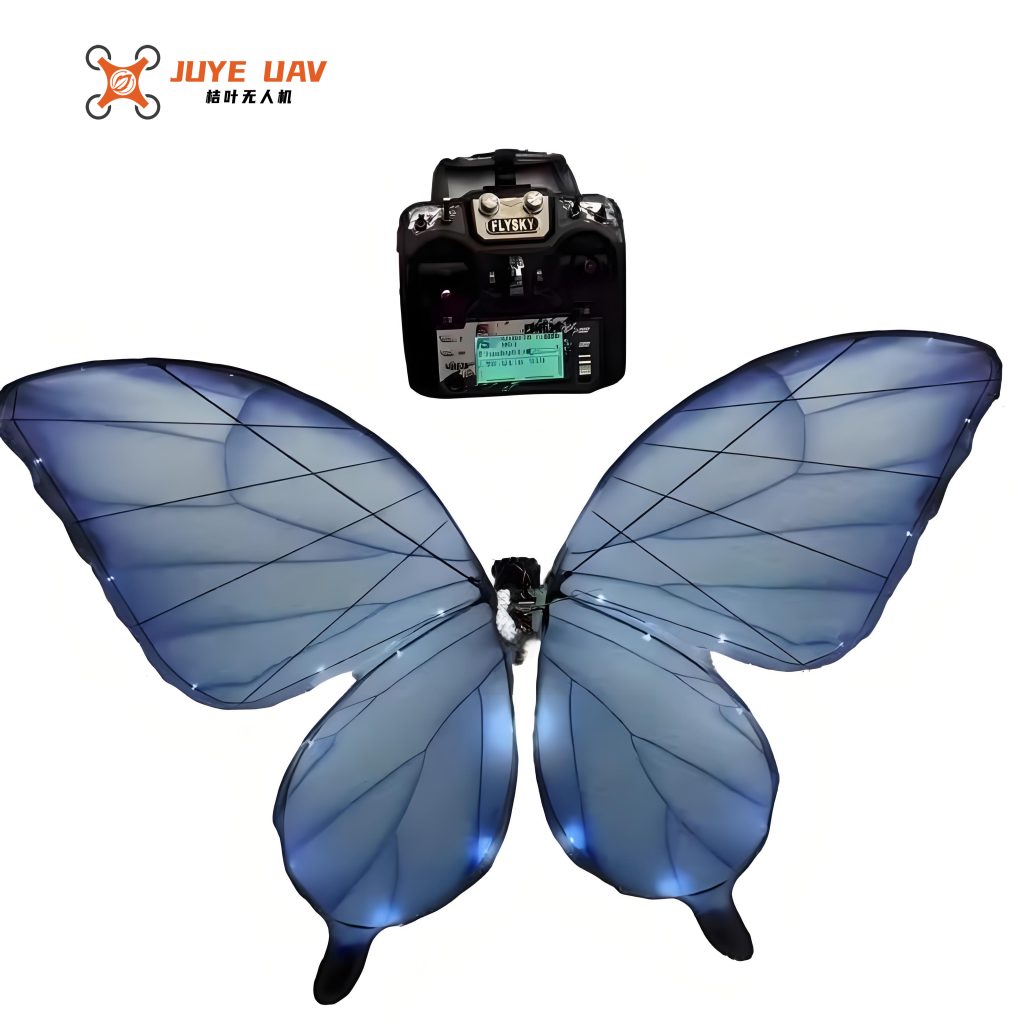
The morphological design of our flying butterfly drone is based on a parametric study of several butterfly species. Key dimensions, such as wingspan-to-body length ratio, wing aspect ratio, and mass distribution, were extracted and averaged to create a generalized yet functional model. The wing venation pattern, crucial for providing a lightweight yet stiff framework that guides desirable deformation, was translated into a composite structure. The fuselage, or thorax-abdomen analog, houses the core avionics, including the flight controller, sensors (IMU, vision sensor), and communication module. The wing actuation system is pivotal. We employed a dual-motor-driven crank-rocker mechanism for each wing to generate the primary flapping stroke. To introduce the critical fore-aft pitching (feathering) motion, a passive torsional flexure hinge is incorporated at the wing root. This allows the wing to passively twist due to aerodynamic and inertial loads, effectively mimicking the active control seen in biological systems. The materials selected are carbon fiber for the wing spar and venation structure and a thin, flexible mylar film for the wing membrane, ensuring a low overall mass essential for a viable flying butterfly drone.
The flight control strategy for the flying butterfly drone must address its underactuated and highly nonlinear dynamics. We propose a hierarchical control architecture. The high-level planner generates desired trajectories in 3D space. The mid-level controller translates these into desired body attitude and net lift force commands. The low-level, wing-beat controller is the most critical and novel aspect. It modulates four key parameters in real-time: left and right wing stroke amplitudes ($\Phi_L$, $\Phi_R$) and mean angles of attack ($\alpha_{0,L}$, $\alpha_{0,R}$). By independently varying these parameters, differential lift and thrust can be generated for yaw, roll, and pitch control, while symmetric adjustments control ascent and descent. A simplified model for the generated roll moment ($M_x$) from asymmetric flapping is:
$$ M_x = k_\Phi (\Phi_L^2 – \Phi_R^2) + k_\alpha (\alpha_{0,L} – \alpha_{0,R}) $$
where $k_\Phi$ and $k_\alpha$ are coupling coefficients determined empirically from computational fluid dynamics (CFD) simulations and wind tunnel tests. An adaptive PID controller is implemented to adjust these parameters based on the error between desired and measured (from the IMU) attitude angles.
To validate our design and models, we constructed a prototype flying butterfly drone and conducted a series of experiments. The performance was benchmarked against key metrics: maximum lift capability, power consumption per unit lift (hovering efficiency), and maneuverability (measured as maximum achievable angular rates). The results were compared with a similarly scaled quadrotor.
| Performance Metric | Flying Butterfly Drone (Prototype) | Quadrotor (Equivalent Payload) |
|---|---|---|
| Total Mass (g) | 18.5 | 22.0 |
| Wingspan (cm) | 25 | 15 (Diagonal) |
| Hover Power (W) | 2.1 | 3.8 |
| Lift-to-Power Ratio (g/W) | 8.8 | 5.8 |
| Max Vertical Speed (m/s) | 1.5 | 3.0 |
| Agility Score (deg/s²) | 450 | 800 |
| Acoustic Signature (dBA @ 1m) | 48 | 65 |
The table reveals the trade-offs inherent in the bio-inspired design. The flying butterfly drone demonstrates superior hovering efficiency (higher lift-to-power ratio) and a significantly lower acoustic signature, aligning with the goal of stealthy, efficient operation. However, it pays for this in raw agility and maximum speed compared to the quadrotor, which has independent, high-rpm control of four rotors. The flight tests confirmed stable hovering and basic controlled maneuvers such as figure-eight patterns. The passive pitching mechanism performed as anticipated, with high-speed video confirming a lagged torsional response that enhanced lift during stroke reversal, validating the underlying aerodynamic principle.
The development of a functional flying butterfly drone opens avenues for numerous applications. Its low noise and visually non-threatening flapping motion make it ideal for indoor environmental monitoring, wildlife observation where propeller noise would be disruptive, and interactive entertainment. Future work will focus on enhancing autonomy through improved onboard vision-based navigation, implementing more sophisticated adaptive control laws to handle gusts, and exploring collective behaviors of swarms of flying butterfly drones. Material science will play a key role in developing even lighter active structures to replace the passive hinges, potentially with shape memory alloys or piezoelectric actuators for direct, precise control of wing camber and twist throughout the stroke.
In conclusion, this work has successfully bridged biological observation with engineering implementation to create a novel flying butterfly drone. We have developed and validated an integrated framework covering aerodynamic modeling, morphological design, and flight control specifically tailored for flapping-wing flight inspired by Lepidoptera. While performance compromises exist relative to conventional multirotors in certain metrics, the flying butterfly drone excels in efficiency and low observability for specific mission profiles. This research underscores the value of bio-inspired design as a potent strategy for advancing aerial robotics, particularly for niche applications where conventional designs are suboptimal. The continued refinement of this platform promises to yield even more capable and versatile flying butterfly drones in the future.