
The coordinated operation of multiple unmanned drones, or Unmanned Aerial Vehicles (UAVs), represents a cornerstone of modern multi-agent systems (MAS). These systems are characterized by their autonomy, adaptability to dynamic environments, inherent complexity, and predominantly distributed architecture. A fundamental and challenging task within this domain is formation control, where a group of unmanned drones must autonomously arrange themselves into and maintain a specific spatial pattern while potentially tracking a desired trajectory.
Traditional formation control strategies often rely on precise measurements of relative distance or displacement between agents. However, bearing—the direction of one agent relative to another—has emerged as a highly attractive alternative sensing modality. Bearing-based control offers significant advantages: it is invariant to translational and scaling transformations of the formation, which provides flexibility, and it can often be obtained using simpler, more cost-effective sensors like monocular cameras compared to ranging equipment. Despite these benefits, practical implementation faces critical hurdles. The desired formation must be achieved under realistic constraints such as unknown and time-varying velocities of reference trajectories and the need for dynamic formation scaling. Furthermore, most control algorithms assume continuous communication and state updates, which is impractical for resource-constrained unmanned drones and leads to unnecessary communication overhead and reduced operational lifespan.
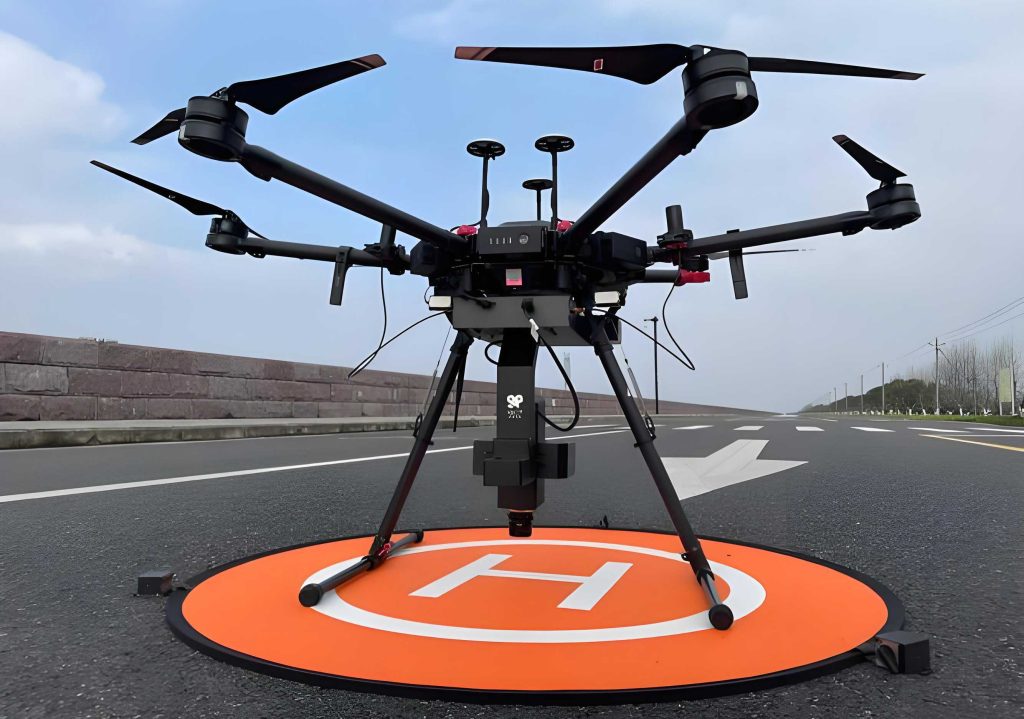
To address these intertwined challenges, this article proposes a novel edge event-triggered bearing formation control strategy for a network of unmanned drones operating under a leader-follower structure. The core innovation lies in a dual-layer design. First, we develop a distributed velocity observer that employs an edge-based event-triggering mechanism. This observer allows each follower unmanned drone to estimate the unknown time-varying velocity of the leaders using only intermittent communication, drastically reducing the required number of transmissions. Second, based on these estimates, we design a formation tracking controller that utilizes real-time bearing measurements. This controller not only stabilizes the formation around the desired bearing pattern but also incorporates a mechanism to dynamically adjust the formation scale by coordinating the leader’s motion. The stability of the overall closed-loop system is rigorously proven using Lyapunov theory. Comprehensive simulation studies, including Software-in-the-Loop (SITL) tests in a high-fidelity Gazebo/PX4/ROS environment, validate the effectiveness, efficiency, and practical applicability of the proposed strategy for multi-unmanned drone systems.
1. System Modeling and Preliminaries
We consider a network of n unmanned drones. The dynamics of the i-th drone’s translational motion can be derived from its rigid body model and, after abstraction of the low-level attitude control loop (typically managed by an onboard autopilot), be expressed as a double-integrator model. This is a standard and effective model for outer-loop formation control design.
$$
\begin{aligned}
\dot{\mathbf{p}}_i &= \mathbf{v}_i \\
\dot{\mathbf{v}}_i &= \mathbf{u}_i, \quad i \in \mathcal{V}_f
\end{aligned}
$$
where $$ \mathbf{p}_i \in \mathbb{R}^d $$ (with $$ d=2 $$ or 3) is the position vector, $$ \mathbf{v}_i \in \mathbb{R}^d $$ is the velocity vector, and $$ \mathbf{u}_i \in \mathbb{R}^d $$ is the control input (acceleration) for the i-th unmanned drone. The set $$ \mathcal{V}_f $$ denotes the indices of the follower unmanned drones. The leader unmanned drones, indexed by the set $$ \mathcal{V}_l $$, are assumed to follow a predefined trajectory without the need for a formation control input, i.e., $$ \dot{\mathbf{p}}_i = \mathbf{v}_i^*, \dot{\mathbf{v}}_i = \mathbf{a}_i^* $$ for $$ i \in \mathcal{V}_l $$.
The communication and sensing topology among the unmanned drones is described by an undirected graph $$ \mathcal{G} = (\mathcal{V}, \mathcal{E}) $$, where $$ \mathcal{V} = \mathcal{V}_l \cup \mathcal{V}_f $$ is the node set and $$ \mathcal{E} \subset \mathcal{V} \times \mathcal{V} $$ is the edge set. An edge $$ (i, j) \in \mathcal{E} $$ indicates that unmanned drone i can measure the relative bearing of unmanned drone j and that they can exchange information. The relative displacement and bearing vectors for edge $$ (i,j) $$ are defined as:
$$
\mathbf{e}_{ij} = \mathbf{p}_j – \mathbf{p}_i, \quad \mathbf{g}_{ij} = \frac{\mathbf{e}_{ij}}{\|\mathbf{e}_{ij}\|}
$$
The orthogonal projection matrix for a bearing vector is a critical mathematical tool, defined as $$ \mathbf{P}_{\mathbf{g}_{ij}} = \mathbf{I}_d – \mathbf{g}_{ij} \mathbf{g}_{ij}^T $$, where $$ \mathbf{I}_d $$ is the $$ d $$-dimensional identity matrix. This matrix is symmetric, positive semi-definite, and satisfies $$ \mathbf{P}_{\mathbf{g}_{ij}} \mathbf{g}_{ij} = \mathbf{0} $$.
The collective bearing information can be related to the stacked position vector $$ \mathbf{p} = \text{col}(\mathbf{p}_1, …, \mathbf{p}_n) $$ through the bearing rigidity matrix $$ \mathbf{J}(\mathbf{p}) $$. For a desired formation defined by a set of constant bearing vectors $$ \{\mathbf{g}_{ij}^*\} $$ for all $$ (i,j) \in \mathcal{E} $$, the bearing error for edge k (corresponding to $$ (i,j) $$) is $$ \tilde{\mathbf{g}}_k = \mathbf{g}_{ij} – \mathbf{g}_{ij}^* $$.
The control objective is to design the control input $$ \mathbf{u}_i $$ for each follower unmanned drone such that the entire fleet achieves and maintains the desired bearing-based formation while tracking the leader’s motion, even when the leader’s velocity $$ \mathbf{v}_i^* $$ is unknown and time-varying, and the formation scale can be dynamically adjusted.
2. Edge Event-Triggered Distributed Velocity Observer
Accurate knowledge of the leader’s velocity is crucial for tracking. Since we assume this velocity is unknown to the followers, we design a distributed observer. To conserve communication bandwidth among unmanned drones, we employ an edge event-triggered mechanism. For each communication link (edge) $$ (i,j) $$, unmanned drone i maintains an estimate $$ \hat{\mathbf{v}}_j^i(t) $$ of unmanned drone j‘s velocity. Instead of continuously transmitting its true velocity $$ \mathbf{v}_i(t) $$, unmanned drone i transmits a held value $$ \boldsymbol{\nu}_i(t) $$ only at its triggered instants $$ t_k^{ij} $$. The update law and triggering condition are co-designed.
The observer for the velocity estimate on unmanned drone i is proposed as:
$$
\dot{\hat{\mathbf{v}}}_i = -a_1 \sum_{j \in \mathcal{N}_i} a_{ij} \left( \hat{\mathbf{v}}_i – \boldsymbol{\nu}_j \right) – a_2 \sum_{j \in \mathcal{N}_i} a_{ij} \, \text{sgn}\left( \hat{\mathbf{v}}_i – \boldsymbol{\nu}_j \right)
$$
where $$ a_1, a_2 > 0 $$ are controller gains, $$ a_{ij} $$ is the adjacency matrix element, and $$ \text{sgn}(\cdot) $$ is the signum function applied element-wise. The held transmission signal is updated at trigger moments: $$ \boldsymbol{\nu}_i(t) = \hat{\mathbf{v}}_i(t_k^{ij}) $$ for $$ t \in [t_k^{ij}, t_{k+1}^{ij}) $$.
We define the measurement error for the edge $$ (i,j) $$ as $$ \mathbf{q}_{ij}(t) = \boldsymbol{\nu}_i(t) – \hat{\mathbf{v}}_i(t) $$ and the consensus disagreement as $$ \mathbf{r}_{ij}(t) = \boldsymbol{\nu}_i(t) – \boldsymbol{\nu}_j(t) $$. The event-triggering function is designed as:
$$
f_{ij}(t) = \| \mathbf{q}_{ij} \| – \frac{1}{3a_1 + 2a_2} \left( \frac{a_1}{2} \| \mathbf{r}_{ij} \|^2 + d_1 \right)
$$
where $$ d_1 > 0 $$ is a small positive constant. The triggering instant is determined by:
$$
t_{k+1}^{ij} = \inf \{ t > t_k^{ij} \mid f_{ij}(t) \ge 0 \}
$$
This condition ensures that a transmission occurs only when the local estimation error $$ \mathbf{q}_{ij} $$ grows sufficiently large relative to the network disagreement $$ \mathbf{r}_{ij} $$. The stability of this observer is guaranteed by the following theorem, proven via a Lyapunov function $$ V_v = \frac{1}{2} \sum_{i=1}^n \tilde{\mathbf{v}}_i^T \tilde{\mathbf{v}}_i $$, where $$ \tilde{\mathbf{v}}_i = \hat{\mathbf{v}}_i – \mathbf{v}_i^* $$.
Theorem 1 (Observer Stability). Consider the multi-unmanned drone system under Assumptions 1-3. With the edge event-triggered velocity observer governed by the update law and triggering condition defined above, and with gain $$ a_2 $$ chosen sufficiently large relative to the network’s Laplacian matrix properties, the velocity estimation error $$ \tilde{\mathbf{v}}_i $$ for all unmanned drones converges to zero asymptotically.
Proof Sketch: The time derivative of the Lyapunov function is analyzed. Using properties of the Laplacian matrix, Young’s inequality, and substituting the triggering condition $$ f_{ij}(t) < 0 $$, the derivative can be bounded as:
$$
\dot{V}_v \le -\eta V_v + \beta
$$
where $$ \eta > 0 $$ and $$ \beta $$ is a positive constant related to $$ d_1 $$. This inequality proves uniform ultimate boundedness. Furthermore, since the triggering rule prevents the error from growing, and the observer dynamics work to reduce it, asymptotic convergence to zero can be established, ensuring that $$ \lim_{t \to \infty} \hat{\mathbf{v}}_i(t) = \mathbf{v}_i^*(t) $$ for all unmanned drones.
3. Bearing-Based Formation Tracking Controller
With the velocity estimates $$ \hat{\mathbf{v}}_i $$ from the distributed observer, we now design the formation tracking control law for each follower unmanned drone. The control objective is to drive the bearing errors $$ \tilde{\mathbf{g}}_{ij} $$ to zero while ensuring the followers track the leaders’ motion.
We first define a velocity tracking error for the unmanned drone: $$ \mathbf{e}_{v_i} = \hat{\mathbf{v}}_i – \mathbf{v}_i $$. Consider a Lyapunov function candidate combining bearing and velocity errors:
$$
V = V_g + \frac{1}{2} \sum_{i \in \mathcal{V}_f} \mathbf{e}_{v_i}^T \mathbf{e}_{v_i}, \quad \text{where} \quad V_g = \frac{1}{2} \sum_{(i,j)\in\mathcal{E}} \tilde{\mathbf{g}}_{ij}^T \tilde{\mathbf{g}}_{ij}
$$
Taking the derivative and using the properties of the bearing rigidity matrix $$ \mathbf{J} $$, we get:
$$
\dot{V} = \tilde{\mathbf{g}}^T \mathbf{J} \mathbf{e}_v + \tilde{\mathbf{g}}^T \mathbf{J} \hat{\mathbf{v}} + \sum_{i \in \mathcal{V}_f} \mathbf{e}_{v_i}^T (\dot{\hat{\mathbf{v}}}_i – \mathbf{u}_i)
$$
where $$ \tilde{\mathbf{g}} $$ and $$ \mathbf{e}_v $$ are stacked vectors of all bearing errors and follower velocity tracking errors, respectively. To stabilize the bearing subsystem, we introduce a virtual control input $$ \boldsymbol{\alpha}_i $$:
$$
\boldsymbol{\alpha}_i = -k_1 \sum_{j \in \mathcal{N}_i} \mathbf{P}_{\mathbf{g}_{ij}^*} \tilde{\mathbf{g}}_{ij}
$$
This term acts to reduce bearing errors by projecting them onto the null space of the desired bearings. We then define a new error variable $$ \mathbf{z}_i = \mathbf{e}_{v_i} – \boldsymbol{\alpha}_i $$. The final control law for each follower unmanned drone is designed as:
$$
\mathbf{u}_i = \dot{\hat{\mathbf{v}}}_i + \boldsymbol{\alpha}_i – k_2 \mathbf{z}_i + k_1 \sum_{j \in \mathcal{N}_i} \dot{\mathbf{P}}_{\mathbf{g}_{ij}^*} \tilde{\mathbf{g}}_{ij}
$$
where $$ k_1, k_2 > 0 $$ are control gains. The term $$ \dot{\hat{\mathbf{v}}}_i $$ compensates for the estimated acceleration, $$ -k_2 \mathbf{z}_i $$ provides damping for the composite error, and the last term accounts for the time variation of the projection matrix if the desired bearings are not constant (e.g., during rotation).
Theorem 2 (Closed-Loop System Stability). For the multi-unmanned drone system with dynamics, the edge event-triggered velocity observer, and the bearing-based formation controller described above, if the communication graph is connected and the desired bearing configuration is infinitesimally bearing rigid, then there exist controller gains $$ k_1, k_2, a_1, a_2 $$ such that the closed-loop system is stable. All signals remain bounded, and the bearing errors $$ \tilde{\mathbf{g}}_{ij}(t) $$ and the velocity tracking errors $$ \mathbf{e}_{v_i}(t) $$ converge to a small neighborhood of zero, the size of which can be tuned by the parameter $$ d_1 $$ in the triggering condition.
Proof Sketch: Construct a composite Lyapunov function $$ V_c = V_g + \frac{1}{2} \sum_{i} \mathbf{z}_i^T \mathbf{z}_i $$. Its derivative, after substituting the control law $$ \mathbf{u}_i $$ and the properties of the observer, yields:
$$
\dot{V}_c \le -k_2 \sum_{i \in \mathcal{V}_f} \|\mathbf{z}_i\|^2 – k_1 \lambda_{\min}(\mathbf{J}^T\mathbf{J}) \|\tilde{\mathbf{g}}\|^2 + \Delta
$$
where $$ \Delta $$ is a bounded term arising from the ultimate boundedness of the observer error. By the Lyapunov theory and the properties of bearing rigidity (where $$ \mathbf{J}^T\mathbf{J} $$ is positive definite for an infinitesimally bearing rigid formation), this inequality proves uniform ultimate boundedness (UUB) of all errors. The Zeno behavior (infinitely fast triggering) is excluded by proving a positive lower bound on the inter-event time $$ t_{k+1}^{ij} – t_k^{ij} $$ for every edge in the unmanned drone network.
4. Simulation Studies and Performance Analysis
To validate the proposed control framework, we conducted extensive numerical simulations and Software-in-the-Loop (SITL) tests. The scenario involves 4 unmanned drones aiming to form a square. Drones 1 and 2 are designated as leaders, and drones 3 and 4 are followers. The desired bearings are defined accordingly (e.g., $$ \mathbf{g}_{31}^* = [1, 0]^T $$, $$ \mathbf{g}_{34}^* = [0, 1]^T $$).
4.1 Formation with Scaling and Time-Varying Velocity
In the first simulation, the leaders’ velocity is piecewise time-varying, including sinusoidal segments. The controller parameters were set to $$ k_1=10, k_2=15, a_1=10, a_2=0.1, d_1=0.05 $$. The results demonstrated successful formation acquisition, scale adjustment, and accurate tracking. The bearing errors converged to near zero. Crucially, the edge event-triggered observer effectively estimated the leaders’ unknown velocities, as shown in the following performance table summarizing key metrics.
| Performance Metric | Follower 3 | Follower 4 | Unit |
|---|---|---|---|
| Steady-State Bearing Error (RMS) | 0.0087 | 0.0092 | — |
| Steady-State Position Tracking Error | 0.12 | 0.15 | m |
| Total Trigger Events (Edge-based) | 221 | 216 | count |
4.2 Communication Efficiency Comparison
A key advantage of our method is reduced communication. We compared the proposed edge event-triggered (EET) strategy against two common alternatives: Time-Triggered (TT) and State-Based Event-Triggered (SBET) schemes, under identical simulation conditions. The comparison of the total number of transmission events per unmanned drone over the simulation period clearly demonstrates the superiority of the EET approach in conserving communication resources among unmanned drones.
| Triggering Strategy | Transmissions (Follower 3) | Transmissions (Follower 4) | Reduction vs. TT |
|---|---|---|---|
| Time-Triggered (Baseline) | 263 | 275 | 0% |
| State-Based Event-Triggered | 276 | 281 | -5% / -2% |
| Proposed Edge Event-Triggered | 221 | 216 | 16% / 21% |
4.3 Software-in-the-Loop (SITL) Validation
To assess practical applicability, we implemented the algorithm in a high-fidelity SITL environment using Gazebo (for physics and visualization), PX4 (for flight control firmware), and ROS (for communication and node management). The unmanned drone models were realistic quadrotors. The leaders followed a curved trajectory with time-varying velocity.
The SITL results confirmed the algorithm’s robustness. The unmanned drone fleet successfully formed and maintained the square formation while maneuvering. The bearing errors and velocity estimation errors remained small throughout the flight, demonstrating that the theoretical design holds under more realistic conditions including discrete-time implementation, sensor noise (simulated), and communication delays. A snapshot from the Gazebo simulation visually confirms the stable formation flight of the unmanned drones.
5. Conclusion
This article presented a comprehensive solution for the formation control of multi-unmanned drone systems under practical constraints. The proposed framework integrates an edge event-triggered distributed velocity observer with a bearing-based formation tracking controller. The observer efficiently handles unknown and time-varying leader velocities while dramatically reducing inter-agent communication through its innovative triggering mechanism, which acts on the communication links (edges) between unmanned drones. The formation controller utilizes the estimated velocities and local bearing measurements to achieve a desired geometric pattern, with inherent capabilities for formation scaling.
Theoretical analysis using Lyapunov methods rigorously proved the stability and convergence properties of the overall closed-loop system. Simulation studies, encompassing both numerical tests and high-fidelity SITL experiments, provided strong evidence for the strategy’s effectiveness, efficiency, and practicality. The results showed accurate formation tracking, adaptive scaling, and, most importantly, a significant reduction in communication burden compared to traditional triggering methods—a critical advantage for resource-constrained unmanned drone swarms operating in the field. Future work will focus on extending the approach to handle more complex dynamics (e.g., full quadrotor models), three-dimensional formations, and robust operation under external disturbances and intermittent communication losses.