
The spectacle of a formation drone light show represents a pinnacle of coordination, where hundreds or thousands of unmanned aerial vehicles (UAVs) act as luminous pixels in the night sky. As an engineer and researcher in the field of multi-agent systems, I have long been fascinated by the underlying control challenges that transform this concept into a reliable and awe-inspiring reality. Beyond mere static patterns, the true artistry and technical brilliance of a modern formation drone light show lie in its ability to perform dynamic, seamless transitions—morphing from one intricate shape to another while maintaining strict safety and spatial constraints. This process, known as formation reconfiguration, is not merely an artistic choice but a critical capability that mirrors advanced applications in tactical surveillance, distributed sensing, and collaborative payload delivery. In this article, I will delve into the core control methodologies that enable such sophisticated behaviors, framing the discussion around the distributed intelligence required for a scalable and robust formation drone light show.
At its heart, controlling a massive formation drone light show is a problem of distributed decision-making under constraints. Each drone is an autonomous agent with limited computational resources, communication range, and sensory input. The central challenge is to guide the entire swarm from an initial geometric configuration to a desired target formation—perhaps spelling a logo, depicting a dynamic animal, or forming complex 3D structures—while ensuring no collisions occur, all drones remain within reliable communication links, and the transition is executed in a timely, energy-efficient manner. This cannot be managed by a single central computer issuing precise commands to each unit; the latency, single point of failure, and sheer communication overhead would be prohibitive. Instead, the solution must be distributed, with each drone making localized decisions based on information from its immediate neighbors.
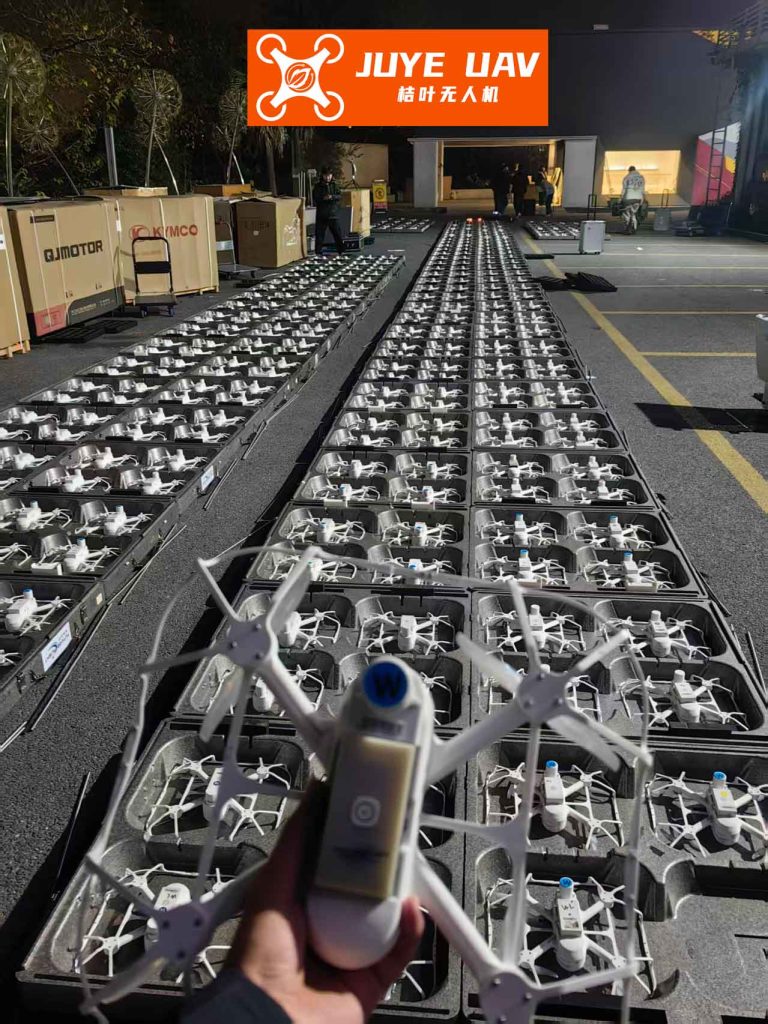
The foundation of any control strategy is a mathematical model of the agent’s dynamics. For a drone in a light show, we often simplify the model to 2D or 3D kinematic equations, focusing on position and heading, as the altitude is typically controlled separately for the display layer. A common discrete-time model for the i-th drone’s motion in a horizontal plane can be represented as:
$$
\begin{aligned}
x_i(k+1) &= x_i(k) + v_i(k) \Delta T \cos(\psi_i(k)) \\
y_i(k+1) &= y_i(k) + v_i(k) \Delta T \sin(\psi_i(k)) \\
\psi_i(k+1) &= \psi_i(k) + \omega_i(k) \Delta T \\
v_i(k+1) &= v_i(k) + (v_{c,i}(k) – v_i(k)) / \tau_v
\end{aligned}
$$
Here, $(x_i, y_i)$ denotes the position, $v_i$ the speed, $\psi_i$ the heading angle, and $\omega_i$ the turning rate. The control inputs are the commanded speed $v_{c,i}$ and commanded turning rate $\omega_{c,i}$. The term $\Delta T$ is the sampling period, and $\tau_v$ is a time constant modeling the drone’s velocity response. These dynamics are subject to practical constraints:
$$
\begin{aligned}
v_{\text{min}} &\leq v_i \leq v_{\text{max}} \\
\omega_{\text{min}} &\leq \omega_i \leq \omega_{\text{max}} \\
|v_i(k+1) – v_i(k)|/ \Delta T &\leq \Delta v_{\text{max}} \\
|\omega_i(k+1) – \omega_i(k)|/ \Delta T &\leq \Delta \omega_{\text{max}}
\end{aligned}
$$
These constraints ensure the drones operate within safe and physically feasible limits, a non-negotiable aspect of any formation drone light show.
To achieve cohesion, drones in a formation drone light show typically follow a virtual structure or a virtual leader. Instead of tracking a physical lead drone, all drones coordinate relative to a common reference trajectory or a set of virtual points that define the shape. If $(x_r(k), y_r(k), \psi_r(k))$ defines the state of a virtual reference frame moving along a show’s master timeline, the desired position for drone $i$ in the world frame is calculated as:
$$
\begin{bmatrix}
x^d_i(k) \\
y^d_i(k)
\end{bmatrix} =
\begin{bmatrix}
x_r(k) \\
y_r(k)
\end{bmatrix} +
\begin{bmatrix}
\cos \psi_r(k) & -\sin \psi_r(k) \\
\sin \psi_r(k) & \cos \psi_r(k)
\end{bmatrix}
\begin{bmatrix}
x^{dr}_i \\
y^{dr}_i
\end{bmatrix}
$$
Here, $(x^{dr}_i, y^{dr}_i)$ is the fixed offset of drone $i$ within the formation’s body frame. This approach elegantly handles collective maneuvers: rotating, translating, or scaling the entire formation simply involves modifying the virtual leader’s state $(x_r, y_r, \psi_r)$.
The primary challenge, and the focus of my work, is the reconfiguration phase. When the show’s narrative calls for a transition from one shape (Formation A) to another (Formation B), each drone must plan a new trajectory from its current position to its new assigned offset in Formation B. This is a complex optimization problem with multiple, often conflicting, objectives and hard constraints. We can formalize a generic cost function $J_i$ for drone $i$ over a future prediction horizon of $N$ steps:
$$
J_i(k) = \sum_{s=1}^{N-1} \| \mathbf{e}_i(k+s|k) \|^2_{\mathbf{Q}} + \| \mathbf{e}_i(k+N|k) \|^2_{\mathbf{P}} + \sum_{s=0}^{N-1} \| \mathbf{u}_i(k+s|k) \|^2_{\mathbf{R}}
$$
where $\mathbf{e}_i(k+s|k) = \mathbf{p}_i(k+s|k) – \mathbf{p}^d_i(k+s|k)$ is the predicted position error relative to the desired formation path, and $\mathbf{u}_i$ is the control effort. The matrices $\mathbf{Q}$, $\mathbf{P}$, and $\mathbf{R}$ are weighting matrices. This cost must be minimized subject to the dynamics and constraints listed earlier, plus two absolutely critical coupling constraints:
- Collision Avoidance: $d_{ij}(k+s) = \| \mathbf{p}_i(k+s) – \mathbf{p}_j(k+s) \| \geq d_{\text{safe}}, \quad \forall j \ne i$.
- Connectivity Maintenance: $d_{ij}(k+s) \leq d_{\text{com}}, \quad \forall j \in \mathcal{N}_i$, where $\mathcal{N}_i$ is drone $i$’s communication neighbor set.
Violating the first constraint risks a catastrophic mid-air collision, destroying drones and ending the show. Violating the second can lead to a drone losing coordination information, potentially causing it to drift out of formation and create a gap in the formation drone light show.
This is where Distributed Model Predictive Control (DMPC) becomes a powerful framework. In a centralized approach, a single supercomputer would solve one massive optimization problem for all drones—an intractable task for a large swarm. DMPC decomposes the problem. Each drone $i$ solves its own local optimization, but it must cooperate with its neighbors to handle the coupling constraints. The key is the definition of a neighbor set $\kappa(i)$. A drone only exchanges information and coordinates plans with drones inside this set, which typically includes those within its communication radius and, crucially, those with which a collision is imminent within the prediction horizon (the “tight constraint” neighbors).
Therefore, the local optimization for drone $i$ at time $k$ becomes:
$$
\begin{aligned}
\min_{\mathbf{U}_i, \mathbf{U}_{j \in \kappa(i)}} & \quad J_i(k, \mathbf{X}_i, \mathbf{U}_i) + \alpha \sum_{j \in \kappa(i)} J_j(k, \mathbf{X}_j, \mathbf{U}_j) \\
\text{subject to:} & \quad \text{Dynamics and local constraints for } i \text{ and } j \in \kappa(i) \\
& \quad d_{ij}(k+s|k) \geq d_{\text{safe}} – \eta s, \quad j \in \kappa(i) \\
& \quad d_{ij}(k+s|k) \leq d_{\text{com}}, \quad j \in \kappa(i)
\end{aligned}
$$
Notice two important features. First, drone $i$’s cost function now includes a weighted sum ($\alpha$) of its neighbors’ costs, promoting cooperative behavior where a drone might slightly lengthen its own path to allow the group to achieve a better overall configuration faster. Second, the safety constraint is relaxed by a small, time-growing margin $\eta s$. This “constraint tightening” technique makes the distributed optimization feasible and encourages early, gentle avoidance maneuvers rather than last-second, aggressive turns. The drones then exchange their planned trajectories, apply the first control input, and repeat the process at the next time step in a receding horizon fashion. This creates a robust, feedback-based control loop for the entire formation drone light show.
Solving the local, constrained non-convex optimization problem within the stringent real-time requirements of a flying formation drone light show is itself a major challenge. Classical solvers can get stuck in local minima or be too slow. This is where advanced metaheuristic algorithms like Quantum-behaved Particle Swarm Optimization (QPSO) show great promise. In my research, I have focused on enhancing QPSO for this specific task. Standard PSO and QPSO simulate a swarm of particles (potential solution vectors) searching the solution space. In QPSO, particles exhibit quantum behavior, being drawn towards a “mean best position” ($Mbest$), leading to better global search properties. The position update for a particle’s dimension is given by:
$$
X_{l}^{d}(t+1) = p^{d} \pm b \cdot |Mbest^{d} – X_{l}^{d}(t)| \cdot \ln(1/u), \quad u \sim U(0,1)
$$
where $p^{d}$ is a stochastic attractor between the particle’s personal best and the global best, $b$ is a contraction-expansion coefficient, and $u$ is a random number. However, standard QPSO can suffer from premature convergence. My revised approach (RQPSO) incorporates two key mechanisms:
- Diversity-Guided Search: The swarm’s diversity $D$ is monitored. If $D$ falls below a threshold $d_{low}$, indicating convergence to a small region, a mutation is applied to the global best particle to “kick” the swarm into a more exploratory state, preventing stagnation in poor local minima.
- Stochastic Attractor Selection: Instead of always using the global best $P_g$, the attractor $p^d$ is sometimes calculated using the personal best of a randomly selected particle that has a better fitness than the current particle’s personal best. This enriches information sharing across the entire particle swarm, not just from the single best point.
For a formation drone light show reconfiguration problem, each “particle” in the RQPSO swarm encodes a potential control input sequence $[ \mathbf{u}_i(k), \mathbf{u}_i(k+1), …, \mathbf{u}_i(k+N-1) ]$ for drone $i$ and its tight-constraint neighbors. The fitness is the cooperative cost function $J_i + \alpha \sum J_j$. RQPSO efficiently explores this high-dimensional, constrained space to find a high-quality solution within the available computation time window.
The performance of different control and optimization strategies can be summarized and compared effectively. The table below contrasts key aspects of centralized MPC, basic DMPC, and the proposed DMPC with enhanced solvers like RQPSO, specifically in the context of a formation drone light show.
| Feature / Aspect | Centralized MPC | Basic DMPC (with Standard Solver) | DMPC with RQPSO Solver |
|---|---|---|---|
| Scalability | Very Poor. Computation grows exponentially with swarm size. | Good. Local problems are small and parallelizable. | Excellent. Inherits scalability of DMPC with efficient local search. |
| Robustness to Failure | Poor. Central computer is a single point of failure. | High. System degrades gracefully if a drone fails. | High. Maintains distributed robustness. |
| Communication Load | Extremely High (All-to-Center). | Moderate (Neighbor-to-Neighbor only). | Moderate (Same as Basic DMPC). |
| Solution Quality | Theoretically Global Optimal (if solvable). | Good, but can get stuck in local minima due to constraint coupling. | Very High. Enhanced global search finds better cooperative trajectories. |
| Real-Time Feasibility for Large Swarms | Not feasible for >~20 drones. | Feasible for 100s of drones. | Feasible for 100s-1000s of drones; RQPSO converges faster to good solutions. |
| Primary Challenge | Combinatorial explosion of problem size. | Coordinating to avoid local minima in coupled constraints. | Tuning algorithm parameters (e.g., $\alpha$, $d_{low}$, $b$) for specific show choreography. |
Furthermore, the choice of algorithm directly impacts the convergence speed and final performance of the reconfiguration. A comparative analysis of the optimization core itself is crucial. The following table highlights the evolution from PSO to the RQPSO used in my proposed framework, detailing the mechanisms that make it suitable for the dynamic planning required in a formation drone light show.
| Algorithm | Core Mechanism | Advantage | Disadvantage / Challenge | Applicability to Formation Reconfiguration |
|---|---|---|---|---|
| Standard PSO | Particles move towards personal best (pbest) and global best (gbest) with inertia. | Simple, easy to implement. | Prone to premature convergence; particles can stagnate. | Baseline; often finds feasible but sub-optimal paths quickly. |
| Quantum PSO (QPSO) | Particles have quantum state behavior, converging to a “mean best” (Mbest) attractor. | Stronger global search ability; guaranteed convergence in probability. | Parameter $b$ needs careful tuning; diversity can still drop over time. | Better at exploring the solution space to find lower-cost trajectories. |
| Revised QPSO (RQPSO) – Proposed | QPSO + Diversity monitoring + Stochastic attractor selection from superior random particles. | Prevents premature convergence; maintains population diversity; more robust search. | Slightly more complex; has additional parameters ($d_{low}$, mutation rate). | Highly suitable. Excels at finding high-quality, cooperative solutions for tight, constrained maneuvers in dense formations. |
The mathematical rigor of DMPC combined with the exploratory power of RQPSO creates a robust framework. However, the real-world environment for a formation drone light show introduces more than just neighbor drones. We must consider “threats” or no-fly zones, which could be physical obstacles (like a tree or building), temporary exclusion zones, or areas of poor GPS signal. In the cost function or constraints, we can incorporate repulsive potential fields or hard constraints. For a circular no-fly zone centered at $(x_{nfz}, y_{nfz})$ with radius $R_{nfz}$, the constraint for drone $i$ is:
$$
\| \mathbf{p}_i(k+s) – [x_{nfz}, y_{nfz}]^T \| \geq R_{nfz} + R_{drone\_margin}
$$
Integrating this into the local DMPC problem ensures the entire formation drone light show will smoothly deform around obstacles, adding another layer of autonomous intelligence to the performance.
In conclusion, the magic of a modern, large-scale formation drone light show is deeply rooted in advanced control theory and optimization. The transition from a static logo to a flying dragon is not a pre-recorded path for each drone but the emergent result of a distributed, collaborative decision-making process. Each drone, acting as an intelligent agent, continuously solves a localized model predictive control problem—planning its future trajectory while explicitly negotiating with its neighbors to avoid collisions, maintain connectivity, and collectively minimize the energy and time to achieve the new artistic formation. The use of enhanced optimization algorithms like RQPSO within this DMPC framework is critical to solving these complex, non-convex problems reliably in real-time. As these technologies mature, we can expect formation drone light show performances to become even more complex, resilient, and dynamically interactive, pushing the boundaries of where distributed autonomous systems can blend technical precision with artistic expression. The sky is not the limit; it is the canvas.