
In modern aerial operations, the deployment of unmanned aerial vehicles (UAVs) or drones in coordinated formations has become a cornerstone for missions ranging from surveillance to combat support. As a researcher in autonomous systems, I have observed that the dynamic nature of battlefield environments necessitates adaptive and intelligent control strategies. Specifically, drone formations must reconfigure autonomously to mitigate threats, optimize resource allocation, and maintain mission efficacy. This paper delves into a novel approach for autonomous reconfiguration control of drone formations, leveraging Nash bargaining theory and distributed model predictive control (DMPC). Our work addresses the complex interplay of multi-objective optimization in hostile settings, where drones with varied payloads—such as radar jammers, missile countermeasures, and reconnaissance units—must collaborate seamlessly. The core challenge lies in achieving a balance between individual drone objectives and collective formation goals, all while adhering to constraints like threat avoidance, collision prevention, and operational limits. Through this research, we aim to contribute a scalable, efficient framework that enhances the resilience and autonomy of drone formations in real-time scenarios.
The impetus for this study stems from the increasing reliance on drone swarms for high-risk missions. Traditional formation control methods often rely on centralized or rigid protocols, which can falter under dynamic threats and communication constraints. In contrast, our approach embraces a distributed paradigm, where each drone acts as an autonomous agent capable of negotiating its role within the formation. This mirrors real-world applications where drones must adapt to unforeseen obstacles, such as enemy radar, guided missiles, and anti-aircraft artillery. By framing the reconfiguration problem as a multi-player cooperative game, we can harness Nash bargaining principles to derive solutions that are both fair and optimal from a system-wide perspective. The integration with DMPC ensures that decisions are made proactively over a prediction horizon, accounting for future states and constraints. Throughout this paper, we will explore the mathematical foundations, algorithmic design, and empirical validation of our method, emphasizing its practicality for enhancing drone formation survivability and mission success.
To contextualize our work, consider a drone formation tasked with reconnaissance over contested airspace. The formation comprises diverse drones: reconnaissance units for intelligence gathering, radar jammers to suppress enemy detection, and missile jammers to deflect incoming threats. These drones operate under the guidance of a virtual leader, which defines the mission path through waypoints. However, the battlefield is littered with hazards—early warning radars, surface-to-air missiles, and anti-aircraft gun emplacements—whose locations may be partially unknown. The drone formation must continuously reconfigure its geometry to ensure mutual support; for instance, jamming drones should position themselves to maximally protect reconnaissance drones, while all units avoid threats and maintain safe distances. This reconfiguration process is not merely a geometric adjustment but a strategic optimization problem, where each drone’s objectives conflict yet must be harmonized. We model this as a Nash bargaining process, where drones negotiate their trajectories to achieve a Pareto-optimal equilibrium. The distributed nature of our control method allows for scalable computation, reducing the burden on any single agent and enhancing robustness against communication failures.
In the following sections, we will detail the threat modeling, drone dynamics, and optimization framework. We begin by formalizing the battlefield threats that influence drone formation behavior. Let the drone formation consist of $N_v$ drones, indexed as $V_c = \{v_i \mid i = 1, \dots, N_v\}$, categorized into subsets: reconnaissance drones $V_{\text{con}}$, radar jamming drones $V_{\text{rad}}$, and missile jamming drones $V_{\text{mis}}$, such that $V_c = V_{\text{con}} \cup V_{\text{rad}} \cup V_{\text{mis}}$. The threats are modeled as constraints on drone positions, derived from physical and operational limits. For early warning radars, the detection radius $R$ adapts based on jamming interference. If a radar at position $\mathbf{x}_r$ is jammed by a source at $\mathbf{x}_{dj}$, the effective radius is given by:
$$R = \begin{cases} R_0, & \|\mathbf{x}_r – \mathbf{x}_{dj}\| > R_0 \\ \|\mathbf{x}_r – \mathbf{x}_{dj}\|, & \|\mathbf{x}_r – \mathbf{x}_{dj}\| \leq R_0 \end{cases}$$
where $R_0$ is the nominal detection range. This reduction enables drones to penetrate deeper into contested zones when jammers are optimally placed. For guided missiles, a jammer creates a safe conical region behind it, defined by a safety distance $d_f$ and angle $\theta$. A drone at position $\mathbf{x}_i$ is safe from a missile at $\mathbf{x}_{tf}$ if:
$$d_f = \|\mathbf{x}_i – \mathbf{x}_{tf}\| – \|\mathbf{x}_{oj} – \mathbf{x}_{tf}\| \geq 0 \quad \text{and} \quad c_{sf} = \frac{(\mathbf{x}_i – \mathbf{x}_{tf}) \cdot (\mathbf{x}_{oj} – \mathbf{x}_{tf})}{\|\mathbf{x}_i – \mathbf{x}_{tf}\| \|\mathbf{x}_{oj} – \mathbf{x}_{tf}\|} \geq \cos\left(\frac{\theta}{2}\right)$$
where $\mathbf{x}_{oj}$ is the jammer position. Anti-aircraft gun emplacements are modeled as no-fly zones with circular boundaries of radius $R_n$, requiring drones to circumvent them entirely. These threat models are integrated into constraints that drones must satisfy during reconfiguration, ensuring the drone formation remains resilient against diverse adversarial systems.
The dynamics of each drone are simplified to a planar motion model, capturing essential kinematics for control design. For drone $v_i$, the state vector at time $k$ is $\mathbf{x}_i(k) = [x_i(k), y_i(k), \chi_i(k)]^\top \in \mathbb{R}^2 \times \mathbb{S}$, where $(x_i, y_i)$ is the position and $\chi_i$ is the heading angle. The control input is $\mathbf{u}_i(k) = [V_i(k), \omega_i(k)]^\top$, representing speed and turning rate. The discrete-time dynamics with sampling period $\tau$ are:
$$\begin{aligned} x_i(k+1) &= x_i(k) + V_i(k) \cos \chi_i(k) \tau \\ y_i(k+1) &= y_i(k) + V_i(k) \sin \chi_i(k) \tau \\ \chi_i(k+1) &= \chi_i(k) + \omega_i(k) \tau \end{aligned}$$
These dynamics are subject to operational constraints: $V_{\min} \leq V_i \leq V_{\max}$, $|\Delta V_i| \leq \Delta V_{\max}$, $\omega_{\min} \leq \omega_i \leq \omega_{\max}$, $|\Delta \omega_i| \leq \Delta \omega_{\max}$, and a minimum turn radius constraint $|V_i / \omega_i| \leq R_{\min} = V_i / (g \sqrt{n_{\max}^2 – 1})$, where $g$ is gravity and $n_{\max}$ is the maximum load factor. These constraints ensure feasible trajectories for the drone formation, accounting for physical limits during aggressive maneuvers.
The reconfiguration problem is formulated as a multi-objective optimization over a prediction horizon $N$. Each drone type has a distinct cost function, reflecting its role in the drone formation. For reconnaissance drones $v_i \in V_{\text{con}}$, the goal is to track the virtual leader’s position $\mathbf{p}_l(k) = [x_l(k), y_l(k)]^\top$, minimizing:
$$F^c_i(\mathbf{x}_i, \mathbf{u}_i) = \sum_{k=1}^{N} \left( \|\mathbf{p}_l(k) – \mathbf{p}_i(k)\|^2 + \|\mathbf{u}_i(k)\|^2_{\mathbf{R}_i} \right)$$
where $\mathbf{p}_i(k) = [x_i(k), y_i(k)]^\top$ and $\|\mathbf{u}_i(k)\|^2_{\mathbf{R}_i} = \mathbf{u}_i(k)^\top \mathbf{R}_i \mathbf{u}_i(k)$ penalizes control effort. For missile jamming drones $v_i \in V_{\text{mis}}$, the ideal position $\mathbf{p}_a(k)$ lies on the line between the virtual leader and the missile, at a standoff distance $d_{\text{cor}}$ (the formation corridor radius). The cost is:
$$F^m_i(\mathbf{x}_i, \mathbf{u}_i) = \sum_{k=1}^{N} \left( \|\mathbf{p}_a(k) – \mathbf{p}_i(k)\|^2 + \|\mathbf{u}_i(k)\|^2_{\mathbf{R}_i} \right)$$
where $\mathbf{p}_a(k) = \mathbf{p}_l(k) + d_{\text{cor}} (\mathbf{p}_{mj} – \mathbf{p}_l) / \|\mathbf{p}_{mj} – \mathbf{p}_l\|$ for a missile at $\mathbf{p}_{mj}$. For radar jamming drones $v_i \in V_{\text{rad}}$, the ideal position minimizes the sum of distances to all radars within its jamming aperture, while staying on the formation corridor edge. If $\mathcal{O}^i_r = \{r_j \mid j=1,\dots,N^i_r\}$ is the set of radars assigned to drone $v_i$, the ideal position $\mathbf{p}_a(k)$ is computed by solving:
$$\min \sum_{j=1}^{N^i_r} \|\mathbf{p}_a – \mathbf{p}_{r_j}\| \quad \text{subject to} \quad \|\mathbf{p}_a – \mathbf{p}_l\| = d_{\text{cor}}$$
which can be derived geometrically. The cost function is similar to that for missile jammers. These diverse objectives encapsulate the cooperative nature of the drone formation, where each unit contributes to overall mission success.
To unify these objectives, we frame the problem as a Nash bargaining game among drones. Let the global cost vector be $\mathbf{F}(\mathbf{x}, \mathbf{u}) = [F_1(\mathbf{x}_1, \mathbf{u}_1), \dots, F_{N_v}(\mathbf{x}_{N_v}, \mathbf{u}_{N_v})]^\top$, where each $F_i$ corresponds to the appropriate type-specific cost. The Nash bargaining solution (NBS) seeks a control sequence $\mathbf{u}^* = [\mathbf{u}_1^*, \dots, \mathbf{u}_{N_v}^*]^\top$ that maximizes the product of utility gains over a disagreement point $\mathbf{d} = [d_1, \dots, d_{N_v}]^\top$, typically taken as the cost without cooperation. Formally, the NBS solves:
$$\max_{\mathbf{u}} \prod_{i=1}^{N_v} (d_i – F_i(\mathbf{x}_i, \mathbf{u}_i)) \quad \text{subject to} \quad F_i(\mathbf{x}_i, \mathbf{u}_i) \leq d_i \text{ and constraints}$$
This optimization ensures a fair and efficient trade-off among drones in the formation. However, solving it centrally is computationally prohibitive for large drone formations. Hence, we integrate distributed model predictive control (DMPC), where each drone solves a local version of the problem iteratively, exchanging information with neighbors. The combined approach, termed NBS-DMPC, reduces computational load while preserving optimality properties.
The NBS-DMPC algorithm operates in a receding horizon fashion. At each time step $k$, each drone $v_i$ predicts its state over horizon $N$ and solves a local optimization to minimize its cost, subject to local dynamics and constraints involving other drones’ predicted states. The local cost is augmented with a penalty function $P_i(\mathbf{x}_i, \mathbf{u}_i, \{\mathbf{x}_{-i}\})$ that enforces global constraints (e.g., threat avoidance, collision prevention). Let $\sigma_i$ be a penalty factor. The local problem for drone $v_i$ is:
$$\hat{F}_i(\mathbf{x}_i, \mathbf{u}_i, \sigma_i) = F_i(\mathbf{x}_i, \mathbf{u}_i) + \frac{1}{\sigma_i} P_i(\mathbf{x}_i, \mathbf{u}_i, \{\mathbf{x}_{-i}\})$$
where $P_i(\cdot) = \sum_{c=1}^{q_{gi}} \max(0, g_{c}^{gi}(\cdot))^2$, with $g_{c}^{gi}$ being global constraints related to drone $v_i$. The penalty factor $\sigma_i$ is adjusted iteratively to approximate the NBS. Specifically, in iteration $p$ at time $k$, we set:
$$\sigma_i^p(k) = \sigma(k) \prod_{j \neq i} (d_j(k) – F_j(\mathbf{x}_j^{p-1}(k), \mathbf{u}_j^{p-1}(k)))$$
where $\sigma(k)$ is a base penalty factor. This adjustment aligns the distributed solutions with the centralized NBS, as proven in our convergence analysis. The algorithm proceeds as follows: initialize $\sigma_i = \sigma$, compute the disagreement point $d_i(k)$ (e.g., from previous solutions), and iterate until convergence or a maximum iteration count $I_{\max}$. Drones exchange control trajectories $\mathbf{u}_i^{p}(k+q|k)$ with neighbors, update $\sigma_i$, and re-optimize. Upon convergence, the first control input $\mathbf{u}_i^*(k|k)$ is applied, and the process repeats at the next time step. This iterative negotiation enables the drone formation to autonomously reconfigure in response to dynamic threats.
To validate convergence, we define the global cost function $F_g^p(k) = \sum_{i=1}^{N_v} \hat{F}_i(\mathbf{x}_i^p(k), \mathbf{u}_i^p(k), \sigma_i^p)$. If the penalty factor sequence $\{\sigma_i^p\}$ is non-increasing and positive, then as $p \to \infty$, $F_g^p(k) \to F_g^*(k)$, a bounded constant. Moreover, with a termination threshold $\epsilon$ on cost changes, the algorithm stops in finite iterations. This ensures that the drone formation reaches a stable reconfiguration state efficiently. The proof relies on showing that $F_g^p(k)$ is non-increasing and bounded below, leveraging the properties of Nash bargaining and penalty methods. Thus, NBS-DMPC guarantees that the drone formation converges to a Pareto-optimal equilibrium, where no drone can improve its cost without harming others.
We implemented NBS-DMPC in simulation to assess its efficacy for drone formation reconfiguration. The scenario involves six drones: two reconnaissance, three radar jammers, and one missile jammer. They navigate a battlefield with three radars, one missile launcher, and two no-fly zones, as summarized in Table 1. The virtual leader follows a predefined path, and drones must reconfigure to maximize protection and minimize exposure. Parameters include a prediction horizon $N=30$, sampling period $\tau=0.05\,\text{s}$, and penalty factors initialized at $\sigma=10^{-2}$. The jamming aperture for radar drones is $30^\circ$, and the formation corridor radius is $d_{\text{cor}}=500\,\text{m}$. We simulate 100 seconds of operation, with threats dynamically affecting the drone formation.
| Component | Type/Position | Parameters |
|---|---|---|
| Drones | Reconnaissance (2), Radar Jammer (3), Missile Jammer (1) | $V_{\min}=15\,\text{m/s}$, $V_{\max}=80\,\text{m/s}$, $\Delta V_{\max}=5\,\text{m/s}^2$, $\omega_{\max}=0.2\,\text{rad/s}$, $R_{\min}=V/(g\sqrt{n_{\max}^2-1})$ with $n_{\max}=3$ |
| Radars | Positions: [500, 3000], [1000, 3500], [4000, 3500] m | Initial detection range $R_0 > 5000\,\text{m}$, reducible by jamming |
| Missile Launcher | Position: [3500, 0] m | Jamming angle $\theta=10^\circ$, safe distance computed dynamically |
| No-Fly Zones | Centers: [1500, 1850], [2350, 1450] m | Radius $R_n=300\,\text{m}$, strictly avoided |
| Control Weights | For all drones | $\mathbf{Q}_i=\text{diag}(10,10)$, $\mathbf{R}_i=\text{diag}(1,50)$ |
The simulation results demonstrate successful autonomous reconfiguration of the drone formation. Drones dynamically adjust their positions to shield reconnaissance units from threats, while jammers optimally engage radars and missiles. For instance, radar jammers position themselves between the formation and radars, reducing detection ranges, and the missile jammer stays aligned to create safe cones. The trajectories, plotted over time, show smooth transitions between configurations, with no collisions or constraint violations. To quantify performance, we define detection rates: radar detection rate $P_r$ and missile detection rate $P_m$, calculated as the fraction of time a drone is exposed to threats. As shown in Table 2, reconnaissance drones achieve near-zero exposure, thanks to cooperative jamming, while jammers incur minimal risk during reconfiguration maneuvers. This highlights the effectiveness of NBS-DMPC in enhancing drone formation survivability.
| Drone Type | Radar Detection Rate $P_r$ (%) | Missile Detection Rate $P_m$ (%) |
|---|---|---|
| Reconnaissance 1 | 0.0 | 0.0 |
| Reconnaissance 2 | 0.0 | 0.0 |
| Radar Jammer 1 | 1.21 | 0.0 |
| Radar Jammer 2 | 0.0 | 1.56 |
| Radar Jammer 3 | 1.36 | 0.0 |
| Missile Jammer | 1.93 | 0.0 |
Convergence of the Nash bargaining iterations is rapid, typically within 10 iterations per time step. Figure 1 illustrates the cost evolution for all six drones at $t=12\,\text{s}$, showing monotonic decrease to stable values. The final costs are 4.63, 4.72, 4.82, 5.15, 5.71, and 6.32, with corresponding penalty factors $\sigma_i$ ranging from 0.00153 to 0.00198. This confirms that the algorithm efficiently negotiates among drones in the formation. Computational efficiency is a key advantage of NBS-DMPC. Compared to centralized MPC (CMPC), which solves a single optimization with $360$ variables (for $6$ drones over $N=30$), NBS-DMPC distributes the problem into smaller local optimizations. As shown in Table 3, the average computation time per time step for NBS-DMPC is $0.028\,\text{s}$ (excluding communication delays), while CMPC requires $0.15\,\text{s}$ on the same hardware. This speedup enables real-time application for larger drone formations, scalability being critical in swarm operations.
| Algorithm | Average Time per Step (s) | Optimization Variables | Scalability |
|---|---|---|---|
| NBS-DMPC | 0.028 | Local: $2N$ per drone | High (distributed) |
| CMPC | 0.15 | Global: $2N \times N_v$ | Low (centralized bottleneck) |
The robustness of NBS-DMPC is further tested under communication constraints. In scenarios with intermittent links, drones rely on predicted states from neighbors, and the penalty function $P_i$ helps maintain constraint satisfaction. Simulations with packet loss rates up to 20% show that the drone formation still reconfigures effectively, albeit with slightly higher detection rates. This resilience stems from the distributed nature of the algorithm, where each drone can operate independently based on last-known information. Moreover, the approach adapts to new threats detected online; for example, if a radar emerges unexpectedly, drones reassign jamming roles and recompute trajectories via Nash bargaining. This flexibility is vital for real-world missions where threat intelligence evolves.
In summary, our research presents a comprehensive framework for autonomous drone formation reconfiguration using Nash bargaining and distributed predictive control. The NBS-DMPC algorithm transforms a complex multi-objective problem into a tractable negotiation process, ensuring fair and optimal outcomes for all drones in the formation. Key contributions include: (1) a detailed threat modeling for battlefield environments, (2) a Nash bargaining formulation that balances individual and collective goals, (3) a convergent distributed algorithm with penalty factor adjustments, and (4) empirical validation through simulations demonstrating enhanced survivability and efficiency. This work advances the state of the art in drone formation control, offering a scalable solution for cooperative autonomy in dynamic settings. Future directions may extend to 3D dynamics, heterogeneous communication topologies, and integration with machine learning for threat prediction. Ultimately, we believe that such intelligent reconfiguration mechanisms will be pivotal for next-generation drone swarms, enabling them to operate autonomously in high-stakes scenarios.
To further elucidate the mathematical underpinnings, we delve into the Nash bargaining solution properties. The NBS for a cooperative game with players $i=1,\dots,n$ and utility functions $U_i(\mathbf{u})$ is characterized by four axioms: Pareto efficiency, symmetry, invariance to affine transformations, and independence of irrelevant alternatives. In our context, utilities are defined as $U_i = d_i – F_i(\mathbf{x}_i, \mathbf{u}_i)$, where $d_i$ is the disagreement point. The product maximization in the NBS ensures these axioms hold, leading to a unique solution under convexity assumptions. For the drone formation, this translates to a reconfiguration where no drone can improve its cost without increasing another’s, fostering cooperation. The distributed implementation approximates this solution iteratively, with convergence guaranteed as long as the penalty factors satisfy the condition in Equation (31). This theoretical foundation solidifies the reliability of our approach for autonomous drone formation management.
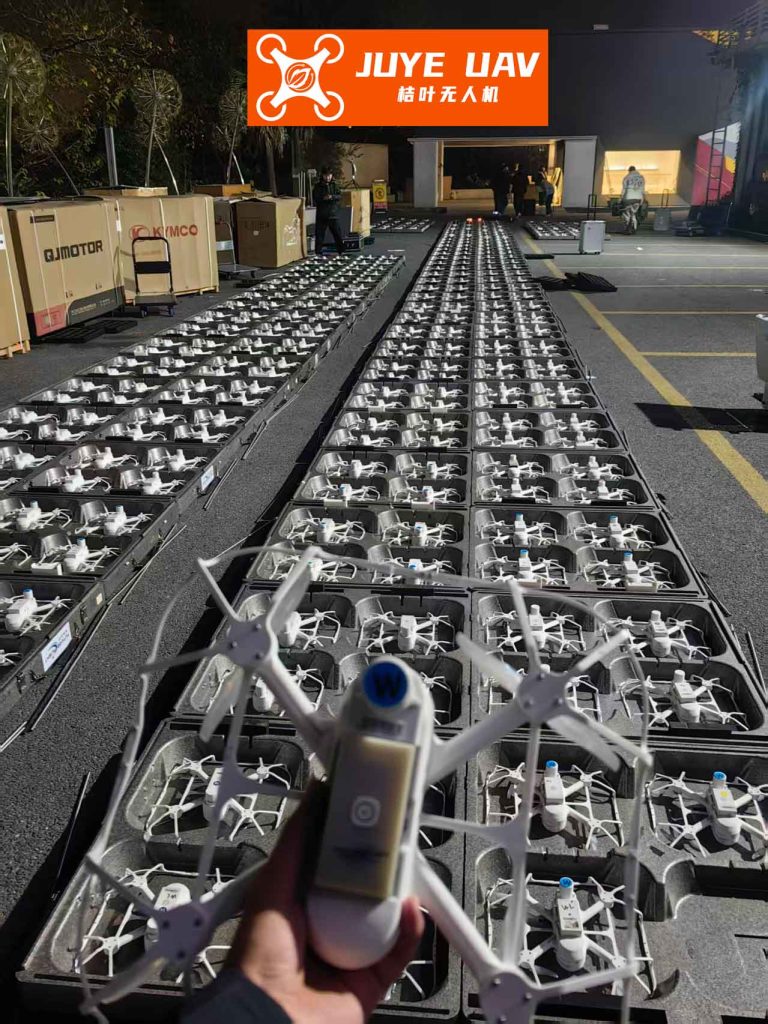
In practical terms, the drone formation reconfiguration process can be visualized as a continuous dance, where units shift positions based on evolving threats and mission demands. The image above captures the essence of such coordination, albeit in a ceremonial light show; in combat scenarios, the stakes are higher, and the algorithms must be robust. Our NBS-DMPC method provides a structured way to achieve this, treating each drone as an intelligent agent capable of negotiation. This paradigm shift from centralized command to distributed autonomy aligns with trends in multi-agent systems, where resilience and adaptability are paramount. As drone technologies advance, we anticipate that methods like ours will become standard for formation control, enabling swarms to tackle increasingly complex missions with minimal human intervention.
In conclusion, the autonomous reconfiguration of drone formations is a critical capability for modern aerial operations. By integrating Nash bargaining theory with distributed model predictive control, we have developed a method that not only optimizes performance but also ensures equitable cooperation among diverse drones. The algorithm’s convergence and efficiency have been proven analytically and validated through simulations, showcasing its potential for real-world deployment. As we continue to refine this approach, we envision drone formations that can self-organize in the face of adversity, embodying the pinnacle of autonomous systems engineering. The journey toward fully autonomous drone swarms is ongoing, and our work represents a significant step forward in making that vision a reality.