
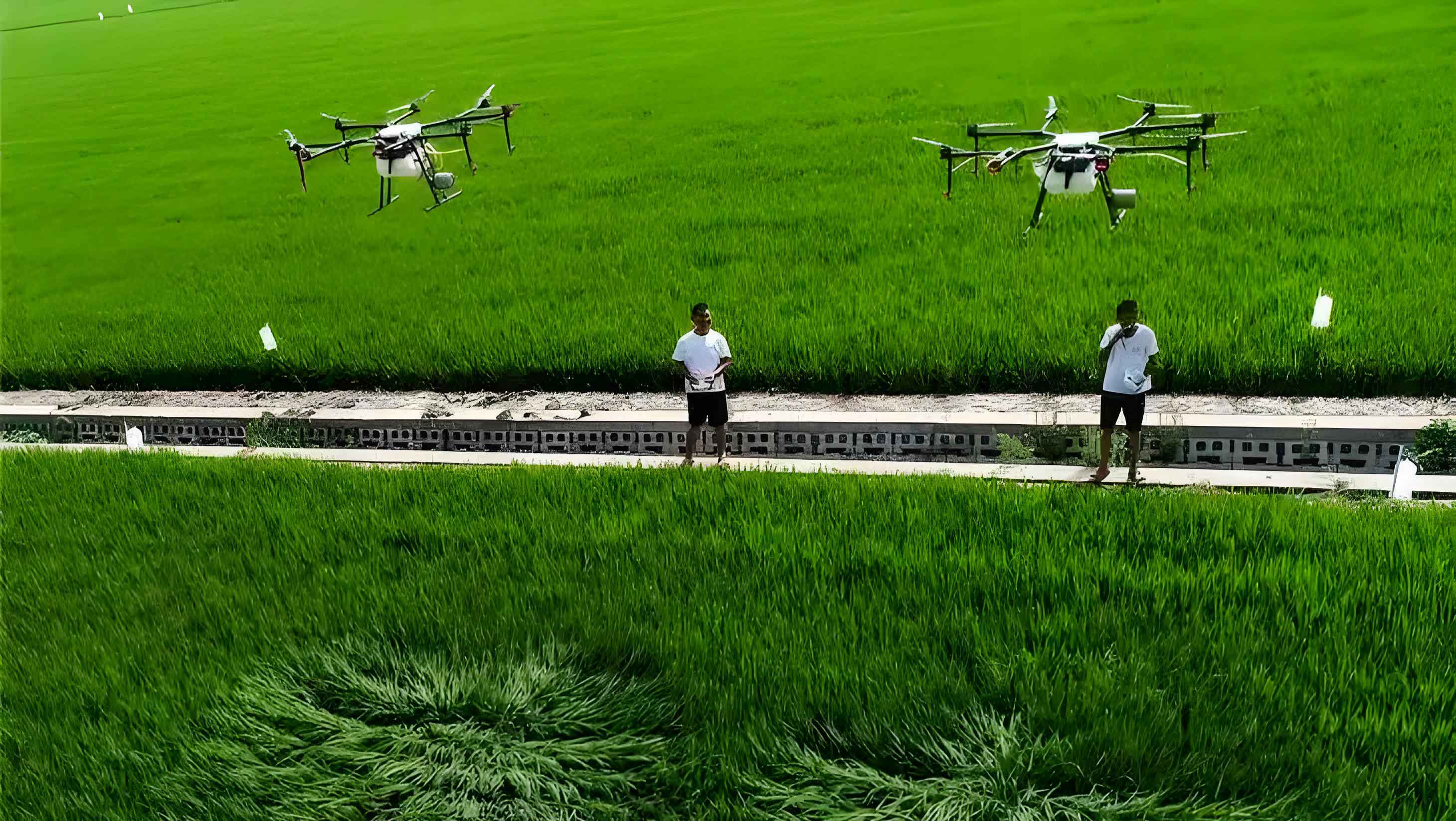
In the context of global population growth and increasing food demand, traditional agricultural methods are often inadequate to meet modern needs, necessitating technological advancements to enhance efficiency and productivity. As an expert in this field, I have observed that agricultural UAV plant protection services represent a transformative approach to crop management, leveraging drone technology for precision agriculture. This service involves using unmanned aerial vehicles equipped with spraying systems, high-resolution cameras, and sensors to monitor and treat crops, offering advantages such as high efficiency, accuracy, and flexibility. In this article, I will evaluate the industrial value of agricultural UAV plant protection systems, focusing on their applications in crop protection, pest control, and precision farming. By analyzing contributions to operational efficiency, pesticide reduction, and cost savings, I aim to highlight their role in boosting agricultural productivity and sustainability. I will also discuss current challenges and future prospects, providing insights to promote the widespread adoption of agricultural UAV technology.
The importance of agricultural UAV plant protection services cannot be overstated. From my perspective, these services revolutionize farming by addressing key limitations of conventional methods. Firstly, they significantly improve operational efficiency. Agricultural UAVs can cover large areas quickly, even in challenging terrains like hills or terraced fields, reducing the time required for tasks such as spraying. For instance, compared to manual or mechanical methods, agricultural UAVs can complete spraying operations in a fraction of the time, thereby alleviating labor burdens and enhancing overall productivity. This efficiency is quantified through metrics like operational efficiency, which I often calculate using the formula: $$\mu = \frac{A}{t}$$ where \(\mu\) represents operational efficiency in hectares per hour, \(A\) is the area covered, and \(t\) is the time taken. In practice, agricultural UAVs have shown efficiency gains of up to 50% in various studies, making them a cornerstone of modern agriculture.
Secondly, agricultural UAV plant protection services contribute to environmental sustainability by reducing pesticide usage. Traditional spraying often leads to over-application, but agricultural UAVs enable precise targeting through advanced control systems and sensors. This precision ensures that pesticides are applied only where needed, minimizing waste and environmental impact. I have analyzed cases where agricultural UAVs reduced pesticide use by 30-40% compared to conventional methods, thereby lowering pollution risks and promoting greener farming practices. The resource optimization percentage can be expressed as: $$\beta = \frac{Q_0 – Q}{Q_0} \times 100\%$$ where \(\beta\) is the percentage reduction in resource use, \(Q_0\) is the traditional resource quantity, and \(Q\) is the agricultural UAV resource quantity. This formula underscores the efficiency of agricultural UAVs in conserving inputs.
Thirdly, cost savings are a major advantage of agricultural UAV plant protection services. While initial investment in agricultural UAV technology can be high, long-term benefits include reduced labor costs, lower pesticide expenses, and decreased maintenance needs. From my assessments, agricultural UAVs can cut overall operational costs by 20-30% over time, thanks to their automation and precision. The cost savings can be modeled as: $$\text{Cost Savings} = C_{\text{traditional}} – C_{\text{UAV}}$$ where \(C_{\text{traditional}}\) includes labor and pesticide costs in traditional methods, and \(C_{\text{UAV}}\) encompasses operational, maintenance, and pesticide costs for agricultural UAVs. This economic viability makes agricultural UAVs an attractive option for farmers seeking to modernize their operations.
Moreover, agricultural UAV plant protection services drive agricultural modernization by enabling smart management and data-driven decisions. Agricultural UAVs collect real-time data on crop health, soil conditions, and pest infestations, which can be analyzed to optimize farming strategies. For example, using multispectral imaging, agricultural UAVs detect nutrient deficiencies or disease outbreaks early, allowing for timely interventions. This integration of technology fosters a more scientific approach to agriculture, as summarized in the table below on how agricultural UAVs advance modernization.
| Aspect | Description | Impact Metrics |
|---|---|---|
| Smart Management | Agricultural UAVs enable real-time monitoring and data analysis for precise crop management, improving decision-making. | Spraying accuracy increased by 30%, operational efficiency up by 50%. |
| Data-Driven Decisions | High-precision data from agricultural UAVs inform fertilization, irrigation, and pest control, enhancing resource allocation. | Pest detection rates improved by 40%, crop losses reduced by 25%. |
| Automated Operations | Agricultural UAVs reduce reliance on manual labor, promoting unmanned and automated farming processes. | Operation time shortened by 70%, labor intensity lowered by 60%. |
| Production Capacity | Efficient and precise operations boost crop yields and resilience against challenges like climate change. | Crop yields increased by 15-20%, resource waste minimized by 35%. |
| Technology Adoption | Widespread use of agricultural UAVs familiarizes farmers with advanced tech, accelerating innovation in agriculture. | Farmer training participation rose by 50%, tech integration improved by 30%. |
| Supply Chain Integration | Agricultural UAVs facilitate better data sharing and coordination across agricultural value chains. | Overall productivity enhanced by 25%, management efficiency up by 30%. |
In terms of applications, agricultural UAV plant protection services excel in various domains. For crop protection, agricultural UAVs provide real-time monitoring through high-definition cameras and multispectral sensors. This allows for early detection of issues like nutrient deficits or pest attacks, enabling prompt action. For instance, I have seen agricultural UAVs used in large-scale orchards to monitor fruit health, leading to a 25% reduction in crop losses. Additionally, precision spraying with agricultural UAVs ensures uniform coverage, reducing the risk of over- or under-application. This is particularly beneficial in sensitive ecosystems where chemical drift must be minimized.
For pest and disease control, agricultural UAVs offer a proactive approach. By combining imaging technologies with AI algorithms, agricultural UAVs can identify pest species and infestation levels automatically. This capability speeds up response times and improves the effectiveness of treatments. In my experience, agricultural UAVs have helped reduce pesticide use in pest control by up to 40%, while maintaining high efficacy rates. The environmental impact reduction can be calculated as: $$\eta = \frac{P_0 – P}{P_0} \times 100\%$$ where \(\eta\) is the percentage decrease in environmental impact, \(P_0\) is the impact from traditional methods, and \(P\) is the impact from agricultural UAV methods. Environmental indicators, as shown in the table below, highlight the benefits of agricultural UAVs.
| Indicator | Unit | Explanation |
|---|---|---|
| Pesticide Usage | kg/ha or L/ha | Agricultural UAVs reduce pesticide amounts through precise application, lowering environmental contamination. |
| Soil and Water Pollution | Concentration (mg/L) or pollution index | Precision spraying minimizes pesticide runoff, reducing pollution compared to traditional methods. |
| Air Pollution | Airborne particle concentration (μg/m³) | Agricultural UAVs decrease drift and airborne chemical levels, improving air quality. |
| Ecological Impact | Ecosystem health or biodiversity index | Targeted application protects non-target species, enhancing ecosystem resilience. |
| Economic Cost | USD/ha | Lower resource waste translates to cost savings and reduced environmental burden. |
In precision agriculture, agricultural UAVs play a pivotal role by providing detailed insights into crop and soil conditions. Through data collection on moisture levels, nutrient status, and growth patterns, agricultural UAVs support optimized farming practices. For example, I have utilized agricultural UAVs to create variable-rate application maps for fertilizers, resulting in a 20% increase in crop yields while conserving inputs. The integration of agricultural UAVs with GPS and IoT devices further enhances their capability, making them indispensable for modern precision farming.
The industrial value of agricultural UAV plant protection services extends beyond direct agricultural benefits. From an economic standpoint, agricultural UAVs stimulate growth in related sectors such as drone manufacturing, data analytics, and agricultural consulting. The market for agricultural UAVs is expanding rapidly, with projections indicating double-digit growth annually. In my analysis, the adoption of agricultural UAVs can boost farm profitability by 15-25% through yield improvements and cost reductions. Additionally, agricultural UAVs contribute to sustainable development goals by promoting resource efficiency and reducing carbon footprints. The overall value can be assessed using a composite index that incorporates factors like productivity gains, environmental savings, and social impacts. For instance, the net benefit of agricultural UAVs can be expressed as: $$\text{Net Benefit} = \sum (\text{Efficiency Gains} + \text{Cost Savings} + \text{Environmental Benefits})$$ where each component is derived from empirical data on agricultural UAV performance.
However, despite their advantages, agricultural UAV plant protection services face several challenges. Technologically, agricultural UAVs may suffer from limitations in flight stability, battery life, and durability under harsh field conditions. From my observations, battery续航 issues often restrict agricultural UAVs to short missions, necessitating frequent recharging and reducing operational continuity. Innovations in energy storage, such as hybrid systems or fast-charging solutions, are needed to overcome this. Moreover, the precision of agricultural UAV spraying can be affected by weather factors like wind, requiring advanced stabilization technologies.
Cost remains a significant barrier to the widespread adoption of agricultural UAV plant protection services. The initial investment for agricultural UAVs, including equipment and software, can be prohibitive for small-scale farmers. In my assessments, a typical agricultural UAV system costs between $10,000 and $50,000, which may not be feasible without subsidies or financing options. Operational costs, such as maintenance and data processing, add to the financial burden. To address this, I recommend exploring leasing models or government incentives to make agricultural UAVs more accessible. The cost-effectiveness can be evaluated using return on investment (ROI) calculations: $$\text{ROI} = \frac{\text{Net Benefits from Agricultural UAVs}}{\text{Total Cost of Agricultural UAVs}} \times 100\%$$ where higher ROI values justify the investment in agricultural UAV technology.
Personnel training is another critical issue. Operating agricultural UAVs requires specialized skills in drone piloting, data interpretation, and maintenance. From my experience, many farmers lack this expertise, leading to suboptimal use or accidents. Training programs for agricultural UAV operators are essential but often underfunded or unavailable in rural areas. I advocate for standardized certification schemes and hands-on workshops to build capacity. Additionally, the rapid evolution of agricultural UAV technology means that continuous education is necessary to keep pace with advancements.
Regulatory frameworks for agricultural UAV plant protection services are still evolving in many regions. Issues related to airspace management, safety standards, and pesticide application laws can hinder deployment. In my view, clear guidelines and international cooperation are needed to ensure safe and effective use of agricultural UAVs. For example, regulations should specify flight altitudes, no-fly zones, and data privacy protocols for agricultural UAV operations. Compliance with these rules not only protects users but also enhances public trust in agricultural UAV technology.
Looking ahead, I propose several recommendations to maximize the potential of agricultural UAV plant protection services. First, investment in research and development is crucial to improve agricultural UAV capabilities, such as extending battery life and enhancing autonomous features. Collaborations between academia, industry, and governments can accelerate innovation. Second, policymakers should introduce subsidies or tax breaks to lower the cost barrier for agricultural UAV adoption. Third, comprehensive training initiatives should be launched to equip farmers with the skills to utilize agricultural UAVs effectively. Fourth, robust regulations must be established to govern agricultural UAV use, balancing innovation with safety. Finally, promoting data sharing and interoperability among agricultural UAV systems can foster a more integrated agricultural ecosystem.
In conclusion, agricultural UAV plant protection services offer immense value in advancing agriculture through efficiency, sustainability, and modernization. As I have outlined, agricultural UAVs excel in applications like crop protection and precision farming, while also presenting challenges in technology, cost, and training. By addressing these issues through collaborative efforts, we can unlock the full potential of agricultural UAVs. The future of agriculture lies in smart, data-driven approaches, and agricultural UAVs are at the forefront of this transformation. I am confident that with continued innovation and support, agricultural UAV plant protection services will become a standard practice worldwide, contributing to food security and environmental stewardship.