
In recent years, with the rapid advancement of contemporary science and technology, we have witnessed a significant transformation in public security operations. The integration of unmanned aerial vehicles (UAVs) into policing, particularly in handling emergencies, has emerged as a critical component of the strategy to strengthen law enforcement through technology. As a researcher and practitioner in this field, I have observed that police UAVs offer remarkable flexibility, low cost, high stability, and reduced risk of personnel casualties. These attributes make them indispensable tools for公安机关 in managing sudden incidents. This article explores the comprehensive role of police UAVs in emergency response, delving into their conceptual framework, diverse applications, and the challenges that lie ahead. We will employ tables and formulas to summarize key aspects, aiming to provide a thorough analysis that underscores the importance of police UAV in modern警务实战.
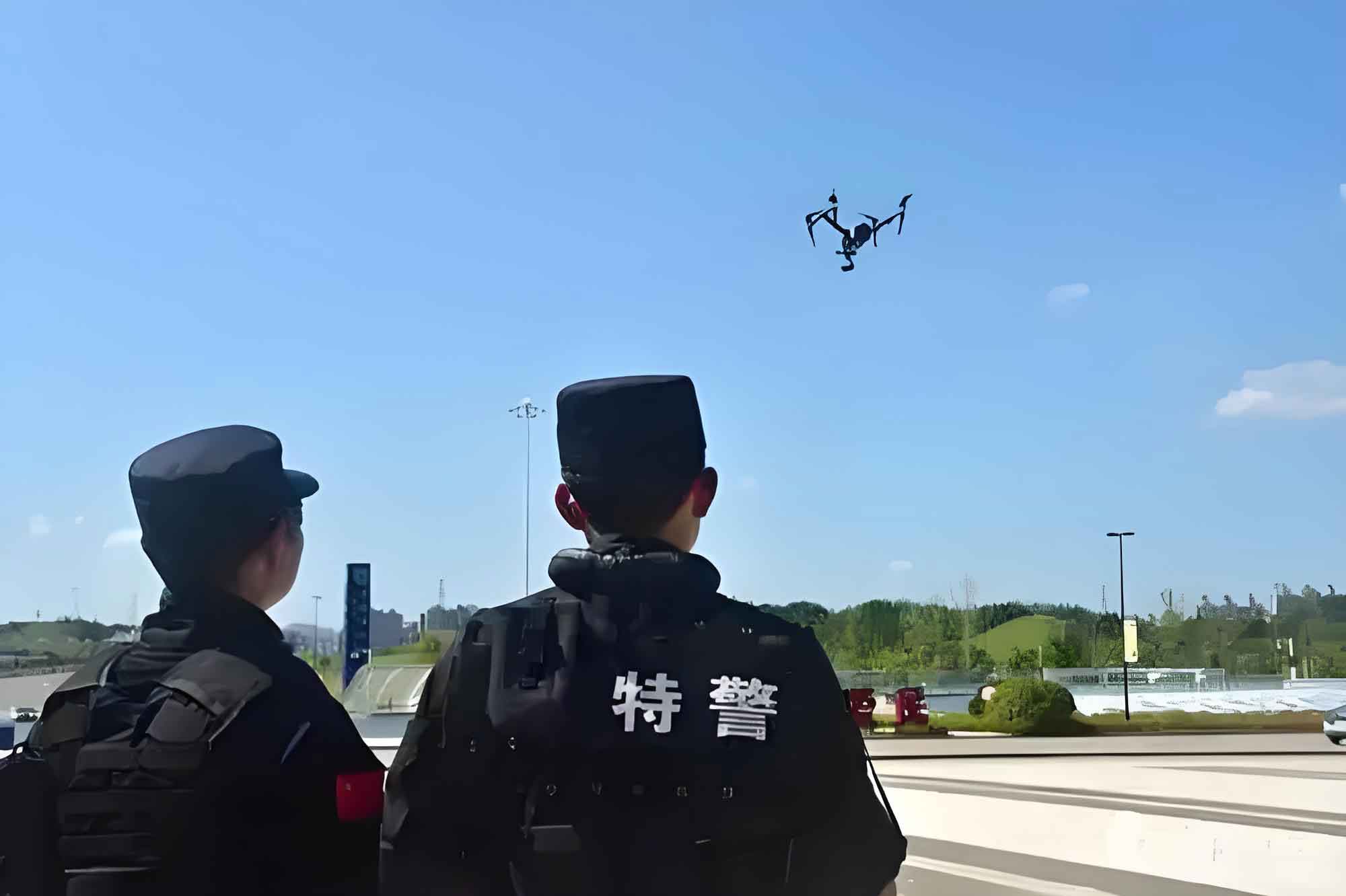
The concept of police UAV refers to unmanned aerial vehicles specifically designed or adapted for law enforcement purposes. These systems are operated via remote control or autonomous programming, enabling them to perform surveillance, reconnaissance, and intervention tasks without onboard human pilots. The police UAV leverages GPS,无线电数传, and other communication technologies to transmit multimedia data in real-time. This capability allows for rapid situational awareness, which is crucial in emergencies. From my perspective, the adoption of police UAV represents a paradigm shift towards more efficient and safer policing methods. The following sections will detail the types, advantages, and prospects of police UAV, setting the stage for a deeper discussion on their applications.
Overview of Police UAV
Police UAV can be categorized into several types, each with distinct characteristics suited for不同的 operational scenarios. The primary types include helicopters, fixed-wing aircraft, and multi-rotor UAVs. In recent years, multi-rotor police UAV have seen exponential growth due to their versatility and ease of use, while fixed-wing and helicopter variants have experienced more modest increases. To illustrate, consider Table 1, which compares key features of these police UAV types.
| Type | Advantages | Limitations | Typical Applications |
|---|---|---|---|
| Fixed-wing Police UAV | Long endurance, high speed, suitable for large-area coverage | Requires runway or launcher, limited hovering capability | Aerial monitoring of highways, border patrol |
| Helicopter Police UAV | Vertical take-off and landing, good maneuverability | Higher complexity and cost, shorter endurance | Precision surveillance in urban areas |
| Multi-rotor Police UAV | Compact size, easy operation, ability to hover and perform close-range tasks | Limited flight time and payload capacity | Crowd monitoring, accident scene investigation |
The advantages of police UAV are manifold. They exhibit strong flexibility, allowing deployment in diverse environments; cost-effectiveness compared to manned aircraft; high stability in various weather conditions; and minimized risk to human life. For instance, multi-rotor police UAV are particularly adept at capturing high-definition images and videos, facilitating real-time data transmission. The development前景 of police UAV is bright, as they align with the科技强警战略 that emphasizes信息化实战警务. We can model the effectiveness of a police UAV using a simple formula for operational efficiency:
$$ E = \frac{A \times R}{T \times C} $$
where \( E \) represents efficiency, \( A \) is area coverage, \( R \) is data resolution, \( T \) is time required, and \( C \) is cost. This formula highlights how police UAV optimize resource use in emergencies.
Applications of Police UAV in Emergency Response
In my experience, police UAV have proven invaluable across various emergency scenarios. Their ability to provide aerial perspectives and real-time data transforms how we approach crises. Below, we explore specific applications, supported by tables and formulas to quantify their impact.
Counter-Terrorism and Emergency Handling
When violent恐怖 incidents occur, police UAV can swiftly deploy to the affected area, conducting立体式全方位监控. They capture continuous footage, relaying dynamic information such as perpetrator numbers and movements to command centers. This aids in formulating precise打击 strategies. For example, in hostage situations, police UAV equipped with thermal imaging can identify heat signatures, enhancing situational analysis. We can express the侦查 coverage of a police UAV using:
$$ C_{cov} = \pi r^2 \times \frac{h}{v} $$
where \( C_{cov} \) is coverage area, \( r \) is detection radius, \( h \) is flight altitude, and \( v \) is velocity. This helps in planning police UAV deployment for maximum effectiveness. Additionally, police UAV can be armed with non-lethal payloads like催泪 or震爆 devices, enabling controlled intervention from the air.
Traffic Accident Management and Control
Following交通突发事件, police UAV quickly ascend to survey the scene, providing全方位立体式监控 that transmits live feeds to traffic指挥中心. This accelerates response and处置. In accidents, police UAV assist in reconstructing events by capturing直观画面, which supports liability determination. They also help in detecting congestion and违章行为, such as illegal lane changes. Table 2 summarizes the roles of police UAV in traffic management.
| Function | Description | Benefit |
|---|---|---|
| Accident Documentation | High-resolution imaging of crash sites | 快速还原 scene for legal evidence |
| Traffic Flow Monitoring | Real-time video of road conditions | Optimizes疏导 and reduces congestion |
| Violation Detection | Automated抓拍 of illegal driving acts | Deters违规行为 and improves safety |
The efficiency of police UAV in traffic management can be modeled by the formula for response time reduction:
$$ \Delta T = T_{traditional} – T_{UAV} $$
where \( \Delta T \) represents time saved, directly correlating with faster clearance and reduced secondary accidents.
Handling Mass Incidents
In群体性突发事件, police UAV offer a bird’s-eye view of crowds, enabling commanders to掌控事态进程 and identify agitators. When fitted with声控 and空投 systems, police UAV can broadcast messages or disperse crowds with非致命手段. This addresses challenges like指挥难 and取证难. We can quantify the deterrent effect of police UAV using a probability model:
$$ P_{deter} = 1 – e^{-k \cdot D} $$
where \( P_{deter} \) is the probability of crowd dispersion, \( k \) is a constant based on police UAV presence, and \( D \) is deployment density. This underscores how police UAV enhance public order management.
Firefighting and Rescue Operations
For火灾救援, police UAV provide critical insights into high-rise buildings where ground crews have limited visibility. They can deliver灭火弹 or救生物资, and use thermal imaging to locate heat sources. The effectiveness in搜救 can be expressed through a search efficiency formula:
$$ SE = \frac{N_{found}}{N_{total}} \times \frac{1}{t_{search}} $$
where \( SE \) is search efficiency, \( N_{found} \) is number of victims located, \( N_{total} \) is total victims, and \( t_{search} \) is time taken. Police UAV significantly improve \( SE \) by covering areas inaccessible to humans.
Disaster Relief Efforts
In灾害救援, police UAV conduct preliminary侦查 to identify geographic targets and deliver应急物品. Equipped with生命探测 technology, they accelerate搜救, minimizing casualties. The cost-benefit analysis of deploying police UAV in disasters can be summarized as:
$$ BCR = \frac{B_{lives} + B_{property}}{C_{UAV} + C_{operation}} $$
where \( BCR \) is benefit-cost ratio, \( B_{lives} \) and \( B_{property} \) are benefits from saved lives and property, and \( C_{UAV} \) and \( C_{operation} \) are costs. Police UAV often yield high \( BCR \) due to their rapid deployment and versatile capabilities.
Challenges and Solutions for Police UAV Implementation
Despite their advantages, police UAV face several hurdles that need addressing. As an observer, I note that these challenges span regulatory, technical, and operational domains. Table 3 outlines key issues and potential solutions.
| Challenge | Description | Proposed Solution |
|---|---|---|
| Policy and Regulations | Lack of specific laws governing police UAV use in emergencies | Develop comprehensive法规政策 tailored to law enforcement needs |
| Industry Manufacturing Standards | Inconsistent quality among producers, with some non-specialized firms entering the market | Establish certification protocols and encourage collaboration with reputable manufacturers |
| Maintenance and Training | Shortage of skilled operators and inadequate保养 plans, leading to high维护成本 | Implement standardized training programs and predictive maintenance schedules using IoT |
| Technical Equipment Limitations | Issues with reliability, endurance, payload capacity, and performance in恶劣环境 | Invest in R&D for improved电池 technology, obstacle avoidance, and防风 systems |
From a technical perspective, we can model the reliability of a police UAV using a failure rate formula:
$$ \lambda(t) = \lambda_0 e^{-\beta t} $$
where \( \lambda(t) \) is the failure rate at time \( t \), \( \lambda_0 \) is initial rate, and \( \beta \) is improvement factor. Enhancing \( \beta \) through better design is crucial for police UAV durability. Additionally, the training effectiveness for police UAV operators can be expressed as:
$$ TE = \frac{S_{acquired}}{T_{training}} \times R_{retention} $$
where \( TE \) is training effectiveness, \( S_{acquired} \) are skills acquired, \( T_{training} \) is training time, and \( R_{retention} \) is knowledge retention rate. Investing in模拟训练 can boost \( TE \), ensuring that police UAV are used optimally.
Conclusion
In conclusion, police UAV have become a cornerstone of modern emergency response, offering unparalleled advantages in surveillance, intervention, and救援. Through this analysis, we have seen how police UAV enhance capabilities in反恐处突, traffic management, crowd control, firefighting, and disaster relief. The integration of tables and formulas has allowed us to summarize their performance and challenges quantitatively. However, to fully realize the potential of police UAV, we must address regulatory gaps, improve manufacturing standards, enhance training, and advance technological robustness. As we move forward, the continued development of police UAV will undoubtedly propel公安工作 towards greater efficiency and safety, embodying the principle of向科技要警力. I am confident that with concerted efforts, police UAV will play an even more pivotal role in safeguarding public security, making our communities more resilient to emergencies.