
In recent years, as societal and economic development has accelerated, a complex interplay of social, economic, and public security issues has emerged, leading to frequent crisis incidents that pose unprecedented challenges to police work. From my perspective as a researcher in public security management, the current emergency police support systems often struggle with timely, precise, and comprehensive delivery of materials, particularly in the “last mile” of logistics. This gap significantly hampers operational effectiveness, as support capability directly translates to combat strength. Therefore, addressing this “last mile” problem in emergency police support is critical. With advancements in police equipment technology, police drones have become a vital component of strengthening police forces through technology, thanks to their flexibility, practicality, and intelligence. They are widely used in counter-terrorism reconnaissance, traffic management, large-scale security, and crowd control. However, their application in emergency police support remains underexplored. In this article, I will delve into how police drones can revolutionize emergency support material delivery, proposing a dedicated system to enhance efficiency and responsiveness.
Emergency police support is characterized by its urgency, continuity, diversity, and complexity. Firstly, urgency arises because incidents like major public disturbances or natural disasters occur suddenly, requiring immediate response and support. For instance, when a crisis hits, support materials must be deployed swiftly to sustain operations. Secondly, continuity refers to the prolonged nature of such events; support must be maintained throughout the incident lifecycle, from initial response to resolution. Thirdly, diversity stems from the need to mobilize various police units and social resources, demanding a wide range of materials. Lastly, complexity involves challenging environments—such as blocked roads or rugged terrain—that complicate coordination and delivery. These characteristics impose specific requirements on material delivery: rapid support to ensure quick response times, efficient support to optimize resource use and minimize errors, precise support to meet the unique needs of dispersed teams, and dynamic support to adapt to evolving situations. To visualize this, I summarize these requirements in a three-dimensional framework encompassing time, space, and content, as shown in the table below.
| Dimension | Requirement | Description |
|---|---|---|
| Time | Rapid Support | Minimize response time; ensure materials arrive within critical windows. |
| Space | Wide Coverage & Precision | Reach remote or inaccessible areas; deliver to specific coordinates accurately. |
| Content | Comprehensive & Tailored | Provide diverse material types; customize deliveries based on unit needs. |
To meet these demands, I propose a Police Drone Emergency Support Material Delivery System. This system integrates several components: a Command and Control System, an Identification System, police drones themselves, Navigation and Positioning Technology with Sensor Systems, and Portable Handheld Terminals. The synergy of these elements aims to overcome traditional logistics bottlenecks. The command system acts as the brain, processing real-time data and making decisions. Identification relies on RFID technology for tracking materials. Police drones serve as the aerial carriers, equipped with advanced navigation. Portable terminals enable field personnel to request and receive supplies. Below, I outline the system’s architecture in another table.
| Component | Function | Key Features |
|---|---|---|
| Command and Control System | Centralized decision-making; route planning; real-time monitoring. | AI-driven; data integration; multi-scenario simulation. |
| Identification System (RFID) | Tag and track materials; enable automatic retrieval. | Wireless scanning; data storage on tags. |
| Police Drone | Aerial delivery; adaptive flight; obstacle avoidance. | High payload; long endurance; autonomous operation. |
| Navigation & Sensors | GPS/BeiDou positioning; environmental sensing. | Collision detection; path optimization. |
| Portable Handheld Terminal | Field requests; status updates; RFID reading. | Rugged design; real-time communication. |
The effectiveness of this police drone-based system can be quantified using mathematical models. For example, delivery efficiency \(E\) can be expressed as a function of drone speed \(v\), payload capacity \(p\), and environmental factors \(\alpha\) (e.g., wind resistance). Assuming a distance \(d\) to the target, the time \(T\) for delivery is:
$$T = \frac{d}{v} + \beta \cdot \alpha$$
where \(\beta\) is a correction factor. The system’s overall performance \(P\) might be modeled as:
$$P = \sum_{i=1}^{n} \left( \frac{w_i \cdot m_i}{T_i} \right)$$
Here, \(n\) is the number of drones, \(w_i\) is a weight for priority, \(m_i\) is the material quantity delivered, and \(T_i\) is the time for each drone. This highlights how police drones can optimize support operations.
In developing this system, the command and control system is paramount. From my experience, it must handle vast data streams from field sensors and drones, using algorithms to generate optimal delivery routes. For instance, if multiple police teams request supplies simultaneously, the system can prioritize based on urgency and resource availability. I envision it employing machine learning to predict demand spikes, thereby pre-positioning police drones. The identification system, leveraging RFID, ensures that each material item is tagged with details like expiration dates or usage instructions. When a police drone receives a delivery order, it scans these tags via onboard readers, confirming the correct items before takeoff. This reduces errors and speeds up logistics.
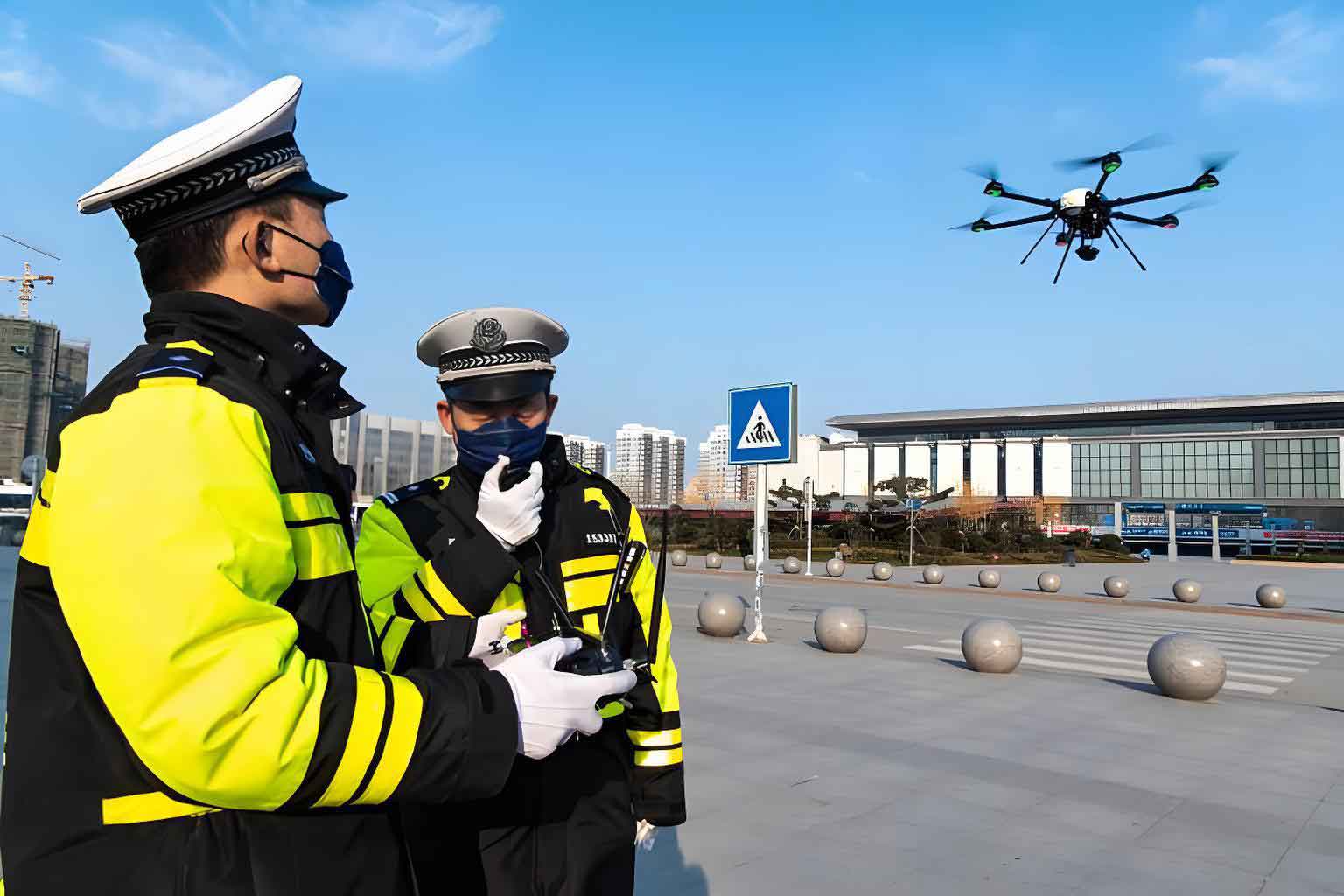
The police drone is the workhorse of this system. Modern police drones come in various configurations—fixed-wing for long distances or multi-rotor for maneuverability. Key parameters include flight endurance, which can be modeled as \(E_f = \frac{C_b \cdot \eta}{P_m}\), where \(C_b\) is battery capacity, \(\eta\) is efficiency, and \(P_m\) is motor power. Payload capacity \(L\) often follows \(L = k \cdot (T – W)\), with \(k\) as a design constant, \(T\) as thrust, and \(W\) as drone weight. To enhance performance, I recommend integrating hybrid power systems or solar panels to extend mission times. Sensors like LiDAR and cameras enable obstacle avoidance, crucial in complex terrains. For example, a police drone navigating a disaster zone can use real-time data to adjust its path, ensuring safe delivery.
Navigation relies on global positioning systems, with BeiDou offering advantages in China due to its accuracy. Sensor systems provide environmental awareness; for instance, ultrasonic sensors detect nearby objects, triggering evasive maneuvers. This is vital for police drones operating in crowded or unstable areas. Portable handheld terminals, carried by officers, allow them to submit requests via a user-friendly interface. The terminal’s GPS pinpoints their location, and its RFID reader verifies delivered materials. This closed-loop communication ensures accountability and efficiency.
Implementing this police drone system requires strategic pathways. First, institutional frameworks must be strengthened. From my viewpoint, we need to shift from reactive to proactive support mindsets, embedding technology into emergency protocols. Policies should standardize police drone operations, covering aspects like airspace management and safety regulations. A “big support” concept, involving cross-department coordination, can unify efforts. Second, data systems need optimization. I propose developing a cloud-based platform that integrates with existing police databases, enabling real-time analytics. Command networks should be扁平化 (flattened) to reduce latency, with decision-support tools that visualize drone fleets and material flows.
Third, technological innovation is essential. Research should focus on improving police drone endurance and payload. For example, using lightweight composites can reduce weight \(W\), increasing \(L\) as per the earlier formula. Advances in AI can enable autonomous swarming, where multiple police drones collaborate. The efficiency of a swarm can be expressed as:
$$S_e = \frac{N \cdot v_{avg} \cdot \rho}{D_{total}}$$
where \(N\) is drone count, \(v_{avg}\) is average speed, \(\rho\) is coordination factor, and \(D_{total}\) is total distance covered. Battery technology also matters; energy density \(E_d\) impacts flight time, modeled as \(t_{flight} = \frac{E_d \cdot V}{P_{consumed}}\), with \(V\) as volume and \(P_{consumed}\) as power consumption. Partnerships with tech firms can accelerate these developments.
Fourth, talent cultivation is crucial. Police drone operations require skilled personnel for maintenance, piloting, and data analysis. I advocate for specialized training programs in academies, with curricula covering drone mechanics, logistics, and emergency response. Simulation exercises can hone skills; for instance, using virtual environments to practice deliveries under stress. Certification standards should ensure competency, boosting the professionalism of police drone teams.
To illustrate the system’s impact, consider a scenario: a natural disaster strikes, blocking roads. Traditional support is hampered, but police drones are deployed. The command system assesses requests from field teams via portable terminals, then dispatches drones from a central depot. Each police drone carries RFID-tagged supplies—medical kits, food, or communication gear. Using GPS waypoints, they navigate autonomously, avoiding obstacles with sensors. Upon arrival, officers scan tags to confirm contents. This process slashes delivery times from hours to minutes, exemplifying rapid and precise support.
In terms of scalability, the system can be expanded with drone charging stations or mobile command units. Economic analysis might involve cost-benefit ratios \(R_{cb} = \frac{B}{C}\), where benefits \(B\) include reduced response times and saved lives, and costs \(C\) cover drone procurement and maintenance. Over time, as police drone technology matures, \(R_{cb}\) is likely to improve, justifying investment.
In conclusion, police drones offer a transformative solution for emergency police support material delivery. By addressing the “last mile” challenge, they enhance rapidity, efficiency, precision, and dynamism. The proposed system—integrating command, identification, drones, navigation, and handheld devices—can significantly boost police operational capabilities. However, success hinges on robust institutions, advanced data systems, continuous tech研发, and skilled personnel. As a proponent of科技强警 (strengthening police with science and technology), I believe police drones will play an increasingly vital role in future emergency responses, driving innovation in public safety logistics. Their potential is vast, and with concerted efforts, we can fully realize their benefits for society.