
In modern land and resource management systems, property registration serves as a cornerstone, playing a vital role in safeguarding the legitimate rights and interests associated with land ownership and the use of buildings and structures. However, when faced with the high standards and stringent requirements of contemporary property registration work, traditional real estate surveying methods are increasingly revealing their limitations. These methods often struggle with efficiency, coverage, and precision in complex environments. To address these challenges, we turn to innovative technological solutions. Low-altitude UAV drone tilt photography measurement technology has emerged as a revolutionary direction for reform in the field of real estate surveying for property registration. This technology utilizes a UAV drone platform equipped with a multi-lens camera system to perform multi-angle, comprehensive photographic operations in low-altitude airspace over a target area. Through this method, vast amounts of tilted image data containing rich spatial information can be rapidly acquired, laying a solid foundation for subsequent 3D modeling and related tasks. Compared to other prevalent photogrammetric techniques, employing low-altitude UAV drone technology for image acquisition and tilt photography can significantly reduce data collection time while ensuring extensive coverage of sampled images. Furthermore, it enables a rapid response to the demands of surveying and mapping tasks. Given the notable advantages of this technology, this paper, based on the specific requirements of related work, will comprehensively design surveying workflows grounded in low-altitude UAV drone photography technology. Our aim is to contribute to the standardized construction and development of China’s real estate and property-related industries.
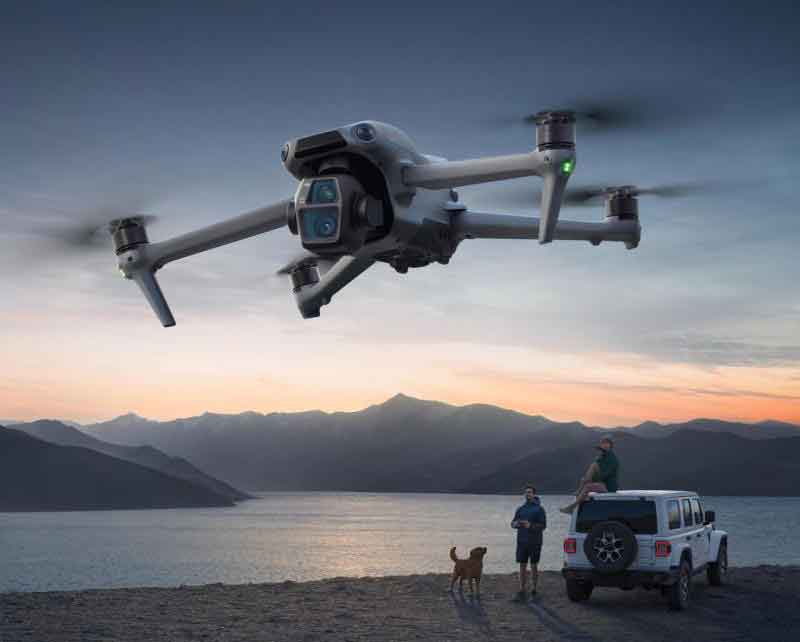
The successful implementation of UAV drone-based surveying hinges on meticulous planning and parameter design. To ensure the standardization of surveying operations and achieve the desired outcomes, it is crucial to design flight parameters before commencing field work, considering the specifications of the selected UAV drone equipment and the site conditions. Only by ensuring the compliance of these UAV drone flight parameters can we guarantee that the images and data collected post-flight meet high-precision requirements. In our design process, we must define key parameters for the UAV drone during flight, including altitude, on-site conditions, and the angles for image capture during tilt photography. We denote the designed flight altitude of the UAV drone as $$H$$, the effective focal length of the camera lens mounted on the UAV drone as $$F$$, and the maximum tilt angle during flight as $$\theta$$. Based on these known parameters, the vertical distance $$z$$ between the UAV drone in the air and the ground can be calculated, as shown in Equation (1).
$$z = H – m \tan \theta$$
In this equation, $$m$$ represents the effective flight height of the UAV drone, which is the horizontal distance between the UAV drone in space and the ground. After calculating the vertical distance $$z$$ using Equation (1), this parameter is controlled based on real-time data feedback from the camera and sensors. Ensuring the stability of this parameter is fundamental for collecting relevant images and data for measurement.
Following this calculation, we must define another critical parameter for ensuring high-quality photography: the resolution of the captured images during the UAV drone’s flight. Combining the above results with the inherent structural parameters of the UAV drone, we calculate the ground resolution of the images captured by the UAV drone in both vertical and horizontal directions, as shown in Equations (2) and (3), respectively.
$$d_v = \frac{F H}{z \cdot F \cos \theta + \sin \theta}$$
$$d_h = \frac{x \cdot (H + m \tan \theta)}{F \cos \theta + (m \sin \theta – \cos \theta)^2}$$
Here, $$d_v$$ is the ground resolution of the image in the vertical direction during UAV drone aerial photography, $$d_h$$ is the ground resolution in the horizontal direction, and $$x$$ is the effective pixel size of the UAV drone’s camera. In addition to the above, during UAV drone flight operations, we must comprehensively consider the aerial projection of the images. Typically, the image projected onto the ground is trapezoidal. We can further adjust aerial photography parameters based on the projected coverage area during practical operations. Through the aforementioned methods, we complete the design of parameters for low-altitude UAV drone tilt photography measurement, ensuring the standardization of surveying tasks. To summarize key design relationships, we present the following table correlating flight altitude with achievable ground resolution for a typical UAV drone setup.
| Primary UAV Drone Flight Parameter | Symbol | Design Consideration |
|---|---|---|
| Flight Altitude | $$H$$ | Determines coverage and base resolution. |
| Camera Focal Length | $$F$$ | Fixed hardware parameter influencing perspective. |
| Maximum Tilt Angle | $$\theta$$ | Critical for capturing façade and oblique details. |
| Effective Flight Height | $$m$$ | Horizontal component used in distance calculations. |
| Vertical Ground Resolution | $$d_v$$ | Calculated from $$H$$, $$F$$, $$z$$, and $$\theta$$. |
| Horizontal Ground Resolution | $$d_h$$ | Calculated from $$x$$, $$H$$, $$m$$, $$F$$, and $$\theta$$. |
Building upon the designed parameters, we proceed to sample images and data during the UAV drone flight mission. In the process of collecting image samples, it is necessary to introduce a zonal network layout method to plan the sampling flight lines based on the UAV drone operation parameters designed above. During this process, attention must be paid to ensuring that all control points in the flight line are uniformly distributed, and the layout direction of the control points must be highly consistent with the UAV drone’s flight direction. When setting control points, Real-Time Kinematic (RTK) or similar high-precision measurement systems can be utilized to quickly and accurately locate the spatial positions of these points based on specific requirements. After preliminary image acquisition by the UAV drone, technicians are deployed on-site to perform image collection checks, including verifying whether the images cover the entire area and meet accuracy requirements. Following manual inspection, GPS technology is introduced for image spatial positioning to obtain the coordinates of encryption points for the images in space, thereby achieving aerial triangulation (AT) measurement of the UAV drone survey images. This process is represented by Equations (4) to (6).
$$X = A X_0 + B Y_0 + C Z_0 + D$$
$$Y = D X_0 + E Y_0 + G Z_0 + I$$
$$Z = J X_0 + K Y_0 + L Z_0 + M$$
Here, $$X$$, $$Y$$, and $$Z$$ are the spatial coordinates of the encryption points for the UAV drone sampling data; $$X_0$$, $$Y_0$$, and $$Z_0$$ are the coordinates of control points arranged along the UAV drone’s flight path; and $$A$$, $$B$$, $$C$$, $$D$$, $$E$$, $$G$$, $$I$$, $$J$$, $$K$$, $$L$$, $$M$$ are constant coefficients determined by the geometric configuration. Through this method, image control points and sample points are matched using a bundle adjustment method, outputting matched point coordinates to complete the aerial triangulation of sampled images and coordinate points. This AT process is fundamental for establishing a accurate and consistent geometric model from the overlapping images captured by the UAV drone.
The design of the flight route plan is a critical step for efficient and effective data acquisition with the UAV drone. The key points of route planning方案 include three main aspects. First, the ground clarity index (Ground Sample Distance – GSD) for the aerial imagery must be determined. Second, the overlap ratio between adjacent images during the flight must be planned. Third, key parameters for the UAV drone during the data acquisition phase, such as flight speed, operating altitude, and camera angle adjustments, must be set. These core elements are indispensable components of the route planning process, and their interrelationships are described below. The correspondence between image ground resolution and flight altitude is given by Equation (7).
$$H = \frac{f \times GSD}{a}$$
Here, $$f$$ is the focal length of the aerial camera lens, $$GSD$$ is the ground resolution of the image, $$a$$ is the size of a single pixel on the camera’s sensor, and $$H$$ is the flight altitude of the UAV drone. For our experimental setup, we utilized an Md4-1000 quadcopter UAV drone platform equipped with a five-lens tilt photography camera. The main camera had a focal length of 35mm and a pixel size of 0.00241mm. Based on Equation (7), we can derive the flight altitudes corresponding to different ground resolutions, as detailed in Table 1.
| Photography Altitude, $$H$$ (m) | Ground Resolution, $$GSD$$ (m) |
|---|---|
| 100 | 0.019 |
| 90 | 0.016 |
| 80 | 0.013 |
When determining the flight altitude, we need to balance multiple factors including ground resolution, image quality, and flight safety. Ultimately, the operating altitude for this field mission was set at 90m. Image overlap rate includes two key metrics: forward overlap and side overlap. According to photogrammetric specifications, the minimum forward overlap during aerial operations should be 53%, and the side overlap should not be less than 60%. In practical data collection, these two overlap rates can be appropriately increased based on specific needs. The related calculations are shown in Equations (8) and (9).
$$p_x = p_x’ + (1 – p_x’) \frac{\Delta h}{H}$$
$$q_y = q_y’ + (1 – q_y’) \frac{\Delta h}{H}$$
Here, $$\Delta h$$ is the height difference between the camera and the ground; $$p_x$$ is the actual forward overlap degree; $$q_y$$ is the actual side overlap degree; $$p_x’$$ is the image forward overlap degree; $$q_y’$$ is the image side overlap degree; and $$H$$ is the photography altitude. The setting of overlap rates must consider various aspects. Based on the accuracy requirements for property measurement, field work efficiency, project cost control, and scheduling, we finally determined that using an 80% forward overlap and a 70% side overlap would be the optimal parameter configuration. The complete flight route plan parameters are summarized in Table 2.
| Parameter | Value | Unit |
|---|---|---|
| Flight Altitude ($$H$$) | 90 | m |
| Ground Resolution ($$GSD$$) | 0.016 | m |
| Flight Speed | 6.5 | m/s |
| Camera Aspect Ratio | 3:2 | – |
| Forward Overlap ($$p_x’$$) | 80 | % |
| Side Overlap ($$q_y’$$) | 70 | % |
Following the measurement operations, we process the internal data to further optimize the surveying work for the property engineering project. In this stage, all measured images and data are imported into a terminal PC. Parameters such as brightness, illumination, contrast, and exposure are adjusted to ensure key areas within the images are highlighted. Within the processing software interface, built-in algorithms are used to screen and match homonymous points between images and the map. During the matching process, an optimal transformation matrix $$T$$ in space is selected and used to align two images, as expressed in Equation (10).
$$\min f = \sum \| T(P’) – P_0 \|^2$$
Here, $$\min f$$ represents the image after alignment processing; $$P’$$ and $$P_0$$ are two effective matching points (homonymous points) in the images. Building upon this, after ensuring all homonymous points are perfectly matched, measurements are performed within the surveying interface. Error optimization algorithms are employed to adjust camera parameters and image positions, thereby refining the results of the aforementioned aerial triangulation, as shown in Equation (11).
$$Q = \min_{c, (X,Y,Z)} \sum \| \pi\{c, (X,Y,Z)\} – (X’, Y’, Z’) \|^2$$
In this equation, $$Q$$ is the optimized surveying result; $$c$$ represents camera parameters; $$(X, Y, Z)$$ are three-dimensional point coordinates; $$\pi$$ is the projection function; and $$(X’, Y’, Z’)$$ are observed point coordinates. By solving this optimization problem, more precise camera parameters and image positions are obtained. Utilizing these optimized parameters, a three-dimensional model is generated by directly inputting the UAV drone sampling data into the software, thus achieving standardized real estate surveying operations.
To validate the effectiveness of the proposed method based on low-altitude UAV drone tilt photography, we conducted an实例 application analysis. We selected a pilot project in a residential area as the surveying object. The total construction area was 14455.46 m², with an internal area of 11341.18 m². The building had 27 total floors, comprising 26 above-ground floors and 1 underground floor. To ensure the standardization of the surveying work, we chose a representative property area with complex and diverse terrain as the test site to fully verify the applicability and accuracy of the technology. We configured a high-performance data processing terminal to ensure real-time reception, storage, and processing of the tilted image data transmitted by the UAV drone. Before measurement, flight parameters were designed based on operational requirements and site conditions, as outlined in Table 3.
| Parameter Category | Specification/Value | Unit |
|---|---|---|
| UAV Drone Model | U60 | – |
| Material | Carbon Fiber + Aluminum Alloy | – |
| Expanded Size | 3060 × 3050 × 840 | mm |
| Folded Propeller Size | 1780 × 1800 × 840 | mm |
| Folded Body Size | 1110 × 800 × 865 | mm |
| Maximum Take-off Weight | 110 | kg |
| Wheelbase | 2272 | mm |
| Maximum Flight Altitude | 30 | m |
| UAV Drone Empty Weight | 35 | kg |
| Designed Operational Altitude | 90 | m |
A comprehensive check and debugging of the UAV drone were performed to ensure stable flight status and reliable image acquisition quality. A detailed flight plan and data acquisition方案 were also formulated to ensure the smooth progression of the test and the accuracy of the data. After completing the survey using our UAV drone-based method, we selected multiple measurement points to statistically analyze the偏差 in the surveying results. The results from our method were compared with those from traditional manual measurements. The surveying accuracy was examined using graphical analysis of error distribution along the X, Y, and Z coordinate axes. The analysis revealed that the application of our UAV drone method for property surveying resulted in errors distributed within ±6 cm in the X-direction, within ±4 cm in the Y-direction, and within ±10 cm in the Z-direction. Although there is some偏差 between the survey results from this method and the actual values, the overall errors are relatively small. The maximum error was -10 cm in the Z-direction, which does not significantly impact the overall surveying results. This demonstrates that the surveying accuracy of the proposed method in application is relatively high. The precision achieved confirms the reliability and effectiveness of employing low-altitude UAV drone tilt photography for such detailed cadastral and architectural surveys.
The choice of UAV drone platform and sensor is critical. The UAV drone’s ability to maneuver at low altitudes and capture multi-angle imagery is indispensable for creating accurate 3D models of structures. Every phase, from the initial parameter design for the UAV drone flight to the final internal data processing, contributes to the final precision. The formulas governing the relationship between UAV drone altitude, camera specs, and ground resolution (like $$H = \frac{f \times GSD}{a}$$) are essential tools for planners. Similarly, the overlap equations ($$p_x = p_x’ + (1 – p_x’) \frac{\Delta h}{H}$$) ensure sufficient image correspondence for robust 3D reconstruction. The aerial triangulation equations (e.g., $$X = A X_0 + B Y_0 + C Z_0 + D$$) mathematically bind the collected UAV drone images into a coherent spatial framework. Finally, the bundle adjustment optimization ($$Q = \min_{c, (X,Y,Z)} \sum \| \pi\{c, (X,Y,Z)\} – (X’, Y’, Z’) \|^2$$) refines this framework to its highest possible accuracy. Throughout this process, the role of the UAV drone as a versatile data acquisition platform cannot be overstated.
In conclusion, through the design of UAV drone flight parameters, aerial triangulation measurement, and other stages, we have completed the design of a real estate surveying method based on UAV drone technology. Selecting a pilot engineering project as the research object and applying the method proposed in this paper for engineering surveying, the results not only demonstrate the high accuracy of our method in the X, Y, and Z directions but also, to a certain extent, verify the reliability of UAV drone measurement operations. The integration of UAV drone technology with photogrammetric processing workflows offers a powerful solution to the challenges of modern property registration surveying. Therefore, in subsequent work, we will increase investment in research related to UAV drone surveying and similar tasks to provide technical support for the standardization of real estate measurement, cadastral planning, and related work. The future of precise, efficient, and comprehensive asset documentation lies in the intelligent deployment of UAV drone systems coupled with sophisticated data analytics.