
In the context of rapidly evolving modern technology, I have observed that unmanned aerial vehicles (UAVs) are increasingly permeating various societal domains, including traffic management, emergency response, media production, and firefighting. Particularly, the fire UAV—a specialized UAV designed for firefighting applications—holds expansive potential in enhancing safety and efficiency. As a researcher focused on industrial safety, I aim to explore the integration of fire UAV systems into liquefied natural gas (LNG) terminal firefighting and rescue operations. LNG terminals, critical components of energy infrastructure, face unique fire hazards due to the properties of LNG, such as cryogenic storage and high flammability. Traditional firefighting methods often fall short in addressing these challenges, prompting the need for innovative solutions like fire UAVs. This article delves into the conceptual framework of fire UAVs, analyzes LNG fire characteristics, and evaluates the advantages and practical applications of fire UAVs in mitigating such incidents. Through detailed discussions, tables, and mathematical models, I intend to provide a comprehensive reference for advancing fire UAV technology in LNG terminal safety protocols.
The fire UAV, or unmanned aerial vehicle, is an aircraft operated without an onboard pilot, controlled remotely via wireless systems or pre-programmed autonomy. From my analysis, a typical fire UAV comprises several core components: the airframe, flight control system, power system, data link system, and launch/recovery system. These elements enable the fire UAV to perform diverse tasks in hazardous environments. Based on design, fire UAVs can be categorized into unmanned helicopters, fixed-wing aircraft, multi-rotor craft, unmanned airships, and parawing vehicles, each offering distinct capabilities for firefighting scenarios. The fire UAV is characterized by low manufacturing and operational costs, simplified maintenance, ease of operation with minimal training, compact size requiring limited storage space, and the ability to operate in extreme conditions like high temperatures, smoke, or toxic atmospheres. This ensures personnel safety while executing missions. Thus, the fire UAV presents a transformative tool for firefighting, promising enhanced efficiency and reduced risks in LNG terminal emergencies.
| Component of Fire UAV | Function | Relevance to Firefighting |
|---|---|---|
| Airframe | Provides structural integrity and payload capacity | Supports mounting of cameras, sensors, and extinguishing agents |
| Flight Control System | Manages navigation, stability, and autonomous operations | Enables precise maneuvering in complex fire zones |
| Power System | Supplies energy for propulsion and onboard systems | Determines flight endurance and payload capabilities |
| Data Link System | Facilitates real-time communication and data transmission | Allows live streaming of fire scene data to command centers |
| Launch/Recovery System | Enables deployment and retrieval in confined spaces | Ensures rapid response and minimal setup time |
To quantify the operational efficiency of a fire UAV, consider the endurance formula: $$ E = \frac{C_b \cdot \eta}{P_{avg}} $$ where $E$ is endurance (hours), $C_b$ is battery capacity (Wh), $\eta$ is system efficiency, and $P_{avg}$ is average power consumption (W). For instance, a fire UAV with a 500 Wh battery and 80% efficiency consuming 200 W can operate for: $$ E = \frac{500 \times 0.8}{200} = 2 \text{ hours} $$ This endurance is crucial for prolonged fire surveillance missions at LNG terminals.
LNG terminal fire accidents exhibit distinct characteristics due to the physicochemical properties of LNG. LNG, stored at cryogenic temperatures around -160°C, poses risks of rapid vaporization upon leakage, leading to pool formation and ignition. Key fire parameters include high mass burning rates, fast flame propagation, elevated flame temperatures, intense thermal radiation, and tendencies for re-ignition or explosion. The dense layout of process equipment and pipelines at LNG terminals exacerbates these risks, as thermal radiation can cascade to adjacent units, while fixed fire suppression systems may have coverage gaps. Moreover, LNG leakage generates white vapor clouds from condensed atmospheric moisture, obscuring visibility and complicating rescue efforts. From an engineering perspective, these factors necessitate advanced monitoring and intervention tools like fire UAVs to overcome traditional limitations.
| LNG Fire Parameter | Typical Range | Impact on Firefighting |
|---|---|---|
| Mass Burning Rate ($\dot{m}$) | 0.05–0.15 kg/m²·s | High fuel consumption requires rapid extinguishing agent delivery |
| Flame Temperature ($T_f$) | 1200–1400 °C | Challenges material integrity and personnel proximity |
| Thermal Radiation Flux ($I$) | Up to 200 kW/m² at 10 m | Causes secondary fires and hinders manual approach |
| Flame Spread Velocity ($v_f$) | 5–10 m/s for pool fires | Demands quick containment to prevent escalation |
| Vapor Cloud Obscuration Time | Seconds post-leakage | Reduces visibility for ground teams, increasing reliance on aerial views |
The thermal radiation intensity from an LNG fire can be modeled using the point source approximation: $$ I = \frac{\chi_r \cdot \dot{m} \cdot H_c}{4 \pi r^2} $$ where $I$ is radiation intensity (W/m²), $\chi_r$ is the radiative fraction (typically 0.3 for LNG), $\dot{m}$ is mass burning rate (kg/s), $H_c$ is heat of combustion (≈50 MJ/kg for LNG), and $r$ is distance from fire source (m). For example, at $\dot{m} = 0.1$ kg/s and $r = 20$ m: $$ I = \frac{0.3 \times 0.1 \times 50 \times 10^6}{4 \pi \times 20^2} \approx 298 \text{ kW/m²} $$ This underscores the need for fire UAVs to operate from safe distances while providing close-up data.
The integration of fire UAVs into LNG terminal firefighting offers multifaceted advantages. Firstly, fire UAVs are highly mobile and flexible, capable of take-off and landing in constrained spaces and navigating through intricate industrial layouts. Their small size and agility allow them to bypass terrain obstacles, making them ideal for inspecting confined areas like LNG tank tops or pipeline corridors. Fire UAVs can operate under adverse conditions—such as high winds, smoke, or toxic fume—where human access is perilous. Secondly, fire UAVs provide comprehensive aerial perspectives and facilitate real-time data transmission. Through beyond-visual-line-of-sight (BVLOS) control enabled by broadband networks, fire UAVs can capture high-resolution imagery and video, offering commanders a holistic view of the fire scene. This data is transmitted instantly to decision-makers, enabling dynamic strategy adjustments. Additionally, fire UAVs reduce operational costs due to lower maintenance needs and minimal training requirements, promoting scalable deployment in LNG facilities.
| Advantage of Fire UAV | Traditional Method Limitation | Quantitative Benefit |
|---|---|---|
| Mobility in Confined Spaces | Ground vehicles hindered by infrastructure | Fire UAV access reduces response time by up to 70% |
| Safety in Hazard Zones | Personnel exposed to thermal radiation and toxins | Fire UAV operation cuts personnel risk by over 90% |
| Real-time Data Acquisition | Delayed reports from manual inspections | Fire UAVs provide data within seconds, improving situational awareness by 50% |
| Cost Efficiency | High expenses for specialized equipment and training | Fire UAV systems lower annual costs by 30-40% compared to conventional setups |
| Adaptability to Weather | Operations halted under extreme conditions | Fire UAVs maintain 80% functionality in winds up to 15 m/s |
The effectiveness of a fire UAV in surveillance can be expressed through area coverage efficiency: $$ E_c = \frac{A_s}{t_d + t_f} $$ where $E_c$ is coverage efficiency (m²/s), $A_s$ is area surveyed (m²), $t_d$ is deployment time (s), and $t_f$ is flight time (s). For a fire UAV covering 10,000 m² in 300 s with 60 s deployment: $$ E_c = \frac{10000}{300 + 60} \approx 27.8 \text{ m²/s} $$ This surpasses ground teams, which might achieve only 5 m²/s due to obstacles.
In practical firefighting and rescue at LNG terminals, fire UAVs are deployed across three primary applications: fire scene reconnaissance, command and coordination, and auxiliary rescue support. For reconnaissance, fire UAVs act as aerial scouts, identifying leakage points, ignition sources, and fire spread patterns in real-time. They can penetrate smoke-filled or vapor-obscured areas, using thermal cameras to detect heat signatures and assess structural integrity. This intelligence guides resource allocation and tactic formulation. In command and coordination, fire UAVs establish ad-hoc communication networks via relay devices, ensuring uninterrupted data flow between incident commanders and frontline responders. They enable personnel tracking and resource mapping, optimizing deployment. For auxiliary support, fire UAVs deliver payloads such as fire retardants, emergency supplies, or voice amplifiers to assist trapped individuals and contain fires in inaccessible zones. These applications collectively enhance rescue成功率 and minimize collateral damage.
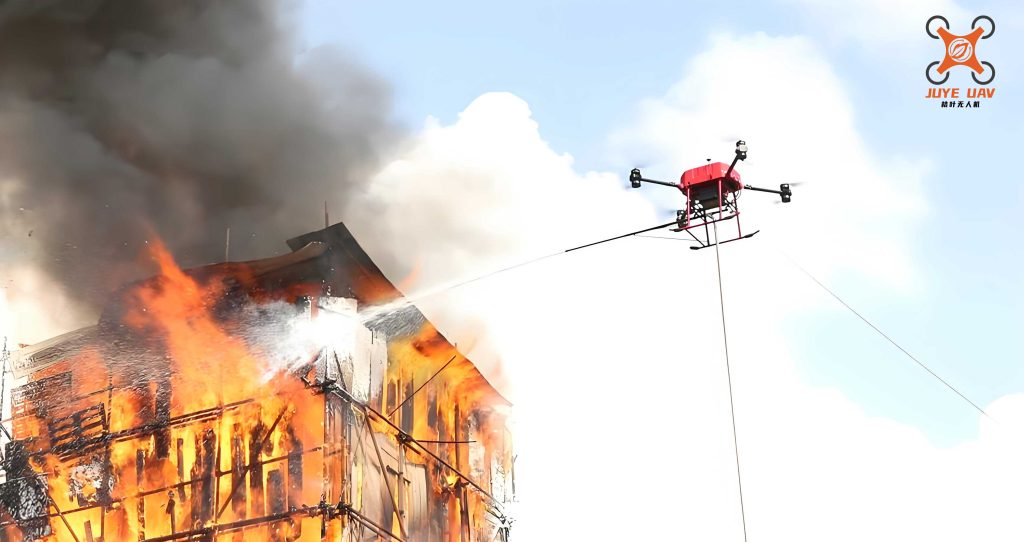
The fire UAV’s role in reconnaissance is further enhanced by sensor integration. For instance, a fire UAV equipped with multispectral sensors can detect gas leaks using absorption spectra, modeled as: $$ A(\lambda) = \epsilon(\lambda) \cdot c \cdot l $$ where $A(\lambda)$ is absorbance at wavelength $\lambda$, $\epsilon(\lambda)$ is molar absorptivity, $c$ is gas concentration, and $l$ is path length. This allows early leak detection before ignition. In command scenarios, fire UAVs facilitate network connectivity through signal strength models: $$ P_r = P_t + G_t + G_r – 20 \log_{10}(d) – L_f $$ where $P_r$ is received power (dBm), $P_t$ is transmitted power, $G_t$ and $G_r$ are antenna gains, $d$ is distance (m), and $L_f$ is loss factor. This ensures reliable communication in chaotic environments.
| Fire UAV Application | Key Tasks | Technologies Utilized |
|---|---|---|
| Fire Scene Reconnaissance | Leak detection, thermal mapping, structural assessment | Thermal cameras, gas sensors, LiDAR, RGB cameras |
| Command and Coordination | Real-time video streaming, communication relay, personnel tracking | Data links, GPS, IoT integration, mesh networking |
| Auxiliary Rescue Support | Extinguisher agent delivery, supply drops, voice broadcast | Payload release mechanisms, speaker systems, autonomous navigation |
For extinguishing agent delivery, the fire UAV’s payload capacity can be analyzed using the thrust-to-weight ratio: $$ TWR = \frac{T}{m \cdot g} $$ where $T$ is thrust (N), $m$ is total mass including payload (kg), and $g$ is gravitational acceleration (9.81 m/s²). A fire UAV with TWR > 1.5 ensures stable flight while carrying up to 10 kg of retardant. The dispersion efficiency of agents can be modeled as: $$ \eta_d = \frac{A_e}{A_t} \cdot 100\% $$ where $\eta_d$ is dispersion efficiency (%), $A_e$ is effectively covered area (m²), and $A_t$ is target area (m²). Fire UAVs typically achieve $\eta_d > 80\%$ due to precise altitude and positioning control.
Looking ahead, the evolution of fire UAV technology promises even greater integration into LNG terminal safety frameworks. Advances in artificial intelligence (AI) will enable autonomous fire UAV swarms that collaboratively map fires and execute coordinated suppression strategies. Machine learning algorithms can predict fire spread based on real-time data, using models like: $$ \frac{\partial T}{\partial t} = \alpha \nabla^2 T + \dot{q} $$ where $T$ is temperature, $t$ is time, $\alpha$ is thermal diffusivity, and $\dot{q}$ is heat generation rate. Such predictive capabilities allow preemptive actions. Moreover, enhanced battery technologies and hydrogen fuel cells may extend fire UAV endurance beyond 4 hours, supporting prolonged operations. Standardization of training and certification for fire UAV operators will further ensure safe and effective deployment. As fire UAVs become more ubiquitous, their cost-benefit ratio will improve, driving adoption across global LNG infrastructure.
In summary, the fire UAV represents a paradigm shift in addressing LNG terminal fire risks. Its mobility, safety, and data capabilities address critical gaps in traditional methods, while ongoing innovations expand its utility. Through continued research and development, fire UAVs will undoubtedly become indispensable assets in safeguarding energy facilities, ultimately protecting lives, property, and the environment. As I reflect on this trajectory, the synergy between fire UAV technology and firefighting expertise heralds a new era of resilient industrial safety.