
As a professional deeply involved in firefighting communications, I have witnessed the transformative impact of unmanned aerial vehicles, particularly fire UAVs, in enhancing operational efficiency and safety. The integration of fire UAVs into firefighting communications has evolved significantly, driven by advancements in flight control systems, open-source platforms, and supporting technologies. However, despite progress, challenges such as inadequate specialized training and limited in-depth application by frontline communication personnel persist, hindering their full potential. This article aims to systematically explore the application of fire UAVs in firefighting communications, emphasizing their technical advantages, practical pathways, and technological requirements to foster broader adoption and improve fire safety outcomes.
From my experience, fire UAVs offer a paradigm shift in how we approach emergency response. Their ability to provide real-time data and aerial perspectives has revolutionized firefighting strategies. In this discussion, I will delve into the specifics of fire UAV technology, supported by tables and formulas to summarize key aspects. The goal is to provide a comprehensive resource that underscores the critical role of fire UAVs in modern firefighting communications.
The adoption of fire UAVs in firefighting communications is not merely a trend but a necessity in an era where rapid response and accurate information are paramount. I have observed that fire UAVs can be deployed swiftly in various disaster scenarios, from urban fires to wilderness emergencies. Their versatility stems from several technical advantages, which I will outline in detail. Moreover, by addressing current limitations through enhanced training and technological refinement, we can unlock even greater benefits. This article will also explore future directions, including the integration of artificial intelligence and 5G connectivity, to further elevate the capabilities of fire UAVs.
To begin, let me highlight the core technical advantages of fire UAVs that make them indispensable in firefighting communications. Based on my fieldwork and research, these advantages can be categorized into mobility, visibility, operability, and safety. Each aspect contributes to the overall effectiveness of fire UAVs in critical situations.
| Advantage | Description | Impact on Firefighting |
|---|---|---|
| Mobility and Flexibility | Fire UAVs are lightweight (typically under 100 kg) and require only 1-2 operators. They can be quickly transported to disaster sites and take off from small open areas, enabling rapid deployment. | Reduces response time and adapts to constrained environments, such as dense urban settings or remote locations. |
| Comprehensive Visibility | Equipped with broadband and data link technologies, fire UAVs offer wide-angle views and can operate in low-light conditions using thermal imaging and infrared night vision. | Provides real-time aerial footage for better situational awareness, aiding in decision-making during complex incidents. |
| Ease of Operation | Operators control fire UAVs via remote video transmission and control systems, using devices like tablets or smartphones for intuitive interface. | Lowers training barriers and allows for quick adaptation by communication personnel, enhancing operational efficiency. |
| Safety and Reliability | Fire UAVs can withstand harsh conditions (e.g., rain, high temperatures) and reduce risks by minimizing human entry into hazardous zones like toxic or explosive environments. | Protects firefighters from direct exposure to dangers and provides continuous monitoring without compromising safety. |
In mathematical terms, the mobility of a fire UAV can be expressed through its flight time and range. For instance, the flight time $$ T_{flight} $$ is determined by the battery capacity $$ E_{battery} $$ and power consumption $$ P_{consumption} $$, as shown in the formula: $$ T_{flight} = \frac{E_{battery}}{P_{consumption}} $$. A typical fire UAV with a battery energy of 10,000 mAh and a power consumption of 200 W might have a flight time of approximately 30 minutes, which is crucial for sustained operations. Additionally, the operational range $$ R_{max} $$ can be modeled as $$ R_{max} = v \times T_{flight} $$, where $$ v $$ is the average flight velocity. For a fire UAV flying at 18 km/h, this translates to a range of about 9 km per charge, ensuring coverage of large incident areas.
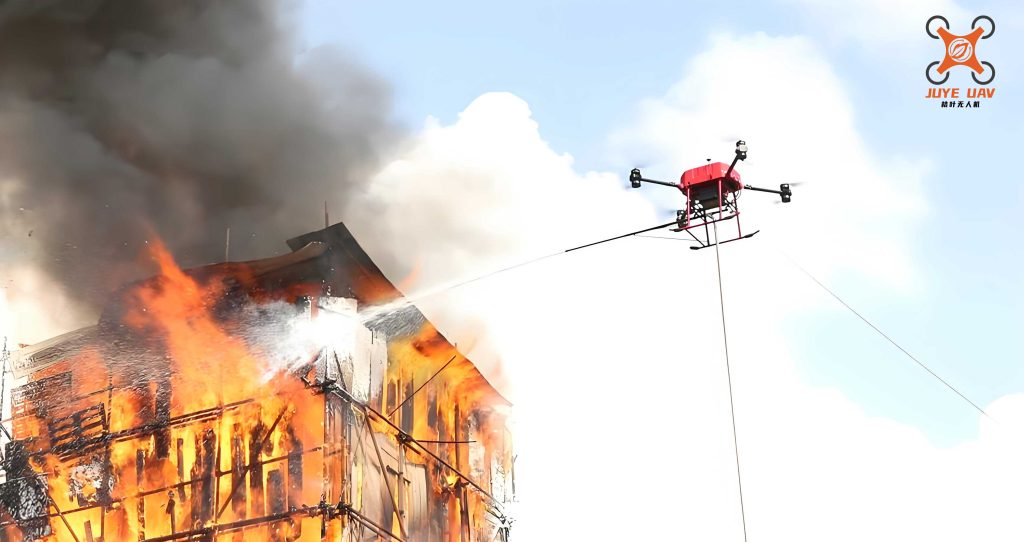
Beyond technical advantages, the application pathways of fire UAVs in firefighting communications are diverse and impactful. From my involvement in numerous rescue operations, I have seen fire UAVs employed in roles ranging from initial reconnaissance to ongoing monitoring and direct support. These applications not only enhance communication but also save lives by providing critical data that informs strategic decisions.
| Application | Specific Uses | Benefits |
|---|---|---|
| Comprehensive Disaster Reconnaissance | Fire UAVs conduct initial assessments of fire scenes, identifying key factors like ignition sources and structural integrity. They can also measure gas concentrations (e.g., CO, methane) using integrated sensors. | Provides immediate insights for command decisions, reduces guesswork, and prevents unnecessary exposure of personnel to risks. |
| Real-time Monitoring and Tracking | During ongoing incidents, fire UAVs track fire spread, monitor hotspots, and relay live video feeds to command centers. This includes using thermal cameras to detect hidden flames. | Enables dynamic response adjustments, helps contain fire escalation, and minimizes collateral damage through timely interventions. |
| Assisted Rescue Operations | Fire UAVs deliver tools or supplies (e.g., life vests, ropes) in water or mountain rescues, act as temporary communication relays via integrated audio modules, and facilitate emergency mapping for route planning. | Expands rescue capabilities in inaccessible areas, ensures communication continuity in signal-blocked zones, and speeds up victim localization. |
| Auxiliary Supervision of Rescue Sites | For high-rise buildings or complex structures, fire UAVs provide aerial oversight, generate fire spread models, and integrate with existing security systems for remote viewing. | Enhances coordination among teams, supports post-incident analysis, and aids in preventive inspections for fire hazards. |
The effectiveness of these applications relies on precise technical parameters. For example, in reconnaissance, the fire UAV’s ability to detect gas concentrations can be quantified using sensor sensitivity $$ S $$ and environmental noise $$ N $$. The detection accuracy $$ A_{detect} $$ might be expressed as $$ A_{detect} = \frac{S}{N} \times 100\% $$, where higher values indicate better performance. In monitoring, the frame rate $$ f $$ and resolution $$ R $$ of the camera system affect data quality; a common requirement is $$ f \geq 30 \, \text{fps} $$ and $$ R \geq 1080p $$ for clear, actionable footage. For rescue assistance, the payload capacity $$ P_{load} $$ of a fire UAV determines what it can carry, often modeled as $$ P_{load} = m_{max} – m_{UAV} $$, where $$ m_{max} $$ is the maximum takeoff mass and $$ m_{UAV} $$ is the drone’s base mass. A typical fire UAV might support $$ P_{load} = 5 \, \text{kg} $$, enabling delivery of essential items.
To fully leverage fire UAVs in firefighting communications, specific technological requirements must be met. Based on my observations, these requirements encompass reliability, controllability, stability, integration compatibility, and operational rigor. Meeting these standards ensures that fire UAVs perform consistently under the demanding conditions of fire scenes.
First, reliability is paramount. Fire UAVs must endure extreme environments, such as high winds, smoke, and temperatures. The抗风能力 (wind resistance) can be expressed in terms of the Beaufort scale; for instance, a fire UAV should withstand winds of at least Level 6, which corresponds to speeds of $$ v_{wind} \geq 10.8 \, \text{m/s} $$. The probability of failure $$ P_{fail} $$ under such conditions should be minimized, ideally below 0.01, as per reliability engineering principles: $$ P_{fail} = 1 – R(t) $$, where $$ R(t) $$ is the reliability function over time $$ t $$. Additionally, thermal resistance is critical; fire UAVs may need to operate near flames where temperatures exceed $$ 100^\circ \text{C} $$. The material tolerance can be modeled using heat transfer equations, such as $$ Q = k A \Delta T / d $$, where $$ Q $$ is heat flux, $$ k $$ is thermal conductivity, $$ A $$ is surface area, $$ \Delta T $$ is temperature difference, and $$ d $$ is material thickness. Selecting materials with low $$ k $$ values enhances durability.
Second, controllability involves flight duration and altitude capabilities. As mentioned earlier, flight time $$ T_{flight} $$ is crucial; for extended missions, fire UAVs should achieve $$ T_{flight} \geq 30 \, \text{minutes} $$ with recharge intervals under 15 minutes. Battery technology plays a key role here, with energy density $$ \rho_E $$ (in Wh/kg) dictating performance: $$ E_{battery} = \rho_E \times m_{battery} $$. Modern lithium-polymer batteries offer $$ \rho_E \approx 200 \, \text{Wh/kg} $$, enabling longer flights. Altitude-wise, fire UAVs must reach heights suitable for skyscraper fires, often requiring operational ceilings above $$ 300 \, \text{m} $$. The lift force $$ F_{lift} $$ needed can be derived from the drone’s mass and gravitational acceleration $$ g $$: $$ F_{lift} = m_{UAV} \cdot g $$, and propeller efficiency $$ \eta $$ affects achievable altitude: $$ h_{max} \propto \eta \times P_{motor} $$, where $$ P_{motor} $$ is motor power.
Third, stability in data transmission is essential for effective communication. Fire UAVs must maintain clear, continuous video feeds with minimal latency $$ L $$ and packet loss $$ P_{loss} $$. For real-time applications, $$ L \leq 100 \, \text{ms} $$ and $$ P_{loss} \leq 1\% $$ are desirable targets. The signal-to-noise ratio (SNR) in dB influences this: $$ \text{SNR} = 10 \log_{10} \left( \frac{P_{signal}}{P_{noise}} \right) $$, where higher SNR values correlate with better image quality. Interference resilience can be enhanced through frequency hopping or encryption protocols, ensuring that fire UAV communications remain robust amidst electromagnetic noise from firefighting equipment.
Fourth, integration compatibility allows fire UAVs to work seamlessly with existing firefighting infrastructure. This includes modular designs for easy attachment of sensors (e.g., gas detectors, multispectral cameras) and compatibility with communication protocols like LTE or satellite links. The interoperability index $$ I_{interop} $$ can be defined as the ratio of supported interfaces to total required interfaces: $$ I_{interop} = \frac{N_{supported}}{N_{required}} $$, aiming for $$ I_{interop} \geq 0.9 $$. Moreover, fire UAVs should be portable for rapid deployment; a compact form factor with dimensions $$ l \times w \times h \leq 0.5 \, \text{m}^3 $$ and weight under 20 kg facilitates transport in emergency vehicles.
Fifth, operational rigor demands rigorous training and maintenance protocols. From my perspective, this involves standard operating procedures (SOPs) for fire UAV pilots, including simulation-based training and certification exams. The skill retention rate $$ R_{skill} $$ over time $$ t $$ can be modeled as $$ R_{skill} = e^{-kt} $$, where $$ k $$ is a decay constant, highlighting the need for periodic refreshers. Maintenance schedules should follow reliability-centered maintenance (RCM) principles, with mean time between failures (MTBF) targets exceeding 500 hours for critical components. A checklist table, as below, summarizes key maintenance tasks for fire UAVs:
| Component | Inspection Frequency | Key Metrics | Action Required if Faulty |
|---|---|---|---|
| Battery System | Before each mission | Voltage $$ V \geq 3.7 \, \text{V per cell} $$, capacity retention $$ \geq 80\% $$ | Recharge or replace cells; calibrate battery management system (BMS) |
| Propellers and Motors | Weekly | Vibration levels $$ \leq 0.5 \, \text{g} $$, rotational symmetry $$ \Delta r \leq 0.1 \, \text{mm} $$ | Balance or replace propellers; lubricate motor bearings |
| Camera and Sensors | Monthly | Focus accuracy $$ \pm 0.5 \, \text{mm} $$, calibration error $$ \leq 2\% $$ | Clean lenses; recalibrate using reference targets |
| Communication Modules | Quarterly | Transmission power $$ P_{tx} \geq 1 \, \text{W} $$, antenna gain $$ G \geq 3 \, \text{dBi} $$ | Update firmware; test in varied environments for signal integrity |
| Structural Frame | After major incidents | Crack detection via stress $$ \sigma \leq \sigma_{yield} $$, where $$ \sigma_{yield} $$ is material yield strength | Reinforce or replace damaged parts; conduct non-destructive testing (NDT) |
Looking ahead, the future of fire UAVs in firefighting communications holds immense promise. Emerging technologies like artificial intelligence (AI) and 5G networks can further enhance their capabilities. For instance, AI algorithms can automate fire detection and prediction using image processing techniques. The accuracy of such systems can be quantified with metrics like precision $$ P = \frac{TP}{TP + FP} $$ and recall $$ R = \frac{TP}{TP + FN} $$, where TP, FP, and FN are true positives, false positives, and false negatives, respectively. Integrating these into fire UAVs could achieve $$ P \geq 0.95 $$ and $$ R \geq 0.90 $$, significantly improving response times. Similarly, 5G connectivity offers ultra-low latency and high bandwidth, enabling real-time data fusion from multiple fire UAVs. The data rate $$ D $$ in 5G networks can reach $$ D \geq 1 \, \text{Gbps} $$, supporting high-definition video streaming and sensor data aggregation for comprehensive situational awareness.
Moreover, swarm technology—where multiple fire UAVs operate collaboratively—presents a frontier for large-scale incidents. The coordination efficiency $$ E_{coord} $$ in a swarm of $$ n $$ drones can be modeled as $$ E_{coord} = \frac{\sum_{i=1}^{n} u_i}{n \cdot u_{max}} $$, where $$ u_i $$ is the utilization rate of each fire UAV and $$ u_{max} $$ is the maximum possible rate. Swarms could cover vast areas simultaneously, with fire UAVs sharing data via mesh networks to map fire perimeters or search for survivors. Energy management becomes critical here; the total energy consumption $$ E_{total} $$ for a swarm scales with $$ n $$: $$ E_{total} = n \times E_{per UAV} $$, necessitating efficient charging stations or solar-powered options for field operations.
In terms of training, virtual reality (VR) simulations can address the current gap in specialized programs. By creating immersive scenarios, trainees can practice operating fire UAVs in simulated fire environments, reducing risks and costs. The learning curve $$ L(t) $$ might follow a logarithmic model: $$ L(t) = a \ln(t) + b $$, where $$ a $$ and $$ b $$ are constants, indicating rapid skill acquisition with consistent practice. Such initiatives, combined with certification standards, will ensure that communication personnel are proficient in leveraging fire UAVs to their fullest.
From a regulatory perspective, standardization of fire UAV protocols is essential. This includes frequency allocations for emergency communications, airspace coordination with aviation authorities, and data privacy measures. The compliance level $$ C $$ can be assessed through audits, with targets like $$ C \geq 95\% $$ to ensure interoperability and safety. International collaborations, such as sharing best practices for fire UAV deployment, can accelerate adoption globally.
In conclusion, the application of fire UAVs in firefighting communications is a dynamic and evolving field that offers substantial benefits for enhancing public safety. Through my work, I have seen firsthand how fire UAVs can transform emergency response by providing real-time insights, aiding rescues, and reducing risks to personnel. By addressing technological requirements—such as reliability, controllability, stability, integration, and rigor—we can overcome current limitations and expand the use of fire UAVs. The integration of advanced technologies like AI and 5G will further propel this evolution, making fire UAVs indispensable tools in modern firefighting. As we move forward, continued research, training, and collaboration will be key to realizing the full potential of fire UAVs in safeguarding communities from fire hazards.
Ultimately, the journey toward widespread fire UAV adoption requires a concerted effort from researchers, operators, and policymakers. By fostering innovation and sharing knowledge, we can ensure that fire UAVs become a cornerstone of firefighting communications, driving efficiency and saving lives in crises worldwide.