
In modern urban environments, the increasing complexity of infrastructure, such as high-rise buildings and dense populations, poses significant challenges to firefighting and rescue operations. Traditional methods often struggle with accessibility, speed, and safety, leading to potential delays in response and increased risks to both firefighters and civilians. As a firefighting technology researcher, I have explored the integration of multi-rotor unmanned aerial vehicles (UAVs), commonly referred to as fire drones, into urban firefighting and rescue workflows. These fire drones offer a transformative approach by enhancing situational awareness, enabling rapid intervention, and reducing human exposure to hazards. In this article, I will delve into the conceptual framework, advantages, practical applications, and future prospects of fire drones, supported by technical analyses, tables, and formulas to provide a comprehensive overview. The goal is to demonstrate how fire drones can revolutionize urban firefighting, making it more efficient and effective.
Fire drones, specifically multi-rotor UAVs, are aerial vehicles powered by multiple rotors (typically three or more) that generate lift and thrust through electrically driven motors. Unlike conventional helicopters, fire drones have fixed rotor configurations and rely on differential rotor speeds for maneuvering, which allows for precise control in confined spaces. The basic principle involves adjusting the angular velocities of rotors to produce desired movements, such as hovering, ascending, or turning. Mathematically, the thrust generated by each rotor can be expressed as:
$$ T_i = k \cdot \omega_i^2 $$
where \( T_i \) is the thrust of rotor \( i \), \( k \) is a constant dependent on rotor design and air density, and \( \omega_i \) is the angular velocity. For a fire drone with \( n \) rotors, the total thrust \( T_{\text{total}} \) and torque \( \tau_{\text{total}} \) are given by:
$$ T_{\text{total}} = \sum_{i=1}^{n} T_i $$
$$ \tau_{\text{total}} = \sum_{i=1}^{n} r_i \times T_i $$
where \( r_i \) is the position vector of rotor \( i \) relative to the center of mass. By controlling \( \omega_i \) electronically, fire drones achieve stable flight through closed-loop control systems that monitor attitude and position using sensors like accelerometers and GPS. This simplicity in design, coupled with modular payload capabilities, makes fire drones ideal for urban firefighting, where adaptability is key. Fire drones can be equipped with various tools, such as thermal cameras, speakers, or extinguishing agents, transforming them into versatile firefighting assets.
| Configuration Type | Number of Rotors | Typical Payload Capacity (kg) | Flight Time (minutes) | Primary Advantages for Firefighting |
|---|---|---|---|---|
| Quadcopter (X-type) | 4 | 1-3 | 20-30 | Compact size, agile maneuverability in tight spaces |
| Hexacopter | 6 | 5-10 | 15-25 | Redundancy: can lose one rotor and remain airborne |
| Octocopter | 8 | 10-20 | 10-20 | High payload for heavy equipment like water pumps |
| Coaxial Multi-rotor | Varies (e.g., 12) | 20+ | 5-15 | Maximum stability and lift for extreme conditions |
The advantages of fire drones in urban firefighting are multifaceted, stemming from their unique design and technological integration. Firstly, fire drones exhibit exceptional structural simplicity, which translates to ease of operation. A single operator can deploy a fire drone within minutes, using handheld controllers or automated flight plans, reducing the need for extensive training compared to traditional aviation assets. This simplicity is enhanced by modular components; for instance, a fire drone can quickly swap payloads between a thermal imaging module and a water dispenser, allowing for mission-specific adaptations. Secondly, fire drones offer unparalleled mobility and flexibility. They can take off and land vertically in confined areas, such as narrow alleyways or rooftop helipads, and navigate through complex urban geometries where ground vehicles or manned aircraft cannot reach. This is crucial in dense cities where fire spread can be rapid and unpredictable.
Thirdly, fire drones provide high stability and reliability. Redundant rotor systems, as seen in hexacopters or octocopters, ensure that even if one or two rotors fail, the fire drone can maintain controlled flight, minimizing the risk of crashes during critical operations. This redundancy is quantified by fault-tolerance metrics, such as the probability of system failure \( P_f \), which for a fire drone with \( n \) rotors and independent failures can be modeled as:
$$ P_f = 1 – \sum_{i=0}^{k} \binom{n}{i} p^i (1-p)^{n-i} $$
where \( p \) is the failure probability per rotor, and \( k \) is the maximum number of tolerable failures (e.g., \( k=1 \) for hexacopters). Fourthly, fire drones are cost-effective and scalable. They require minimal infrastructure and can be deployed in swarms for large-scale incidents, offering distributed sensing and intervention capabilities. These advantages collectively enhance firefighting efficacy, as summarized in Table 2.
| Advantage Category | Description | Impact on Firefighting Operations |
|---|---|---|
| Operational Simplicity | Easy deployment and control by 1-2 operators | Reduces response time and training overhead |
| Spatial Flexibility | Vertical takeoff/landing, hovering in confined spaces | Enables access to high-rise buildings and dense areas |
| Redundancy and Safety | Multiple rotors allow continued operation after failures | Minimizes operational risks in hazardous environments |
| Modular Payloads | Interchangeable equipment for diverse tasks | Supports multi-role missions (e.g.,侦查, extinguishing) |
| Real-time Data Transmission | Live video and sensor feeds to command centers | Improves situational awareness and decision-making |
In practical terms, the application pathways for fire drones in urban firefighting are extensive and can be categorized into several core areas. Each pathway leverages the fire drone’s capabilities to address specific challenges, from initial侦查 to active救援. Below, I elaborate on these applications, incorporating technical details and examples to illustrate their effectiveness.
Fire Scene Reconnaissance: One of the primary uses of fire drones is for real-time火场侦查. Upon arrival at a fire incident, fire drones can be rapidly deployed to assess the situation from aerial perspectives. Equipped with high-resolution cameras and thermal imaging sensors, fire drones provide critical data on fire spread, hotspots, and structural integrity. For example, thermal cameras detect temperature variations, identifying hidden fire sources behind walls or under debris. The data can be processed using algorithms to generate heat maps, with temperature distribution modeled as:
$$ T(x,y,t) = T_0 + \Delta T \cdot e^{-\alpha (x^2 + y^2)} $$
where \( T(x,y,t) \) is the temperature at coordinates \( (x,y) \) and time \( t \), \( T_0 \) is ambient temperature, \( \Delta T \) is the peak temperature rise, and \( \alpha \) is a diffusion coefficient. This information helps commanders allocate resources efficiently, such as directing water streams to critical areas. Moreover, fire drones can enter hazardous zones, like chemical spill sites or collapsing structures, without endangering firefighters, thereby enhancing safety. In my experience, fire drones have reduced reconnaissance time by up to 70% compared to manual methods, allowing for faster intervention.
Continuous Dynamic Support: Fire drones offer persistent surveillance and support throughout救援 operations. By maintaining a constant aerial presence, fire drones relay live video feeds to ground teams and command centers, enabling dynamic adjustments to tactics. For instance, if a fire suddenly intensifies or shifts direction, fire drones can alert firefighters via audio warnings or data transmissions, providing a buffer against unexpected dangers. Additionally, fire drones can act as communication relays in environments where traditional radio signals are weak or blocked, such as in subterranean parking garages or high-rise stairwells. This is achieved by deploying fire drones as airborne nodes in a mesh network, with signal strength \( S \) approximated by:
$$ S = P_t G_t G_r \left( \frac{\lambda}{4\pi d} \right)^2 $$
where \( P_t \) is transmission power, \( G_t \) and \( G_r \) are antenna gains, \( \lambda \) is wavelength, and \( d \) is distance. Such support ensures seamless coordination, which is vital for complex urban fires involving multiple agencies.
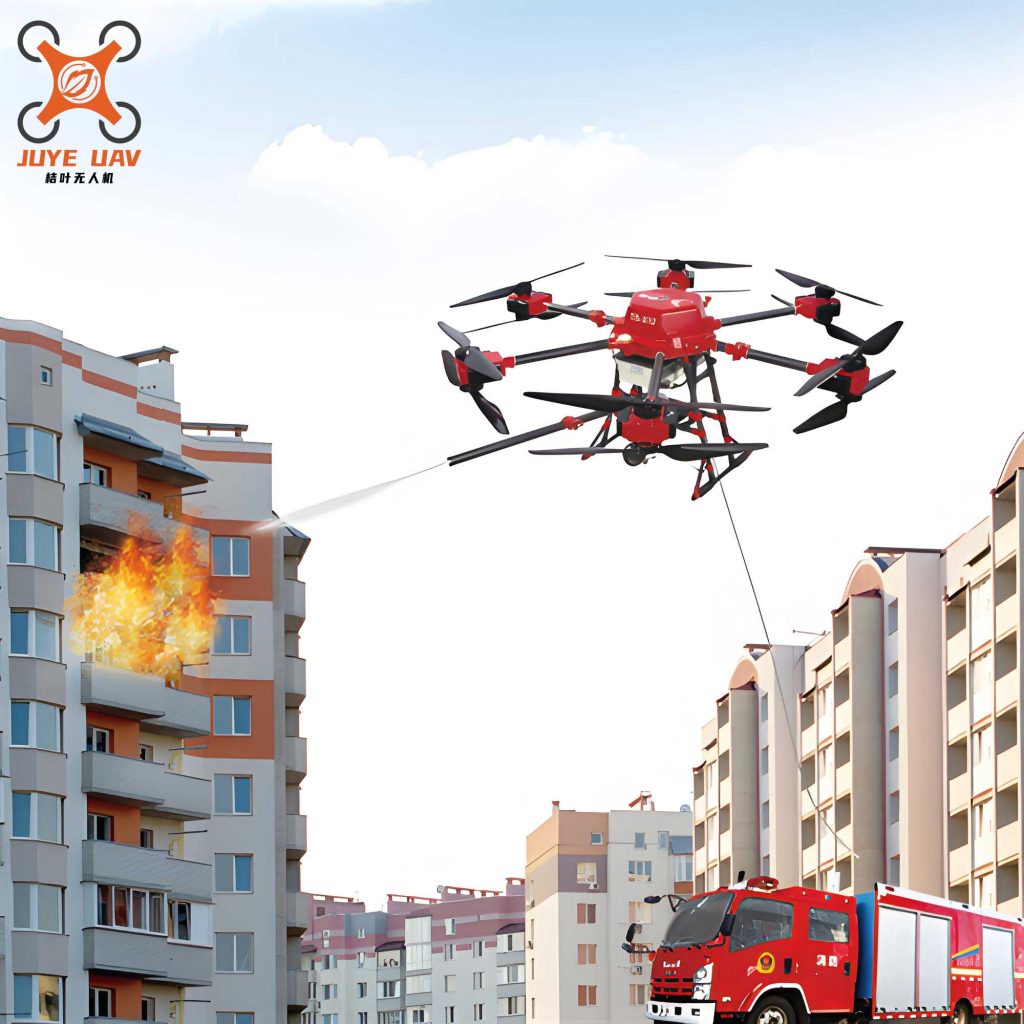
Aerial Real-time Monitoring: Beyond initial侦查, fire drones facilitate ongoing aerial monitoring of fire scenes. They can be programmed to follow predefined patrol routes, scanning for flare-ups or structural changes over time. This is particularly useful for large-scale incidents, such as industrial fires or forest-urban interface blazes, where manual monitoring is impractical. Data collected by fire drones, including video and sensor readings, can be integrated into building information modeling (BIM) systems or geographic information systems (GIS) for analysis. For example, fire progression can be predicted using computational fluid dynamics (CFD) models, with fire drone data serving as boundary conditions. The rate of fire spread \( R \) in an urban canyon can be estimated as:
$$ R = k \cdot \sqrt{H/W} \cdot U $$
where \( k \) is a constant, \( H \) and \( W \) are building height and street width, and \( U \) is wind speed measured by fire drones. This predictive capability allows for proactive measures, such as evacuations or barrier deployments.
Assisted Rescue Operations: Fire drones directly contribute to救援 efforts through various payloads and functionalities. Table 3 outlines common辅助救援 applications of fire drones, each tailored to specific scenarios. For instance, fire drones equipped with loudspeakers and spotlights can guide trapped civilians to safety by broadcasting instructions or illuminating escape routes. In cases where survivors are buried under rubble, fire drones with life-detection radar can identify vital signs, such as breathing or heartbeat, using Doppler effect principles. The radar return signal \( s(t) \) from a moving chest wall can be expressed as:
$$ s(t) = A \cos\left(2\pi f_0 t + \frac{4\pi x(t)}{\lambda}\right) $$
where \( A \) is amplitude, \( f_0 \) is carrier frequency, \( x(t) \) is chest displacement, and \( \lambda \) is wavelength. Furthermore, fire drones can deliver emergency supplies, such as respirators, first-aid kits, or water bottles, to inaccessible locations using precision droppers. For fire suppression, specialized fire drones carry extinguishing agents like dry powder or water mist, enabling targeted attacks on small fires or cooling of hotspots. A notable example is the “aerial water cannon” fire drone, which uses a tethered hose connected to a ground pump to deliver continuous water streams to high-rise fires, with flow rate \( Q \) given by:
$$ Q = C_d A \sqrt{2g h} $$
where \( C_d \) is discharge coefficient, \( A \) is nozzle area, \( g \) is gravity, and \( h \) is pressure head. These applications underscore the versatility of fire drones in saving lives and property.
| Application Type | Typical Payload | Operational Mechanism | Expected Outcome |
|---|---|---|---|
| Communication and Guidance | Loudspeaker, LED spotlight | Broadcast audio instructions or light paths for evacuation | Reduced panic and improved civilian self-rescue rates |
| Life Detection | Micro-Doppler radar, thermal camera | Scan debris for vital signs; transmit coordinates to rescuers | Faster localization of survivors, increasing survival probability |
| Supply Delivery | Payload release mechanism | Airdrop essentials (e.g., medical kits, ropes) to stranded individuals | Sustained support until ground teams arrive |
| Initial Fire Attack | Extinguishing canisters, water mist systems | Direct application of suppressants to incipient fires | Containment of fire spread before escalation |
| Structural Assessment | LiDAR, high-resolution camera | Create 3D maps of damaged buildings for stability analysis | Informed entry decisions for firefighters, reducing collapse risks |
System Function Design: To realize these applications, fire drone systems comprise two main modules: the airborne platform and the ground control station. The airborne platform includes sensors (e.g., GPS, thermometers), actuators (e.g., motor controllers), and payload interfaces, all managed by an onboard computer. The ground control station features software for mission planning, real-time monitoring, and data analysis. Key functions include video display, telemetry logging, and remote payload activation. The integration is governed by communication protocols, such as MAVLink, which ensure low-latency data exchange. For optimization, the system can be modeled as a control loop with transfer function \( G(s) \), where:
$$ G(s) = \frac{K}{s^2 + 2\zeta\omega_n s + \omega_n^2} $$
Here, \( K \) is gain, \( \zeta \) is damping ratio, and \( \omega_n \) is natural frequency, parameters tuned for stable fire drone performance under windy or turbulent conditions. This design enables firefighters to operate fire drones intuitively, even in high-stress environments.
Looking ahead, the future of fire drones in urban firefighting is promising, driven by technological advancements and growing adoption. Several trends are likely to shape their evolution. Firstly, payload capacities will increase, allowing fire drones to carry heavier equipment, such as larger water reservoirs or advanced sensors. Research into hybrid propulsion systems, combining electric motors with internal combustion engines, may extend flight endurance beyond current limits of 30 minutes. Secondly, autonomy will improve through artificial intelligence (AI) and machine learning. Fire drones could autonomously navigate complex environments, identify hazards, and make decisions without human intervention, using algorithms like reinforcement learning to optimize paths. The reward function \( R \) for an autonomous fire drone might be defined as:
$$ R = w_1 \cdot \text{extinguishment\_rate} – w_2 \cdot \text{risk\_exposure} – w_3 \cdot \text{energy\_consumption} $$
where \( w_1, w_2, w_3 \) are weighting factors. Thirdly, interoperability with other smart city infrastructure, such as IoT sensors or autonomous fire trucks, will enable coordinated responses. For example, fire drones could receive real-time data from building smoke detectors, prompting pre-emptive deployments. Lastly, regulatory frameworks will mature, standardizing operations and ensuring safety in shared airspace. These developments will solidify fire drones as mainstream tools in firefighting arsenals.
In conclusion, fire drones represent a paradigm shift in urban firefighting and rescue. By leveraging their agility, versatility, and technological integration, fire departments can enhance operational efficiency, protect firefighter lives, and improve outcomes for affected communities. From火场侦查 to辅助救援, fire drones offer scalable solutions tailored to the unique challenges of modern cities. As I continue to research and advocate for their adoption, I believe that fire drones will become indispensable assets, transforming how we respond to fires and ultimately making urban environments safer. The ongoing innovation in this field, coupled with practical experience, promises a future where fire drones play a central role in safeguarding our cities.