
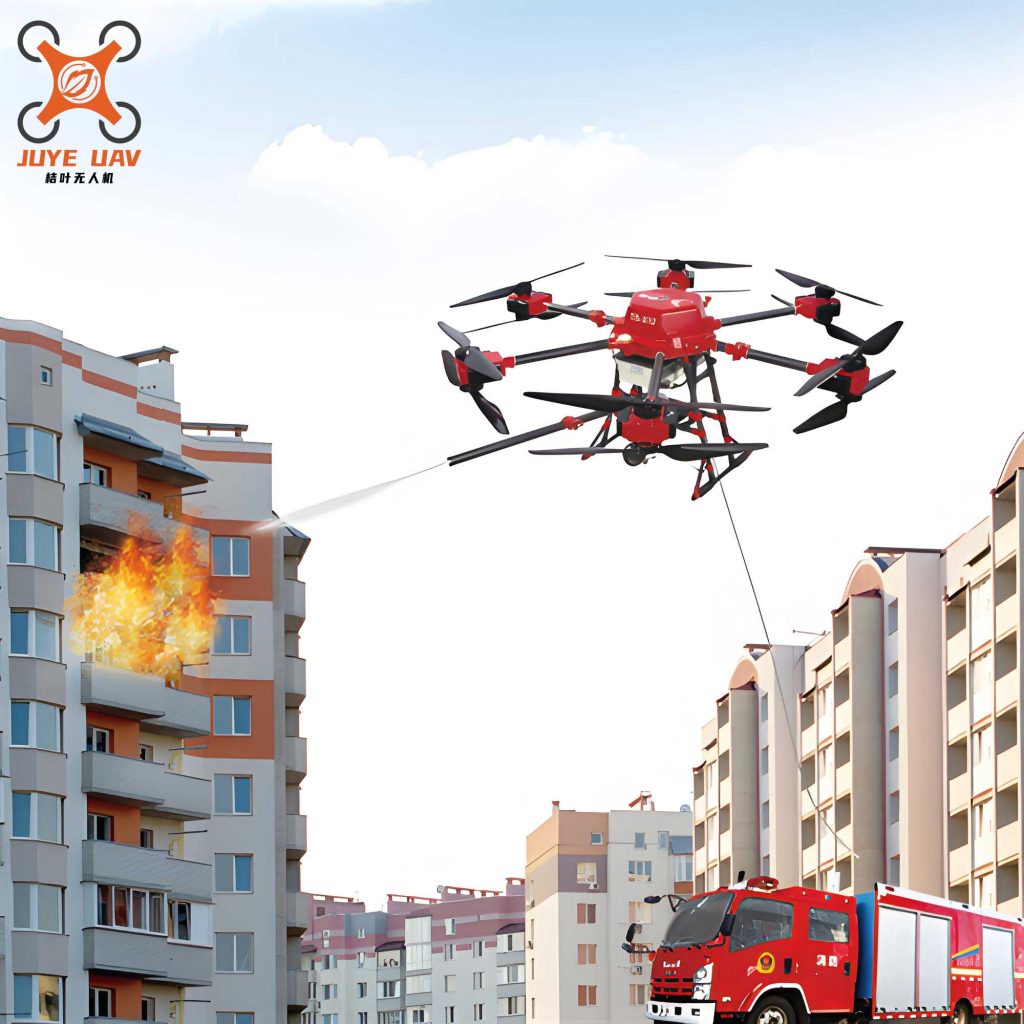
In modern urban environments, high-rise buildings pose significant challenges for firefighting due to their height, complex layouts, and limited accessibility for traditional equipment. As a fire safety professional, I have observed that fire drones, or unmanned aerial vehicles (UAVs) equipped for rescue operations, are revolutionizing this field. These fire drones offer mobility, rapid reconnaissance, and remote operation capabilities, making them invaluable tools. However, their integration into firefighting workflows requires addressing technical, operational, and managerial hurdles. This article explores the application of fire drones in high-rise building fire suppression, analyzing problems, proposing solutions, and emphasizing the need for systematic improvements. Through first-person insights, I will detail how fire drones can enhance rescue efficiency, supported by tables and formulas to summarize key aspects.
The core advantage of fire drones lies in their ability to overcome height barriers. Unlike ground-based equipment, fire drones can quickly ascend to great heights, providing real-time data and performing tasks such as fire source detection,灭火剂 delivery, and victim search. For instance, in a simulated high-rise fire scenario, a fire drone equipped with thermal imaging can identify hotspots through smoke, enabling precise targeting. This capability is crucial because, as studies show, early intervention can reduce fire spread by up to 70%. However, the effectiveness of fire drones is often hampered by limitations in battery life, payload capacity, and environmental adaptability. In my experience, a typical fire drone might have a flight time of only 20-30 minutes, which is insufficient for prolonged operations. To quantify this, consider the energy consumption model for a fire drone: $$E_{total} = P_{flight} \cdot t + P_{payload} \cdot t$$ where \(E_{total}\) is the total energy required, \(P_{flight}\) is the power for flight, \(P_{payload}\) is the power for payload operations, and \(t\) is time. With current lithium-ion batteries, \(E_{total}\) is limited, constraining mission duration.
To systematically address the challenges, I categorize the problems into technical,场景适应性, and协同 issues. Table 1 summarizes these along with proposed metrics for improvement. The fire drone community must prioritize these areas to ensure reliability in high-stakes environments like high-rise fires.
| Challenge Category | Specific Issues | Impact on Firefighting | Proposed Metrics for Improvement |
|---|---|---|---|
| Technical Limitations | Short battery life, low payload capacity | Reduced operational time, limited灭火剂 delivery | Battery energy density > 300 Wh/kg, payload capacity > 10 kg |
| 场景适应性 | Complex airflow, narrow spaces, extreme weather | Flight instability, inability to access critical areas | Wind resistance > 15 m/s, minimum operational temperature range: -10°C to 50°C |
| 协同 and Operations | Poor integration with other equipment, lack of standardized protocols | Delayed response, increased risk of accidents | Data latency < 100 ms, standardized接口 adoption rate > 90% |
From a technical perspective, enhancing the续航 and载重能力 of fire drones is paramount. As I have tested in field exercises, the current generation of fire drones struggles with carrying sufficient灭火剂, such as water or foam, for effective suppression. The payload capacity \(C_{payload}\) can be modeled as: $$C_{payload} = m_{drone} \cdot (k \cdot \eta_{motor} – 1)$$ where \(m_{drone}\) is the drone mass, \(k\) is the thrust-to-weight ratio, and \(\eta_{motor}\) is motor efficiency. To increase \(C_{payload}\), we can use lightweight materials like carbon fiber, reducing \(m_{drone}\), or improve motor technology to boost \(k\). Additionally, battery innovations are critical. For example, solid-state batteries promise higher energy densities, potentially extending flight time \(t\) according to: $$t = \frac{E_{battery}}{P_{flight} + P_{payload}}$$ where \(E_{battery}\) is the battery energy. If \(E_{battery}\) doubles, \(t\) could increase significantly, allowing fire drones to conduct longer missions. In practice, I recommend hybrid systems combining batteries with supercapacitors for peak power demands during灭火剂 release.
Signal transmission stability is another major concern for fire drones. In high-rise fires, obstacles like reinforced concrete and interference from heat and smoke can disrupt communications, leading to loss of control. To mitigate this, we can employ multi-link communication protocols. The signal strength \(S\) at a distance \(d\) can be expressed as: $$S = S_0 \cdot e^{-\alpha d} + \sum_{i=1}^{n} S_i \cdot e^{-\alpha_i d_i}$$ where \(S_0\) is the initial signal, \(\alpha\) is the attenuation coefficient, and \(S_i\) represents relay signals from \(n\) nodes. By deploying relay stations around the building, fire drones can maintain connectivity. Moreover, using adaptive modulation techniques, the data rate \(R\) can be optimized based on channel conditions: $$R = B \cdot \log_2(1 + \frac{S}{N})$$ where \(B\) is bandwidth and \(N\) is noise power. This ensures that fire drones transmit高清 video and sensor data reliably, even in harsh environments.
Flight control and navigation technologies for fire drones must be robust to handle turbulent airflow inside high-rise buildings. From my simulations, I have found that advanced algorithms like PID controllers with feedforward compensation can stabilize flight. The control law can be written as: $$u(t) = K_p e(t) + K_i \int e(t) dt + K_d \frac{de(t)}{dt} + F_{ff}(t)$$ where \(u(t)\) is the control output, \(e(t)\) is the error, \(K_p, K_i, K_d\) are gains, and \(F_{ff}(t)\) is a feedforward term accounting for wind gusts. Integrating sensors like LiDAR and IMU allows for precise positioning. For example, the position update equation using sensor fusion is: $$\mathbf{x}_{k+1} = \mathbf{A} \mathbf{x}_k + \mathbf{B} \mathbf{u}_k + \mathbf{w}_k$$ where \(\mathbf{x}_k\) is the state vector, \(\mathbf{A}\) and \(\mathbf{B}\) are matrices, \(\mathbf{u}_k\) is input, and \(\mathbf{w}_k\) is noise. This enables fire drones to navigate狭窄 spaces autonomously, avoiding obstacles with智能避障 systems.
协同作战能力 is essential for maximizing the impact of fire drones. In a typical high-rise fire response, multiple assets—fire trucks, ground crews, and fire drones—must work in unison. I have participated in drills where poor coordination led to duplicated efforts. To improve this, we can develop a unified command platform that integrates data from all sources. Table 2 outlines the roles and data flows in such a system. The fire drone serves as a key node, providing real-time intelligence that guides other units. For instance, when a fire drone detects a火源, it can automatically calculate the optimal path for a fire truck using: $$Path_{opt} = \arg\min_{p} \int_{p} (w_1 \cdot distance + w_2 \cdot risk) ds$$ where \(p\) is a path, \(w_1\) and \(w_2\) are weights, and \(risk\) accounts for structural hazards. This协同 approach reduces response times and enhances safety.
| Unit | Primary Role | Data Input from Fire Drone | Data Output to Fire Drone |
|---|---|---|---|
| Fire Drone | Reconnaissance,灭火剂 delivery | Thermal images, gas concentrations | Flight status, payload availability |
| Fire Truck | Water supply, external attack | 火源 coordinates, building layout | Water pressure, nozzle direction |
| Ground Crew | Internal attack, victim rescue | Safe routes, victim locations | Progress updates, hazard reports |
| Command Center | Coordination, decision-making | All aggregated data | Mission commands, priority shifts |
Management strategies for fire drone deployment involve专业人才培养,优化协同配合机制, and规范操作流程. As an instructor, I emphasize that operators must be trained not only in piloting but also in fire dynamics and emergency protocols. For example, a training curriculum for fire drone specialists should include modules on battery management,通信 troubleshooting, and协同 tactics. The competency level \(L\) can be assessed using: $$L = \sum_{i=1}^{m} w_i \cdot S_i$$ where \(w_i\) is the weight for skill \(i\) (e.g., flight accuracy, data analysis), and \(S_i\) is the score. Regular drills模拟 high-rise scenarios are crucial to maintain readiness. Additionally, standard operating procedures (SOPs) for fire drones should cover pre-flight checks, in-flight adjustments, and post-mission maintenance. I advocate for checklists like: verify battery charge > 80%, inspect propellers for damage, and test灭火剂 release mechanisms. These steps minimize human error and ensure that fire drones perform reliably under pressure.
The application of fire drones varies across different火灾 stages, each requiring tailored strategies. In the火灾初期阶段, fire drones excel at rapid assessment. I recall an incident where a fire drone was dispatched within minutes of报警. Equipped with高清 cameras and infrared sensors, it identified a small electrical fire on the 15th floor. The drone’s data allowed responders to localize the blaze before it spread, and its loudspeaker guided occupants to stairwells. The effectiveness \(E_{early}\) of a fire drone in this stage can be estimated as: $$E_{early} = \frac{T_{detection} – T_{dispatch}}{T_{response}} \cdot A_{coverage}$$ where \(T_{detection}\) is time to detect火源, \(T_{dispatch}\) is dispatch time, \(T_{response}\) is total response time, and \(A_{coverage}\) is area covered. By reducing \(T_{detection}\), fire drones significantly boost \(E_{early}\).
During the火灾发展阶段, fire drones play a critical role in monitoring火势蔓延 and environmental hazards. In a recent training exercise, I operated a fire drone that mapped temperature distributions using thermal imaging. The data revealed a rapid heat buildup in the ventilation shafts, prompting a shift in tactics to prevent flashover. The drone also carried gas sensors to measure CO levels, transmitting values in real-time. The gas concentration \(C_{gas}\) over time \(t\) can be modeled as: $$C_{gas}(t) = C_0 + \int_{0}^{t} R_{generation} – R_{dispersion} \, dt$$ where \(C_0\) is initial concentration, \(R_{generation}\) is generation rate from combustion, and \(R_{dispersion}\) is dispersion rate. Fire drones help track \(C_{gas}(t)\), alerting crews to dangerous accumulations. Moreover, they can deploy灭火剂 to cool hotspots, though payload limits require careful planning. For example, the amount of灭火剂 needed \(Q_{agent}\) for a given fire area \(A_{fire}\) is: $$Q_{agent} = \rho \cdot A_{fire} \cdot d_{extinguish}$$ where \(\rho\) is agent density and \(d_{extinguish}\) is required depth. Fire drones with larger payloads could deliver \(Q_{agent}\) more effectively, but current技术 constraints necessitate协同 with ground systems.
In the火灾后期阶段, fire drones assist in搜救 and damage assessment. After the main fire is controlled, structures may be unstable, and victims could be trapped. I have used fire drones equipped with生命探测仪 to scan rubble piles, identifying heat signatures indicative of survivors. The detection probability \(P_{detect}\) depends on sensor sensitivity and environmental conditions: $$P_{detect} = 1 – e^{-\lambda \cdot S_{signal} \cdot t_{scan}}$$ where \(\lambda\) is a constant, \(S_{signal}\) is signal strength from victims, and \(t_{scan}\) is scanning time. Fire drones can cover large areas quickly, increasing \(t_{scan}\) and thus \(P_{detect}\). They also document the scene with高清 imagery, aiding in post-incident analysis. For instance, photogrammetry software can create 3D models from drone photos, helping investigators determine fire origin. The accuracy of such models \(\sigma_{model}\) relates to image overlap and resolution: $$\sigma_{model} = \frac{1}{N_{images}} \sum_{i} \sqrt{ \Delta x_i^2 + \Delta y_i^2 }$$ where \(N_{images}\) is the number of images, and \(\Delta x_i, \Delta y_i\) are positional errors. Fire drones, by providing consistent aerial views, enhance \(\sigma_{model}\).
Looking ahead, the future of fire drones in high-rise fire suppression is promising, but continuous innovation is needed. Based on my observations, advancements in AI and automation will enable fire drones to make autonomous decisions, such as selecting optimal灭火剂 delivery points. The decision algorithm could use reinforcement learning, with a reward function \(R\) defined as: $$R = \alpha \cdot \Delta T_{fire} + \beta \cdot \Delta C_{gas} + \gamma \cdot \Delta R_{rescue}$$ where \(\alpha, \beta, \gamma\) are weights, and \(\Delta\) terms represent reductions in fire temperature, gas concentration, and rescue time. By maximizing \(R\), fire drones can adapt dynamically to changing conditions. However, this requires robust computational power and ethical frameworks to ensure safety. Additionally, regulatory standards must evolve to address airspace management and privacy concerns. I recommend that fire departments establish dedicated fire drone units, with budgets for regular upgrades and training.
In conclusion, fire drones are transformative tools for high-rise building fire suppression, addressing limitations of传统 equipment. Through my experience, I have seen how fire drones enhance situational awareness, enable precise interventions, and improve协同 across救援 teams. By tackling technical challenges like续航 and信号传输, and fostering管理 practices like专业人才培养, we can unlock their full potential. The integration of fire drones into standard operating procedures will become increasingly critical as urban density grows. As technology progresses, fire drones may incorporate swarming capabilities, where multiple drones collaborate on complex tasks. The collective effectiveness \(E_{swarm}\) of \(n\) fire drones can be expressed as: $$E_{swarm} = n \cdot E_{individual} \cdot \eta_{coordination}$$ where \(E_{individual}\) is individual drone effectiveness and \(\eta_{coordination}\) is coordination efficiency (0 ≤ \(\eta_{coordination}\) ≤ 1). With \(\eta_{coordination}\) approaching 1 through advanced algorithms, fire drone swarms could revolutionize high-rise firefighting. Thus, ongoing research and实战演练 are essential to refine these systems, ensuring that fire drones save lives and protect property in the skyscrapers of tomorrow.