
In my experience as a professional involved in modern firefighting operations, I have witnessed firsthand the transformative impact of technology on rescue efforts. One of the most significant advancements in recent years is the integration of unmanned aerial vehicles, commonly referred to as fire drones, into firefighting communications. The need for all-weather, omnidirectional, and whole-process effective communication to ensure the smooth execution of firefighting and rescue activities is paramount. While leveraging the professional expertise of firefighting teams remains crucial, enhancing the application of modern technology, particularly advanced technological achievements, is essential. The adoption of fire drones in firefighting communications has emerged as a potent solution to address the challenges in rescue operations. To further promote the application of fire drones and harness their technical advantages, in-depth research, application analysis, and continuous technological refinement are necessary. This article, from my perspective, explores the advantages, technical requirements, and application pathways of fire drones in firefighting communications, utilizing tables and formulas to summarize key points.
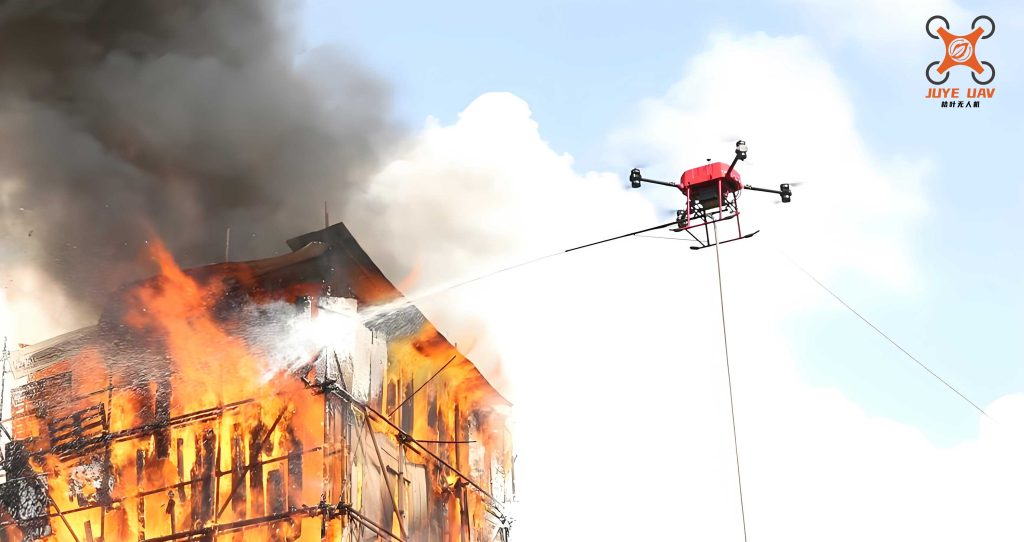
Fire drones, or unmanned aircraft, are operated via radio remote control devices and self-contained programs without onboard pilots. These versatile flying machines can maneuver flexibly through remote control and execute a series of operations via pre-programmed instructions. The benefits of fire drones are multifaceted, but I will focus on their core advantages in the context of firefighting communications. Firstly, safety is a top priority. Despite the variety of fire drone types, all are remotely operated, ensuring that operators remain in secure locations. Fire drones can perform flight missions in diverse terrains or complex environments without endangering human lives. Secondly, portability is a key feature. Fire drones are lightweight and easy to transport, with ongoing technological evolution enhancing their durability. They require minimal space for takeoff and landing, making them ideal for rapid deployment. Thirdly, effectiveness stands out. Fire drone systems can be upgraded or modified as needed, equipped with devices such as cameras, audio recorders, and communication relays to meet real-time capture requirements, significantly improving operational efficiency.
The integration of fire drones with firefighting communications offers distinct advantages that I have observed in practice. To summarize these, I present a table that encapsulates the key benefits:
| Advantage | Description | Impact on Firefighting |
|---|---|---|
| Mobility and Flexibility | Small fire drones typically weigh under 100 kg, operated by 1-2 personnel, with controllable flight speeds and minimal takeoff space requirements. | Enables rapid entry into accident scenes, enhancing response times and adaptability in confined areas. |
| Expansive Field of View | Incorporates data links and broadband technology for wide-angle shooting, with capabilities for multi-point remote sensing data collection and automatic correction. | Facilitates comprehensive scene assessment, even in low-light or obscured conditions, using infrared or thermal imaging. |
| Multi-Channel Video Communication | Supports real-time image transmission via audio-video modules, linking to command systems for multi-angle, all-weather monitoring. | Provides critical data to command centers, improving decision-making and situational awareness across multiple levels. |
From my viewpoint, these advantages underscore why fire drones are indispensable in modern firefighting. For instance, the mobility of fire drones allows them to navigate hazardous environments where human access is limited, while their expansive view compensates for the limitations of ground-based observations. In terms of communication, the multi-channel capabilities ensure that vital information flows seamlessly, supporting coordinated rescue efforts. To quantify the effectiveness of fire drones in coverage, we can use a simple formula for the area covered by a fire drone’s camera or communication relay. Assuming a circular coverage area, the area $$ A $$ is given by:
$$ A = \pi r^2 $$
where $$ r $$ represents the effective radius of the fire drone’s sensors or communication devices. In practice, this radius can be enhanced by deploying multiple fire drones, leading to overlapping coverage areas. The total coverage area $$ A_{\text{total}} $$ for $$ n $$ fire drones can be approximated as:
$$ A_{\text{total}} = n \cdot \pi r^2 – \text{overlap} $$
where the overlap depends on the deployment strategy. This mathematical representation highlights how fire drones can scale to meet the demands of large-scale incidents.
In my analysis, the technical requirements for fire drones in firefighting communications are critical to their successful deployment. Based on operational needs, I have identified several key technical demands that must be met to handle the complex and harsh environments of disaster scenes. First, reliability is paramount. Fire drones must operate reliably under adverse conditions, such as high temperatures, explosive atmospheres, or severe weather, to ensure continuous monitoring and data feedback. This involves robust design to prevent malfunctions or crashes. Second, controllability is essential. Fire drones require sufficient battery life for uninterrupted cruising and precise control over flight altitude, especially in urban settings with high-rise buildings. Third, stability in data transmission is crucial. Fire drones must deliver clear, continuous, and anti-interference video feeds to command systems. Fourth, integration and compatibility are necessary for flexibility. Fire drones should have expandable functionalities to accommodate various payloads and deployment methods. To elaborate, I present a table summarizing these technical requirements:
| Requirement | Description | Technical Indicators |
|---|---|---|
| Reliability | Ability to withstand harsh environments (e.g., heat, explosions) and maintain operational integrity. | Temperature resistance up to $$ T_{\text{max}} = 500^\circ \text{C} $$, impact-resistant materials. |
| Controllability | Precise flight control and extended battery life for sustained missions. | Flight time $$ t \geq 60 \text{ minutes} $$, altitude control accuracy $$ \Delta h \leq 1 \text{ meter} $$. |
| Stability | Consistent and high-quality image transmission without interference. | Video resolution $$ \geq 1080p $$, latency $$ \leq 100 \text{ ms} $$, signal-to-noise ratio $$ \text{SNR} > 20 \text{ dB} $$. |
| Integration | Compatibility with various devices and ease of deployment. | Support for modular payloads (e.g., thermal cameras, communication relays), standard interfaces. |
From my perspective, meeting these technical requirements ensures that fire drones can perform effectively in real-world scenarios. For example, the reliability requirement can be modeled using a failure rate formula. If the probability of a fire drone failing in a given environment is $$ p $$, then the reliability $$ R $$ over $$ n $$ missions is:
$$ R = (1 – p)^n $$
By minimizing $$ p $$ through robust engineering, we enhance the overall reliability of fire drone operations. Similarly, for controllability, the battery life can be expressed in terms of energy consumption. Let $$ E_{\text{total}} $$ be the total battery energy, and $$ P_{\text{flight}} $$ the power consumption during flight. The maximum flight time $$ t_{\text{max}} $$ is:
$$ t_{\text{max}} = \frac{E_{\text{total}}}{P_{\text{flight}}} $$
Optimizing this ratio through efficient power management is key to extending mission durations for fire drones.
In my practice, I have identified several application pathways for fire drones in firefighting communications. These pathways leverage the strengths of fire drones to address specific challenges in rescue operations. First, fire drones play a vital role in commanding on-site rescue efforts. Upon arrival at a disaster scene, firefighting teams need comprehensive situational awareness, including details on casualties, trapped individuals, and accessible routes. Fire drones provide an aerial perspective, enabling real-time monitoring without exposing personnel to risks. For instance, fire drones can survey areas that are inaccessible or too dangerous for humans, transmitting live feeds to command centers. This enhances decision-making and reduces the likelihood of unnecessary injuries. Second, fire drones are instrumental in detecting on-site conditions. Equipped with cameras and sensors, fire drones can collect vast amounts of image data from various altitudes and angles. They can identify key areas, such as hotspots using infrared detectors, and relay this information to ground teams. The data collected by fire drones can be used to generate temperature distribution maps, aiding in fire suppression strategies. To illustrate, the temperature $$ T(x,y) $$ at a point $$ (x,y) $$ can be measured by a fire drone’s thermal imager, and the overall heat map can be integrated to prioritize actions.
Third, fire drones enable real-time tracking of changes in disaster scenes. Given the dynamic nature of emergencies, continuous monitoring is essential. Fire drones offer all-weather and omnidirectional surveillance, allowing command personnel to adjust strategies based on evolving conditions. For example, if a fire spreads rapidly, fire drones can provide updates on its progression, helping to reallocate resources efficiently. The rate of change in a disaster parameter, such as fire spread velocity $$ v_f $$, can be estimated from sequential fire drone images using the formula:
$$ v_f = \frac{\Delta d}{\Delta t} $$
where $$ \Delta d $$ is the change in distance over time interval $$ \Delta t $$. This quantitative analysis supports proactive response. Fourth, fire drones ensure communication effectiveness. In challenging environments like high altitudes or dense smoke, traditional communication methods may falter. Fire drones can serve as communication relays, transmitting voice commands and data with high fidelity. They can carry multiple functional devices, enabling seamless integration of image, audio, and signal transmission. The communication efficiency $$ \eta $$ of a fire drone system can be defined as:
$$ \eta = \frac{B_{\text{effective}}}{B_{\text{total}}} $$
where $$ B_{\text{effective}} $$ is the bandwidth used for successful data transfer and $$ B_{\text{total}} $$ is the total available bandwidth. By optimizing this efficiency, fire drones enhance the reliability of firefighting communications.
To summarize these application pathways, I provide a table that outlines the key roles of fire drones in firefighting communications:
| Application Pathway | Description | Key Functions |
|---|---|---|
| Commanding On-Site Rescue | Providing aerial views for real-time situational awareness and risk reduction. | Live video streaming, scene assessment, route planning. |
| Detecting On-Site Conditions | Collecting data on casualties, hazards, and environmental factors. | Infrared imaging, multi-angle photography, data transmission. |
| Real-Time Change Tracking | Monitoring dynamic changes in disasters to inform strategy adjustments. | Continuous surveillance, progress updates, velocity estimation. |
| Ensuring Communication Effectiveness | Serving as communication relays in challenging environments. | Voice/data transmission, anti-interference features, multi-device integration. |
From my experience, these pathways demonstrate how fire drones can be leveraged to overcome traditional limitations in firefighting. For instance, in a high-rise fire scenario, fire drones can fly to upper floors to assess conditions, while ground teams rely on the transmitted data to plan entry points. The use of fire drones in this context not only improves safety but also accelerates response times. Moreover, the integration of fire drones with existing communication systems, such as command video networks, creates a cohesive operational framework. In terms of scalability, deploying multiple fire drones can form a network that enhances coverage and redundancy. The overall system performance $$ P_{\text{system}} $$ can be modeled as a function of the number of fire drones $$ n $$ and their individual capabilities $$ C_i $$:
$$ P_{\text{system}} = \sum_{i=1}^{n} C_i \cdot f(\text{coordination}) $$
where $$ f(\text{coordination}) $$ represents the synergy factor from coordinated operations. This highlights the importance of strategic deployment in maximizing the benefits of fire drones.
In conclusion, as someone deeply involved in the evolution of firefighting technologies, I believe that fire drones represent a pivotal advancement in enhancing firefighting communications. The rapid development of flight control systems, supporting technologies, and market demand has propelled the widespread adoption of fire drones across various fields. In firefighting, fire drones offer unique advantages such as mobility, expansive views, and reliable communication, effectively addressing longstanding challenges. Through continuous technical improvements and expanded application pathways, fire drones can significantly boost the efficiency and safety of rescue operations. Looking ahead, I anticipate further innovations in fire drone technology, including enhanced autonomy, longer endurance, and better integration with artificial intelligence. By embracing these advancements, we can ensure that firefighting communications become more resilient and effective, ultimately saving more lives and minimizing property damage. The journey of integrating fire drones into firefighting is ongoing, but from my perspective, the progress so far underscores their indispensable role in modern emergency response.
To reinforce the technical aspects, consider the optimization of fire drone deployment. In a typical mission, the goal is to maximize coverage while minimizing resource use. This can be formulated as an optimization problem. Let $$ x_j $$ be a binary variable indicating whether fire drone $$ j $$ is deployed, and $$ y_{ij} $$ represent the coverage of area $$ i $$ by fire drone $$ j $$. The objective is to maximize total coverage:
$$ \text{Maximize} \sum_{i} \sum_{j} y_{ij} $$
subject to constraints such as battery life and communication range. This mathematical approach aligns with the practical need for efficient fire drone utilization. In summary, the application of fire drones in firefighting communications is not just a technological trend but a fundamental shift towards smarter, safer, and more effective rescue operations. As I continue to explore this field, I am confident that fire drones will play an increasingly central role in shaping the future of firefighting.