
Open-pit mining serves as a critical method for coal extraction, with its production capacity holding a significant position domestically. According to relevant statistics from domestic coal institutions, the raw coal output from open-pit mines has gradually expanded from 4.6% in 2003 (0.80 billion tons of open-pit mine raw coal output, total coal output of 17.36 billion tons) to 25.9% in 2021 (10.40 billion tons of open-pit mine raw coal output, total coal output of 41.30 billion tons). Blasting, as one of the primary production processes in open-pit mining, plays a vital role, and the morphological characteristics of the blast pile after rock bench detonation are crucial for production decisions in subsequent steps such as loading, transportation, and disposal.
Currently, many scholars worldwide have conducted systematic analysis and research in various fields, including factors influencing blast pile characteristics, perception of blast pile morphological features, and prediction of blasting effects. However, the existing methods for blast pile information collection in open-pit mines primarily rely on 3D laser scanners. These methods face challenges such as delayed scanning operations, high labor intensity, and blind spots in the scanning field of view, leading to local deviations in blast pile data and hindering subsequent blasting effect evaluation and production decisions. Therefore, this study proposes a perception method for blast pile characteristic information in open-pit mines based on Unmanned Aerial Vehicle (UAV) survey technology to establish a foundation for precise blast pile information collection and accurate blasting effect prediction.
The widespread adoption of drone technology in engineering surveying, due to its strong timeliness, low operational costs, and flexibility, has been validated through numerous studies and experiments. This research leverages UAV survey technology to develop a rapid collection method for high bench, goaf, and blast pile characteristic information. By designing a blast pile characteristic information collection scheme, calculating material volume based on blast pile characteristic models, and conducting fine verification of blast pile reconstruction models, a standardized operational process for blast pile characteristic information collection and analysis is established, achieving real-time, fast, and accurate collection of blast pile characteristic information.
To enhance the feature accuracy of point cloud data in later stages, ground control points need to be deployed around the blast pile area before UAV takeoff for subsequent point cloud data correction. Considering the complexity of blast pile terrain, personnel safety, and signal coverage, a ground control point layout scheme based on the regional network method is proposed, with all points being planar elevation points. The UAV survey scheme is as follows:
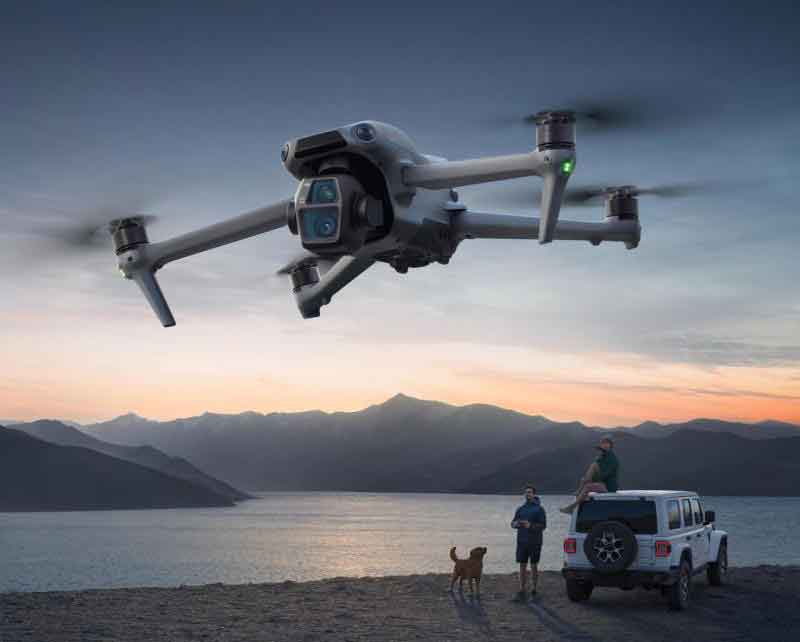
1) Selection of UAV Equipment Model: The performance of the drone significantly determines the accuracy of blast pile data collection. In this study, the DJI M300, currently the best-performing UAV for aerial surveying, is employed. This device has a maximum flight speed of 23 m/s, a maximum ascent speed of 6 m/s, and is equipped with an image sensor with up to 45 million pixels and an accuracy of 3 cm.
2) Flight Altitude Design: To ensure the completeness and reliability of blast pile morphological point cloud data collection, the design of UAV flight altitude is crucial. The average height of the UAV during horizontal flight relative to the cast blasting blast pile area can be expressed by the relation:
$$ H_{hg} = \frac{f \times GSD}{a} $$
where \( H_{hg} \) is the relative flight altitude in meters, \( f \) is the gimbal focal length in mm, \( GSD \) is the blast pile resolution in cm, and \( a \) is the pixel spacing in mm.
3) Image Overlap Design: Reasonable image overlap is essential to ensure the integrity of blast pile morphological features. To reduce the number of UAV flight passes and minimize the workload of later data processing, the image overlap relations are expressed as:
$$ Q_x = \frac{P_x}{L_x} \times 100\% $$
$$ Q_y = \frac{P_y}{L_x} \times 100\% $$
where \( Q_x \) is the longitudinal overlap percentage, \( Q_y \) is the lateral overlap percentage, \( P_x \) is the overlapping length of adjacent images in the flight direction, \( P_y \) is the overlapping length of adjacent images between adjacent flight strips, and \( L_x \) is the total image length.
4) Flight Speed Design: UAV flight speed is a key factor affecting field operation time and blast pile image clarity. Proper planning of flight speed helps improve field operation efficiency and image clarity. The maximum cruise speed of the UAV is calculated as:
$$ v_{max} = \frac{\delta_{max} \times GSD}{t} $$
where \( v_{max} \) is the maximum cruise speed in m/s, \( t \) is the gimbal exposure time in seconds, and \( \delta_{max} \) is the allowable maximum image displacement value.
From March 2023 to March 2024, blast pile characteristic information was collected four times. Compared to previous on-site blast pile information collection, the collection time was reduced by more than 4 hours. Taking the cast blasting in the south as a collection case, based on the specifications of CH/Z 4005-2010 “Low-Altitude Digital Aerial Photography规范,” the UAV flight indicators were calculated and analyzed. The UAV field data indicators are summarized in the following table:
| Parameter | Value |
|---|---|
| Blast Pile Range | 650 m × 200 m |
| Survey Mode | “#”-shaped orthophoto |
| Number of Ground Control Points | 5 |
| Number of Takeoff and Landing Passes | 2 |
| Maximum Flight Speed | 12 m/s |
| Maximum Flight Altitude | 120 m |
| Image Overlap | 70% |
| Number of Collected Images | 470 |
Based on drone technology, the environmental characteristics of the blast area before and after cast blasting implementation are obtained. Before cast blasting, the environmental characteristics of the blast area mainly include the characteristic information of the solid high bench to be blasted, partial coal seam characteristic information, goaf characteristic information, and dump characteristic information. After cast blasting, the environmental characteristic information of the blast area is mainly the blast pile characteristic information.
1) Volume of Blast Area After Cast Blasting: The total volume of the blast area after cast blasting \( V_h \) is mainly composed of the rock volume above the coal seam and the coal seam volume. Based on the blast area characteristic model, a reference plane model for the cast blasting blast area is constructed. Then, using the grid calculation module of professional modeling software, the total volume of the blast area after cast blasting \( V_h \) is calculated.
2) Volume of Blast Area Before Cast Blasting: The blast pile characteristic model contains the coal seam to be mined. To accurately quantify the total volume of blast pile material, a coal seam structure model needs to be constructed. Based on the coal seam structure model, the coal seam volume \( V_m \) and the total volume of the blast area before blasting \( V_q \) are quantified.
3) Volume at the Junction of Blast Pile and Dump: After cast blasting implementation, the blast pile slope merges with the adjacent dump and forms a certain interface according to the natural angle of repose. Then, based on the interface model, the physical volume is quantified.
Based on the blast area characteristic models before and after cast blasting, the goaf structure model, coal seam structure model, and dump interface model, combined with the following equations, key indicators such as the volume of the high bench to be blasted in the cast blasting blast area \( V_1 \), the material volume after blasting \( V_2 \), and the looseness coefficient \( \lambda \) can be calculated. The relations and key indicator parameters are as follows:
$$ V_1 = V_q – V_m $$
$$ V_2 = V_h – V_m – V_L $$
$$ \lambda = \frac{V_2}{V_1} $$
Using drone technology, blast pile information from four cast blasting events was collected. Through the analysis and processing of blast pile characteristics and blast area environmental characteristics, combined with the on-site design parameters of the four cast blasting events, key indicators characterizing the cast blasting effect were calculated. The key indicator parameters of the cast blasting blast pile are summarized in the following table:
| Date | Total Blast Pile Volume (10^4 m³) | Total Bench Volume (10^4 m³) | Coal Seam Volume (10^4 m³) | Upper Layer Volume (10^4 m³) | Looseness Coefficient | Effective Casting Rate (%) | Auxiliary Operation Volume (%) |
|---|---|---|---|---|---|---|---|
| 03-28 | 250.4 | 226.6 | 163.4 | 109.7 | 1.26 | 21.0 | 43.6 |
| 05-10 | 310.2 | 262.7 | 180.8 | 120.0 | 1.18 | 21.8 | 38.7 |
| 06-20 | 239.0 | 178.8 | 152.5 | 84.8 | 1.34 | 21.7 | 35.1 |
| 06-27 | 254.2 | 189.4 | 155.4 | 107.3 | 1.34 | 22.3 | 42.1 |
To verify the accuracy of the blast pile 3D reconstruction model, based on the spatial three-dimensional coordinates of the five deployed ground control points, the mean square error in the plane and the mean square error in elevation are used for error analysis of the blast pile data. The expressions for the mean square error in the plane and the mean square error in elevation are:
$$ m_x = \pm \sqrt{\frac{\sum \Delta x \Delta x}{n}} $$
$$ m_y = \pm \sqrt{\frac{\sum \Delta y \Delta y}{n}} $$
$$ m_z = \pm \sqrt{\frac{\sum \Delta z \Delta z}{n}} $$
$$ m = \pm \sqrt{m_x^2 + m_y^2} $$
where \( m \) is the mean square error in the plane and \( m_z \) is the mean square error in elevation.
According to the relevant provisions of CH/T 9015-2012 “3D Geographic Information Model Data Product规范,” for surveying and mapping results at a scale of 1:500, the requirements for Class I accuracy are that the mean square error in the plane is ≤ 0.3 m and the mean square error in elevation is ≤ 0.5 m. After error analysis of the blast pile reconstruction model, the research results show that the mean square error in the plane of the blast pile reconstruction model is \( m = \pm 0.13 \) m, and the mean square error in elevation is \( m_z = \pm 0.26 \) m, both meeting the requirements of industry standards.
In summary, the application of drone technology in open-pit mine blast pile characterization addresses the limitations of traditional methods, such as delayed scanning operations, high labor intensity, and blind spots in the scanning field of view. The proposed method based on Unmanned Aerial Vehicle survey technology enables rapid, real-time, and accurate collection of blast pile characteristic information. By constructing structural models of high bench characteristics, coal seam characteristics, goaf characteristics, and dump characteristics, a standardized method for calculating material volume is proposed, laying the foundation for accurately obtaining key indicator parameters such as total blast pile material volume, cast volume, and looseness coefficient in cast blasting. Based on the spatial three-dimensional coordinates of deployed ground control points, error analysis of the blast pile reconstruction model using mean square error in the plane and mean square error in elevation shows that the error accuracy meets industry standard requirements. The integration of drone technology into open-pit mining operations enhances the efficiency and precision of blast pile monitoring, contributing to improved production decisions and overall mining productivity. The continuous advancement in UAV capabilities and the increasing adoption of drone-based surveying methods underscore the transformative potential of this technology in the mining industry. Future work may focus on optimizing flight parameters, automating data processing pipelines, and integrating real-time data analysis for dynamic blast pile assessment. The successful implementation of drone technology in this context demonstrates its value as a reliable tool for sustainable and efficient mining practices.