
In the realm of mineral resource development, ensuring efficiency, cost reduction, safety risk management, and extended service life of mining areas is paramount. As practitioners in geological survey, we recognize the critical need to collect, analyze, and evaluate target information, identify potential threats, and optimize mining technical schemes. Drone oblique photogrammetry has emerged as a transformative technology, enabling innovation in data acquisition, analysis, sharing, and application, thereby enhancing the quality of mine geological information. This article delves into the integration of this technology, emphasizing its role in fostering resource-efficient, high-utilization, and eco-friendly mining practices. With the increasing demand for accurate geological data, as highlighted by regulatory bodies, we must continuously leverage technological advancements to improve data interaction and application levels. In this context, drone training becomes essential for mastering these techniques and achieving precision in surveys.
Drone oblique photogrammetry involves capturing multi-angle imagery of target objects using drones equipped with multiple sensors, generating detailed 3D models through software processing. This technology allows for continuous acquisition of external features, accurately describing object morphology and producing valuable survey outcomes. We have observed a growing recognition of its economic and social value, driving innovation in automated image matching and interference mitigation. Guided by industry standards, we have developed a comprehensive technical system based on full elements, addressing challenges such as flight route planning. However, limitations in hardware, image data processing, and data collection cycles persist, necessitating ongoing improvements. Key components include attitude positioning systems and digital surface model generation, which optimize geometric relationships and fill data gaps. For instance, the attitude system uses regional joint adjustment and multi-view image matching to enhance accuracy, expressed mathematically as:
$$ \Delta P = \sum_{i=1}^{n} (x_i – \bar{x})^2 / n $$
where \(\Delta P\) represents positional error, \(x_i\) denotes measured points, and \(\bar{x}\) is the mean value. Through drone training, technicians learn to implement these systems effectively, ensuring robust survey outcomes.
| Aspect | Traditional Drone Low-Altitude Remote Sensing | Drone Oblique Photogrammetry |
|---|---|---|
| Flight Stability | Poor stability, large旋偏角 | High stability with multi-sensor integration |
| Image Acquisition | Limited perspectives, small base-height ratio | Multiple angles (vertical and倾斜), rich data |
| Data Output | 2D digital images with extraction challenges | 3D models with清晰纹理 and spatial info |
| Application Scope | Suitable for basic monitoring | Ideal for high-precision mine surveys |
| Drone Training Needs | Moderate, focused on basic operations | Extensive, covering advanced processing and analysis |
The advantages of drone oblique photogrammetry are multifaceted. Compared to traditional methods, it overcomes issues like poor flight attitude and small像幅, delivering superior resolution and adaptability for high-standard surveys. By deploying multiple sensors, drones capture comprehensive ground object information, facilitating 3D modeling that vividly represents features. The technical system comprises modules such as attitude positioning and digital surface modeling, which work synergistically. For example, the digital surface model integrates外方位 elements to reconstruct terrain, using parallel algorithms to address blind spots. This can be modeled as:
$$ z = f(x, y) + \epsilon $$
where \(z\) is the elevation, \(f\) denotes the surface function, and \(\epsilon\) accounts for errors minimized through drone training. Regular drone training sessions help teams understand these mathematical foundations, enhancing data integrity and application.
In applying drone oblique photogrammetry to mine geological surveys, we emphasize proactive methodologies aligned with technical principles. This involves optimizing workflows, refining control point layouts, and boosting aerial photography capabilities. First, we design image control point schemes and flight plans, ensuring drones follow precise航线 to mark coordinates and acquire影像 data. Parameters like payload, endurance, speed, and wind resistance are configured manually and automatically, as summarized in the table below.
| Parameter | Typical Range | Importance for Drone Training |
|---|---|---|
| Standard Payload (kg) | 2-10 | Ensures sensor compatibility and flight balance |
| Endurance Time (hours) | 1-4 | Affects survey coverage and planning |
| Flight Speed (m/s) | 5-15 | Impacts image overlap and quality |
| Wind Resistance Level | Up to 12 m/s | Crucial for safe operations in rugged terrains |
| Camera Resolution | 1.2亿像素 or higher | Determines detail capture for 3D modeling |
Second, we focus on外业像控点布设方案. Scientific layout of image control points is vital for data accuracy and image quality. Points should be placed in清晰识别 locations, avoiding shadows and signal interference. We optimize distribution density, ensuring uniformity at corners, and conduct preliminary tests to eliminate干扰点. The coordinate systems—plane, spatial, and object-space—are selected based on survey needs, with transformations applied via automated extraction and matching. Drone training programs often simulate these scenarios, teaching technicians to handle coordinate conversions using formulas like:
$$ X’ = R \cdot X + T $$
where \(X’\) is the transformed coordinate, \(R\) is the rotation matrix, and \(T\) is the translation vector. By enhancing control point precision through comparative analysis, we reduce errors. Software tools enable automated精度 checks, allowing adjustments via point addition or deletion. For instance, in a有色金属矿区 case, we used a DJI M30 drone with a PSDK102S five-lens camera and 35mm定焦 lenses to survey 2.8 km², acquiring 3570 images over 2 hours. Post-acquisition, we剔除不合格影像, ensuring high-quality input for 1:1000 map revision. This underscores the importance of drone training in equipment selection and data筛选.
Third, improving drone aerial photography acquisition能力 involves meticulous planning of drone models, cameras, lenses, and flight routes. We consider factors like airspace, area size, and climate to eliminate technical gaps. The aforementioned case illustrates how tailored drone training prepares teams for such challenges, emphasizing flight planning software and仿地飞行 modes. The影像获取 process can be quantified using the overlap ratio formula:
$$ O = \frac{A_{\text{overlap}}}{A_{\text{total}}} \times 100\% $$
where \(O\) is the overlap percentage, critical for seamless 3D reconstruction. Drone training modules cover these calculations, ensuring optimal flight patterns.
When utilizing drone oblique photogrammetry, we must integrate and analyze measurement data comprehensively, building 3D models for complete representation. Three primary modeling methods exist: CAD-based, laser scanning, and 3D component-based automatic modeling. CAD techniques import data for differential processing, creating立体 models that replicate object features. Laser scanning uses onboard scanners to generate models, while component-based methods enable integrated data handling for精细表达. To address正射影像 limitations, we leverage倾斜摄影 to consolidate single-image measurements, assigning textures to different object facets. For单体 models, texture mapping outputs individual地物 models; for non-single models, joint adjustment automates texture generation. Drone training often includes hands-on exercises with these software tools, fostering proficiency in model construction.
Accuracy analysis of 3D modeling is crucial as survey demands increase. We compute errors for various地物点 types, such as点位中误差 and间距中误差, using formulas like:
$$ \sigma = \sqrt{\frac{\sum_{i=1}^{n} (d_i – \bar{d})^2}{n}} $$
where \(\sigma\) is the standard deviation of errors, \(d_i\) denotes differences between measured and model coordinates, and \(\bar{d}\) is the mean. By剔除畸变数据 and verifying精度配准, we refine models to meet technical standards. In practice, we use platforms like PixelGrid for影像处理, constructing stereo models to reduce判读难度. With AutoCAD CASS modules, we edit data into DLG formats, following “internal positioning, external定性” principles. For unclear objects, supplemental field surveys ensure completeness. Drone training emphasizes these post-processing steps, teaching technicians to conduct图廓修饰 and属性标记 for informative outputs.
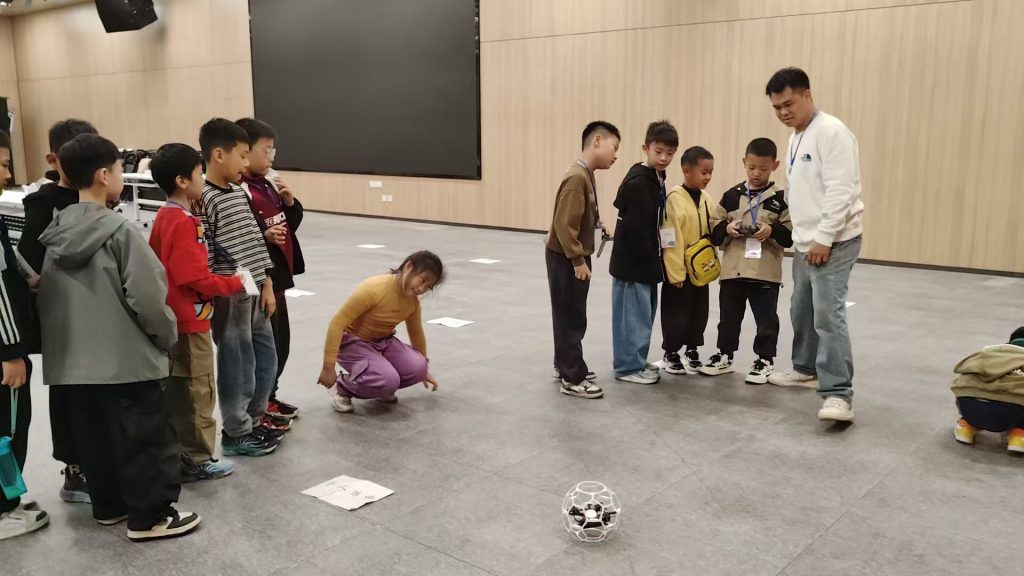
A cornerstone of successful implementation is comprehensive drone training for technical personnel. Given the complexity of mine geological surveys, we prioritize building skilled teams through expert-led sessions and thematic workshops. These programs cover survey theories, standards, and technologies like GPS, total stations, and laser rangefinders, integrating them with drone operations. To address精度差 issues, we organize practical competitions that simulate real surveys, reinforcing规范 application and error reduction. Drone training not only enhances technical prowess but also cultivates a工匠精神, motivating continuous learning. Key training components include flight planning, data analysis, and safety management, as outlined below.
| Module | Content | Outcome |
|---|---|---|
| Flight Operations | Drone piloting, route optimization, risk assessment | Safe and efficient data acquisition |
| Data Processing | Image matching, 3D modeling, error correction | High-precision geological models |
| Software Proficiency | CAD, PixelGrid, AutoCAD CASS tools | Streamlined workflow integration |
| Field Application | Control point布设, supplemental surveys | Adaptability to terrain challenges |
| Continuous Learning | Updates on regulations and tech advancements | Sustained competency and innovation |
Through iterative drone training, we empower technicians to handle large-scale projects, from planning to execution, ensuring data accuracy and operational efficiency. This human resource development transforms into a precision advantage, directly impacting survey quality. Moreover, drone training fosters a culture of collaboration, where teams share insights on overcoming obstacles like signal interference or harsh weather, further refining methodologies.
In conclusion, the application of drone oblique photogrammetry in mine geological surveys significantly boosts information acquisition capabilities, supporting activities like planning, ecological restoration, and disaster response. From a practical standpoint, we advocate for continuous innovation in technical approaches, guided by an understanding of principles and advantages. By refining workflows, enhancing control point strategies, and investing in drone training, we can achieve高效 and high-quality survey outcomes. The future lies in integrating emerging technologies with robust training programs, ensuring that drone oblique photogrammetry remains a cornerstone of sustainable mining practices. As we advance, ongoing drone training will be pivotal in navigating evolving challenges and maximizing the potential of this transformative technology.