
In recent years, the integration of unmanned aerial vehicles (UAVs) into surveying and mapping has revolutionized various industries, including power engineering. As a professional engaged in this field, I have extensively utilized DJI drones for power engineering measurements, such as site surveys for substations and transmission line routing. The DJI drone, with its advanced global navigation satellite system (GNSS) and position and orientation system (POS) capabilities, offers a cost-effective and efficient solution for low-altitude aerial photography. This article shares my first-hand experience in designing workflows, addressing key challenges, and implementing quality control methods for using DJI drones in power engineering projects. The focus is on practical applications, from data acquisition to processing, highlighting how DJI drones can enhance accuracy and reduce operational costs.
The design of a UAV-based aerial survey system for power engineering requires careful consideration of both hardware and software components. Based on my experience, the system typically includes a DJI drone platform—such as the DJI Phantom or Mavic series—equipped with a high-resolution camera, a flight control platform like DJI GS Pro or custom software, and a data processing workstation. The software suite involves camera calibration tools, flight planning applications, aerial triangulation software, and data collection platforms. For power engineering, low-altitude photography is essential, with relative flying heights ranging from 100 to 800 meters to capture detailed terrain features. The DJI drone’s stability and reliability make it suitable for such tasks, but a safety应急预案 must be in place to handle unexpected events. In my workflow, I prioritize hardware selection based on project needs—for instance, choosing a DJI drone with longer flight time for extensive transmission line surveys—and develop a quality control plan that includes checks on equipment functionality, image quality, and data accuracy. The overall process can be summarized in a flowchart, but here, I emphasize the iterative nature of planning, execution, and validation.
To illustrate the hardware and software considerations, I often refer to the following table that compares different DJI drone models and their suitability for power engineering surveys:
| DJI Drone Model | Maximum Flight Time | Camera Resolution | Recommended Use Case |
|---|---|---|---|
| DJI Phantom 4 Pro | 30 minutes | 20 MP | Small to medium site surveys |
| DJI Mavic 2 Pro | 31 minutes | 20 MP | Portable transmission line inspections |
| DJI Matrice 300 RTK | 55 minutes | Various payloads | Large-scale power plant mapping |
In addition to hardware, software selection is critical. I typically use flight control software that allows for flexible route planning, such as custom applications integrating Google Satellite imagery, to set parameters like ground sample distance (GSD) and overlap. For data processing, software like Pix4D or ContextCapture is employed for aerial triangulation and generating digital surface models (DSM) and digital orthophoto maps (DOM). The integration of these components ensures that the DJI drone can produce high-quality data for subsequent surveying tasks.
When deploying a DJI drone for power engineering measurements, several key issues must be addressed to ensure data accuracy and efficiency. First, route planning is a fundamental challenge. While DJI GS Pro offers basic functionality, I have found that custom software solutions provide greater flexibility. For example, by accessing real-time satellite maps, I can design flight paths that optimize coverage for irregularly shaped areas, such as transmission line corridors. The algorithm should automatically generate waypoints based on user-defined parameters like flight altitude and image overlap. This is crucial for maximizing the DJI drone’s battery life and ensuring complete data capture. In my projects, I use a formula to calculate the required overlap based on terrain complexity: $$ \text{Overlap} = \frac{\text{Base}}{\text{Height}} \times 100\% $$ where Base is the distance between consecutive images and Height is the flying altitude. This helps in adjusting the DJI drone’s flight plan to meet specific project needs.
Second, camera calibration is essential due to the use of non-metric cameras on DJI drones. The lens distortion can introduce errors in image geometry, affecting the accuracy of photogrammetric outputs. I apply a calibration model that includes radial, tangential, and eccentric distortion parameters. The mathematical representation, which I frequently use in processing, is given by:
$$ \Delta x = (x – x_0)(k_1 r^2 + k_2 r^4 + k_3 r^6) + p_1 [r^2 + 2(x – x_0)^2] + 2p_2 (x – x_0)(y – y_0) + m_1 (x – x_0) + m_2 (y – y_0) $$
$$ \Delta y = (y – y_0)(k_1 r^2 + k_2 r^4 + k_3 r^6) + p_2 [r^2 + 2(y – y_0)^2] + 2p_1 (x – x_0)(y – y_0) + m_1 (x – x_0) + m_2 (y – y_0) $$
where \( (x_0, y_0) \) is the principal point, \( f \) is the focal length, \( k_i \) are radial distortion coefficients, \( p_i \) are tangential distortion coefficients, \( m_i \) are decentering distortion coefficients, and \( r = \sqrt{(x – x_0)^2 + (y – y_0)^2} \). I typically perform this calibration using a test field method before each major project to ensure the DJI drone’s camera parameters are accurately determined.
Third, the design of ground control points (GCPs) significantly impacts the precision of aerial triangulation. For power engineering surveys, I follow a strategy that balances efficiency and accuracy. In transmission line projects, I place GCPs at regular intervals along the corridor, with additional points at corners to strengthen the network. A common approach involves using pairs of points spaced every 10-15 baselines, as shown in the table below for a typical DJI drone survey:
| Project Type | GCP Distribution | Recommended Spacing | Accuracy Improvement |
|---|---|---|---|
| Substation Site | Uniform grid | 50-100 meters | High for detailed mapping |
| Transmission Line | Linear pairs | 800 meters apart | Moderate for long corridors |
Fourth, aerial triangulation processing requires robust software to handle the large volumes of imagery from DJI drones. I prefer using bundle adjustment techniques that incorporate the calibrated camera parameters. The error minimization can be expressed as: $$ \min \sum_{i=1}^{n} \left\| \mathbf{x}_i – \mathbf{P}_i \mathbf{X} \right\|^2 $$ where \( \mathbf{x}_i \) are image coordinates, \( \mathbf{P}_i \) are projection matrices, and \( \mathbf{X} \) are object space coordinates. Software like Pix4D automates this process, generating dense point clouds, DSM, and DOM. However, I always validate the results by comparing with independent check points to ensure the DJI drone data meets project specifications.
Fifth, data interoperability between different software platforms is a practical hurdle. For instance, when exporting results from Pix4D to a stereoplotting tool like Bentley ContextCapture, I develop custom scripts to convert data formats. This ensures seamless integration for tasks like digital line graph (DLG) extraction or 3D modeling. In my experience, this step is crucial for leveraging the full potential of DJI drone outputs in power engineering applications.
Quality control is paramount throughout the DJI drone survey process. I implement a multi-stage checking protocol that begins with pre-flight inspections of the DJI drone and camera hardware. During flight, I monitor image quality in real-time, assessing factors like cloud cover, blurriness, and overlap compliance. Post-flight, I conduct a thorough analysis of the aerial triangulation results, focusing on residual errors and model consistency. The accuracy assessment often involves statistical measures, such as root mean square error (RMSE), calculated as: $$ \text{RMSE} = \sqrt{\frac{1}{n} \sum_{i=1}^{n} (d_i – \hat{d}_i)^2} $$ where \( d_i \) are observed values and \( \hat{d}_i \) are predicted values from the DJI drone data. For example, in a recent project, the RMSE for horizontal coordinates was within ±0.3 meters, which is acceptable for 1:1000 scale mapping. I document all findings in a quality report to ensure traceability and compliance with industry standards.
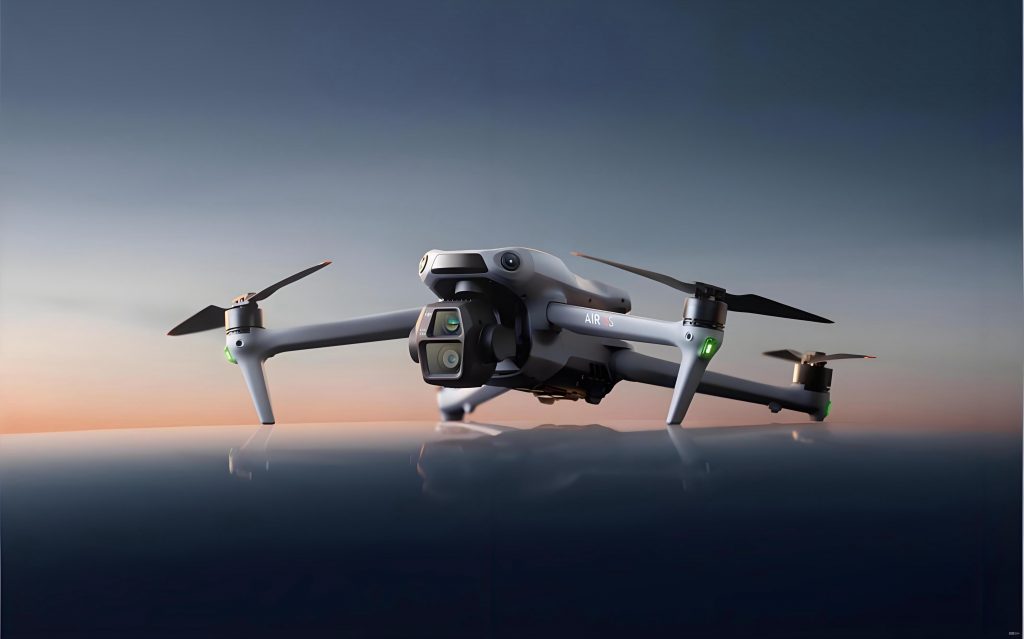
In practical applications, the DJI drone has proven invaluable for power engineering surveys. For instance, in a transmission line project spanning mountainous terrain, I deployed a DJI Phantom 4 Pro to capture imagery over an 8-kilometer corridor. The DJI drone was flown at a relative altitude of 400 meters, with 70% forward overlap and 65% side overlap, achieving a GSD of 0.12 meters. We divided the area into six flight zones to account for battery limitations, each session lasting about 18 minutes. Ground control points were placed at strategic locations, and after processing with Pix4D, we generated accurate DSM and DOM. The data was then used for route optimization and cross-section profiling in stereoplotting software. The results showed that elevation errors were within 0.2 meters, and field verification confirmed the suitability for construction staking. This case underscores how the DJI drone can streamline surveying tasks, even in challenging environments.
Another application involves substation site mapping, where high-resolution data is needed for detailed design. Here, the DJI drone’s ability to fly at lower altitudes allows for capturing fine details, such as equipment layouts and terrain contours. I often use the DJI drone to create 3D models that facilitate virtual site inspections, reducing the need for physical visits. The integration of DJI drone data with building information modeling (BIM) systems further enhances project planning and management. In all cases, the key is to tailor the DJI drone’s flight parameters and processing workflows to the specific requirements of power engineering.
Despite its advantages, the DJI drone has limitations. Compared to traditional manned aircraft with wide-format cameras, the DJI drone’s shorter flight time and smaller sensor size can restrict its use in large-area surveys. However, for localized tasks like transmission line rerouting or small-scale topographic mapping, the DJI drone offers a compelling alternative. In my view, the future of DJI drones in power engineering lies in advancements in autonomy, such as AI-based route planning and real-time data processing. Additionally, the integration of real-time kinematic (RTK) modules on DJI drones can further improve positional accuracy, minimizing the need for ground control points.
To summarize, the DJI drone is a versatile tool for power engineering surveying, enabling efficient data collection and processing. Through careful design, addressing key technical issues, and rigorous quality control, I have successfully applied DJI drones to various projects, from transmission lines to substations. The use of formulas and tables, as discussed, helps in optimizing workflows and ensuring data integrity. As technology evolves, I anticipate that DJI drones will become even more integral to the power industry, offering enhanced capabilities for monitoring, maintenance, and design. Ultimately, the DJI drone represents a significant step forward in making aerial surveying more accessible and cost-effective for engineering applications.
In conclusion, my experience with DJI drones in power engineering has been overwhelmingly positive. The ability to quickly deploy a DJI drone for aerial surveys saves time and resources, while the data quality meets the stringent demands of engineering projects. By sharing these insights, I hope to encourage further adoption and innovation in the use of DJI drones for surveying tasks. The key is to continuously refine methods, leverage advanced software, and adhere to best practices in quality assurance. With proper implementation, the DJI drone can significantly contribute to the accuracy and efficiency of power engineering measurements, paving the way for smarter infrastructure development.