
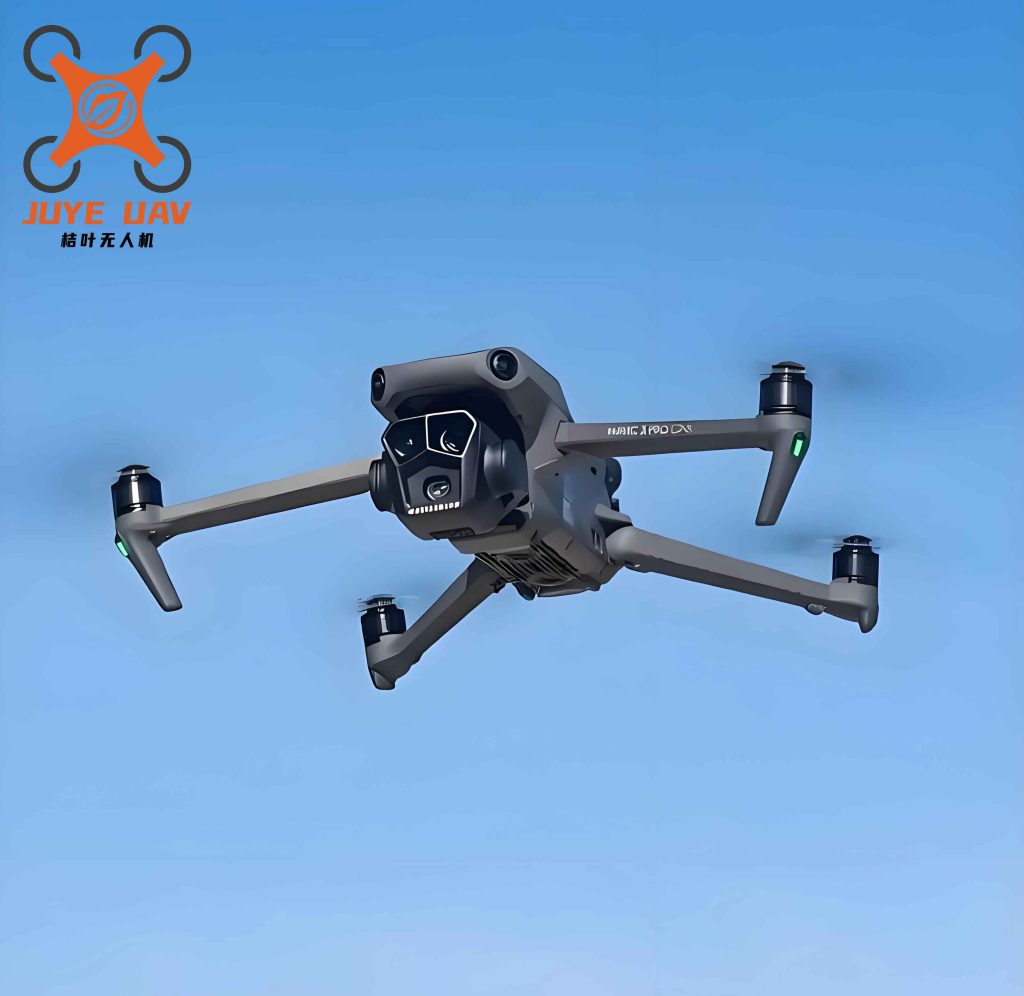
In modern civil engineering and water conservancy projects, accurate estimation of earthwork volume is critical for cost control, construction scheduling, and resource allocation. Traditional methods using total stations or GNSS-RTK to collect discrete elevation points are time-consuming and labor-intensive, especially over large areas. With the rapid advancement of unmanned aerial vehicle (UAV) technology, China drone photogrammetry has become a powerful tool for acquiring high-resolution topographic data. In this study, I utilized a China drone equipped with a high-precision GNSS receiver and a camera system to capture aerial images. The onboard positioning and orientation system (POS) provided direct georeferencing, enabling camera-free image orientation. The digital surface model (DSM) generated from the China drone imagery was then used to compute earthwork volumes via the triangulated irregular network (TIN) method. This paper presents the methodology, experimental results, and accuracy analysis based on a dredging project in a large irrigation district in northern China.
The entire workflow of applying China drone photogrammetry to earthwork calculation involves three main steps: (1) acquisition of aerial images with a China drone and generation of DSM; (2) extraction of elevation points from DSM and construction of TIN; (3) computation of earthwork volume based on TIN differencing. I focus on the influence of sampling interval and the addition of terrain feature points on the accuracy of volume calculation.
1. Methodology of TIN-Based Earthwork Volume Calculation
1.1 Construction of Triangulated Irregular Network (TIN)
A TIN represents the terrain surface by connecting irregularly spaced elevation points into a network of non-overlapping triangles. The Delaunay triangulation algorithm is commonly used. The procedure is as follows:
- Select the point closest to the centroid of the region as the first point, then find its nearest neighbor as the second point to form the initial baseline.
- Search for the third point on the right-hand side of the directed baseline using the orientation criterion:
$$ (y – y_1)(x_2 – x_1) – (x – x_1)(y_2 – y_1) < 0 $$
where \((x_1, y_1)\) and \((x_2, y_2)\) are the endpoints of the baseline, and \((x, y)\) is the candidate point. - Use the two new edges of the triangle as new baselines and repeat the search until no more points can be connected.
- Apply the empty circumcircle criterion or minimum angle maximization to ensure optimal triangle shape.
The resulting TIN closely approximates the actual terrain surface, especially when terrain feature points (e.g., ridge lines, break lines) are incorporated.
1.2 Earthwork Volume Calculation Using TIN
After constructing the TIN for both the pre-construction and post-construction surfaces, the volume between them is computed by summing the volumes of all triangular prisms. For each triangle with vertices \(A, B, C\) on the actual surface, the corresponding points on the design surface (or reference surface) are projected vertically. The volume of a single triangular prism is given by:
$$ V = \frac{1}{3} \left[ (h_1 – h) + (h_2 – h) + (h_3 – h) \right] \times S $$
where \(h_1, h_2, h_3\) are the elevations of the triangle vertices on the actual surface, \(h\) is the design elevation, and \(S\) is the area of the triangle projected onto the horizontal plane. The total earthwork volume is the sum of all such prism volumes.
2. Experimental Setup and Data Acquisition
The study area was a dredging site (approximately 110 m long and 80 m wide) located in an irrigation district project. I used a China drone model DJI M300 RTK equipped with a Zenmuse P1 camera. Flight parameters were set as follows:
| Parameter | Value |
|---|---|
| Flight altitude | 100 m |
| Forward overlap | 80% |
| Side overlap | 70% |
| Camera | Zenmuse P1 (45 MP full-frame) |
| Shooting mode | Intelligent swing (5-direction oblique) |
| RTK positioning | Real-time kinematic (base station network) |
After flight, I imported all images into the processing software (DJI Terra). The POS data from the China drone included geographic coordinates (latitude, longitude, ellipsoidal height) and attitude angles. Using seven-parameter transformation, I converted these to local Cartesian coordinates (Northings, Eastings, orthometric height). Table 2 shows a sample of the POS data after transformation.
| Image ID | Northing (m) | Easting (m) | Elevation (m) | Yaw (°) | Pitch (°) | Roll (°) |
|---|---|---|---|---|---|---|
| 100-0001 | 4,010,318.797 | 415,994.129 | 141.845 | -153.7 | -90 | 0 |
| 100-0002 | 4,010,307.658 | 415,989.436 | 141.885 | -158.4 | -90 | 0 |
| 100-0003 | 4,010,289.038 | 415,982.069 | 141.835 | -159.5 | -90 | 0 |
| 100-0004 | 4,010,270.808 | 415,974.907 | 141.825 | -159.3 | -90 | 0 |
| 100-0005 | 4,010,252.342 | 415,967.672 | 141.856 | -159.2 | -90 | 0 |
| 100-0006 | 4,010,234.207 | 415,960.553 | 141.846 | -159.2 | -90 | 0 |
| 100-0007 | 4,010,215.654 | 415,953.281 | 141.846 | -159.2 | -90 | 0 |
The DSM generated by the China drone had a ground sample distance (GSD) of approximately 2.5 cm. I then used the civil engineering software CASS 11 to extract elevation points from the DSM at different sampling intervals. Points along the boundary of the spoil area were also extracted. Before constructing the TIN, I removed noisy points caused by vegetation or temporary equipment, verified by field RTK checks.
3. Accuracy Analysis and Results
3.1 Effect of Sampling Interval
To investigate the influence of sampling density, I generated TINs using elevation points extracted at intervals of 30 m, 20 m, 15 m, 10 m, 5 m, and 2.5 m. The design elevation was set to 42 m. The volume computed with a 1 m interval (the densest) was taken as the reference value: \(V_{ref} = 50,442.4\ \text{m}^3\). Table 3 presents the results.
| Sampling Interval (m) | Number of Triangles | Calculated Volume (m³) | Difference from Reference (m³) | Relative Error (%) |
|---|---|---|---|---|
| 30 | 58 | 42,273.4 | -8,169.0 | -16.19 |
| 20 | 99 | 44,608.6 | -5,833.8 | -11.57 |
| 15 | 164 | 49,219.8 | -1,222.6 | -2.42 |
| 10 | 346 | 49,578.5 | -863.9 | -1.71 |
| 5 | 1,215 | 50,258.7 | -183.7 | -0.36 |
| 2.5 | 4,547 | 50,424.1 | -18.3 | -0.036 |
As shown, decreasing the sampling interval increases the number of triangles and improves accuracy. However, computational time grows exponentially, making very fine intervals impractical for routine work.
3.2 Effect of Adding Terrain Feature Points
In the same spoil area, obvious terrain breaks existed at the top and bottom edges. I digitized these break lines in the DSM and extracted elevation points along them. The same sampling intervals were then used for interior points, but the feature points were always included. Table 4 summarizes the results.
| Sampling Interval (m) | Number of Triangles | Calculated Volume (m³) | Difference from Reference (m³) | Relative Error (%) |
|---|---|---|---|---|
| 30 | 92 | 52,066.8 | +1,624.4 | +3.22 |
| 20 | 146 | 51,524.0 | +1,081.6 | +2.14 |
| 15 | 222 | 51,420.3 | +977.9 | +1.94 |
| 10 | 441 | 50,969.5 | +527.1 | +1.04 |
| 5 | 1,403 | 50,561.2 | +118.8 | +0.236 |
| 2.5 | 4,895 | 50,467.3 | +24.9 | +0.049 |
Comparing Table 3 and Table 4, it is evident that incorporating terrain feature points significantly improves accuracy at all sampling intervals. For example, at 15 m interval, the relative error dropped from -2.42% to +1.94% (absolute error reduction). The improvement is more pronounced at coarser intervals, as feature points help capture critical topographic variations that uniform sampling misses.
4. Discussion
Several factors affect the quality of earthwork volume calculation using China drone derived DSMs:
- Point cloud noise: Vegetation, construction equipment, and water bodies can introduce non-ground points. Careful filtering and field verification are necessary. In this study, I used manual editing and RTK checkpoints to remove outliers.
- Coordinate transformation: The China drone POS data are in WGS84 ellipsoidal heights. A rigorous seven-parameter transformation to local grid coordinates and orthometric heights is essential. Inaccurate transformation can lead to systematic elevation biases.
- Sampling strategy: Uniform grid sampling is simple but may miss important terrain features. Adding break lines or feature points is highly recommended, especially when large flat areas or steep slopes exist.
- Computational efficiency: Although denser sampling gives higher accuracy, the TIN construction time and memory usage increase quadratically. A balance between accuracy and processing time should be struck. In practice, a sampling interval of 5 m with feature points yields errors below 0.5%, which is acceptable for most engineering projects.
The China drone technology used in this study provided centimeter-level accuracy without ground control points. The combination of RTK positioning and high-resolution imagery enables rapid mapping of large areas. The resulting DSM can be directly used for volume calculations, reducing field work by 70% compared to traditional methods.
5. Conclusions
Based on the experiments, I draw the following conclusions:
- The China drone photogrammetry approach can generate high-precision DSMs that are suitable for earthwork volume calculation using the TIN method. The overall accuracy depends on sampling density and the representation of terrain features.
- Reducing the sampling interval improves accuracy, but at the cost of increased computation. A sampling interval of 2.5 m yields errors below 0.05% but requires processing of thousands of triangles. For typical projects, 5 m to 10 m intervals are a good compromise.
- Adding terrain feature points (such as break lines and ridge lines) to the TIN construction significantly enhances volume accuracy, especially when the sampling interval is large. The relative error can be reduced by several percentage points.
- Before constructing the TIN, it is crucial to remove noise points from the DSM. Field RTK checks should be performed in areas with heavy vegetation or occlusions to ensure data quality.
- The China drone based method greatly improves efficiency and reduces labor costs, making it an ideal tool for earthwork management in large-scale construction and irrigation projects.
In summary, the integration of China drone photogrammetry with TIN-based volume calculation provides a fast, accurate, and cost-effective solution for earthwork estimation. Future research could explore automated feature line extraction and real-time volume monitoring using drone swarm technology.