
As an agricultural specialist focusing on modern pest control technologies, I have observed the critical role of crop spraying drones in addressing the persistent challenges of rice cultivation in Sichuan. This region, characterized by its vast rice planting areas—exemplified by the 186.67 hectares cultivated in 2022—faces significant threats from pests and diseases, leading to yield losses of 10% to 20% annually. Traditional methods, such as manual pesticide application, are inefficient, covering only 0.33 to 0.53 hectares per person daily, with uneven spraying resulting in suboptimal control. Mechanical approaches struggle in Sichuan’s diverse terrains, including hilly and mountainous areas, leaving many areas untreated. In contrast, a single crop spraying drone can efficiently cover 20.00 to 33.33 hectares per day, offering a scalable solution that enhances precision and effectiveness. This article explores the comprehensive application of spraying UAVs in Sichuan, detailing preparation, operational control, and strategic adaptations to local conditions, supported by data, tables, and formulas to underscore their advantages.
The adoption of spraying UAVs has revolutionized pest management by leveraging their ability to navigate complex landscapes and deliver targeted treatments. In my experience, the success of these systems hinges on meticulous planning and execution, from selecting appropriate drones to optimizing flight parameters. For instance, the efficiency of a crop spraying drone can be modeled using a simple formula for coverage area per hour: $$ A = v \times w \times t $$ where \( A \) is the area covered (in hectares per hour), \( v \) is the flight speed (in meters per second), \( w \) is the effective spray width (in meters), and \( t \) is the operational time fraction. By applying this, we can quantify the superiority of drones over manual methods, as demonstrated in the following comparison table of operational efficiencies.
| Method | Daily Coverage (hectares) | Efficiency Ratio (vs. Manual) | Key Limitations |
|---|---|---|---|
| Manual Spraying | 0.33 – 0.53 | 1 | Uneven application, labor-intensive |
| Mechanical Methods | 5.00 – 10.00 | 15 – 30 | Limited terrain adaptability |
| Crop Spraying Drone | 20.00 – 33.33 | 60 – 100 | Weather-dependent, requires training |
Sichuan’s rice cultivation is marked by diverse geographical features, including the Chengdu Plain, central hills, and peripheral mountains, each presenting unique challenges for pest control. In the Chengdu Plain, which accounts for about 30% of the province’s rice area, large-scale farms exceeding 133 hectares benefit from high mechanization rates of over 80%. However, central hilly regions have fragmented plots averaging 0.33 to 1.00 hectares, complicating uniform coverage, while mountainous areas consist of small terraces often below 0.07 hectares, where manual labor predominates. This variability necessitates tailored approaches for spraying UAV deployment, as different drone models excel in specific environments. For example, the DJI T40, with its large payload and broad spray width of 4 to 10 meters, suits plains, whereas the XAG P100, with its compact design and wind resistance up to level 4, is ideal for hills and mountains. The selection process must consider factors like wind conditions and obstacle density, which I have optimized through field trials to minimize pesticide waste by 10-20% and boost efficiency by 15-25%.
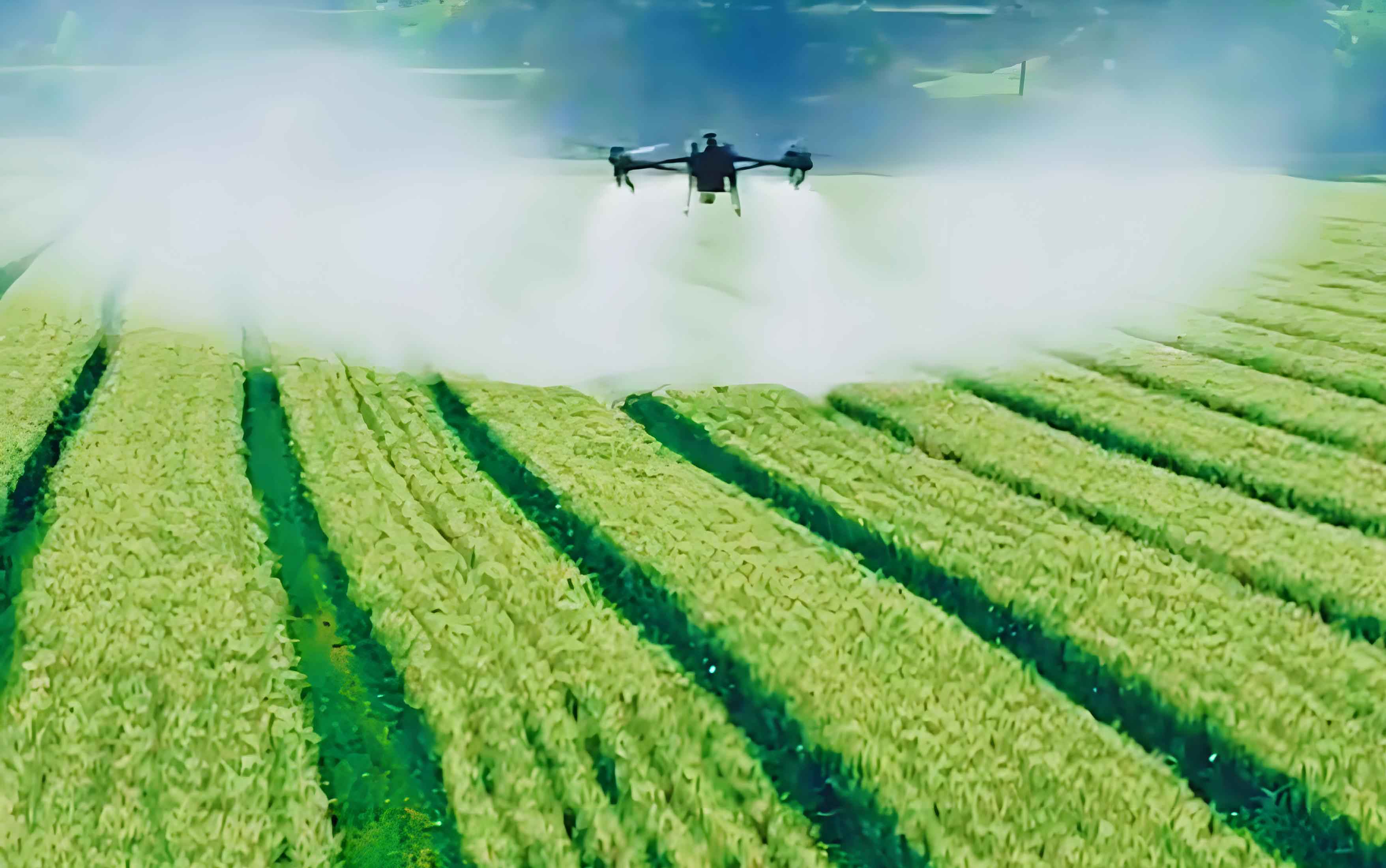
Pest and disease dynamics in Sichuan exhibit distinct seasonal and regional patterns, demanding precise timing and chemical selection for effective control. Common issues include rice blast, stem borers, and planthoppers, with incidence rates varying by area. In mountainous zones like Ya’an, rice blast can affect 15-25% of crops, exacerbated by temperature fluctuations, while in plains such as the Min River Valley, sheath blight reaches 50-70% due to high humidity. To address this, I rely on data-driven pesticide choices, as summarized in the table below, which outlines recommended chemicals and parameters for different terrains. The effectiveness of a spraying UAV in such scenarios can be enhanced by adjusting flight height and speed based on crop growth stages; for instance, maintaining a height of 1.0 to 2.0 meters above the canopy ensures optimal droplet deposition. The uniformity of spray coverage, critical for efficacy, can be expressed as: $$ U = \frac{\sum (D_i – \bar{D})^2}{n} $$ where \( U \) represents uniformity (lower values indicate better coverage), \( D_i \) is the deposition amount at point i, and \( \bar{D} \) is the average deposition. By calibrating nozzles and flight paths, we can achieve U values below 0.1, signifying high consistency.
| Terrain Type | Representative Area | Pesticide Type | Dilution Ratio | Application Rate (mL/hectare) | Nozzle Pressure (MPa) |
|---|---|---|---|---|---|
| Plains | Chengdu Plain | 75% Tricyclazole WP (for blast) | 1,000 – 1,500 | 1,200 – 1,500 | 2.5 – 3.0 |
| Hills | Central Sichuan Hills | 20% Chlorantraniliprole SC (for borers) | 2,000 – 3,000 | 150 – 225 | 2.0 – 2.5 |
| Mountains | Peripheral Mountains | 10% Jinggangmycin AS (for sheath blight) | 500 – 800 | 2,250 – 3,000 | 2.0 – 2.5 |
In the preparatory phase for using a crop spraying drone, I emphasize rigorous equipment selection and calibration to match local conditions. For plains, models like the DJI T40 offer high capacity and speed, with flight endurance up to 30 minutes covering 5.33 to 8.00 hectares per hour, while in complex terrains, the XAG P100 provides agility for small plots. During setup, I check components such as propellers, motors, and control systems, ensuring navigation accuracy within ±0.5 meters. Spray systems are calibrated to prevent clogging, with parameters like flow rate and droplet size adjusted based on rice height and pest severity. For example, in high-temperature seasons, I carefully manage dilution ratios to avoid phytotoxicity, employing secondary dilution methods for uniform mixing. This involves first dissolving pesticides in a small container before adding to the drone’s tank, typically 20-30 liters in capacity. The required chemical amount is calculated based on infestation levels; for instance, against leaf rollers in hills, using 20% chlorantraniliprole at 150-225 mL/hectare, a 10-hectare area would need 1,000-1,500 mL diluted in water.
Field information collection and route planning are crucial for maximizing the efficiency of spraying UAVs. I utilize onboard sensors, such as high-resolution cameras and multispectral imagers, to scan rice fields, capturing data on area, plant health, and pest distribution. Multispectral analysis allows early detection of diseases like rice blast through specific spectral signatures, enabling proactive interventions. Using specialized software, I design flight paths that account for plot shape, obstacles, and wind patterns to minimize drift and ensure comprehensive coverage. In mountainous terrains, this involves avoiding trees and slopes, with routes optimized to reduce往返 trips. Research shows that such planning can cut pesticide waste by 10-20% and improve efficiency by 15-25%. Additionally, I factor in battery life and chemical load to enable continuous operation over large zones, enhancing the overall throughput of the crop spraying drone.
During operational control, I fine-tune flight parameters to adapt to dynamic field conditions. Flight height is typically set at 1.0 to 2.0 meters above the canopy, adjusted for growth stages: lower at early stages (around 1.0 m) to protect young plants, and higher later (1.5-2.0 m) for full coverage. Studies indicate that a height of 1.5 meters yields the most uniform deposition, with droplet distribution efficiency modeled as: $$ E_d = \frac{C_a}{C_t} \times 100\% $$ where \( E_d \) is the deposition efficiency, \( C_a \) is the actual coverage, and \( C_t \) is the theoretical maximum. Flight speed is regulated between 5 to 8 m/s for standard operations, slowing to 3-5 m/s in high-infestation areas to increase chemical application. In windy conditions, I adjust speeds inversely to wind direction—reducing by 1-2 m/s against wind to limit drift below 10%, and increasing by 1-2 m/s with wind to maintain over 85% uniformity. This responsiveness ensures that the spraying UAV delivers consistent results despite environmental variability.
Spraying techniques require careful attention to nozzle orientation and real-time monitoring for optimal performance. I align nozzles perpendicular to rice plants, with deviations kept within ±5° to achieve over 90% coverage uniformity on leaf surfaces. In sloped areas, I adjust angles to compensate for terrain, preventing uneven application. Throughout operations, I monitor via ground stations for issues like blockages or uneven spray, pausing immediately for repairs to avoid efficacy drops. Chemical levels are tracked to plan剩余 tasks efficiently, boosting utilization rates. For instance, if a tank has 20 liters remaining and the application rate is 10 L/hectare, I can cover 2 hectares before refilling, minimizing interruptions. This proactive approach underscores the reliability of crop spraying drones in maintaining high standards.
Weather conditions play a pivotal role in the success of spraying UAV missions. I avoid operations in extreme heat above 35°C to prevent rapid pesticide evaporation and equipment stress, preferring temperatures of 20-30°C. Humidity levels of 60-80% are ideal; lower humidity accelerates droplet evaporation, while higher levels cause runoff, reducing adhesion. Wind speeds exceeding level 3 (approximately 5.5 m/s) are avoided to control drift and environmental contamination. Additionally, I schedule sprays to avoid rainfall within 6 hours, ensuring adequate absorption. In Sichuan’s summer, with frequent thunderstorms, I implement contingency plans to safeguard operations. The impact of weather on drone efficacy can be summarized with a risk index formula: $$ R = \frac{T \times W}{H} $$ where \( R \) is the risk factor, \( T \) is temperature deviation from optimal, \( W \) is wind speed, and \( H \) is humidity ratio. By keeping R low, I maximize the effectiveness of each spraying UAV sortie.
In conclusion, the integration of crop spraying drones into Sichuan’s rice pest management represents a transformative advancement, offering efficiency, precision, and adaptability to diverse terrains. Through meticulous preparation—including model selection, pesticide调配, and route planning—and dynamic control of flight and spray parameters, these systems overcome the limitations of traditional methods. The use of spraying UAVs not only enhances coverage and reduces chemical waste but also supports sustainable agriculture by minimizing environmental impact. As technology evolves, further refinements in drone capabilities and data integration will amplify their benefits, enabling more resilient rice production in the face of climatic and pest challenges. My ongoing work aims to optimize these applications, ensuring that crop spraying drones remain a cornerstone of modern agricultural practices in Sichuan and beyond.
To illustrate the quantitative benefits, consider the overall efficiency gain from using a spraying UAV compared to manual methods. The time saved per hectare can be calculated as: $$ T_s = \frac{1}{R_m} – \frac{1}{R_d} $$ where \( T_s \) is the time saving (in hours per hectare), \( R_m \) is the manual rate (hectares per hour), and \( R_d \) is the drone rate. With \( R_m \approx 0.02 \) ha/h and \( R_d \approx 1.25 \) ha/h, \( T_s \) is substantial, highlighting the drone’s advantage. This efficiency, combined with reduced labor costs and improved pest control, underscores why crop spraying drones are indispensable in contemporary agriculture. As I continue to advocate for their adoption, I am confident that they will drive significant improvements in yield and sustainability for Sichuan’s rice farmers.