
In modern agriculture, the integration of technology has revolutionized traditional farming practices. As a researcher and practitioner in agricultural engineering, I have witnessed the transformative impact of agricultural UAV (unmanned aerial vehicle) systems, particularly in pest control for complex cropping systems like corn-soybean strip intercropping. This innovative planting pattern, derived from traditional intercropping and relay cropping methods, involves arranging crops in wide-narrow rows to leverage edge-row effects, promote harmonious growth, and facilitate mechanized operations for dual harvesting in a single season. However, this system is prone to various pests and diseases due to multiple environmental and biological factors, which can severely compromise crop yield and quality. In this article, I will delve into the application of agricultural UAV in pest control for corn-soybean strip intercropping, highlighting its advantages, operational strategies, and practical implementations through detailed analyses, tables, and formulas.
The corn-soybean strip intercropping system is designed to optimize land use and resource efficiency, but it necessitates precise pest management to sustain productivity. Traditional manual spraying methods are labor-intensive and inefficient; for instance, a farmer might cover only 30 acres per day. In contrast, an agricultural UAV can complete the same task in 30 minutes, boosting efficiency by a factor of 40. This stark difference underscores the critical role of agricultural UAV in enhancing operational speed and reducing human effort. The core of agricultural UAV technology lies in its intelligent control systems, which enable accurate pesticide application, minimize drift risks, and adapt to low-altitude spraying, thereby improving pesticide utilization rates and reducing chemical usage. From my experience, agricultural UAV models with capacities up to 10 kg are particularly effective in meeting regional spray requirements, thanks to their simplicity, high efficiency, and adaptability, ultimately contributing to increased yields and sustainable farming.
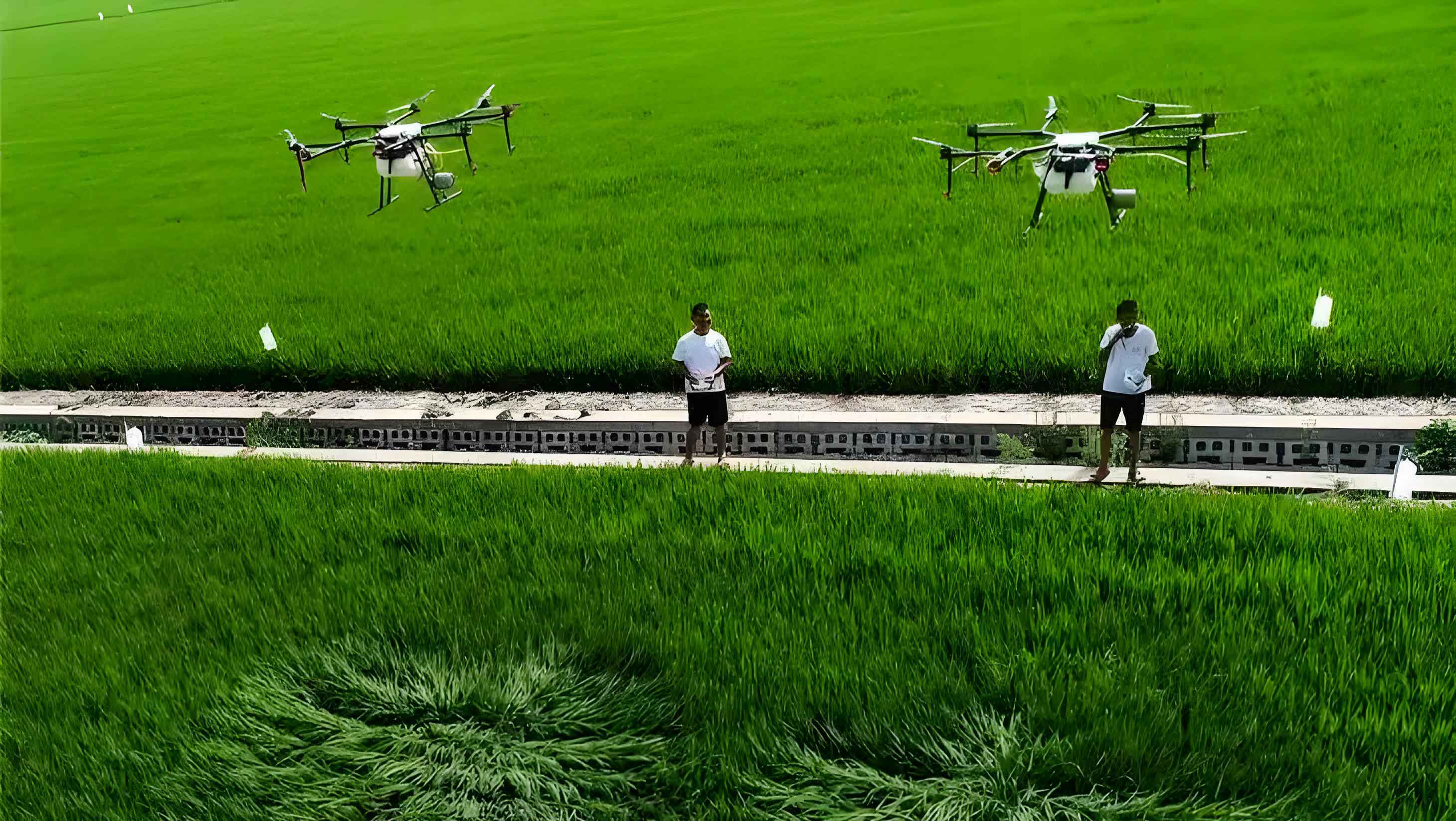
To understand the full potential of agricultural UAV, it is essential to examine its application across the entire pest control lifecycle in corn-soybean strip intercropping. I will break this down into three phases: pre-planting prevention, during-disease management, and post-infection control. Each phase leverages the unique capabilities of agricultural UAV, such as real-time monitoring, targeted spraying, and data analytics. For example, agricultural UAV equipped with cameras can dynamically monitor crop growth, predict pest outbreaks, and facilitate timely interventions. In the following sections, I will elaborate on these phases, supported by technical details, formulas, and tables to provide a comprehensive guide.
In the pre-planting phase, agricultural UAV serves as a proactive tool for pest prevention. By conducting aerial surveys, agricultural UAV can assess field conditions, identify potential risk areas, and collect data on soil health and crop residues. This allows for early detection of pest habitats, such as weeds or infected plant debris, which might harbor pathogens. From my observations, agricultural UAV-based monitoring can predict pest emergence times with high accuracy, enabling pre-emptive pesticide applications. For instance, if agricultural UAV detects stunted growth or leaf curling in corn seedlings—indicative of viral infections—farmers can implement control measures before widespread damage occurs. The predictive capability of agricultural UAV relies on algorithms that analyze multispectral imagery; this can be expressed using a formula for pest risk assessment:
$$ P = \frac{1}{1 + e^{-(a \cdot VI + b \cdot T + c \cdot H)}} $$
where \( P \) is the pest probability, \( VI \) is a vegetation index derived from UAV imagery, \( T \) is temperature, \( H \) is humidity, and \( a, b, c \) are coefficients determined from historical data. This logistic regression model helps in scheduling agricultural UAV interventions optimally. Additionally, Table 1 summarizes key pre-planting activities facilitated by agricultural UAV.
| Activity | Agricultural UAV Role | Key Parameters |
|---|---|---|
| Field Surveillance | High-resolution imaging for pest habitat identification | Flight altitude: 10-20 m; Resolution: 5 cm/pixel |
| Data Analytics | Predictive modeling for pest outbreaks | Use of NDVI (Normalized Difference Vegetation Index) from UAV data |
| Targeted Spraying | Pre-emptive application of biopesticides | Spray rate: 0.5-1 L/acre; UAV speed: 3-4 m/s |
During the pest infestation phase, agricultural UAV excels in precise and rapid response. When pests or diseases are detected, agricultural UAV can pinpoint affected zones within the intercropping system, assess severity, and execute targeted spraying. This minimizes pesticide waste and environmental impact. For example, in a corn-soybean strip field, if aphids are found on soybean plants, agricultural UAV can spray insecticides specifically on those rows while avoiding corn areas, thus preserving beneficial insects. The operational efficiency of agricultural UAV in this phase can be quantified using a formula for spray coverage efficiency:
$$ E = \frac{A_c}{A_t} \times 100\% $$
where \( E \) is the spray efficiency, \( A_c \) is the area covered by the agricultural UAV spray, and \( A_t \) is the total target area. Typically, agricultural UAV achieve efficiencies above 90% due to their precision guidance systems. Moreover, flight parameters are critical; based on my field tests, optimal conditions include wind speeds below 3 m/s, temperatures between 12°C and 30°C, and relative humidity over 40%. Agricultural UAV models, such as multi-rotor systems, operate at heights of 1-4 m above the canopy, with speeds of 3-4 m/s, ensuring uniform droplet distribution. Table 2 outlines recommended practices for agricultural UAV during pest outbreaks.
| Parameter | Optimal Range | Impact on Pest Control |
|---|---|---|
| Flight Altitude | 1-4 m above canopy | Ensures droplet penetration and reduces drift |
| Flight Speed | 3-6 m/s | Balances coverage and droplet density; speeds below 3 m/s may reduce spray uniformity |
| Spray Volume | 1-3 L/acre for field crops | Minimizes chemical usage while maintaining efficacy |
| Droplet Size | 100-300 microns | Enhances adhesion to plant surfaces; fine droplets from agricultural UAV improve coverage |
| Weather Conditions | Wind ≤3级 (approx. 3.4 m/s), low precipitation | Prevents spray drift and ensures accurate targeting by agricultural UAV |
In the post-infection phase, agricultural UAV assists in evaluating treatment efficacy and planning future strategies. After spraying, agricultural UAV can resurvey fields to monitor crop recovery and residual pest populations. This data is invaluable for refining integrated pest management (IPM) plans. For instance, in a case where agricultural UAV were used to apply foliar fertilizers and pesticides to soybean plants, follow-up imagery revealed improved plant vigor and reduced insect counts, confirming the success of the intervention. The economic benefit of agricultural UAV in this phase can be modeled using a cost-effectiveness formula:
$$ CE = \frac{Y_i – Y_c}{C_u} $$
where \( CE \) is the cost-effectiveness ratio, \( Y_i \) is the yield after agricultural UAV intervention, \( Y_c \) is the yield under conventional methods, and \( C_u \) is the cost per acre of agricultural UAV operation. Typically, agricultural UAV reduce costs by 30-50% compared to manual labor, due to lower pesticide use and labor savings. Furthermore, agricultural UAV facilitate data archiving; information on pest types, spray times, and weather conditions is compiled into databases for predictive analytics. This iterative learning process enhances the long-term sustainability of corn-soybean strip intercropping. From my perspective, agricultural UAV not only address immediate pest issues but also contribute to resilient farming systems through continuous monitoring.
To ensure the successful deployment of agricultural UAV, several保障措施 (safeguard measures) must be implemented. First, establishing robust safety protocols is paramount. When operating agricultural UAV, personnel should wear protective gear like gloves and masks, and flights should follow wind patterns—starting from upwind positions to minimize exposure. If wind directions shift, agricultural UAV routes must be adjusted dynamically to maintain safety. Spraying is best done during early morning or late evening to reduce evaporation and drift, with agricultural UAV飞行高度 (flight altitudes) maintained at 1.8-2.5 m for optimal droplet deposition. Speed control is also crucial; as noted earlier, agricultural UAV speeds of 3-6 m/s balance coverage and uniformity. Post-operation, agricultural UAV equipment must be cleaned thoroughly to prevent contamination. Additionally, operational areas should have clear pathways for personnel, keeping a safe distance—at least 10 m for multi-rotor agricultural UAV and 15 m for single-rotor models—to avoid accidents. Regular maintenance checks for issues like water damage or battery failures are essential to prevent crashes. From my experience, adhering to these protocols maximizes the reliability of agricultural UAV systems.
Second, thorough terrain assessment is vital before deploying agricultural UAV. I recommend conducting detailed surveys of the intercropping field to identify obstacles like buildings, trees, or power lines. This data can be mapped using GPS and integrated into agricultural UAV control software for route planning. For example, by uploading地形图 (topographic maps) to agricultural UAV apps, operators can design flight paths that avoid hazards and ensure complete coverage. This pre-flight planning reduces risks and enhances spraying accuracy. The process can be formalized using a formula for route optimization:
$$ R = \min \sum_{i=1}^{n} d_i \cdot w_i $$
where \( R \) is the optimized route length, \( d_i \) is the distance between waypoints, and \( w_i \) is a weight factor based on obstacle density. Agricultural UAV equipped with obstacle avoidance sensors further enhance safety during these missions. Table 3 summarizes key terrain assessment steps for agricultural UAV operations.
| Step | Description | Tools Used with Agricultural UAV |
|---|---|---|
| Field Mapping | Identify and mark obstacles and crop rows | GPS, aerial imagery from agricultural UAV |
| Data Integration | Upload maps to agricultural UAV control systems | Mobile apps or ground control stations |
| Route Planning | Design efficient spray paths avoiding hazards | Algorithmic software for agricultural UAV navigation |
| Safety Validation | Test routes in simulation before actual flight | Agricultural UAV simulator software |
Third, selecting appropriate pesticides and formulations is critical for agricultural UAV efficacy. Since agricultural UAV use low-volume spray systems, they require specific药剂 (formulations) such as soluble concentrates, emulsions, or suspensions to prevent nozzle clogging. Powder formulations are generally avoided as they can damage agricultural UAV components. From my practice, pesticide dilution must follow manufacturer guidelines, often using a secondary dilution method to ensure accuracy. Safety is paramount; highly toxic chemicals should be avoided, and protective measures must align with industry standards. The pesticide selection process can be guided by a formula for optimal concentration:
$$ C_o = \frac{D_r \times V_s}{A_s} $$
where \( C_o \) is the optimal concentration, \( D_r \) is the recommended dosage rate, \( V_s \) is the spray volume per acre from the agricultural UAV, and \( A_s \) is the area sprayed. By fine-tuning these parameters, agricultural UAV achieve precise application, reducing environmental impact and health risks. In corn-soybean strip intercropping, this tailored approach allows for differential spraying—for instance, applying herbicides only to weed-infested zones while sparing crops, thanks to the agility of agricultural UAV.
The advantages of agricultural UAV extend beyond pest control to broader agricultural management. For example, agricultural UAV can be used for crop health monitoring, yield estimation, and even pollination assistance. In the context of corn-soybean strip intercropping, the synergy between agricultural UAV and other smart farming technologies—like IoT sensors or drones for soil analysis—creates a holistic precision agriculture framework. From my observations, farmers who adopt agricultural UAV report not only higher yields but also reduced operational costs and improved environmental stewardship. The scalability of agricultural UAV makes them suitable for large-scale farms, where they can cover hundreds of acres daily, as evidenced by cases where multiple agricultural UAV units sprayed foliar fertilizers on thousands of acres efficiently. This demonstrates how agricultural UAV are reshaping modern agriculture into a more data-driven and sustainable enterprise.
In conclusion, agricultural UAV represent a transformative tool in pest control for corn-soybean strip intercropping systems. Through their efficiency, precision, and adaptability, agricultural UAV address the unique challenges of this cropping pattern, from pre-planting prevention to post-infection evaluation. By integrating safety protocols, terrain assessments, and careful pesticide selection, agricultural UAV operations can be optimized for maximum impact. The formulas and tables presented here underscore the technical rigor behind agricultural UAV applications, highlighting their role in enhancing crop productivity and sustainability. As a proponent of agricultural innovation, I believe that widespread adoption of agricultural UAV will continue to drive advancements in pest management, ultimately contributing to food security and ecological balance. The future of farming lies in embracing technologies like agricultural UAV, and I encourage stakeholders to explore their potential through pilot projects and continuous learning.
Looking ahead, further research could focus on enhancing agricultural UAV autonomy, such as integrating AI for real-time pest detection, or developing hybrid systems that combine agricultural UAV with ground-based robots. Additionally, economic studies on the long-term benefits of agricultural UAV in diverse cropping systems would provide valuable insights for policymakers. From my perspective, the journey with agricultural UAV is just beginning, and their evolution will undoubtedly unlock new possibilities in agricultural engineering. As I reflect on my experiences, the key takeaway is that agricultural UAV are not merely tools but catalysts for a smarter, more resilient agricultural landscape—one where technology and tradition converge to meet the demands of a growing population.