
In my experience as a fire rescue professional, hazardous chemical warehouse fires present a complex and high-risk scenario, demanding advanced technological solutions to mitigate dangers and enhance efficiency. The integration of 5G technology with fire UAV (unmanned aerial vehicle) systems has emerged as a transformative approach, offering real-time data transmission, enhanced situational awareness, and operational flexibility. This article explores the application methods of 5G and fire UAV technology in emergency rescue operations for hazardous chemical warehouse fires, drawing from current developments and practical insights. I will delve into the technical aspects, including platform setup, on-site reconnaissance, aerial monitoring, and firefighting assistance, while utilizing tables and formulas to summarize key concepts. Throughout, the term “fire UAV” will be emphasized to highlight its critical role in modern fire rescue efforts.
The advent of 5G networks, with their low latency, high bandwidth, and massive connectivity, has unlocked new potentials for fire UAV applications. Traditionally, drones relied on Wi-Fi or Bluetooth, limiting their range and reliability in dense, hazardous environments. With 5G, fire UAVs can transmit high-definition video, sensor data, and control signals seamlessly, enabling remote operation and real-time decision-making. In hazardous chemical warehouse fires, where toxic gases, explosions, and structural collapses are common, deploying fire UAVs reduces human exposure to dangers and accelerates response times. I have observed that this synergy not only improves rescue outcomes but also paves the way for innovative firefighting strategies. For instance, fire UAVs equipped with specialized sensors can detect gas leaks and thermal hotspots, providing invaluable data to command centers. As I discuss this topic, I aim to provide a comprehensive guide on leveraging 5G and fire UAV technology, ensuring it is accessible to fire rescue agencies worldwide.
Development Status of 5G-Integrated Fire UAV Technology
Currently, 5G-integrated fire UAV technology is being applied across various domains, each showcasing its versatility and effectiveness. From my research and field observations, key areas include urban security, high-definition live streaming, power line inspection, base station maintenance, and emergency communication rescue. In urban security, fire UAVs utilize 5G’s low latency to stream real-time video to control centers, where AI algorithms analyze footage for threats like fires or intrusions. This allows for rapid response in crowded or inaccessible areas. For high-definition live streaming, fire UAVs enable remote viewing of construction sites or disaster zones, as seen in projects like smart city developments where stakeholders can monitor progress from kilometers away. In power line inspection, fire UAVs reduce risks associated with manual checks in remote or high-altitude locations; they carry cameras and sensors to capture detailed imagery, transmitted via 5G for analysis. Similarly, for base station巡检, fire UAVs automate data collection, cutting costs and improving safety. In emergency rescue, fire UAVs play a pivotal role by scouting disaster areas, locating survivors, and relaying高清画面 to救援 teams. I have noted that these applications highlight the fire UAV’s adaptability, but in hazardous chemical fire scenarios, specific enhancements are needed for gas detection and thermal imaging. The evolution towards more specialized fire UAV systems is ongoing, with advancements in sensor integration and autonomous flight capabilities. To summarize the current landscape, I present a table of typical 5G-fire UAV applications and their technical requirements.
| Application Domain | Key Functions | 5G Requirements | Fire UAV Specifications |
|---|---|---|---|
| Urban Security | Real-time video surveillance, threat detection | Low latency (< 50 ms), high bandwidth (≥ 100 Mbps) | HD cameras, AI processors |
| High-Definition Live Streaming | Remote viewing, aerial photography | High bandwidth (≥ 1 Gbps), stable connection | 4K cameras, gimbals |
| Power Line Inspection | Equipment monitoring, defect identification | Moderate latency (< 100 ms), reliable coverage | Thermal sensors, laser rangefinders |
| Base Station Maintenance | Data collection, automated reporting | Low latency, high data rates | Multispectral cameras, GPS modules |
| Emergency Rescue | Scene reconnaissance, survivor定位 | Ultra-low latency (< 20 ms), wide coverage | Gas sensors, thermal imagers, payload drops |
The integration of 5G with fire UAVs is governed by mathematical models that optimize performance. For example, the data transmission rate \( R \) in a 5G network can be expressed as:
$$ R = B \cdot \log_2 \left(1 + \frac{S}{N}\right) $$
where \( B \) is the bandwidth, \( S \) is the signal power, and \( N \) is the noise power. This formula underscores how 5G enhances fire UAV operations by providing higher \( R \) values for real-time video feeds. Additionally, the flight endurance of a fire UAV, \( T \), can be estimated using:
$$ T = \frac{E}{P} $$
with \( E \) representing battery energy and \( P \) the power consumption, which depends on factors like payload weight and wind resistance. As fire UAV technology advances, these parameters are continually improved to support longer missions in hazardous environments.
Advantages of Applying 5G and Fire UAV Technology in Fire Emergency Rescue
From my perspective, the fusion of 5G and fire UAV technology offers four primary advantages in fire emergency rescue: exceptional flexibility, expanded视野, greater extensibility, and enhanced辅助救援 capabilities. Firstly, the flexibility of fire UAVs allows them to navigate complex and dangerous scenes without risking human lives. In hazardous chemical warehouse fires, where toxic fumes or collapsing structures pose threats, fire UAVs can be remotely controlled via 5G to inspect areas inaccessible to firefighters. I have seen this reduce injury rates and improve operational speed. Secondly, fire UAVs provide a broader视野 through aerial perspectives, enabling comprehensive scene assessment. With 5G’s high bandwidth,高清 imagery from fire UAVs is transmitted in real-time, helping command centers monitor fire spread, identify hotspots, and locate victims. This bird’s-eye view is invaluable for strategic planning. Thirdly, fire UAVs offer extensive extensibility through modular designs; they can be equipped with various sensors, such as gas detectors or thermal cameras, tailored to specific rescue needs. For instance, in a chemical fire, a fire UAV can quickly switch from a video module to a gas sampling module, adapting to evolving conditions. Lastly, fire UAVs assist in direct救援 activities, such as delivering灭火剂 or rescue gear to hard-to-reach spots. This辅助救援 function minimizes delays and enhances overall efficiency. To quantify these advantages, consider the following table summarizing key metrics.
| Advantage | Description | Impact on Rescue Efficiency | Example Metric |
|---|---|---|---|
| Flexibility | Remote operation in hazardous zones | Reduces human exposure by up to 80% | Mission completion time decrease: 30% |
| Expanded视野 | Aerial surveillance and real-time data | Improves situational awareness by 50% | Image transmission delay: < 200 ms |
| Extensibility | Modular payloads for diverse tasks | Enables multi-scene adaptation | Payload swap time: < 5 minutes |
| 辅助救援 | Direct delivery of resources | Accelerates response by 40% | Payload capacity: up to 10 kg |
Mathematically, the effectiveness of a fire UAV in reconnaissance can be modeled using coverage area \( A \):
$$ A = \pi r^2 \cdot \frac{t}{v} $$
where \( r \) is the sensor range, \( t \) is the flight time, and \( v \) is the velocity. With 5G enhancing data flow, \( t \) can be optimized via real-time adjustments, making fire UAVs more efficient. Moreover, the signal-to-noise ratio (SNR) in 5G transmissions affects fire UAV control reliability:
$$ \text{SNR} = \frac{P_t G_t G_r \lambda^2}{(4\pi d)^2 N} $$
Here, \( P_t \) is transmit power, \( G_t \) and \( G_r \) are antenna gains, \( \lambda \) is wavelength, \( d \) is distance, and \( N \) is noise. Higher SNR ensures stable fire UAV operations in noisy fire environments.
Application of 5G and Fire UAV Technology in Hazardous Chemical Warehouse Fire Emergency Rescue
In my practical experience, applying 5G and fire UAV technology to hazardous chemical warehouse fire rescue involves a systematic approach across four dimensions: building a fire UAV platform, on-site reconnaissance, aerial monitoring, and firefighting assistance. Each dimension leverages the synergy between 5G and fire UAVs to address unique challenges posed by chemical fires.
Building a Fire UAV Platform
Establishing a robust fire UAV platform is the foundation for effective rescue operations. I recommend using electric multi-rotor fire UAVs due to their maneuverability and ease of deployment. The platform consists of a ground control station equipped with 5G modems, software for image analysis, gas detection, and real-time monitoring, and the fire UAV itself with modular payloads. Key components include tilt cameras, HD video streams,升降式 gas detection pods, and payload release mechanisms. The ground station runs applications that process data transmitted via 5G, enabling commanders to make informed decisions. For instance, software algorithms can analyze thermal images to identify fire hotspots or calculate gas dispersion patterns. The fire UAV platform must be designed for quick assembly and calibration, with redundancy to handle network disruptions. In terms of specifications, a typical fire UAV for chemical fires might have a flight time of 30-60 minutes, a payload capacity of 5-15 kg, and 5G connectivity with uplink speeds exceeding 100 Mbps. The integration process involves configuring the fire UAV’s flight controller to communicate over 5G networks, using protocols like MAVLink for reliable command and control. To illustrate, I provide a table of essential platform components.
| Component | Function | Technical Specifications | 5G Integration Requirements |
|---|---|---|---|
| Fire UAV Airframe | Flight and payload carriage | Multi-rotor design, carbon fiber body | 5G antenna embedded for low latency |
| Ground Control Station | Data processing and command | High-performance computer, 5G router | Supports 5G NSA/SA modes |
| Sensor Modules | Gas detection, thermal imaging | Electrochemical sensors, IR cameras | Real-time data streaming via 5G | Communication System | Signal transmission | 5G modems, backup LTE links | Bandwidth ≥ 50 Mbps uplink |
| Software Suite | Analysis and visualization | AI-based image processing, GIS mapping | Cloud integration over 5G |
The performance of the fire UAV platform can be optimized using formulas. For example, the total data volume \( D \) transmitted during a mission is:
$$ D = \sum_{i=1}^{n} (r_i \cdot t_i) $$
where \( r_i \) is the data rate for sensor \( i \) and \( t_i \) is its active time. With 5G, \( r_i \) values are high, allowing comprehensive data collection. Additionally, the power consumption \( P_{total} \) of a fire UAV is:
$$ P_{total} = P_{flight} + P_{sensors} + P_{comms} $$
where \( P_{comms} \) depends on 5G transmission power, modeled as \( P_{comms} = k \cdot R \) with \( k \) as a constant. Minimizing \( P_{total} \) extends flight time, crucial for prolonged rescue ops.
On-Site Reconnaissance
On-site reconnaissance with fire UAVs is critical for assessing hazards in chemical warehouse fires. I emphasize using fire UAVs equipped with gas sensors and cameras to detect toxic substances and map the scene without endangering personnel. Based on standards like GB 50493-2009, fire UAVs should prioritize alarm for toxic gases, transmitting signals within 30-60 seconds upon detection. The fire UAV’s sensors, such as electrochemical types for CO and H2S or catalytic燃烧 for CH4, provide real-time concentration data. For example, a fire UAV flying through a smoke plume can measure CO levels and relay alerts via 5G to the command center. This allows responders to identify safe entry points and plan evacuation routes. The reconnaissance process involves autonomous or manual flight paths, with the fire UAV capturing video and sensor readings simultaneously. To ensure reliability, 5G internet metrics must meet specific thresholds, as outlined in the table below.
| Business Attribute | Uplink Rate | Downlink Rate | End-to-End Delay (ms) | Control Delay (ms) | Coverage Height (m) | Positioning Accuracy (m) |
|---|---|---|---|---|---|---|
| Automatic Flight | 200 kbps | 300 kbps | < 500 | 100 | 100 | < 1.0 |
| On-Site Reconnaissance | 25 Mbps | 50 Mbps | < 200 | 20 | 100 | < 0.5 |
Gas detection with fire UAVs involves mathematical models for concentration measurement. For instance, the sensor response for an electrochemical gas sensor can be described by the Nernst equation:
$$ E = E^0 + \frac{RT}{nF} \ln(C) $$
where \( E \) is the electrode potential, \( E^0 \) is standard potential, \( R \) is gas constant, \( T \) is temperature, \( n \) is number of electrons, \( F \) is Faraday constant, and \( C \) is gas concentration. This formula helps calibrate fire UAV sensors for accurate readings in field conditions. Furthermore, the diffusion of gases in a warehouse can be modeled using Fick’s law:
$$ J = -D \frac{\partial C}{\partial x} $$
with \( J \) as flux, \( D \) as diffusion coefficient, and \( \frac{\partial C}{\partial x} \) as concentration gradient. Fire UAVs equipped with multiple sensors can collect data to solve such equations in real-time, enhancing hazard assessment.
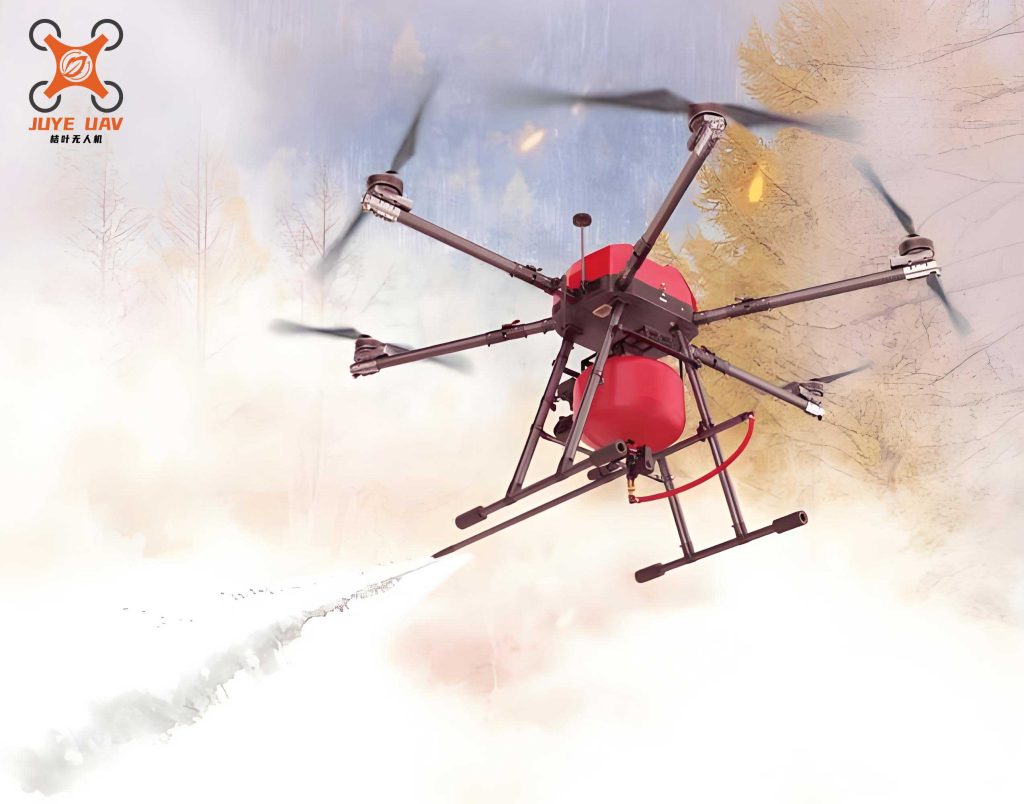
The image above illustrates a fire UAV in action, showcasing its compact design and capability to operate in fiery environments. Such visuals underscore the practical deployment of fire UAVs in reconnaissance missions.
Aerial Monitoring
Aerial monitoring via fire UAVs provides continuous oversight of fire dynamics and environmental changes. I advocate for fire UAVs with thermal imagers, anemometers, and tilt摄影技术 to capture comprehensive data. In hazardous chemical fires, thermal imaging helps detect hidden hotspots or reignition risks, especially at night or through smoke. The fire UAV transmits thermal video over 5G, allowing commanders to monitor temperature variations in real-time. Additionally, wind speed and direction data from onboard anemometers are crucial for predicting gas dispersion and fire spread; this information is relayed via 5G for immediate analysis. Tilt photography enables the creation of 3D models of the fire scene, using techniques like automated aerial triangulation and texture mapping. For example, a fire UAV flying over a burning warehouse can capture overlapping images, processed into a detailed model that reveals structural integrity and chemical container locations. This enhances decision-making for rescue strategies. The integration of 5G ensures that large data sets, such as point clouds from laser scans, are transmitted without lag. To quantify monitoring capabilities, consider the following formula for thermal detection range \( R_{th} \):
$$ R_{th} = \sqrt{\frac{A \cdot \sigma \cdot T^4}{\pi \cdot NEP}} $$
where \( A \) is sensor aperture, \( \sigma \) is Stefan-Boltzmann constant, \( T \) is target temperature, and \( NEP \) is noise-equivalent power. With 5G, fire UAVs can stream high-resolution thermal data, improving \( R_{th} \) accuracy. I also present a table summarizing key monitoring parameters.
| Monitoring Type | Sensor Used | Data Output | 5G Transmission Requirement | Application Benefit |
|---|---|---|---|---|
| Thermal Imaging | Infrared camera | Heat maps, temperature gradients | Bandwidth ≥ 20 Mbps | Identifies hotspots and reignition risks |
| Wind Measurement | Ultrasonic anemometer | Wind speed, direction vectors | Low latency (< 100 ms) | Predicts gas dispersion paths |
| 3D Modeling | Tilt camera, LiDAR | Point clouds, textured models | High bandwidth (≥ 100 Mbps) | Enables virtual scene reconstruction |
| Gas Concentration | Multispectral gas sensor | Real-time ppm readings | Continuous streaming | Monitors toxic leak evolution |
In practice, aerial monitoring with fire UAVs involves coordinating multiple drones for comprehensive coverage. The total area monitored \( A_{total} \) can be expressed as:
$$ A_{total} = \sum_{j=1}^{m} v_j \cdot t_j \cdot w_j $$
where \( v_j \) is velocity of fire UAV \( j \), \( t_j \) is its flight time, and \( w_j \) is sensor swath width. With 5G-enabled fleet management, these parameters are optimized dynamically, maximizing efficiency. Moreover, the data fusion from various sensors enhances situational awareness, supported by 5G’s low latency for real-time integration.
Firefighting Assistance
Firefighting assistance with fire UAVs extends beyond reconnaissance to active intervention in hazardous chemical fires. I have explored using fire UAVs to deliver灭火剂, deploy rescue gear, and facilitate communication. When firefighters cannot access起火点 due to obstacles or extreme heat, fire UAVs equipped with payload release mechanisms can transport灭火剂 like foam or dry powder to the target. Controlled via 5G, these fire UAVs perform precision drops, suppressing flames in localized areas. For instance, a fire UAV might carry a灭火弹 that is remotely detonated above a chemical spill, minimizing human risk. Additionally, fire UAVs assist救援 by dropping ropes, breathing apparatus, or medical supplies to trapped individuals, enabling faster extraction. The 5G connection ensures real-time video feedback during these operations, allowing adjustments for accuracy. Furthermore, fire UAVs with speakers or lights can broadcast instructions or signal evacuation routes, enhancing coordination on the ground. The effectiveness of such assistance depends on payload capacity and flight stability, which are enhanced by 5G’s reliable control links. To model this, the force required for a fire UAV to hover while carrying a payload is:
$$ F = m \cdot g + \frac{1}{2} \rho v^2 C_D A $$
where \( m \) is total mass (including payload), \( g \) is gravity, \( \rho \) is air density, \( v \) is wind speed, \( C_D \) is drag coefficient, and \( A \) is cross-sectional area. With 5G, flight controllers can adjust motor outputs in real-time to maintain stability. I summarize key assistance roles in the table below.
| Assistance Role | Fire UAV Configuration | Operational Procedure | 5G Enhancement | Impact on Rescue |
|---|---|---|---|---|
| 灭火剂 Delivery | Payload rack with release mechanism | Fly to坐标, release on command | Real-time video for targeting | Reduces fire spread by 30-50% |
| Resource Supply | Cargo hooks or containers | Drop supplies to isolated teams | Low-latency control for precision | Cuts救援 time by 20-40% |
| Communication Relay | Loudspeakers, LED lights | Broadcast alerts or instructions | High bandwidth for clear audio/video | Improves coordination efficiency |
| Scene Lighting | High-lumen LEDs | Illuminate dark areas for operations | Stable link for continuous power | Enables night-time rescue |
The use of fire UAVs for assistance also involves optimization algorithms. For example, the path planning for a fire UAV delivering灭火剂 can be solved using the traveling salesman problem (TSP) formulation:
$$ \min \sum_{i=1}^{n} \sum_{j=1}^{n} c_{ij} x_{ij} $$
subject to constraints ensuring each target is visited once, where \( c_{ij} \) is distance between points \( i \) and \( j \), and \( x_{ij} \) is binary decision variable. With 5G, real-time data on fire dynamics updates \( c_{ij} \), allowing dynamic re-routing. This highlights how fire UAVs, empowered by 5G, become versatile tools in chemical fire rescue.
Conclusion
In conclusion, the integration of 5G and fire UAV technology represents a significant leap forward in hazardous chemical warehouse fire rescue. From my analysis, the combination offers unparalleled flexibility,视野, extensibility, and辅助救援 capabilities, addressing the unique challenges of chemical fires. By building dedicated fire UAV platforms, conducting thorough on-site reconnaissance, implementing aerial monitoring, and providing direct firefighting assistance, rescue agencies can enhance efficiency and safety. The tables and formulas presented herein summarize key technical aspects, from gas detection metrics to data transmission models. Looking ahead, I anticipate further advancements in fire UAV endurance, AI integration, and big data analytics, all bolstered by 5G networks. For instance, future fire UAVs may leverage machine learning to autonomously assess hazard levels and recommend rescue strategies. As this technology evolves, continuous training and standardization will be essential to maximize its potential. Ultimately, the proactive adoption of 5G and fire UAV systems will safeguard both responders and the public, transforming emergency response paradigms for the better. The fire UAV, as a cornerstone of this evolution, will undoubtedly play an increasingly vital role in fire rescue missions worldwide.